Often yes, if an engineer finds a small bow with no slide at the base and the water pushing on the wall gets fixed first. Straps are thin and sit nearly flat on the wall, so they hide behind a finished wall more easily than anchors or steel beams. They stop further bowing, but they don't straighten the wall or relieve the water pressure behind it.1
TL;DR
- Straps suit a wall caught early: a small inward bow and no slide at the base. How much bow is too much is your engineer's call for your wall.
- Straps and steel posts hold the wall. They leave the wet soil behind it alone, so the drainage needs its own line on the quote.1
- For a room you're about to finish, straps are the easiest brace to frame and insulate over. Anchor plates and steel beams leave hardware your walls have to clear.
- Public prices are thin. The one strap quote we found was $12,000 in 2022, with no outside drains.1 Interior waterproofing averages $6,000 to $12,000 and exterior $10,000 to $18,000.2
- Do the drainage, the brace and the rim joist insulation first. Frame last.
How do you tell if a basement wall is bowing?
A bowing wall leans or bulges inward, often with a horizontal crack or stair-step cracks through the block joints. Sight down the wall or hold a long straight board against it. A gap in the middle that grows over months points to bowing. A crack by itself may not.1
Bowed walls also show up on HomeGuide's list of signs that a basement needs waterproofing, next to damp walls, cracks, white chalky residue and musty odors.2 Wet soil is heavy soil, and water trapped behind the wall adds pressure that can help push it in.1
A crack alone is a weaker signal (our guide to basement wall cracks and leaks covers the water side of cracks). In one 2022 forum thread, a commenter pointed out that cracks in the mortar joints of a block wall don't call for strapping on their own. Bowing is what brings in straps or steel posts.1 The homeowner in that thread had a horizontal crack running the width of the wall in a mortar joint, 2 1/2 feet below grade. He was later told it was most likely frost heave, that an exterior French drain would handle it, and that the crack was cosmetic.1 Five of the six companies he called had wanted to install carbon fiber strips.1
So measure before you buy anything. Pencil a line at each end of the crack and write the date. Measure the bow at the same spot with the same straightedge every few weeks, and take photos from a fixed point. A wall that keeps moving, a crack that keeps widening, or a base that looks pushed in toward the room all need a structural engineer or an experienced foundation contractor to look at them.
Do carbon fiber straps work on basement walls?
Yes, for the job they're built for. Epoxied to a prepared wall, straps hold a bowed wall where it is and stop further bowing. They don't pull the wall back straight, and they do nothing about the wet soil pushing on it.1 So the second part needs its own plan.
A typical install goes like this. The installer cleans and grinds the wall where each strap goes so the epoxy bonds. The straps go up vertically at even spacing, and the epoxy cures into a rigid bond. After that the wall can be painted.
Systems differ most at the ends. Ask how the strap connects at the top, to the sill plate or the rim joist, and whether it anchors to the floor at the bottom, where the base of a wall can slide inward. You don't need to settle the engineering yourself. You need the company to explain its top and bottom connections for your wall, and an engineer to agree.
Install quality matters as much as the product. Poor wall prep or straps set at the wrong spacing can leave the repair ineffective. It's also fair to ask any installer whether the product they plan to use has an ICC-ES evaluation report, and to see it.
Used on the right wall and installed well, straps are one of the accepted fixes for a bowing wall.
Straps, wall anchors and steel beams compared
All three hold a bowed wall where it is. Straps and steel posts leave the wet soil behind the wall untouched.1 Anchors don't drain it either. The three differ in how much movement they suit, what they cost and how much they stick out into the room you plan to finish.
Published movement limits and prices for these braces are scarce, so your engineer's report and a written quote fill most of the table below.
| Method | How it holds the wall | Movement limit | Published cost | What it leaves on the wall you'll frame |
|---|---|---|---|---|
| Carbon fiber straps | Vertical straps epoxied to a ground wall face, with top and bottom connections that vary by system | Set by your engineer. Suited to a wall caught early, before it is badly displaced | One 2022 quote of $12,000, straps only, no outside drains1 | Thin strips that paint over, plus top brackets on some systems |
| Wall anchors | A plate on the inside face, a steel rod through the wall and an anchor buried in the yard | Set by your engineer | Priced at your estimate | Anchor plates on the wall face, plus digging in the yard outside |
| Steel beams (posts) | Steel posts set against the wall, fastened at the floor and the framing above | Set by your engineer | Priced at your estimate | Posts standing in front of the wall. Your stud wall moves out to clear them |
| Dig out and rebuild from outside | Excavate, straighten the wall, reinforce the block, seal it and add drainage1 | Set by your engineer | Priced at your estimate | Nothing inside. The drainage gets done in the same dig |
Whether the base has slid matters as much as how far the middle has bowed, so ask your engineer to check both.
The outside dig deserves a fair hearing. In the 2022 thread above, one commenter said interior straps and posts are much cheaper than excavating outside. But they only stop further bowing and leave the water problem behind the wall.1 The same commenter called exterior excavation the best and more permanent fix where you can do it, meaning no slabs or decks in the way and not too close to the property line.1 The homeowner went that way. He chose a company that would excavate, straighten the wall, pin it with rebar, fill the block cells, seal the outside and add drainage.1
How much does it cost to fix a bowing basement wall?
Budget for two jobs: the brace and the drainage. Published prices for straps, anchors and beams are scarce. The one strap quote we found was $12,000, with no outside drains.1 Interior waterproofing averages $6,000 to $12,000 and exterior $10,000 to $18,000.2
Carbon fiber straps
That $12,000 figure comes from one northeast Ohio homeowner's 2022 forum post.1 It was one company's price for straps alone, with no outside drains. It's a single data point. Your price depends on how many feet of wall need straps, the top and bottom hardware the system uses, and how much wall prep the installer has to do. Anchors, beams and an exterior rebuild are priced at your estimate.
The water side of the fix
The drainage work has better public numbers. These come from one independent national cost guide, HomeGuide, dated January 23, 2026.2
| Work | National average cost |
|---|---|
| Interior waterproofing (pumps, drains, sealers, crack filling) | $6,000 to $12,0002 |
| Exterior waterproofing (grading, drains, membranes) | $10,000 to $18,0002 |
| Interior French drain | $4,000 to $17,0002 |
| Exterior French drain | $30 to $90 per linear foot, installed2 |
| Regrading around the house | $1,000 to $5,0002 |
| Replacing downspouts | $220 to $6252 |
All figures from HomeGuide's basement waterproofing cost guide.2
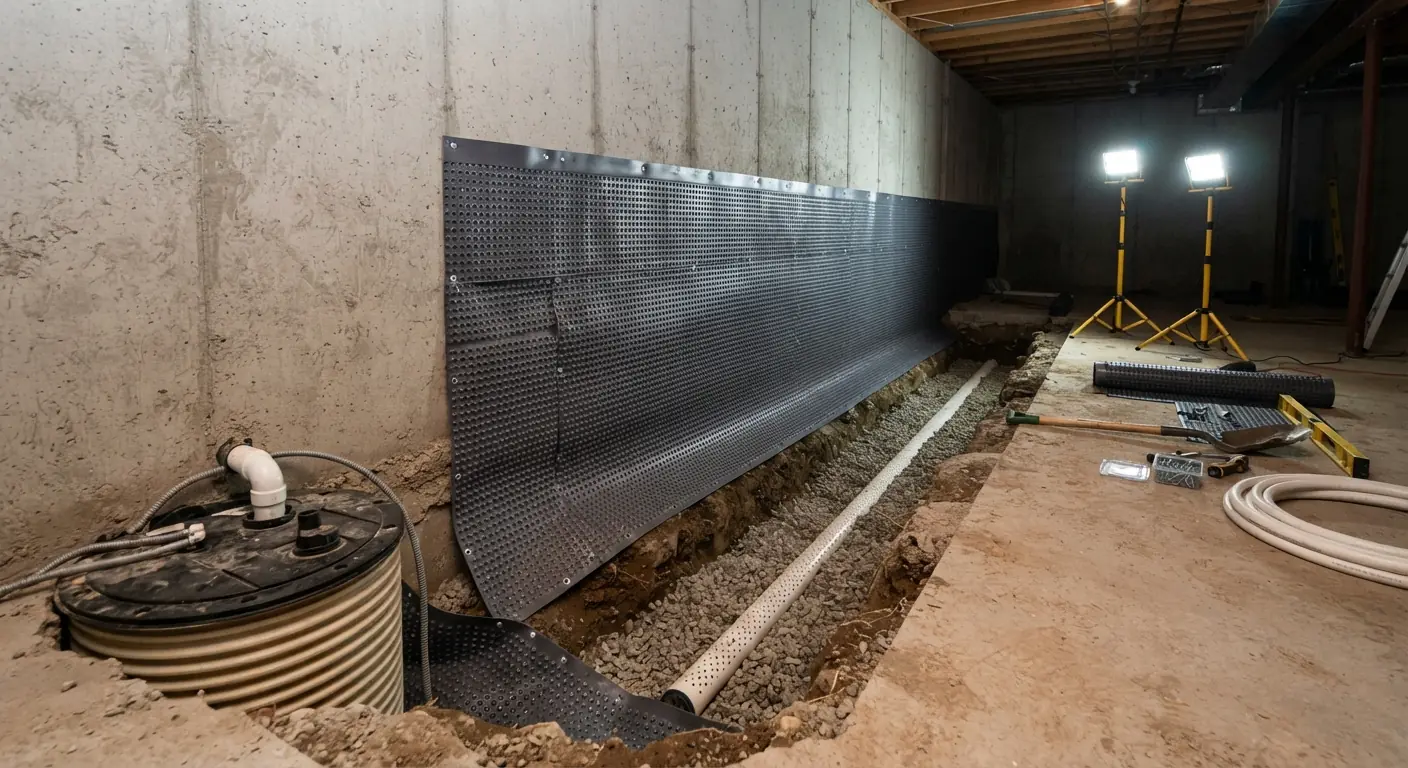
An interior French drain means digging a trench in the basement floor, filling it with gravel and perforated pipe, and running it to one or more sump pumps.2 Regrading is occasionally enough on its own to stop water getting in, but it's often paired with an exterior drain or a membrane.2 Which of these your wall needs depends on where the water comes from, and that's a question for the site visit.
What changes when you plan to finish over the repair?
Basement Remodeling Co.'s planning rule is to settle moisture before anyone frames, and a bowing wall adds structure to that list. Drywall hides the wall you need to watch. Straps leave the flattest surface to build against. Anchors and beams leave hardware your framing has to clear.
Repair-company pages stop at the brace, and you're about to spend real money covering it up. The finish that goes in front of that wall runs $45,000 to $80,000 for a typical job in metro Atlanta and $30,000 to $90,000 in metro Denver (checked September 2026). See the ranges and what drives them on the Atlanta basement finishing page and the Denver basement finishing page. Here's the order that protects that spend.
Fix the water before the wall
Get the water moving away from the house first. The ground should slope away from the foundation so water doesn't collect against it.3 Building scientists put it the same way: collect roof runoff with gutters, drain it away from the foundation and keep the grade sloping away from the walls.4 Straps and posts don't touch the water pressure behind the wall.1 If it stays, the wall keeps working against the brace and the moisture keeps reaching your new wall.
The finish is what pays for skipped drainage. Porous materials like carpet may have to be thrown away if they get moldy3, and mold can hide on the back side of drywall where you won't see it.3 Our guide to basement waterproofing methods walks through the interior and exterior options.
Sequence the rim joist work
The top of the wall is where brace hardware and insulation meet. Building science guidance says that when you insulate a basement from the inside, the rim joist needs air-impermeable insulation such as spray foam.4 If your strap system fastens its top bracket to the rim joist, put the brackets on first and foam around them. Done the other way, someone cuts out new foam to reach the joist. Our rim joist insulation guide covers the foam options. Ask your contractor and the strap installer to agree on who goes first.
Plan the floor edge once
The bottom of the wall can get crowded too. An interior French drain needs a trench cut in the basement floor.2 If your strap system also anchors into the floor at the base of the wall, have one drawing that shows where the bottom anchors go and where the drain runs, before either crew shows up.
Insulate over straps the right way
Straps sit nearly flat on the wall, so rigid foam can go straight over the concrete, straps and all. Building scientists recommend that assembly anyway. Foam against the wall allows drying, isn't damaged by moisture and doesn't support mold growth.4 Fiberglass batts against a basement wall can't tolerate even minor groundwater leakage4, and a plastic vapor barrier over a framed wall commonly leads to odor, mold, decay and corrosion problems.4 Our basement insulation guide covers the full wall build.
Anchors and beams change the framing. Anchor plates sit on the wall face, so foam has to be cut around them. Steel posts stand in front of the wall, so the stud wall moves out into the room to clear them. Ask your contractor to price the framing around whichever brace you choose.
Record the wall before you cover it
Once the wall is finished you can't sight down it anymore. Before framing, photograph every wall from fixed points, write down your bow measurements and crack marks, and keep the engineer's report and the installer's paperwork with your house records. If something moves later, you'll have a baseline to compare against.
Can you repair a bowing basement wall yourself?
Not safely, for the structural part. A bowing wall is holding back soil, and the fix has to match why it moved. Get an engineer or an experienced foundation contractor to diagnose it first.1
A builder in the 2022 thread said it well. Before spending money, get a very experienced foundation contractor or an engineer to explain why it's happening, because the why should dictate the how.1 Ask whether the repair needs a permit where you live. Rules vary by city, and your contractor should know the local answer.
There's still useful work you can do yourself while you wait for that visit:
- Keep gutters and downspouts clear, and extend downspouts away from the foundation.5
- Check that the soil slopes away from the house.3
- Mark and date the ends of each crack, and measure the bow at the same spots every few weeks.
- Take photos from fixed points so a change is easy to see.
Leave the straps, anchors and beams to people who install them for a living.
Are carbon fiber straps worth it?
Yes, if an engineer confirms the wall is a strap candidate and the drainage is fixed in the same plan. Then they're the brace that costs you the least finished space. Be wary if the wall has slid at the base or moved a lot, and be warier of a quote that skips the water.1
The case for straps is simple. They cost much less than excavating outside1, and they leave a flat, paintable wall to frame against. For a basement you're about to finish, that last point matters more than the repair pages let on.
The case against is just as clear. Straps stop further bowing. They don't straighten the wall, and they don't relieve the water pressure that caused the bow.1 The homeowner in the 2022 thread called strips a band-aid after five of six companies proposed them. One of those quotes was $12,000 for straps with no outside drains.1 He chose an exterior rebuild with drainage instead.1
Straps are worth it when they're one line on a plan that also handles the water. They're a poor buy when they're the whole plan.
What should you ask before you sign?
Ask each company why the wall moved, how their brace connects at the top and bottom, and what they'll do about the water. A good quote answers all three in writing. If it only prices straps, you're buying half a repair.1
Take this list to every visit:
- What is pushing the wall in? Soil, water, frost or something else?1
- How far has the wall bowed, and has the base slid inward? How does your system handle sliding at the base?
- Does the top connect to the rim joist or the sill plate, and why?
- Does the product have an ICC-ES evaluation report? Can I see it?
- Are there structural problems that could cause the walls to fail?2
- What drainage is in this quote, and what isn't?
- Does a permit apply here, and who pulls it?
- Who installs the rim joist insulation, and in what order?
- Will I get an itemized estimate and contract in writing before work begins?2
The water side is where your basement contractor comes in. Basement Remodeling Co. matches you with one vetted, licensed basement contractor, who checks moisture at a free on-site estimate and gives you a written, itemized quote. You can get a written quote for waterproofing your basement before you finish it. Keep the structural diagnosis with your engineer or foundation specialist. Once the wall and the water are settled, plan the build on our basement finishing page or find the contractor who covers your ZIP code.