Most basement floor cracks are ordinary shrinkage from the concrete drying, and they usually aren't a structural problem.1 Seal any crack wider than a hairline so water and soil gas stay out.1 Get a pro to look when one side sits higher than the other, the floor is humped or sunken, or water comes through.1 Those point to heave, settlement or water pressure. Fix the cause before you finish the room.
TL;DR
- Thin, flat cracks are usually shrinkage. Leave them alone or cover them with flooring.1
- Width alone doesn't settle it. A raised or dropped edge tells you the ground moved, and that matters more than an extra fraction of an inch.1
- Heave means the soil under the slab is swelling, often clay getting wet. Settlement means the soil gave way and part of the slab dropped. Both need the cause fixed, because filler alone won't hold a crack that keeps moving.1
- Professional epoxy injection runs $250 to $800+ per crack.2 The bill jumps when the crack is a symptom: interior waterproofing runs $6,000 to $12,000.2
- Before finishing, stop the movement and the water first. Then pick flooring and framing that can live with what's left.
Should I worry about cracks in my basement floor?
Usually not. Most basement floor cracks are thin shrinkage cracks that form as the concrete dries. One commenter on a DIY forum put it simply: all concrete cracks, whether it takes one year or 50.1 Worry when a crack keeps growing, when one side sits higher than the other, when the floor around it is heaving or sinking, or when water comes through it.1
A basement slab is rarely a structural part of the house, and it's often poured without steel reinforcing.1 The crack itself rarely matters much. What counts is what it tells you about the soil and water under the slab. One engineer-trained homeowner on a DIY forum put the worst case plainly: whatever cracked the floor may also have affected the footing under the walls.1 So a crack with other symptoms deserves a look, and a lone hairline crack doesn't.
Even a harmless crack is a small hole in a barrier. The slab is meant to stop soil gas as well as hold you up. Building Science Corporation's basement guide describes the slab as the "air barrier" that controls soil gas coming into the basement.3 Cracks give soil gas, including radon, a way through that barrier, and the wider ones let water and moisture in too. So wider cracks get sealed even when they're only shrinkage. The guide to radon mitigation systems explains how radon gets fixed when a test comes back high.
Treat these as red flags:
- One edge of the crack is higher or lower than the other.1
- The floor is humped up along the crack.1
- A section of floor has dropped and feels uneven underfoot.1
- Water, damp or staining shows along the crack.12
- The crack runs into a crack in the wall.1
- The crack is longer or wider than it was a few months ago.
Shrinkage, settlement or heave: which crack do you have?
Shrinkage cracks are thin and flat. Settlement cracks come with a section of floor that has dropped. Heave cracks come with a section pushed up, often over clay soil that swells when wet.1 Flat and thin is usually cosmetic. A step or a hump means the ground moved.
| Crack type | What you see | Usual cause | Width and offset signal | Typical repair | What it means for finishing |
|---|---|---|---|---|---|
| Hairline shrinkage | Thin lines, sometimes a web pattern, edges flush | Concrete shrinking as it dries | Hairline, no step | None needed | Can go under flooring |
| Wider shrinkage | Flat crack you can see into | Concrete shrinking as it dries | Wider than a hairline, no step | Seal it | Seal first, then floor over it |
| Settlement | Floor dropped on one side, uneven surface | Soil under the slab gave way or was poorly compacted | Any drop you can feel | Lift and level, or cut out and patch | Level before any flooring goes down |
| Heave | Floor humped or lifted along the crack | Soil under the slab swelling, often wet clay | Any rise you can feel | Foundation pro plus water control | Plan framing and flooring for movement |
| Wet crack or wall joint | Damp line, water after rain | Water pressure under or beside the slab | Any width with water | Relieve the water pressure, then seal | Drainage before anything covers it |
The table sums up the sections below, which cite their sources.
Shrinkage cracks
Fresh concrete holds a lot of water. Building Science Corporation notes that several thousand pounds of water in freshly placed concrete tries to dry inward.3 As that water leaves, the slab shrinks and pulls itself apart. Cracks can show up long after the floor is poured.1
Builders reduce random cracking by breaking a big slab into smaller sections or tooling shallow grooves into the surface, so the cracks follow the grooves.1 If your floor has no joints, random cracks are what you'd expect.
Hairline shrinkage cracks don't need repair, and flooring can hide them. Cracks wider than a hairline are usually still shrinkage, but they're open enough to let water, moisture and soil gas in, so seal them.1 In a new home, ask the builder whether its warranty covers the repair.
Settlement cracks
When the ground under a slab settles, the slab cracks and the less supported part sinks into the low spot. The result is an uneven floor that can trip you. In a new slab, settlement usually traces back to fill that wasn't compacted or to poor soil.
The fix is to lift and level the low section or cut out and patch the bad area. More on both in the repair section below. For finishing, the floor has to be flat and stable before flooring goes down. Leveling compound poured over a slab that's still sinking just moves the problem up a layer.
Heave cracks
Heave is the crack type to take seriously. A crack with heaving means the soil under the floor is expanding, usually because its moisture has changed.1 Clay soil is the usual culprit, because it swells when it gets wet. In parts of Colorado the soil includes bentonite, a clay that expands upward on contact with moisture.1
Have a structural engineer or foundation professional look at heave.1 Expect them to look at where the water comes from, because changing soil moisture drives the movement.1 Heave also changes how a basement gets framed. A floating wall is a partition wall built with a small gap between its studs and the bottom plate on the slab. The slab can rise a little without shoving the wall into the floor above. If you're finishing along Colorado's Front Range, raise this early with your contractor. The local planning notes for finishing a basement in Denver, finishing in Colorado Springs and finishing in Fort Collins are a good place to start.
Wet cracks and the wall-floor joint
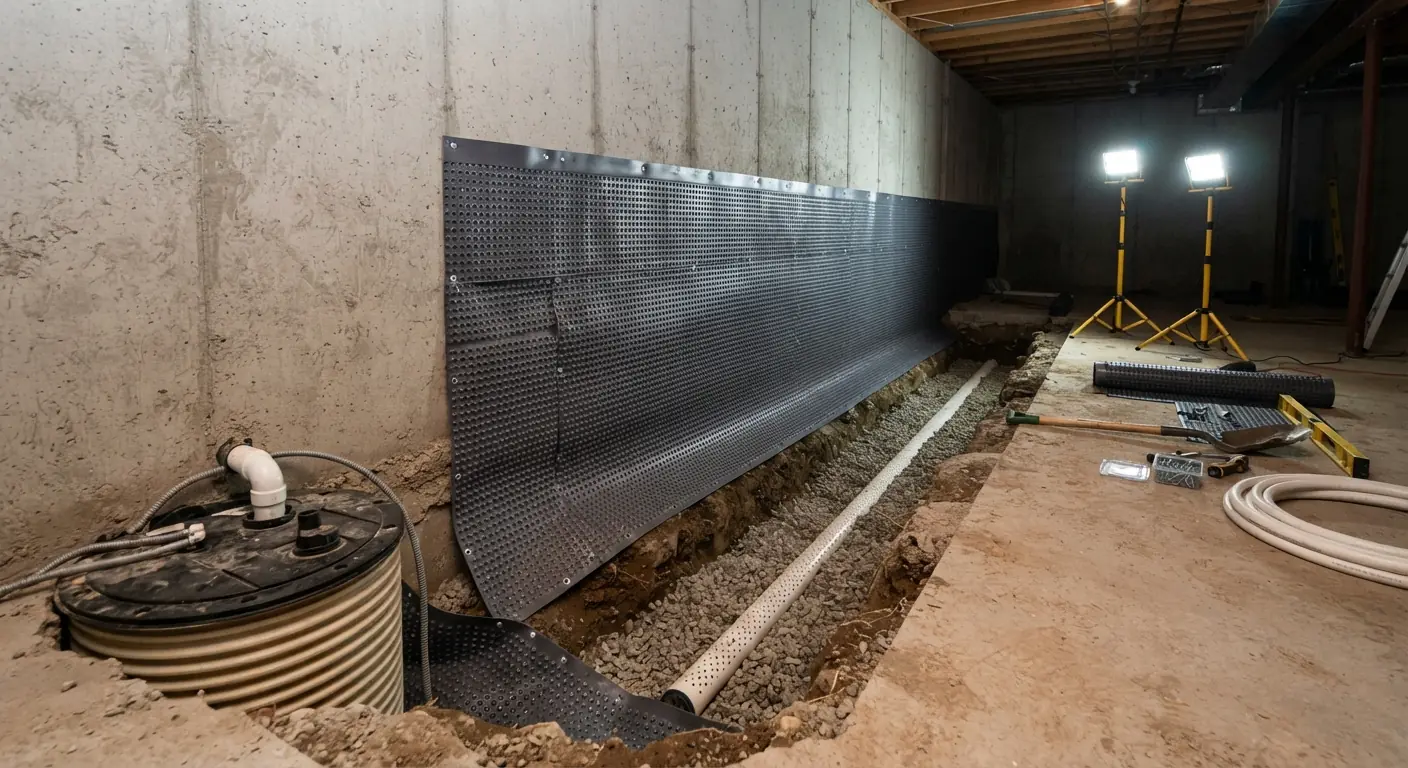
The joint where the floor meets the wall is a common leak point. A small gap is left there when the walls and floor are poured. When groundwater rises and the soil gets saturated, water pressure pushes water through that gap. Sealers won't stop water under pressure.2 A common fix is an interior drain: a trench along the floor's edge, filled with gravel and a perforated pipe, that carries water to a sump pump.2
Building Science Corporation says the slab should be sealed to the wall. Its reason is soil gas, since it treats the slab as the air barrier.3 Soil gas often gets in at that slab-to-wall joint.3 Treat those as two separate jobs. A sealant bead helps with air and soil gas. It won't hold back water under pressure.2 If water comes through the joint, deal with the water first. Then seal for air if your contractor or radon tester recommends it.
A wet crack in the middle of the floor tells you something too. If water seeps through, the crack likely runs all the way through the slab, and radon may be coming in as well.1
How big of a crack is acceptable in concrete?
In a basement floor, a hairline crack with flush edges is normal and needs no repair.1 Seal anything wider, because an open crack lets water, moisture and soil gas through.1 Width alone doesn't make a crack structural. A raised or dropped edge matters more than an extra fraction of an inch.1
Published width lines vary from source to source. One answer on the Home Improvement Stack Exchange forum gave these rough rules of thumb for concrete:
- About 0.3 mm: no problem. It's the kind of crack that earns the comment "all concrete cracks".1
- About 0.5 mm: not a major problem, but it should be repaired, and fixing it sooner is often the cheapest option.1
- About 1.0 mm: a problem. It isn't particularly dangerous for a typical basement floor, but the concrete is coming apart.1
By our arithmetic, 1 mm is about 1/25 inch. For a floor, treat anything wider than a hairline as a crack to seal. Use any step or hump as your call-a-pro line, whatever the width.
Movement over time matters as much as size. Photograph the crack, note the date and put a pencil mark at each end so growth is easy to spot. Check it again after a few months, and call a foundation professional or structural engineer if it has grown.
How can you tell if a concrete crack is structural?
Check four things: whether one side of the crack sits higher than the other, whether the floor around it is humped or sunken, whether the crack is growing, and whether it connects to cracks in the walls.1 A flat, stable hairline crack is cosmetic. Any of the four signs means a structural engineer or foundation pro should look.
Here's how to run those checks yourself:
- Feel for a step. Run your fingertips across the crack. An offset between the two sides is a bad sign.1 Treat any step you can feel as a reason to have it looked at.
- Check the floor plane. Lay a long straight board or level across the crack. A gap under one end shows a dropped section. A board that rocks on a high point shows a hump.
- Watch it over time. Photograph it, date it and look again after a few months. Growth means call a professional.
- Look at the walls. Wall cracks are usually more concerning than floor cracks, especially when they continue onto the floor.1
- Look for water. A damp crack runs through the slab and connects your basement to the soil below.1
If you're buying a house, don't rely on photos or the listing agent. One engineer-trained commenter on a DIY forum said they wouldn't close on a house with an offset floor crack until a structural engineer had examined it. The same commenter advised hiring an experienced, licensed engineer with no tie to your real estate agent.1 A drain tile or sump pump already in place is a good sign.1
Which floor and foundation cracks can you not ignore?
Don't ignore a floor crack with a raised or sunken edge, a floor that's heaving, a crack that leaks, or cracks that keep growing.1 In foundation walls, the ones to take most seriously are horizontal cracks, stair-step cracks in block walls and any wall that bows inward. Wall cracks are generally more concerning than floor cracks.1
What each one tells you:
Heaving floors. Heave means the soil under you is swelling. Changing soil moisture drives it, so the water feeding it has to be controlled before any crack repair will last.1
Sunken sections. A dropped slab has lost support underneath. It also creates a trip hazard.
Leaking cracks. Water through a crack means the crack goes through the slab. It also means soil gas can get in.1
Horizontal wall cracks. These are serious. They usually come from soil and water pressure pushing on the wall, and the wall may bow inward. Have a structural engineer look before anyone quotes a repair.
Stair-step cracks in block walls. They follow the mortar joints. Common causes are settlement in one area or water problems outside the wall. Get a professional opinion on these too.
Vertical and most diagonal wall cracks are less serious. In poured walls they usually come from the concrete curing or the house settling. Watch them and seal them if they leak.
A structural crack that's still moving needs more than filler. One answer on the forum thread warned that a crack injected with mortar or epoxy may simply reappear.1 The same logic applies to a floor. Stop the movement first.
What can be done about a cracked concrete floor in a basement?
Match the fix to the cause. Leave hairline shrinkage cracks alone or cover them. Seal wider cracks. Lift or level a sunken slab. For heave or leaks, fix the water and soil problem first, then repair the crack. Filler in a crack that's still moving just hides it until it opens again.1
Seal stable shrinkage cracks
Epoxy injection fills and seals minor cracks that don't threaten the home's structure.2 For a crack that's wet and actively leaking, contractors often use a flexible polyurethane injection instead. Clean and dry the area first. If there's mold on the surface, don't caulk or paint over it.4
Lift or replace a settled section
A sunken slab can sometimes be lifted from above. The contractor drills small holes and pumps material under the slab to raise it back to level. For a smaller problem, a contractor can cut out the cracked strip and fill the cavity with new concrete.1 Badly broken sections may need full replacement, which your contractor prices at the estimate.
Stop the water before repairing heave or leaks
Crack repair on a heaving or leaking floor won't last until the water is under control. Start outside. Make sure the ground slopes away from the foundation, and keep the gutters clean.4 Extend the downspouts so they carry water away from the basement.2 If water still comes up through the floor, an interior drain and sump pump collect it and pump it away from the house.2 Our guide to basement waterproofing methods compares the interior and exterior options.
How much does it cost to fix a cracked basement floor?
Sealing one crack costs about $250 to $800+ with professional epoxy injection.2 The bill grows when the crack is a symptom of water. Interior waterproofing averages $6,000 to $12,000, and a sump pump that needs a concrete floor broken open can run $2,500 to $5,000 installed.25
| Repair | Typical cost | Source and scope |
|---|---|---|
| Epoxy crack injection | $250 to $800+ per crack2 | HomeGuide, US national, for minor cracks that don't threaten structure |
| Waterproof paint or concrete sealing | $2 to $10 per square foot2 | HomeGuide, US national, labor and materials |
| Foundation leak repair, minor | $250 to $5,000+2 | HomeGuide, US national |
| Foundation leak repair, major | $4,500 to $15,000+2 | HomeGuide, US national |
| Sump pump installed | $600 to $2,5005 | HomeGuide, US national |
| Sump pump where a concrete floor must be broken up | $2,500 to $5,000 total5 | HomeGuide, US national |
| Interior French drain | $4,000 to $17,0002 | HomeGuide, US national |
| Interior waterproofing | $6,000 to $12,0002 | HomeGuide, US national |
| Mold remediation | $1,500 to $15,0002 | HomeGuide, US national |
| Slab lifting or section replacement | Priced at your estimate | No published figure captured |
Sources for the table: HomeGuide's basement waterproofing and sump pump cost guides.25
Budget from the HomeGuide numbers. They're US national averages, and the waterproofing guide is dated January 23, 2026.2 The sump pump guide is dated August 26, 2023, so treat those figures as older.5
A few things push the cost up. Problem type and severity is a big one. Homes with several water entry points or strong water pressure need bigger fixes.2 Mold behind old finishes adds cleanup on top of the crack work.2
How do floor cracks change your finishing and flooring plan?
Basement Remodeling Co.'s rule for finishing over a cracked slab is to fix movement and water first, then choose the floor. Hairline shrinkage cracks can go under almost any flooring. Settlement needs leveling before flooring. Heave calls for floating walls and flooring that tolerates movement. Wet cracks need drainage before anything covers them.
Flooring hides a crack, which does no harm over a stable hairline crack. It's a problem if water shows up later, because you won't see it until the damage is done. Mold can hide on the underside of carpet and pad.4 Porous materials like carpet may have to be thrown out once they're moldy.4
A few choices follow from that:
- Skip fully sealed coverings over a damp slab. Building Science Corporation says impermeable floor finishes such as vinyl should be avoided in basements, because they stop the slab drying and typically lead to mold.3 Ask your contractor how the floor you like handles moisture from below.
- Plan for a flood day. Choose floor finishes and the lower wall finishes knowing a leaky appliance or failed pipe could flood the room.3
- Keep rigid finishes off active cracks. Tile and stone bond to the slab, so a crack that moves will usually show through them. Settle the movement first or pick a floating floor.
- Control humidity. EPA suggests keeping indoor humidity below 60 percent, ideally between 30 and 50 percent.4 ENERGY STAR gives the same 30% to 50% range and notes that anything higher may promote mold growth.6
- Dry fast if water gets in. EPA says water-damaged areas should be dried within 24 to 48 hours to prevent mold growth.4
The guide to basement flooring options compares materials for below-grade slabs. When the slab is sorted, the basement finishing page covers the build itself.
What should a crack repair quote show?
A good quote names the cause of each crack, gives its location and width, and prices the repair method for each one. It should say whether the contractor checked for offset, moisture and wall cracks. It should also list what the price leaves out, such as leveling or drainage work.
Get the estimate, contract and warranty in writing before any work starts.2 Then ask these questions on site:
- How is water getting into my basement?2
- Are there structural problems that could cause the walls to fail?2
- Is this crack still moving? How do you know?
- Does the repair stop the cause, or only fill the crack?
- Do you recommend a structural engineer before this work?
- What should I watch for after the repair, and when?
If water is part of the problem, get a written quote for basement waterproofing before anyone frames a wall. Basement Remodeling Co. matches you with one vetted, licensed basement contractor for your metro. That contractor books a free on-site estimate, checks moisture and gives you a written, itemized quote. Nothing starts until you sign. You can find the contractor for your ZIP code and the contractor will contact you.