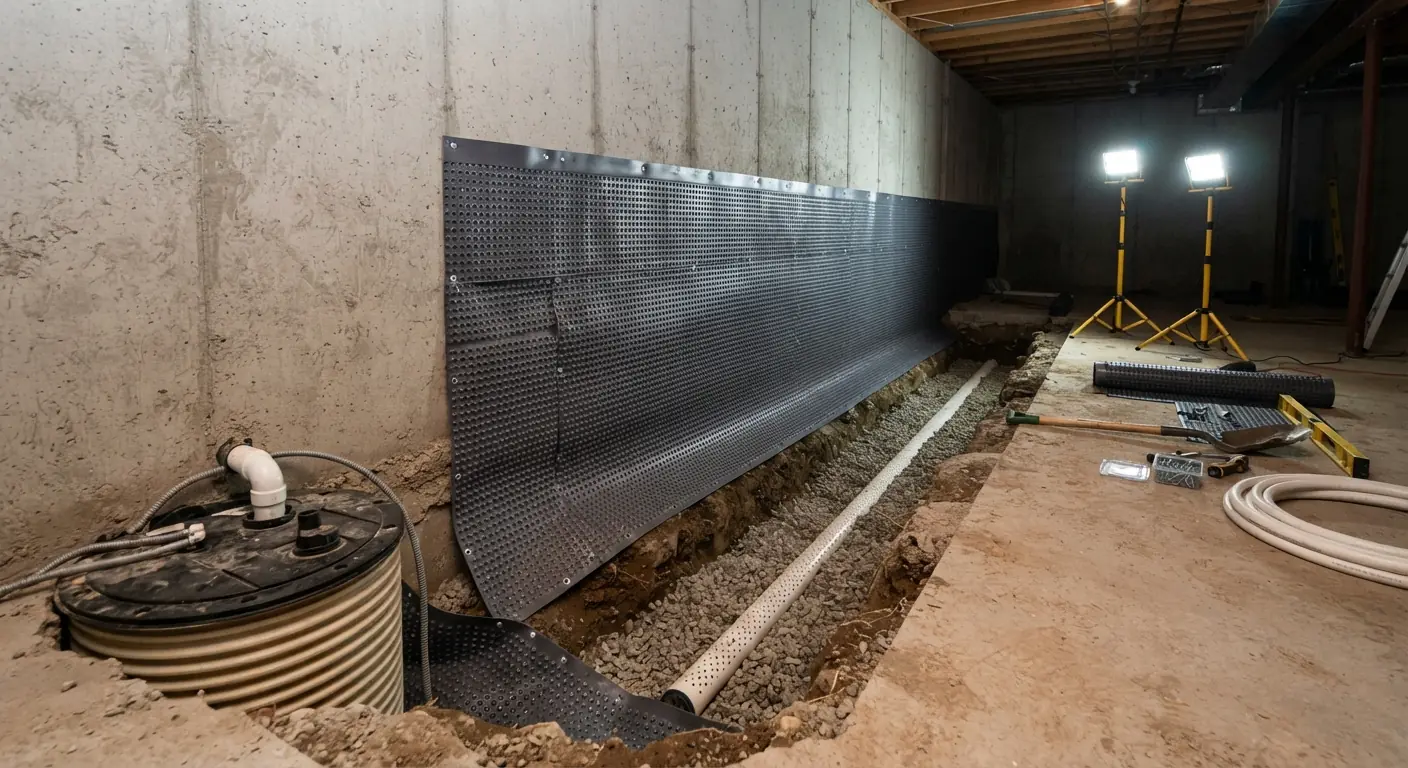
You need a sump pump when groundwater gets into your basement. The signs are water on the floor after heavy rain or snowmelt, a house on low-lying ground or a high water table, and drain tile that can't drain away by gravity.123 A sump pump deals with groundwater only. Water from a burst pipe or a leaking washer is a plumbing job.
TL;DR
- Find the water source before you buy anything. A sump pump fixes groundwater. It does nothing for indoor humidity or plumbing leaks.
- The pump is the last link in a drainage system. Drain tile feeds a pit, a float switch starts the pump, and a check valve stops pumped water from falling back.1
- Deal with roof and surface water first. Extending downspouts directs water away from the basement, and regrading is occasionally enough on its own.2
- For a basement that has already flooded, choose a submersible pump with a battery backup. HomeGuide's 2023 guide puts installation at $600 to $2,500.1
- If the basement floods anyway, make it safe first. Then dry it within 24 to 48 hours to head off mold.4
What are the signs you need a sump pump?
You need a sump pump when water reaches your basement from the ground and fixing gutters or grading hasn't stopped it. HomeGuide lists four triggers: a low-lying or flood-prone lot, water in the basement, poor yard drainage and heavy rain or snow.1 A high water table and drain tile that needs an outlet add to the case.23
Three things decide it for most houses: your flood history, your water table and your drain tile. Start with what you can see.
| What you see | What it usually means | Does a sump pump help? |
|---|---|---|
| Water on the floor or at the base of the walls after heavy rain or snowmelt | Groundwater reaching the basement | Yes, fed by drain tile |
| House on low-lying or flood-prone ground | Higher groundwater risk | Often |
| Drain tile or an interior French drain already in place | Collected water needs an outlet | Yes, unless it drains to daylight |
| Puddles against the foundation and short downspouts | Roof and surface water | Fix gutters and grading first |
| Condensation on walls, pipes or windows with no puddles | High indoor humidity | No, dry the air |
| Water after a pipe, water heater or washer leak | Plumbing | No, fix the leak |
The table draws on HomeGuide, EPA and Building Science Corporation guidance.143
Your flood history
When and where the water showed up tells you where it came from. Water that appears after storms or snowmelt along the floor or the bottom of the walls is most likely groundwater. HomeGuide lists water stains, white or gray chalky residue, damp walls and musty odors among the signs a basement needs waterproofing.2
Condensation is a different problem. EPA says condensation on windows, walls or pipes can be a sign of high humidity.4 A dehumidifier treats that. A single flood from a failed water heater tells you nothing about groundwater.
Your water table
HomeGuide notes that homes in regions with high water tables or heavy rainfall may need more extensive waterproofing.2 Groundwater also moves as damp. Building Science Corporation explains that water in wet soil can wick through the soil and the concrete by capillary flow.3
A pump only removes liquid water that drains into its pit. Damp that wicks up through the footing needs a capillary break or damp-proofing on the wall.3 Your contractor checks moisture at the free on-site estimate, so ask what they find and which kind of water you have.
Your drain tile
Drain tile is perforated pipe laid in gravel that collects groundwater. Building Science Corporation's basement guidance puts a perimeter drain outside the foundation, wrapped in filter fabric. A crushed stone layer under the slab connects to it through the footings.3 An interior French drain does the same job from inside. It is a trench cut in the floor, filled with gravel and perforated pipe and tied to one or more sump pumps.2
Either way, the water has to go somewhere. If your lot lets the drain run out to daylight by gravity, you may not need a pump. If it can't, the pit and pump are how the water leaves.3
How does a sump pump work?
A sump pump empties a pit set into the basement floor. Drain tile carries groundwater into the pit. When the water rises, a float switch turns the pump on. The pump pushes the water up a discharge pipe and away from the house, and a check valve stops it running back when the pump shuts off.12
              discharge pipe runs out through the wall
              and empties away from the foundation
                              ^
                              |
                      [ check valve ]   closes when the pump stops
                              |
  basement floor  ============|===================
                    +---------|---------+
  drain tile  ----> |     [  pump  ]    |
  (perforated pipe  |      [float]      |   float rises, pump starts
   in gravel)       |  ~~~ water ~~~~~  |
                    +-------------------+
                      sump pit (basin)
| Part | Where it sits | What it does |
|---|---|---|
| Drain tile | Outside the footing, under the slab or in a trench inside the floor | Collects groundwater in perforated pipe and gravel and carries it to the pit |
| Sump pit | The lowest point of the basement | Holds the water until the pump runs |
| Pump | In the water (submersible) or with its motor above the pit (pedestal) | Lifts the water out |
| Float switch | On or beside the pump | Starts the pump when water reaches a set level and stops it again |
| Check valve | On the discharge pipe above the pump | Stops water in the pipe from flowing back into the pit |
| Discharge pipe | From the pump out through the wall | Carries the water to higher ground or a storm drain |
The part roles come from HomeGuide, Building Science Corporation and T&J Rooter Service.1235 T&J Rooter Service, a plumber in Toledo, Ohio, describes a typical pit as about 2 feet deep and 18 inches in diameter.5
The check valve matters more than its price suggests. HomeGuide says a broken one makes the pump work too hard, which can damage it.1 Local codes can limit where the discharge pipe may empty, so ask your contractor what applies on your street.5
Building Science Corporation also designs in a backstop. The crushed stone under the slab gives high groundwater somewhere to sit during a downpour if the pump fails in a power outage.3
Will a sump pump keep your basement from flooding?
A sump pump keeps groundwater out when three things hold: water can reach the pit, the pump has power and the discharge line stays open. Lose one and the pit can overflow. Building Science Corporation lists leaky appliances, failed plumbing, overflowing sinks and exterior surface flooding as other ways a basement floods, so plan for those separately.3
HomeGuide notes that sump pumps are often paired with an interior French drain to make them more effective.2 A pit with no drain tile feeding it has a much smaller catch area.
What makes a sump pump fail
These are the failure points HomeGuide and Building Science Corporation name:
- Power loss during a storm. Building Science Corporation plans for pumps that fail in electrical outages.3
- A float switch that has trouble turning the pump on and off.1
- Dirt or debris clogging the pump.1
- A frozen hose extension on the discharge line.1
- A broken check valve that makes the pump work too hard.1
- Continuous running or strange noises, both signs to get it repaired.1
What keeps it working
A battery backup keeps the pump running when the power goes out. HomeGuide notes that batteries in battery-powered pumps need replacing every 3 to 5 years.1 Water-powered pumps run on the flow of municipal water and need no electricity. They are harder to install, less powerful and need annual inspections.1
T&J Rooter Service suggests inspecting the pit and pump at least once a month and checking that the float moves freely.5 Pour a bucket of water into the pit before the wet season and watch the pump start and stop.
Cut the load on the pump too. Building Science Corporation says roof water should not saturate the ground beside the foundation, and the grade should slope away from the house.3
Which sump pump is best for a basement that floods?
For a basement that has already flooded, choose a submersible pump sized for your water load, with a battery backup. HomeGuide rates submersible pumps as more powerful and quieter, and able to take a battery backup. Pedestal pumps cost less and last longer, but they are louder and weaker.1
| Pump type | Unit price | Life or upkeep | Strengths | Drawbacks |
|---|---|---|---|---|
| Pedestal | $100 to $400 | 10 to 30 years1 | Inexpensive, easy to access | Loud, less power, bulky |
| Submersible | $100 to $800 | 5 to 20 years1 | Saves space, powerful but quiet, can have battery backup | Costs more, hard to repair, shorter life |
| Battery-powered | $150 to $8001 | Batteries every 3 to 5 years | Runs in a power outage, can connect to an app for alerts | Battery replacement |
| Water-powered | $100 to $7001 | Needs annual inspection | No electricity needed | Harder to install, less powerful |
Prices and lifespans are from HomeGuide's sump pump cost guide, dated August 2023.1
Size it to the water
Horsepower follows the job. HomeGuide says drier areas may only need 0.25 horsepower pumps, while homes with frequent flooding need 0.33 to 0.5 horsepower. A longer run to the discharge point also calls for more horsepower.1
Metal pumps are more durable than plastic ones but cost about double.1
Think about the room it lives in
In a finished basement, noise and floor space matter. A pedestal pump's motor sits above the pit and runs loud.1 A submersible pump works under the water, which suits a family room or a bedroom next door.
What does a sump pump cost?
HomeGuide's August 2023 guide puts a sump pump at $600 to $2,500 installed.1 That breaks down to $100 to $800 for the unit and $500 to $1,700 for labor.1 Replacing an existing pump runs $400 to $700.1 If the installer has to break up a concrete floor, the total can reach $2,500 to $5,000.1
| Item | Typical cost | Source and date |
|---|---|---|
| Sump pump, installed | $600 to $2,5001 | HomeGuide, August 2023 |
| Pump unit only | $100 to $8001 | HomeGuide, August 2023 |
| Labor | $500 to $1,7001 | HomeGuide, August 2023 |
| Total when a concrete floor must be broken up | $2,500 to $5,0001 | HomeGuide, August 2023 |
| Replacing an existing pump | $400 to $7001 | HomeGuide, August 2023 |
| Float switch, materials only | $35 to $701 | HomeGuide, August 2023 |
| Check valve, parts only | $15 to $301 | HomeGuide, August 2023 |
| New or updated drainage system | $4,000 to $12,0001 | HomeGuide, August 2023 |
| Interior French drain | $4,000 to $17,0002 | HomeGuide, January 2026 |
Pump costs come from HomeGuide's sump pump guide.1 The interior French drain range comes from HomeGuide's waterproofing guide.2
The two drainage ranges measure different jobs. The 2023 figure covers digging a new drainage system or updating an old one. The 2026 figure is for an interior French drain connected to one or more sump pumps, and it depends on basement size and layout.12 Budget from the 2026 range if you need new drain tile inside. It is newer, and it describes the exact job of feeding a pit. Our guide to basement waterproofing cost prices the wider system jobs.
Labor is most of the bill. HomeGuide says it often makes up 65% to 80% of the total, and a simple installation takes 8 to 10 hours.1 Your own job gets its price at the on-site estimate.
What should you do if your sump pump floods your basement?
Make the basement safe, find out why the pump failed, then get the water out and dry everything within 24 to 48 hours. EPA says wet materials dried in that window usually won't grow mold. Pull out soaked carpet and other porous materials early, because they may have to be thrown away if they get moldy.4
1. Make it safe
Stay out of the water if any outlet, cord or appliance sits in it. Shut off the basement circuits at the panel only if you can reach it from a dry spot. If you can't, call your utility or a licensed electrician.
If sewage came up with the water, EPA says to bring in a professional with experience cleaning up after contaminated water.4
2. Find out why the pump stopped
Check the power first. Then look for the failure points HomeGuide lists: a float switch that won't turn the pump on, debris clogging the pump, a broken check valve or a frozen discharge extension.1
Some fixes are cheap. A float switch costs $35 to $70 in materials and a check valve costs $15 to $30 in parts.1 HomeGuide says loud noises, higher electricity use and a history of repairs are signs the pump itself needs replacing.1
3. Get the water out
A wet/dry vacuum handles shallow water. For damaged items you're unsure how to clean, EPA points to specialists in water damage and water restoration.4 A licensed plumber or your contractor can get the pump running again.
4. Clean up and watch for mold
EPA says to scrub mold off hard surfaces with detergent and water, then dry them completely.4 If the moldy area is larger than about 10 square feet, EPA points to its professional remediation guidance and to contractors with mold experience.4
Do not run the HVAC system if you think it is contaminated with mold. EPA warns it could spread mold through the house.4
5. Check your insurance
HomeGuide notes that standard homeowners insurance doesn't cover damage from seepage and flooding.2 It also says a rider for sump pump failure may cost less than flood insurance, depending on the company.1 Read your own policy and ask your agent what it covers.
How do you dry out a basement quickly after a flood?
Dry the basement within 24 to 48 hours, the window EPA gives for preventing mold growth. Get the standing water out, remove soaked carpet and pad, move air with fans and run a dehumidifier sized for wet conditions. Aim to bring indoor humidity below 60 percent, ideally 30 to 50 percent.46
Move air, then dry it
EPA suggests opening doors and windows when practical and using fans.4 Once the dehumidifier is running, ENERGY STAR advises closing the doors and windows to that space so it works efficiently.6
Size the dehumidifier for a wet space
ENERGY STAR sizes dehumidifiers by pints of water removed per day. It rates a space as wet when the walls or floor sweat or seepage is present.6 A flooded basement is in that category.
| Condition | Relative humidity | Space under 2,000 sq ft6 | Space over 2,000 sq ft6 |
|---|---|---|---|
| Slightly to moderately damp | 50 to 75 percent | 20 to 30 pints per day | 30+ pints per day6 |
| Very damp | 75 to 90 percent | 25 to 40 pints per day | 40+ pints per day6 |
| Wet | 90 to 100 percent | 30 to 50 pints per day | 50+ pints per day6 |
The figures are ENERGY STAR's recommended capacity ranges.6 ENERGY STAR also says it's better to oversize than undersize.6 For more on picking a unit, see how to size a basement dehumidifier.
A few details make the dehumidifier work harder for you:
- Run a hose from the bucket to a floor drain or the sump pump so it never fills up.6
- Keep drain hoses away from electrical cords and connections.6
- If the basement stays below 65°F, pick a model rated for lower temperatures.6
- Track progress with a humidity meter. EPA says they cost about $10 to $50 at hardware stores.4
Check where you can't see
In a finished basement, water hides. EPA lists the back of drywall, the underside of carpets and pads and the top of ceiling tiles as places mold grows out of sight.4 If walls got wet, have your contractor open them up and check before anything gets painted over.
Is there a better alternative to a sump pump?
The better alternative is keeping water away from the foundation, so less of it ever reaches a pit. Where the lot allows, a perimeter drain can run to daylight by gravity and needs no pump. Where it can't, gutters, grading and exterior drains cut the load, and a pump still empties the drain tile.32
Building Science Corporation traces the basics back to the Romans: drain the site and drain the ground. Today that means gutters that carry roof water away from the foundation and a grade that slopes away from the house.3 Here is how the other options compare on HomeGuide's January 2026 figures.
| Option | What it does | Typical cost | Limit |
|---|---|---|---|
| Downspout replacement or extension | Carries roof water away from the basement | $220 to $625 to replace downspouts2 | Handles roof water only |
| Regrading | Slopes soil away to fix drainage | $1,000 to $5,0002 | Occasionally enough on its own, often paired with other methods |
| Exterior French drain | Intercepts water before it reaches the foundation walls | $30 to $90 per linear foot2 | Needs excavation around the house |
| Waterproof membrane | Barrier between the foundation and the soil | $4 to $7 per square foot2 | Needs excavation around the house |
| Waterproof paint or sealer | Barrier against moisture | $2 to $10 per square foot2 | Won't stop water under pressure |
Costs and limits are from HomeGuide's basement waterproofing guide.2
HomeGuide's sump pump guide makes the same point from the other side. It says to consider a pump when moisture or flooding can't be fixed by regrading the yard or updating the drainage system.1 You can compare basement waterproofing methods side by side before you choose.
Should you add a sump pump before finishing your basement?
Settle the water question before anyone frames a wall. Building Science Corporation says most interior insulation systems use moisture-sensitive materials that can't tolerate even minor groundwater leakage.3 If your basement has flooded or sits on a high water table, have the drain tile and sump pump in place and tested before finishing starts.
A leak behind finished walls means tearing out wet drywall, carpet and insulation. Building Science Corporation says finishes on the lower parts of basement walls should be chosen with flooding from appliances, plumbing and surface water in mind. It also warns against vinyl floor coverings and vinyl wall coverings, which block inward drying.3 Leave the pit lid reachable, too. You'll need to get to the pump for monthly checks.
If you're planning to finish your basement, put the pump and drain tile at the front of the plan. If your basement is already finished and has started taking on water, remodeling a finished basement may start with opening the walls to find the damage.
Basement Remodeling Co. matches you with one vetted, licensed basement contractor for your metro. That contractor checks moisture at a free on-site estimate and gives you a written, itemized quote. When you know the water is coming from the ground, get a written quote for basement waterproofing before you commit to finishes. You can also find the basement contractor for your ZIP code. In metro Denver or metro Atlanta, start with basement finishing in Denver or basement finishing in Atlanta.
What to ask your contractor about a sump pump
Ask where the water comes from before you talk about pumps. HomeGuide's list of questions for waterproofing contractors includes how water is getting into the basement and which methods they recommend and why.2 A good quote then names the drain tile, the pump, the backup and where the discharge ends.
Use these questions at the estimate:
- How is water getting into my basement, and is it groundwater, surface water or humidity?2
- Is there drain tile to feed the pit, or does it need to be added?
- Could the drain run to daylight by gravity on this lot?3
- Which pump type and horsepower do you recommend, and why?1
- Is a battery backup or water-powered backup included?1
- Where will the discharge pipe empty, and what do local codes allow?5
- Does the quote list the pit, pump, check valve, drain tile, concrete work and electrical work as separate lines?
- Does the estimate cover materials, labor, delivery fees and cleanup?2
Your contractor pulls the permit and books the inspections where your city requires them. Permit rules vary by city and county, so confirm what applies to your address.