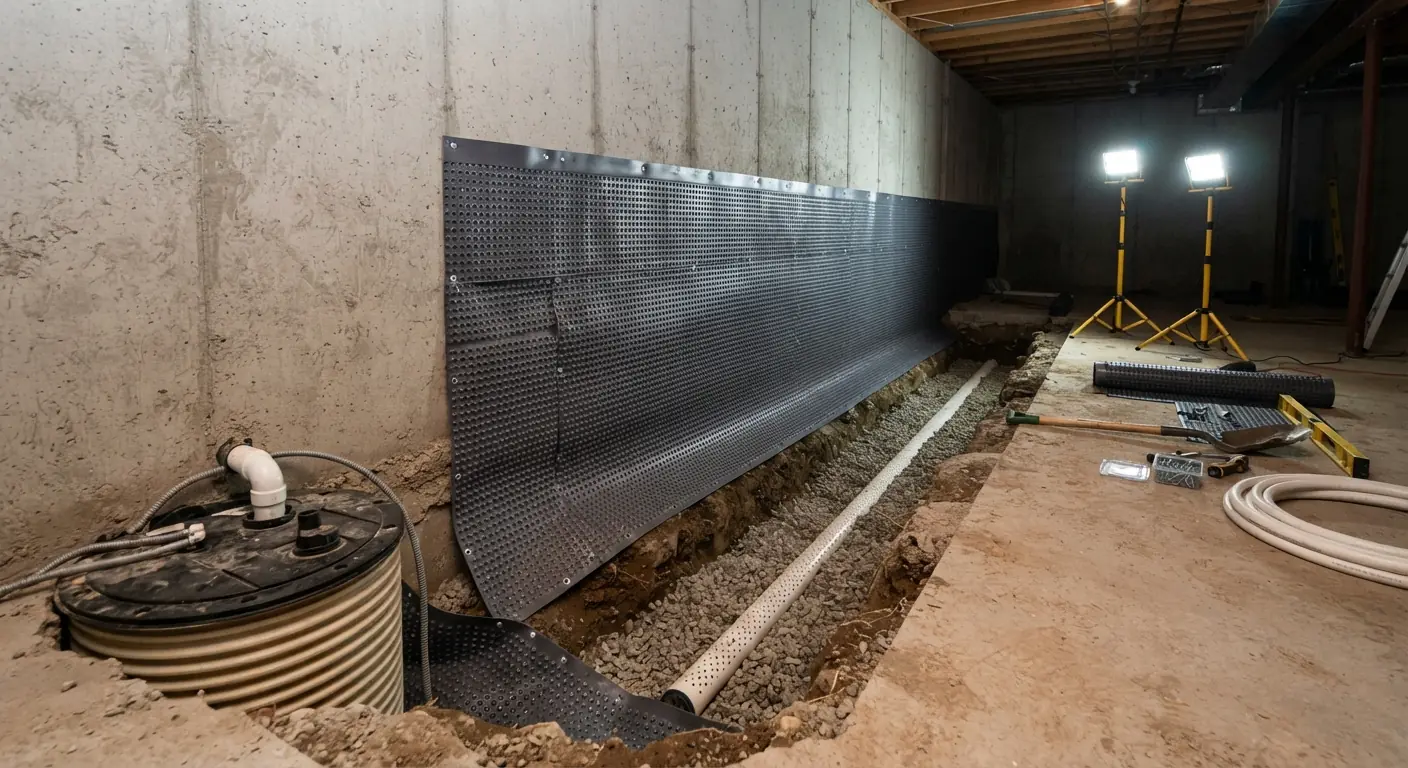
The right basement waterproofing solution depends on how the water gets in. Damp walls that sweat in humid weather need humidity control.1 Damp patches after rain usually start with gutters, downspouts and grading.2 Water at the joint where floor meets wall, or water forced through the walls by saturated soil, needs drainage: an interior drain tile with a sump pump, or an exterior membrane with a perimeter drain.3 Sealers only suit minor dampness.4
TL;DR
- Diagnose before you buy anything. Condensation, seepage, a cove-joint leak and hydrostatic pressure each need a different fix, and a coating on the wrong problem wastes the money.
- Start outside. Gutters, downspouts and soil that slopes away from the house come first in Building Science Corporation's groundwater advice.2 Downspout work costs a few hundred dollars, far less than a drain system.4
- Water under pressure needs drainage. HomeGuide's January 2026 averages put interior systems at $6,000 to $12,000 and exterior work at $10,000 to $18,000.4
- Plan to replace the pump before the drain. Drains last 20 to 30 years with upkeep, while a submersible sump pump lasts 5 to 20.45
- Fix the water before you frame. A plastic vapor barrier or epoxy paint behind a finished wall traps moisture that needs to dry out.2
How do you tell which water problem you have?
Watch when the water appears and where it collects. Moisture on cold walls and pipes in humid weather points to condensation.1 Damp patches after rain point to seepage.3 A wet line where the floor meets the wall is a cove-joint leak. Water forced through cracks and joints when the soil is saturated means hydrostatic pressure.6
Four checks narrow it down before anyone quotes a fix.
Measure the humidity
A humidity meter costs $10 to $50 at many hardware stores.1 EPA advises keeping indoor humidity below 60 percent, and ideally between 30 and 50 percent.1 If the reading is high and the dampness shows up in muggy weather more than after storms, start with the air.
Walk the outside in a storm
Go out during heavy rain. Look for overflowing gutters, downspouts that dump water against the wall and soil that slopes toward the house. EPA's moisture guidance says the ground should slope away from the foundation so water doesn't collect there.1 Building Science Corporation's basement digest adds that roof water should not saturate the ground beside the foundation.2
Read the marks
HomeGuide lists the common signs that a basement needs waterproofing: standing water, water stains, white or gray chalky residue, damp walls, musty odors, mold and cracks in walls or floors.4 Where the marks sit tells you more than the marks themselves. A tide line along the base of every wall points to the cove joint. A damp streak under one crack points to that crack.
Stop for structural signs and large mold
Bowed walls and warped doors are on the same list, and they change the order of work.4 Have a licensed contractor or structural engineer assess a moving wall before anyone quotes waterproofing, because drainage does nothing to brace it. For mold, EPA says a patch under about 10 square feet is usually a homeowner job.1 Past that, it points you to its remediation guidance for larger jobs.1
Which waterproofing method fixes each symptom?
Each symptom has a first-choice fix. Condensation needs drier air and insulated cold surfaces.1 Seepage after rain needs gutter, downspout and grading work, plus crack injection where one crack leaks.4 A cove-joint leak or hydrostatic pressure needs drainage that collects the water and pumps it out, or exterior work that keeps water off the wall.3
| Symptom | What you see | First fix | Typical cost | Expected life |
|---|---|---|---|---|
| Condensation | Droplets on cold walls, pipes and rim joists in humid weather | Dehumidifier, insulated cold pipes, dryer vented outside | $130 to $300 portable dehumidifier; $1,500 to $3,500 whole-house unit installed4 | Depends on the unit |
| Seepage after rain | Damp patches, stains or chalky residue after storms | Gutters, downspout extensions, regrading; epoxy injection for a leaking crack | Downspout replacement $220 to $625; regrading $1,000 to $5,000; crack injection $250 to $800 or more per crack4 | Lasts as long as gutters and grade are kept up |
| Cove-joint leak | Water along the line where the floor meets the wall | Interior drain tile and sump pump; baseboard channel where you can't break the floor | Interior drain $4,000 to $17,000; sump pump $600 to $2,5004 | Drains 20 to 30 years with upkeep; submersible pumps 5 to 20 years45 |
| Hydrostatic pressure | Water through wall cracks, joints or the floor when the soil is saturated | Interior drain tile and sump, or exterior excavation with membrane and perimeter drain | Interior $6,000 to $12,000; exterior $10,000 to $18,0004 | Exterior membranes 10 to 15 years; drains 20 to 30 years; submersible pumps 5 to 20 years45 |
| Bowed wall or warped doors | Wall leaning in, doors sticking | Structural assessment by a licensed pro before waterproofing | Priced at your estimate | Not applicable |
Costs and lifespans are HomeGuide averages from its January 2026 waterproofing guide and its sump pump guide.45 Your contractor prices your own basement at the estimate.
Condensation: dry the air
Condensation forms when warm, humid air meets cooler basement surfaces.6 Building Science Corporation says the worst of it comes in summer, when moist air touches concrete colder than its dew point. It flags rim joists as cold in both summer and winter.2 The water comes from the room, so the fix works on the room. EPA's list is to run a dehumidifier or air conditioner, vent dryers outside, insulate cold water pipes and move more air.1 A wall coating can't dry room air.
Seepage after rain: fix the outside first
Building Science Corporation boils groundwater control down to "drain the site and drain the ground."2 That means gutters that catch roof water, downspouts that carry it away and grade that slopes away from the wall.2 Home Depot's pro guide says a basement that only needs damp-proofing and doesn't flood badly may be fixed with better gutters. It lists moving gutters out, extending downspouts or tying a downspout into an existing drain.3
Regrading costs $1,000 to $5,000.4 HomeGuide says it is occasionally enough on its own and often paired with an exterior drain or membrane.4 Where one crack weeps, epoxy injection fills and seals minor cracks that don't threaten the structure.4
Cove-joint leak: collect the water at the base
The cove joint is where the floor slab meets the wall. When the soil around the foundation is saturated, hydrostatic pressure forces water up through that joint. You have two ways to handle it.
An interior drain tile sits in a trench cut around the edge of the floor. The trench gets gravel and perforated pipe and connects to a sump pump. HomeGuide puts it at $4,000 to $17,000 depending on the basement's size and layout.4
A baseboard channel bonds to the floor along the wall. It collects the seeping water and drains it to a sump pump or floor drain without breaking up the slab. Channel kits are sold for DIY install.
Hydrostatic pressure: drain it or keep it off the wall
Saturated soil presses water against the walls and through cracks and joints.6 HomeGuide says sealers won't stop water under pressure.4 You need to move the water.
Inside, a perimeter drain collects it and a sump pump sends it out. Home Depot's guide notes that interior drains rely on the pump to carry the water away.3 Outside, your contractor digs down to the footings, cleans and dries the wall, and applies a membrane or coating. A drain goes in the perimeter trench, and the soil goes back in compacted 6-inch layers.3 Building Science Corporation adds free-draining backfill or a drainage board, with the perimeter drain wrapped in filter fabric.2
Where the water table is high, Polyguard describes reinforced wall liners that work with a drainage system to channel water away from the room.6
What is the best waterproofing for basements?
The best waterproofing removes the water at its source. For a basement that leaks, that means drainage: surface water sent away from the house first, then a drain that carries off what still reaches the wall. Coatings and sealers work as an extra layer. Home Depot's pro guide calls interior sealants alone a temporary measure.3
HomeGuide says most waterproofing projects combine several methods.4 Home Depot's guide says the most thorough jobs combine inside and outside work.3 So "best" is a ranking by symptom:
- For condensation, a dehumidifier and insulated cold surfaces.1
- For seepage after rain, gutters, downspouts and grading, then crack injection.4
- For a cove-joint leak, an interior drain tile and sump pump, or a baseboard channel.
- For hydrostatic pressure, an interior drain and sump, or exterior excavation with a membrane and perimeter drain.3
The waterproof paints and liquid rubber coatings on store shelves fit the bottom of that list. They help with minor dampness once cracks are filled.43
Should you waterproof from the inside or outside?
Outside work stops water before it reaches the wall. Inside work collects the water that gets through and pumps it away. Building Science Corporation describes the outside as the traditional place for water control layers.2 Inside systems usually cost less and leave the yard alone.4 Polyguard notes they suit homes with limited outside access.6
| Inside: drain tile and sump pump | Outside: excavation, membrane and drain | |
|---|---|---|
| What it does | Collects water that reaches the basement and pumps it out | Keeps water off the foundation wall |
| Average cost | $6,000 to $12,0004 | $10,000 to $18,0004 |
| Disruption | Trench broken through the basement floor | Excavation around the perimeter; replacing sod and plants afterward runs $300 to $1,000 or more4 |
| Expected life | Drains 20 to 30 years with upkeep; submersible pumps 5 to 20 years45 | Membranes 10 to 15 years (HomeGuide); polyurethane up to 25 years and bentonite for the life of the structure (Home Depot)43 |
| Best fit | Cove-joint leaks and lots with limited outside access | Keeping the foundation itself dry |
Costs and interior lifespan come from HomeGuide.4 The polyurethane and bentonite figures come from Home Depot's pro guide.3
Inside work leaves the outside of the foundation wet. Home Depot's guide says sealing or coating the foundation without a drain won't protect it from water on the outside.3 Outside work costs more because of the digging. Excavation equipment can also bring permit or license requirements, so ask your contractor what your job needs.3
You can combine them. Gutters and grading handle the outside, and an interior drain handles what still gets through.4
How much does it cost to waterproof a 1,000 sq. ft. basement?
Expect about $6,000 to $12,000 for an interior drain and pump system, or $10,000 to $18,000 for exterior excavation, based on HomeGuide's January 2026 averages.4 Foundation type, basement size, how bad the water is and local labor rates move the price.4 Downspout and single-crack repairs cost a few hundred dollars.4
A worked example for 1,000 square feet
Some methods are priced per foot of wall. By our arithmetic, a roughly square 1,000 sq. ft. basement is about 31.6 feet on a side, so its walls run about 126 linear feet. A long, narrow basement has more wall for the same floor area.
| Method | Pricing unit | Published rate | At about 126 linear feet | Source |
|---|---|---|---|---|
| Exterior French drain, installed | Per linear foot | $30 to $904 | About $3,780 to $11,340 for the drain alone (our arithmetic) | HomeGuide |
| Interior French drain | Whole job | $4,000 to $17,0004 | Varies with size and layout | HomeGuide |
| Sump pump, installed | Each | $600 to $2,5005 | Rises to $2,500 to $5,000 if the concrete floor must be cut5 | HomeGuide |
| Waterproofing membrane, installed | Per square foot of wall | $4 to $74 | Depends on wall height | HomeGuide |
| Waterproof paint or sealer | Per square foot | $2 to $10 with labor (HomeGuide); $1 to $6 for paint (Home Depot)43 | Depends on wall height | HomeGuide, Home Depot |
The two paint figures have different scopes. HomeGuide's rate includes labor and materials, while Home Depot's guide gives the paint cost without saying so.43 Budget from HomeGuide's range if someone else is doing the work.
Membrane and sealer rates apply to wall area. Ask your contractor for the wall square footage on the quote so you can check the math.
What moves the price
HomeGuide names five drivers. Poured concrete walls are easier and cheaper to waterproof than block, and stone costs the most.4 Larger basements need more material and labor. Severe flooding or strong hydrostatic pressure costs more than minor dampness. Excavation costs more than interior work. Labor rates vary by region, and high water tables or heavy rainfall push toward bigger systems.4
Costs to add
- Mold remediation: $1,500 to $15,000.4
- Replacing sod and plants after outside work: $300 to $1,000 or more.4
- A whole-house dehumidifier: $1,500 to $3,500 installed.4
How long should basement waterproofing last?
Plan on 10 to 30 years or more for a well-installed system, according to HomeGuide.4 Interior drains and sump pumps run 20 to 30 years with regular upkeep, and exterior membranes 10 to 15 years.4 The pump can wear out well before the drain. HomeGuide's sump pump guide puts submersible pumps at 5 to 20 years.5
| Part | Expected life | Source |
|---|---|---|
| Whole system | 10 to 30 years or more4 | HomeGuide |
| Interior drain and sump pump | Drain 20 to 30 years with upkeep; submersible pump 5 to 20 years45 | HomeGuide |
| Pedestal sump pump | 10 to 30 years5 | HomeGuide |
| Submersible sump pump | 5 to 20 years5 | HomeGuide |
| Backup pump batteries | Replace every 3 to 5 years5 | HomeGuide |
| Exterior membrane | 10 to 15 years (HomeGuide); polyurethane up to 25 years (Home Depot)43 | HomeGuide, Home Depot |
| Bentonite sheet | The life of the concrete it's attached to3 | Home Depot |
| Interior sealant | Temporary3 | Home Depot |
The membrane numbers disagree because they cover different scopes. HomeGuide gives one figure for exterior membranes in general. Home Depot's guide gives product-specific upper limits.43 Budget from HomeGuide's shorter 10 to 15 years. Then ask your contractor which product they use and get its warranty terms in writing.
Upkeep sets the real lifespan. Replacing a sump pump costs $400 to $700, and maintenance plans run $100 to $250 a year.5 Gutters need regular cleaning and repair.1 Building Science Corporation's design keeps a crushed-stone layer under the slab as a temporary reservoir in case sump pumps fail during a power outage.2 A battery backup keeps a pump running when the power drops.5
Why settle the water before you finish the basement?
A finished wall hides the next leak and gives mold a place to grow behind the drywall.1 Framing and insulation also change how the concrete dries.2 Waterproofing is the smaller bill. Basement Remodeling Co.'s published finishing ranges start at $30,000. HomeGuide's waterproofing averages run $6,000 to $18,000.4
Building Science Corporation's basement digest explains the drying problem. A framed, insulated wall covered with an interior plastic vapor barrier is common, and it often leads to odor, mold, decay and corrosion.2 Most interior insulation uses moisture-sensitive materials like fiberglass batts that can't tolerate even minor leakage.2 The digest rules out interior plastic vapor barriers and impermeable finishes such as vinyl wall coverings and oil, alkyd or epoxy paints on walls meant to dry inward. It recommends rigid foam or spray foam against the concrete.2
So fix the water first, and skip an epoxy waterproof coat on any wall you plan to insulate and frame, because it blocks the inward drying that wall depends on.2
Once the water is handled, the finish is the bigger decision. The basement finishing service covers the build from the moisture check at the estimate to the inspections. If your basement is already finished and the water came back, basement remodeling covers reworking a finished space. Basement Remodeling Co.'s published finishing ranges, each from one local firm's published figures and checked September 2026:
- Metro Atlanta, typical full finish: $45,000 to $80,000. See finishing a basement in Atlanta.
- Metro Denver: $30,000 to $90,000. See finishing a basement in Denver.
- Colorado Springs, typical 1,000 sq. ft. finish: $30,000 to $75,000. See finishing a basement in Colorado Springs.
- Fort Collins, typical full finish: $50,000 to $110,000. See finishing a basement in Fort Collins.
What a good waterproofing quote shows
A good quote names the water source it fixes, the method and the materials. It itemizes drain length, pump type, crack count and wall area so you can check the math. It says what happens to the floor, walls and yard. HomeGuide advises getting the itemized estimate, contract and warranty in writing before work begins.4
HomeGuide's question list for waterproofing contractors makes a good script.4 These four matter most:
- How is water getting into my basement?
- Which methods do you recommend for my basement, and why?
- Are there structural problems that could cause the walls to fail?
- Does the estimate cover materials, labor, delivery fees and cleanup?
Add three of your own:
- Which symptom does each line item fix?
- Does the sump pump have a battery backup, and when do its batteries need replacing?5
- Where does the pump discharge, and is it far enough from the foundation?
A quote that sells a coating for water that shows up at the cove joint after storms has skipped the diagnosis.4
Basement Remodeling Co. matches you with one vetted, licensed basement contractor for your metro. That contractor contacts you, checks moisture at a free on-site estimate and gives you a written, itemized quote. Nothing starts until you sign. When you know which symptom you have, get a written quote for basement waterproofing. Not sure your area is covered? Find your metro by ZIP.