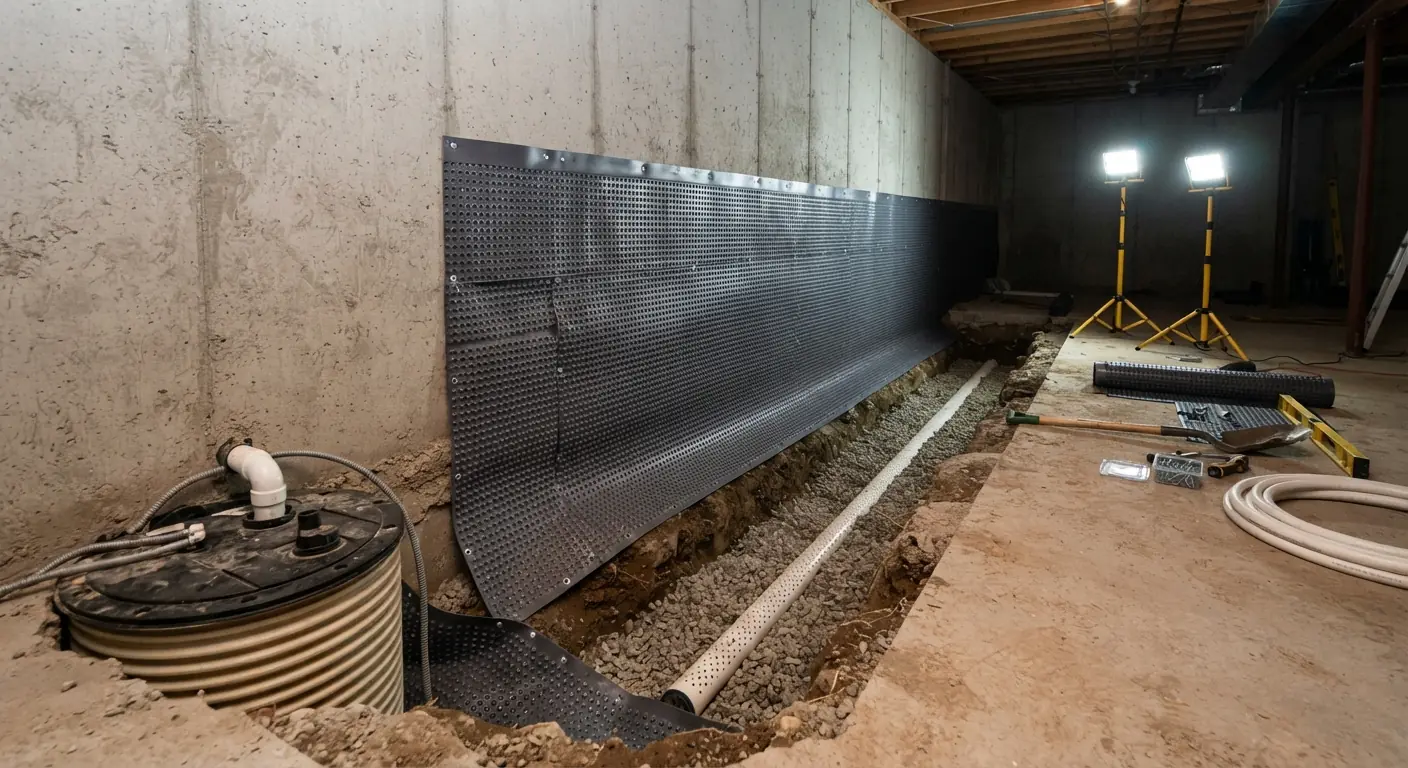
A basement floor drain is the grated opening in your slab that gives stray water a way out. It catches spills, appliance leaks and dehumidifier runoff, then sends that water to the sewer line, a sump pit, gravel or a dry well under the floor, or out to daylight.1 When you finish the basement, keep the grate open and reachable, keep its trap wet and protect it from sewer backups.
TL;DR
- Find out where your drain goes before anyone frames a wall. Sewer drains can back up, sump drains stop when the pump or power fails, and gravel or dry-well drains can only take so much water.
- Keep the grate open and reachable at finished floor height. Plan walls, cabinets and flooring around it.
- If the drain joins the sewer line, ask about a backwater valve and a way to keep the trap full.
- We found no independent guide that prices a single new floor drain. Breaking out concrete drives the cost, and a sump install that needs it runs $2,500 to $5,000 in HomeGuide's data.2
What does a basement floor drain do?
A basement floor drain gives water on the floor somewhere to go before it soaks into carpet, drywall and framing. It handles everyday water, like a dehumidifier hose or a water heater that lets go, and it takes some of the load in a flood.1 It won't fix a wet basement on its own.
Water on a concrete floor has three choices. It runs to the low point, it soaks into something, or it sits there. The drain is what makes the first choice the easy one.
Fast drainage matters more once the room is finished. The EPA's advice is to dry water-damaged areas and items within 24 to 48 hours to prevent mold growth.3 Building Science Corporation says basement floor finishes and lower-wall finishes should be chosen with flooding from leaky appliances, failed plumbing, overflowing sinks or exterior surface flooding in mind.4 A working drain shortens the time water spends on the floor.
What a floor drain can't do is stop groundwater coming through walls or the joint where wall meets floor. That job belongs to surface drainage, perimeter drains and the other layers of a waterproofing system.4 If you see seepage, damp walls or a white chalky residue, read our guide to basement waterproofing methods before you plan the finish.5
Where do basement floor drains usually go?
A basement floor drain empties to one of four places: the house sewer line, a sump pit with a pump, a gravel bed, drain tile or dry well in the ground, or a pipe that runs downhill to daylight. Some older drains turn out to go almost nowhere.6 Each destination fails in its own way.
Sewer-connected drains
This drain ties into the main drain line under the slab, which runs to the city sewer or a septic system. It has a trap below the grate. The trap is a U-shaped bend that holds water, and that water seal keeps sewer gas out of the house.
Two things go wrong. The seal dries out because a floor drain rarely gets used, and the basement starts to smell. Or the sewer backs up in a heavy storm and pushes sewage out of the lowest opening in the house, which is often this drain. A backwater valve exists to stop that return flow of sewage. If sewage does come in, the EPA says to bring in a professional with experience cleaning buildings damaged by contaminated water.3
Sump-connected drains
Here the drain pipe empties into the sump basin. The pump sits in that basin, turns on when the water reaches a set level and sends the water away from the house to higher ground or a storm drain.2
The weak point is the pump. Building Science Corporation notes that the gravel layer under a slab acts as a temporary reservoir if sump pumps fail during power outages.4 The gravel buys time until the pump runs again.
Gravel, drain tile or a dry well
Some drains empty straight into the crushed stone under the slab or into the drain tile around the footings. Building Science Corporation describes a crushed stone layer under the slab connected through the footings to the perimeter drain.4 A dry well is a buried, gravel-filled pit that lets water soak into the surrounding soil.
These drains are simple and often have no trap. They also take water slowly, and they fill with silt over time. One homeowner on the Fine Homebuilding forum found his floor drain "was not connected to anything, just sitting there embedded in concrete," and his drain snake hit gravel.6
There's a second catch. Building Science Corporation treats the sealed slab as the air barrier that controls soil gas.4 An open drain into gravel is a hole in that barrier. Test the basement for radon before you finish it. If the level calls for a fix, a licensed pro should install one of the radon mitigation systems suited to your house.
Gravity to daylight
On a sloped lot the drain pipe can run downhill to an outlet in the yard. Building Science Corporation refers to this as gravity drainage to daylight.4 The forum homeowner above traced his drain tile "all the way out to daylight" after a flood.6 The risk is an outlet that gets buried, crushed or blocked with ice. Find it, mark it and keep it clear.
| Where it goes | Clues you have it | Main risk | Plan before you finish |
|---|---|---|---|
| Sewer line | A water seal sits in a trap under the grate | Sewer gas when the trap dries; sewage backup in storms | Backwater valve, trap primer or a watering habit, open access |
| Sump pit | Water you pour down shows up in the sump basin | Pump or power failure2 | Battery backup, a tested pump, a reachable pit lid |
| Gravel, drain tile or dry well | No trap water; a snake hits gravel6 | Slow drainage, silt, soil gas4 | Camera check, radon test, low expectations for big leaks |
| Daylight outlet | Sloped lot with a pipe end in the yard | Buried, crushed or frozen outlet | Find and mark the outlet, keep it clear |
How can you tell where your floor drain goes?
Pour water down it and watch. If the water shows up in your sump pit, the drain is sump-connected. If you can see a water seal in a trap under the grate, it most likely joins the sewer line. If you can't tell, a plumber's camera inspection settles it.
Pouring water down the drain also confirms that it flows. Water that lingers, or a drain that gurgles or bubbles, points to a blockage or a venting problem.
Do this before the finish goes in. The forum homeowner had no cleanouts anywhere, so he rented a jackhammer and cut a hole in the floor for a sump pump, which is where he found his drain tile.6 That's a rough job in an unfinished basement. In a finished one it means pulling up flooring you just paid for.
Is a basement floor drain necessary?
Not every basement has one, and a dry basement with no plumbing can manage without it. A drain earns its place when the room holds a water heater, a washer, a dehumidifier or anything else that can leak. Whether new work needs one is a local code question, so ask your contractor before you plan around it.
If you already have a drain, keep it. It's far cheaper to protect one during the finish than to add one later through the slab.
The drain also makes humidity control easier. ENERGY STAR says a portable dehumidifier can run a hose into a floor drain or sump, and a whole-home dehumidifier's drain should be routed to a floor drain or condensate pump by an HVAC professional.1 No drain means buckets to empty or another pump to run. The EPA suggests keeping indoor humidity below 60 percent, ideally between 30 and 50 percent.3
How do you keep a floor drain working when you finish the basement?
Keep it open, keep it wet and keep sewage out. That means no flooring, wall or furniture over the grate, a trap that never dries, a backwater valve if the drain ties into a sewer that can back up, and a sump that runs when the power doesn't.
Never cover it
The grate should sit at the finished floor height, with the floor still leading water toward it. Plan the floor thickness with that in mind, because a raised subfloor or thick tile can leave the drain in a hole. Our basement flooring options guide covers how each floor type handles water.
Keep the cover clear and check it now and then for debris that could clog it. A buried drain can't catch anything. Water spreads under the flooring instead, and the EPA notes that porous materials such as carpet may have to be thrown away if they become moldy.3
The best fix is layout. Put the drain inside a utility room or laundry area with a hard, water-tolerant floor, and keep the family room carpet away from it.
Keep the trap wet, or add a trap primer
A sewer-connected drain only blocks sewer gas while its trap holds water. The low-tech fix is to pour a bucket of water down the drain now and then. A trap primer does it for you. It's a small device, usually fed from a nearby water line, that adds water to the trap on its own. Ask your contractor whether your local plumbing code calls for one on new or relocated drains.
Add a backwater valve if the drain joins the sewer
A backwater valve lets water leave and stops sewage coming back. It matters most in a finished basement. The EPA says damage caused by sewage calls for a professional with experience cleaning buildings damaged by contaminated water.3 A licensed plumber sizes and places the valve. Leave an access panel in the finished floor so it can be checked.
Back up the sump
If your drain feeds a sump, the drain only works while the pump does. HomeGuide suggests a battery backup so the pump keeps running when the power goes out.2 Batteries in battery-powered pumps need replacing every 3 to 5 years.2 A check valve stops water flowing back into the basin when the pump is off, and a replacement costs $15 to $30 in parts.2 Keep the pit lid reachable after the finish goes in.
Route condensate on purpose
If a dehumidifier drains to the floor drain, place it close enough to avoid a long hose. ENERGY STAR warns against creating a tripping hazard and says to keep drain hoses away from electrical cords and connections.1
Can you add a drain to existing concrete?
Yes. The slab gets cut or jackhammered, a trench is dug to wherever the water can go, the drain and pipe are set, and the concrete is patched.2 The hard part is the destination. There has to be a sewer line, a sump or another outlet low enough to reach.
A drain with nowhere to go is a hole in the floor. So the first question is always what's under the slab and how deep it sits.
How a floor drain goes into a concrete slab
- Confirm the outlet. A camera inspection or the home's plans show where the main drain line or sump sits and how deep.
- Sort out the permit. Ask whether the work needs a permit where you live. Through Basement Remodeling Co., your contractor pulls the permit and books the inspections.
- Cut the slab. Installers use a concrete saw or jackhammer to break up the floor.2
- Trench and lay pipe. The pipe runs at a steady fall toward the outlet. A sewer connection gets a trap.
- Set the drain body. The grate height is set to the finished floor, not the bare slab.
- Inspect before backfill. The inspector sees the pipe before it disappears.
- Restore the layers and patch. Building Science Corporation says the polyethylene vapor barrier should sit in direct contact with the slab and that a sand layer should never go between them.4 The new concrete should pitch toward the drain.
This is licensed plumber work. It touches the main drain line, the trap and local plumbing code, and a mistake shows up as a smell or a backup after the floor is finished.
How much does it cost to install a floor drain in a basement?
We found no independent national guide that prices a single new floor drain. The closest priced job, a sump install that needs a concrete floor broken up, runs $2,500 to $5,000 in HomeGuide's data.2 The concrete work and the distance to an outlet set the price. The drain fitting itself is a small part of it.
| Related job | Price range | Source and scope |
|---|---|---|
| Sump pump, installed | $600 to $2,5002 | HomeGuide sump pump guide, national average range |
| Sump install when a concrete floor must be broken up | $2,500 to $5,0002 | HomeGuide sump pump guide |
| New or updated drainage system | $4,000 to $12,0002 | HomeGuide sump pump guide |
| Interior French drain | $4,000 to $17,0005 | HomeGuide waterproofing guide, varies by basement size and layout |
| Plumber labor | $45 to $80 per hour or more2 | HomeGuide sump pump guide |
Which line to budget from depends on your outlet. If there's no sump and no sewer line within reach, you're really buying a pit, a pump and concrete work, so budget from the $2,500 to $5,000 line.2 If the main drain line runs close to where you want the drain, the job is smaller, and it's priced at your estimate.
Two caveats. HomeGuide's sump pump page is dated August 2023, and its ranges are national averages.2 Labor and material costs vary by region.5
What to ask your contractor about the floor drain
A good quote shows where the drain goes, what protects it and where you can reach it after the finish. These questions get that on paper before framing starts, while fixes are still cheap. If an answer is vague, ask for it to be written into the itemized quote.
- Where does this drain go, and how did you confirm it?
- Is there a working trap, and how will it stay full? Do you recommend a trap primer?
- Does the sewer line need a backwater valve here?
- Will the finished floor meet the grate, and will the floor still lead water toward it?
- Where will the drain, sump lid, cleanout and valve access sit in the finished layout?
- Is the drain work itemized on the quote, with the permit included?
When you're ready, you can get a written quote for finishing your basement. Basement Remodeling Co. sends your request to one vetted, licensed basement contractor, who books a free on-site estimate and checks moisture before quoting. You'll get a written, itemized quote, and nothing starts until you sign. To see who covers your area, search basement contractors by ZIP code, or go straight to basement finishing in Denver or basement finishing in Atlanta. If the basement is already finished and the drain is buried, remodeling an existing basement is the better starting point. If water is the real problem, start with waterproofing before you finish.