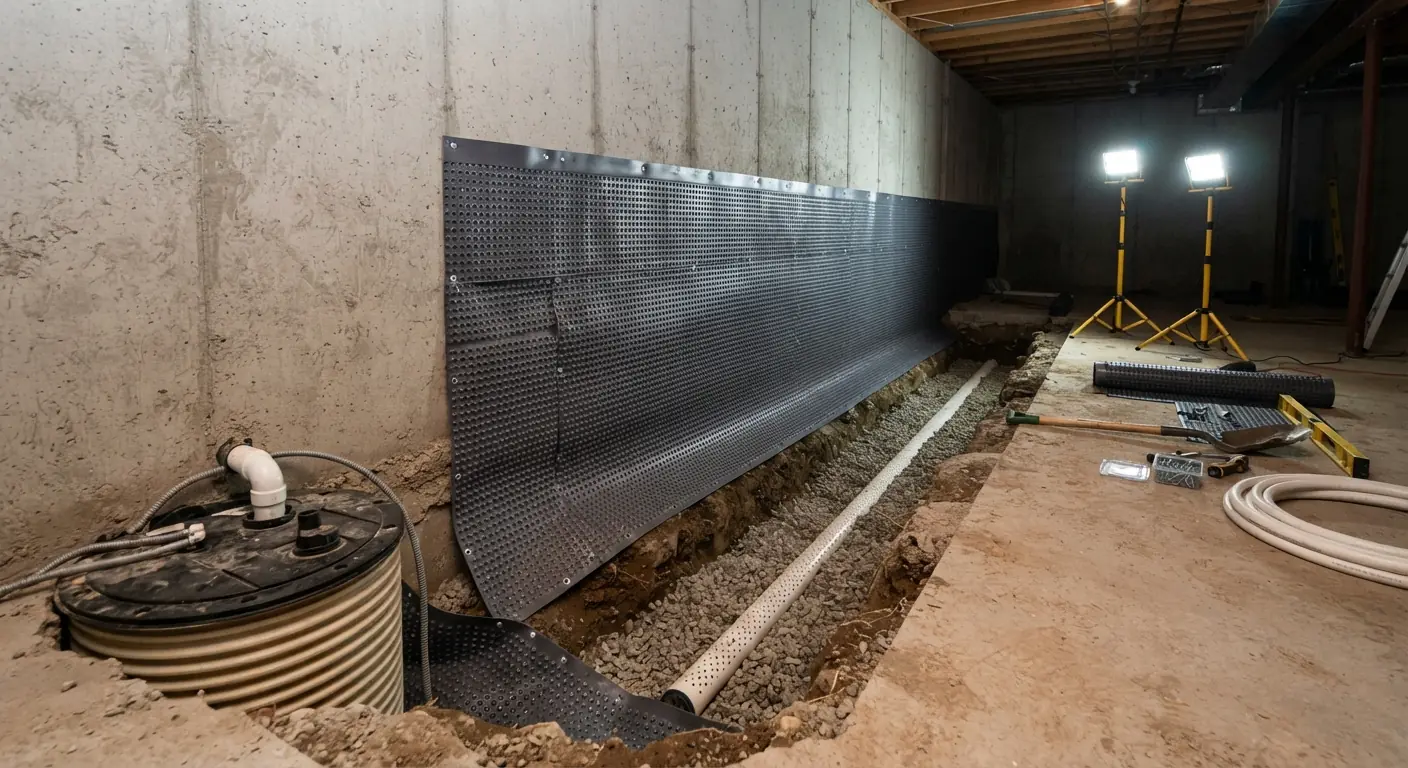
A basement under 2,000 square feet needs a dehumidifier rated 20 to 50 pints per day, depending on how damp it is.1 Above 2,000 square feet, start at 30 pints and plan on 50 or more for a wet space.1 Where a floor drain or sump sits lower than the unit, run a hose to it so nobody empties a bucket.1 If water seeps in, fix that first, because a dehumidifier can't stop water coming through the walls.2
TL;DR
- Size by floor area and dampness together. ENERGY STAR's chart runs from 20 to 30 pints for a slightly damp basement under 2,000 square feet up to 50 pints or more for a wet one over 2,000.1 Between two sizes, buy the bigger one.1
- A 2,000 square foot basement sits on the chart's dividing line. Budget from the large-room column: 30, 40 or 50 pints and up.1
- A gravity hose to a lower floor drain or sump is the simplest setup. Buy a built-in pump model when the only drain point sits higher. Whole-house units drain to a floor drain or condensate pump and go in with an HVAC pro.1
- Running cost comes down to how much water the unit pulls and its integrated energy factor. ENERGY STAR certified models remove the same moisture with 20% less energy.1
- Seepage or sweating walls mean a water problem. Stop the water, then size the dehumidifier for the moisture that's left.2
What size dehumidifier does a basement need?
Size a basement dehumidifier by two things: floor area and how damp the space is without one. ENERGY STAR's chart puts a basement under 2,000 square feet at 20 to 30 pints per day when slightly damp, 25 to 40 when very damp and 30 to 50 when wet.1
| Condition without a dehumidifier | What you notice and relative humidity (RH) | Under 2,000 sq ft | Over 2,000 sq ft |
|---|---|---|---|
| Slightly to moderately damp | Feels damp. Musty odor that may come and go. 50 to 75% RH | 20 to 30 pints | 30+ pints1 |
| Very damp | Always feels and smells damp. Damp spots on walls and floors. 75 to 90% RH | 25 to 40 pints | 40+ pints1 |
| Wet | Walls or floor sweat, or water seeps in. Laundry drying may add load. 90 to 100% RH | 30 to 50 pints | 50+ pints1 |
Source: ENERGY STAR dehumidifier buying guidance, checked September 2026.1
The rows describe the room before any dehumidifier runs.1 So take your reading with the old unit switched off, or before you buy. A hygrometer gives you the relative humidity. EPA says a basic humidity meter costs about $10 to $50 at many hardware stores.3
ENERGY STAR treats these ranges as minimum capacities, and it says it's better to oversize than undersize.1 ENERGY STAR lists laundry drying among the high-load conditions in its wet row.1 If you dry laundry in the basement, size toward that row even if the walls look dry.
Replacing an old unit? ENERGY STAR suggests judging by how much water you empty each day.1 The bucket shows your basement's real moisture load, whatever the old label said.
A worked example
Say your basement is 1,200 square feet. It smells musty after rain but not all the time, and the hygrometer reads 65%. That's the slightly to moderately damp row, so the chart says 20 to 30 pints.1 Add damp spots on the walls and you move to the very damp row at 25 to 40 pints. We'd buy near the top of whichever range fits, since ENERGY STAR's advice leans toward oversizing.1
How big of a dehumidifier do I need for a 2,000 square foot basement?
A 2,000 square foot basement sits right on the line in ENERGY STAR's chart, so budget from the large-room column. That means 30 pints or more if it's slightly damp, 40 or more if it's very damp and 50 or more if walls sweat or water seeps in.1
The small-room column stops at 2,000 square feet, so a basement that size has no headroom left in it.1 The large-room figures are open-ended. Treat each one as the least you should buy.
Some online sizing charts run much lower. We'd budget from ENERGY STAR's numbers. The program's current dehumidifier specification took effect October 1, 2025, and its chart puts a wet basement of this size at 50 pints or more.1 Sizing a seeping basement from a lower chart risks a unit that runs all day and never reaches your target.
If the basement is split into rooms with doors, size each closed-off space on its own. Portable units typically dry a single room or space. ENERGY STAR also advises keeping doors and windows to the space closed while the unit runs.1
What does the pint rating on a dehumidifier mean?
The pint rating is the unit's capacity: how many pints of water it removes in 24 hours. ENERGY STAR notes that capacity ratings have changed, so match a new unit against a current chart. Size a replacement by the water you actually empty each day.1
If you've shopped for a dehumidifier before, ENERGY STAR says, you may notice the capacity options have changed, and it says capacity ratings are changing.1 The number printed on an older machine, or on an older chart, may not line up with a new box. Your daily bucket volume sidesteps that problem because it measures your basement.
The second number worth reading is efficiency. ENERGY STAR measures it as the integrated energy factor, in liters of water removed per kilowatt-hour. A higher figure means a more efficient unit.1
Which type of dehumidifier suits a basement?
A portable compressor dehumidifier suits most basements. A whole-house unit suits homes in humid climates with central air, where humidity stays above 55% through the house.1 A basement that often falls below 65°F calls for a model rated for low temperatures.1 Thermoelectric units are too small for a full basement.
| Type | Best fit | Limits |
|---|---|---|
| Portable compressor unit | One basement or one room | Frost can form on the coils below 65°F unless the model is rated for low temperatures1 |
| Portable unit with built-in pump | Basements where the only drain point is higher than the unit | Needs a hose route to a sink, utility tub or window |
| Whole-house unit | Humid climates, central air and fairly well sealed homes with RH above 55% throughout1 | Higher upfront cost. Needs an HVAC contractor to size and install it |
| Desiccant unit | Cold, unheated basements | Often a smaller pint capacity than a compressor unit |
| Thermoelectric unit | Closets and very small enclosed spaces | Too weak for a full basement |
Source for the figures: ENERGY STAR.1
Portable units
A portable unit usually dries a single room or space and moves where you need it.1 HomeGuide puts a portable dehumidifier at $130 to $300.4 For most unfinished basements, this is where to start.
Whole-house units
A whole-house unit ties into your home's air ducts and is usually permanent.1 ENERGY STAR says these systems can be expensive. They pay off in fairly well sealed homes with central air where humidity reads above 55% throughout the house.1 HomeGuide puts one at $1,500 to $3,500 installed.4 If you have central air, ENERGY STAR also suggests an A/C vent in the humid space. That lets the A/C system do some of the drying.1
Cold basements
Frost can form on the coils when the air drops below 65°F. The compressor then cycles on and off without pulling out moisture.1 Look for a model rated for lower temperatures, or one with an anti-frost sensor.1 Desiccant units have no cold coils. They pull moisture into a drying material, so they keep working in cold air where a compressor unit's coils would frost.
How should a basement dehumidifier drain?
Drain by gravity when a floor drain or sump sits below the unit's hose outlet. Pick a model with a built-in pump when the only drain point is higher, such as a sink or utility tub.1 Keep the bucket for small, lightly damp spaces where emptying it is easy.
Gravity hose to a floor drain or sump
Many units have a fitting for a hose that runs to a floor drain or sump pump, so there's no bucket to empty.1 Water only runs downhill here. The hose outlet has to sit above the drain, with no uphill stretch along the way. Put the unit close to the drain so the hose stays short and nobody trips on it.1 Check the hose now and then for kinks or blockages.
Built-in pump
A built-in pump lifts the water through a hose to a higher drain point, such as a sink or utility tub. It suits a basement where the nearest drain sits above the unit, or where there's no floor drain close to where the unit has to go.
Bucket only
Most portable units collect water in a removable bucket. A warning light comes on when it's full, and the unit usually shuts off.1 Once it shuts off, the unit stops drying until someone empties it. That's fine in a small space you visit daily and a problem in a basement you rarely go into.
Whole-house drain line
Most whole-house units only have a drain. An HVAC professional should route it to a floor drain or condensate pump during installation.1
Power and water safety
Plug the unit into a properly grounded outlet. Keep drain hoses away from electrical cords and connections.1 If there's no grounded outlet near your drain, have a licensed electrician add one before you run an extension cord across a damp floor.
How much will a dehumidifier add to your electric bill?
The added cost depends on how much water the unit removes and how efficiently it does it. Efficiency is listed as the integrated energy factor in liters per kilowatt-hour. ENERGY STAR certified models remove the same moisture as conventional units with 20% less energy.1
You can work out your own figure from the unit's spec sheet and your power bill:
- Estimate the water removed per day from the bucket or the drain run, converted to liters.
- Divide the liters by the integrated energy factor. The result is kilowatt-hours per day.1
- Multiply by your electricity rate, then by the number of days the unit runs.
Several habits cut that number. Every ENERGY STAR model has a built-in humidistat. Once the room reaches your set humidity, it cycles on and off to hold that level.1 Close doors and windows to the space. Keep the unit away from dust, which can clog coils and grills.1 Clean the filter as often as the manual says, and more often when the unit runs hard.
Cutting moisture at the source cuts runtime too. ENERGY STAR lists extending downspouts, keeping gutters clear, venting the clothes dryer outdoors and fixing leaky outdoor faucets.1 A lower humidity setting means longer runs, so set the target to what the space needs and no lower.
What are the downsides of using a dehumidifier?
The main downsides are running cost, upkeep and a false sense of security. A dehumidifier uses power, warms the air around it, needs its filter and drain checked and struggles in cold rooms.1 It also can't stop water that comes through the walls.2
Heat and cold
As a dehumidifier removes moisture, it slightly warms the space around it.1 In a cool storage basement you won't mind. In a finished family room in August, you may notice it. In a basement that falls below 65°F, frost on the coils can stop it drying at all.1
Upkeep
Filters need cleaning, hoses need checking and dust can clog the coils.1 A clogged filter chokes the airflow, so the unit works harder for the same result.
It treats the air, and water still gets in
EPA is blunt about mold: clean it up and fix the water problem, or it will most likely come back.3 Building Science Corporation's basement guidance keeps liquid water out with drainage and uses dehumidification for the moisture that dries inward.2 A dehumidifier in a seeping basement fills up fast and hides the real fault.
The oversizing argument
Advice on oversizing splits. ENERGY STAR says it's better to oversize than undersize.1 The usual counterargument is that an oversized unit cycles on and off too often and wastes energy. We side with ENERGY STAR. A humidistat shuts the unit off at your setting, and an undersized unit never gets there.
What month should you run a dehumidifier in your basement?
Run it whenever the basement's relative humidity climbs above your target, whatever the month. For most basements that means the humid season, because summer air condensing on cold foundation walls is the main moisture problem below grade.2 A humidistat handles the timing for you.1
Set the target between 30% and 50%.1 ENERGY STAR calls that the optimum range and says anything above it may promote mold growth.1 EPA says to keep indoor humidity below 60% if possible, ideally between 30% and 50%.3
Summer is the peak because warm, moist air meets basement surfaces that sit below its dew point. Rim joists are a particular concern, and they stay cold in winter too.2 In colder climates during the heating season, ENERGY STAR suggests 30% to 40% to prevent window condensation.1
If your unit has no humidistat readout, hang a hygrometer near it and switch the unit on and off by the reading.1 In winter, watch the temperature as well. Below 65°F, a standard unit may frost up and stop working.1
Fix water entry before you size for it
If walls or floors sweat or water seeps in, ENERGY STAR's chart puts you in its wet row, and the better first spend is stopping the water.1 Building Science Corporation's guidance keeps liquid water out with drainage and uses dehumidification only for moisture that dries inward.2
That guidance starts outside. Gutters carry roof water away, the ground slopes away from the house and a perimeter drain collects what soaks in.2 EPA adds that wet materials dried within 24 to 48 hours usually won't grow mold.3 Interior drains, exterior membranes and grading each suit different problems, and basement waterproofing methods sets them side by side.
Budget for this separately from the dehumidifier. HomeGuide puts basement waterproofing at $6,000 to $18,000 on average, depending on the method and how bad the problem is.4 The basement waterproofing cost guide breaks that range down by method. A sump pump alone runs $600 to $2,500 installed.5 If seepage is your problem, get a written quote for waterproofing your basement before you spend on a bigger dehumidifier.
Mold changes the job too. EPA says a moldy patch under about 10 square feet is usually a job you can handle yourself.3 For anything bigger, or after heavy water damage, EPA points to its remediation guidance and a contractor with mold cleanup experience.3
If you plan to finish the space, settle moisture before framing starts. Building Science Corporation warns that framed walls covered with an interior plastic vapor barrier often lead to odor, mold, decay and corrosion problems.2 The basement insulation guide covers wall assemblies that let the foundation dry. Once the basement stays dry, basement finishing is the next step.
What to ask your contractor about basement dehumidification
Ask where the water comes from, where the dehumidifier will drain and what humidity the finished space should hold. A good plan names the moisture source, the drain point and the target range before any framing goes up.
- Is the dampness from seepage, summer condensation or both?
- Where will the dehumidifier sit, and is the drain point lower than its hose outlet?
- Is there a grounded outlet near the drain, clear of the hose?1
- Would a whole-house unit or an A/C supply vent suit this house better than a portable unit?1
- What relative humidity will the finished space hold, and how will I check it?1
- Which wall assembly lets the foundation keep drying inward?2
Basement Remodeling Co. matches you with one vetted, licensed basement contractor for your metro. The contractor books a free on-site estimate, checks moisture and gives you a written, itemized quote. Find a basement contractor by ZIP code, or start with basement finishing in Atlanta or basement finishing in Denver. Reworking a space that's already finished? See basement remodeling.