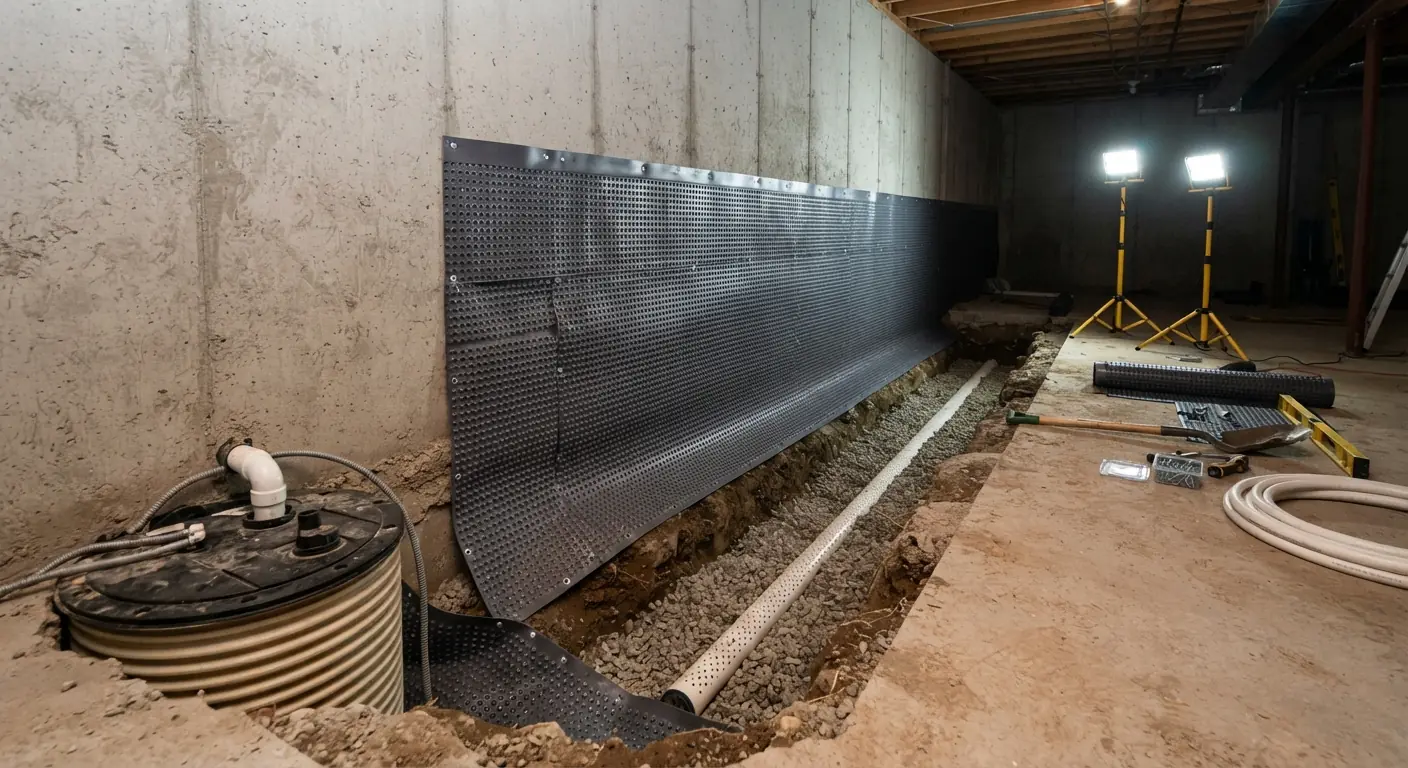
Many basement wall cracks are shrinkage or settling cracks you can seal from the inside once the wall has stopped moving. Hairline cracks, vertical cracks in poured walls and stair-step cracks in block walls usually need a patch or an injection. A horizontal crack, or a wall that bows, leans or keeps widening, points to soil pressure and needs a structural repair. If the crack leaks, deal with the water outside first.1
TL;DR
- Crack direction tells you the most. Hairline, vertical and stair-step cracks in a wall that hasn't moved are usually repairable. Horizontal cracks and bowing walls are structural.
- Match the material to the crack: epoxy for dry cracks in poured walls, polyurethane for leaking ones, hydraulic cement or mortar for block joints, and reinforcement or rebuilding for walls that have moved.
- A leaking crack is also a drainage problem. Patching only the inside can push the water to a new spot on the wall.1
- Budget $250 to $800+ per crack for professional epoxy injection.2 Foundation leak repairs run $250 to $5,000+ for minor work.2 Structural work is priced at your estimate.
- Settle every crack and leak before you frame and insulate. Most interior insulation systems can't handle even a small leak.3
What do the four types of basement wall cracks mean?
The direction of a basement wall crack tells you most of what it means. Hairline cracks, vertical cracks in poured concrete and stair-step cracks along block mortar joints are usually repairable if the wall hasn't moved. A horizontal crack, or any crack in a wall that bows or leans, is a warning sign of soil pressure.
Crack direction and wall type point to a likely cause and the repair that usually fits. Your contractor or a structural engineer confirms it on site.
| Crack type | What it looks like | Poured concrete wall | Concrete block wall | Usual repair | Get a pro now if |
|---|---|---|---|---|---|
| Hairline | A thin line with both sides flush | Can be normal shrinkage of new concrete | Fine lines in mortar joints | Watch it. Seal with flexible sealant or inject if it seeps | It grows, widens or leaks after rain |
| Vertical | Runs straight up and down | Usually repairable if the wall hasn't moved | Can run through blocks or joints | Epoxy injection if dry, polyurethane injection if it leaks | One side sits out of line with the other, or it keeps opening |
| Stair-step | Zigzags along mortar joints | Doesn't occur (no joints) | Usually repairable if the wall hasn't moved | Repoint with mortar or patch with hydraulic cement | Mortar has broken apart or blocks have shifted |
| Horizontal | Runs sideways along the wall | Soil pressing on the wall | Soil pressing on the wall, often with bowing | Structural: carbon fiber strips if the wall hasn't moved, rebuild if it has | Always. Have it checked before any other work |
A crack in a wall that still stands straight and level is a repair job. A crack in a wall that has moved is a structural job.
Hairline cracks
New concrete shrinks as it dries, and some small cracks come from that shrinkage and may never grow. Freshly poured concrete holds several thousand pounds of water that has to dry out over time.3 If a hairline crack stays dry, you can simply watch it. If it seeps, seal it, because even a thin leak brings moisture into the basement.
Vertical cracks
Vertical cracks in poured walls can look alarming but are usually safe to repair without rebuilding. The right repair depends on whether water comes through. A dry crack takes an epoxy injection that bonds the two sides. A wet crack takes a polyurethane injection that foams, fills the gap and stays flexible.
Stair-step cracks
Stair-step cracks follow the mortar joints of a block wall. They are also usually repairable when the wall hasn't shifted. The usual fix is to grind out the cracked mortar, then fill the joint with fresh mortar or a hydraulic water block that expands as it dries.1 If the mortar has broken apart deep into the wall, treat it like a horizontal crack.
Horizontal cracks
A horizontal crack is the one to take seriously, especially a wide one that keeps getting worse. It usually means soil is pressing on the wall.
How do you tell if a foundation crack is structural?
A foundation crack is structural when the wall itself has moved. Look for a horizontal crack, a wall that leans, bulges or bows, a crack that keeps getting wider, or nearby doors and windows that start sticking. A thin crack in a wall that still sits straight and level is usually repairable.
You can do the first check yourself with a level, a pencil and a phone camera.
Look at the wall, then along it
Stand at one end of the wall and sight along its face. A wall that curves in toward the room is bowing. Hold a long level against the wall at the crack. A wall that tilts or bulges from the floor up has moved.
Check the top and bottom of the wall too. A gap at the top or bottom of the wall that changes shape over time is another sign of movement.
Mark the crack and date it
Draw a short pencil line across each end of the crack and write the date beside it. Take a photo. Check again after heavy rain and again next season. A crack that runs past your mark or opens wider is still moving. A dated record of when and where new cracks appear gives your contractor or engineer something to work from.
Look upstairs and outside
Windows or doors near the wall that start sticking or won't close right can point to wider shifting in the foundation. Outside, check that the ground slopes away from the house and that gutters and downspouts carry water away.4
When to bring in a structural engineer
Any horizontal crack, any bowing or leaning wall, and any crack that keeps coming back after repair need a licensed professional to assess them. A crack that returns after each repair is a sign the wall is still moving. A structural engineer or an experienced foundation contractor can tell you what the wall needs before anyone quotes a fix.
What is the most serious crack in a basement wall?
A horizontal crack is the most serious crack in a basement wall, especially one that is wide, growing or paired with a bowing wall. It usually means wet soil outside is pushing harder than the wall can handle. A wall that bows under that pressure may no longer carry the floor above it safely.
Heavy rain, freeze and thaw cycles and poor drainage all add to that pressure. A horizontal crack puts every other basement job on hold until someone qualified has assessed it.
How horizontal cracks get fixed
The repair depends on how far the wall has moved.
- Wall cracked but not shifted. Carbon fiber strips can reinforce a cracked wall that hasn't moved.
- Wall has moved or lost its structure. Replacing the wall section is often the safer route. The work usually includes temporary support for the house, removal of the old wall sections, new footings and drainage lines, and new poured or built walls. The ground is usually regraded afterward so water flows away from the house.
Structural work like this is priced at your estimate. The cost depends on the wall's length, how far it has moved and what the engineer specifies.
Deep stair-step cracks in block walls
Block walls can fail along the mortar too. Deep horizontal cracks or joints where the mortar has broken apart can mean the wall needs more than a repair. Treat them with the same care as a horizontal crack.
Why do basement walls crack and leak?
Basement walls crack because the soil around them moves and the concrete itself shrinks. Soil shrinks as it dries and swells when it gets wet again, and that cycle stresses the wall. Walls leak when water collects against the foundation and finds a crack, because concrete and block are both porous.1
What moves the wall
Soil movement is the main driver. Tree roots close to the house, loose fill from past construction and poor drainage all add pressure. Nearby construction or excavation can also disturb settled soil and start new cracks.
Where the water comes from
Rain and roof water are usually the source. Building Science Corporation puts it simply: drain the site and drain the ground. Gutters should collect roof water and carry it away, and the ground should slope away from the walls.3 The outside of a basement wall should also be damp-proofed.3 Concrete and block aren't meant to hold out water on their own. A liquid membrane on the exterior and proper grading keep it out, and a crack breaches that membrane.1
Block walls are harder to waterproof than poured walls. They have more seams and joints where water can enter.2
Is it a leak or condensation?
A damp wall is not always a crack leak. Basement walls are cold because they sit against the ground. In summer, warm moist air that touches a cold wall can condense on it.3 A quick home test helps. Tape a square of plastic sheet tightly to the damp spot and check it later. Water under the plastic points to moisture coming through the wall. Water on top points to condensation from the room air.
Should I seal cracks in basement walls?
Yes, seal a basement wall crack once you know the wall is stable and you've dealt with the water outside. Even a thin crack that seeps is worth repairing, because it lets moisture into the basement. Sealing only the inside of a leaking crack can push the water to a new spot higher on the wall.1
Sealing matters most before you finish the space. Most interior insulation systems use moisture-sensitive materials such as fiberglass batts. They can't tolerate even minor groundwater leakage.3 A crack that weeps once a year behind new drywall can do real damage before anyone sees it.
Seal it in this order
- Rule out movement. Check for bowing, leaning and widening. Structural cracks go to a professional first.
- Fix the outside water. Clean the gutters, extend the downspouts and make sure the soil slopes away from the foundation.5
- Clean up any mold and dry the wall. Clean the mold and dry the surface before you paint or caulk.4
- Pick the right material for the crack and the wall type.
- Watch the repair through at least one wet season before you frame over it.
If water has already soaked into boxes, carpet or drywall, dry it within 24 to 48 hours. In most cases mold won't grow if wet materials dry out in that window.4
If you're planning to finish the space, the guide to basement waterproofing methods covers drains, sump pumps and membranes that deal with water across the whole wall.
Can I fix basement wall cracks from the inside?
Yes. Most non-structural cracks can be repaired from inside the basement without digging. Poured concrete walls usually take an epoxy or polyurethane injection. Block walls are usually patched along the mortar joint. An inside repair doesn't restore the waterproofing on the outside of the wall, so pair it with drainage fixes.1
Poured concrete walls: injection
Injection kits for homeowners follow the same basic steps a pro uses.
- Clean loose dust and debris out of the crack with a wire brush or vacuum.
- Glue small plastic injection ports along the crack.
- Seal the face of the crack with a surface paste, leaving the ports open.
- Let the paste cure, then inject resin into the lowest port until it shows at the next port up. Cap that port and move up the crack.
- Let the resin cure, then knock off the ports.
Use epoxy on a dry crack you want to bond. Use polyurethane on a crack that leaks or might still move a little.
Block walls: patch the joint
Block walls have hollow cores, and injected resin can run into them instead of filling the crack. Block cracks are usually patched along the joint. For a crack in a concrete basement wall, one forum commenter who worked for an architect on masonry restoration suggests opening the crack with an angle grinder, about 1/8 inch wide, then tuckpointing mortar into it or using hydraulic water block from a home center, which expands as it dries.1 The same open-and-fill method suits a cracked mortar joint in a block wall.
When the inside repair won't hold
An inside patch doesn't fix a breached exterior membrane. If the soil outside stays wet, water can soak into the wall and come through over a larger area.1 Leave horizontal cracks, bowing walls and cracks with one side offset to a professional.
What is the best sealant for basement wall cracks?
The best sealant depends on the crack. Epoxy injection suits minor cracks that don't threaten the structure.2 It works best on dry cracks in poured concrete. Polyurethane injection suits leaking cracks because it foams and stays flexible. Hydraulic cement suits block joints and active drips because it expands as it dries.1 Flexible crack sealant suits small cracks that still move slightly.6 None of them fix a wall that has shifted.
| Material | Best for | Wall type | Flexes with movement | Stops an active leak | Watch out for |
|---|---|---|---|---|---|
| Epoxy injection | Dry, stable cracks you want bonded | Poured concrete | No, it cures rigid | Best on a dry crack | Won't fix a wall that has moved |
| Polyurethane injection | Cracks that leak | Poured concrete | Yes | Yes | Seals water but adds no strength |
| Hydraulic cement or water block | Block joints, holes and active drips | Block, or patches on poured walls | No | Yes, it sets fast and expands | Can crack again if the wall keeps moving |
| Flexible crack sealant | Small cracks that still move a little | Both | Yes | Minor seepage only | Surface repair only |
| Waterproof paint or sealer | General dampness on the wall face | Both | No | No | Won't stop water under pressure |
| Carbon fiber strips | Reinforcing a cracked wall | Both | Not a sealant | No | Only for walls that haven't moved |
How each material performs
- Epoxy injection fills and seals minor cracks that don't threaten the home's structure. A pro charges $250 to $800+ per crack.2
- Hydraulic water block expands when it dries and is sold at home centers.1
- Flexible crack sealant goes on like caulk and dries rubbery, so it moves with small stress cracks. One product in a homeowner demo is rated for cracks up to one inch wide.6 The same demo notes a mortar patch would likely crack again.6
- Waterproof paint and sealers cost $2 to $10 per square foot and won't stop water under pressure.2 They suit minor dampness.2
- Carbon fiber strips reinforce cracked walls that haven't shifted.
One warning for finished basements. Impermeable wall coatings such as oil, alkyd or epoxy paints stop a basement wall from drying inward. Building Science Corporation advises against them on walls designed to dry to the inside.3 Seal the crack itself, then leave the rest of the wall able to breathe.
How much does it cost to repair a crack in a basement wall?
Professional epoxy injection costs $250 to $800+ per crack.2 Foundation leak repair costs $250 to $5,000+ for minor repairs and $4,500 to $15,000+ for major ones.2 The price moves with the cause of the crack, the wall type, the number of cracks and whether the outside needs drainage work.
These national ranges come from one independent cost guide, HomeGuide, dated January 23, 2026.2
| Job | Typical cost | What it covers |
|---|---|---|
| Epoxy crack injection | $250 to $800+ per crack2 | Sealing a minor, non-structural crack |
| Foundation leak repair, minor | $250 to $5,000+2 | Cracks, gaps around pipes, worn mortar joints |
| Foundation leak repair, major | $4,500 to $15,000+2 | Larger leak repairs |
| Replacing downspouts | $220 to $625 total2 | Moving roof water away from the wall |
| Regrading around the house | $1,000 to $5,0002 | Sloping soil away from the foundation |
| Interior waterproofing | $6,000 to $12,0002 | Pumps, drains, sealers and crack filling |
| Exterior waterproofing | $10,000 to $18,0002 | Grading, drains and membranes |
| Structural reinforcement or wall rebuild | Priced at your estimate | Depends on the engineer's design |
Priced rows: HomeGuide national ranges.2
What moves the price
- Wall type. Poured concrete is generally easier and cheaper to waterproof than block, which has more seams and joints.2
- Severity. Minor dampness costs less to fix than flooding or structural damage.2
- Location. Labor and material costs vary a lot by region.2
- What comes with it. Mold remediation costs $1,500 to $15,000, depending on severity and basement size.2
If you're only budgeting for one crack, use the per-crack injection range. If the wall leaks in several places or the yard drains toward the house, budget from the foundation leak repair range instead.
What mistakes should you avoid when repairing concrete cracks?
The biggest mistake is patching the inside while the water problem outside stays in place. Others include putting a rigid patch on a crack that still moves, sealing over mold or damp concrete, injecting a wall that has shifted, and hiding an unproven repair behind new drywall.
Patching the inside and ignoring the outside
A patch on the inside of a leaking crack works like a dam. When the water rises high enough, it comes through the wall at a higher spot.1 You may then see white mineral deposits spread across a larger area of the wall.1 Fix the gutters, downspouts and grading first.
Using a rigid patch on a moving crack
Mortar and hydraulic cement cure hard. If the crack still opens and closes with the seasons, a rigid patch can crack again beside it. A flexible sealant moves with small stress cracks instead.6
Sealing over mold or damp concrete
Paint or caulk applied over moldy surfaces is likely to peel. Clean up the mold and dry the surface before you seal.4 If mold covers more than about 10 square feet, EPA points you to its remediation guidance for larger jobs.4
Treating a structural crack like a cosmetic one
Injection seals a crack. It doesn't straighten a bowing wall. Once a wall has moved or lost its structure, crack repair isn't enough and replacing the wall section may be the safer route.
Relying on waterproof paint
Sealer paints won't stop water under pressure.2 Impermeable coatings can also trap moisture in walls that need to dry inward.3
Framing over a crack too soon
Moisture-sensitive insulation behind a finished wall can't tolerate even minor leaks.3 Watch the repair through a wet season before you frame. Water control comes before framing in the basement finishing steps for the same reason.
What should a good crack repair quote show?
Basement Remodeling Co. treats cracks and moisture as the first step of any basement project, settled before framing starts. A good crack repair quote names the cause of each crack, the repair method and why it was chosen, and whether the outside drainage needs work. It lists materials, labor and cleanup in writing.
Ask these questions before you sign.2
- How is water getting into my basement?
- Which repair methods do you recommend for each crack, and why?
- Are there structural problems that could cause the walls to fail?
- Does the estimate cover materials, labor, delivery fees and cleanup?
- Do you offer a written warranty on the work?
Get the estimate, contract and any warranty in writing before work begins.2 If a contractor quotes an injection on a horizontal crack without mentioning the wall's movement, get a structural opinion before you agree. The same checks help when you choose a basement contractor for the finish itself.
When you're ready, you can get a written quote for fixing basement leaks and cracks before you finish the space. Basement Remodeling Co. sends your request to one vetted, licensed basement contractor for your metro. That contractor contacts you, books a free on-site estimate, checks moisture and gives you a written, itemized quote. Nothing starts until you sign.
Once the walls are dry and sound, the next step is the build itself. See how basement finishing works from bare walls, or how basement remodeling reworks a space that is already finished. You can also find a basement contractor by ZIP code, or see what matched contractors cover for basement finishing in Denver and basement finishing in Atlanta.