White fluff on bare basement concrete is often efflorescence: mineral salt left behind when water moves up through the slab and evaporates.1 Mold looks similar but needs moisture and something organic to feed on, like dust, cardboard or wood.2 Spray a patch with water. Salt dissolves into the concrete and mold stays put.1 Either way, your basement is too wet to finish until the moisture is fixed.
TL;DR
- A water test settles most cases. Efflorescence dissolves and soaks in, while mold holds its shape. A pinch test and a sniff back it up.
- Efflorescence is salt, so it doesn't grow or spread. It does prove that water is moving through your slab.1
- Brushing it off is cosmetic. It keeps coming back while water keeps moving through the concrete.
- Hold paint, sealers, vinyl and carpet until the water source is fixed and the slab stays clean through a wet season. Tight finishes like vinyl stop the slab drying into the room.3
- Mold gets different handling. EPA says a patch under about 10 square feet is usually a DIY job.2 Bigger growth calls for EPA's fuller remediation guidance or a contractor with mold experience.2
What is the white fluffy stuff on a basement floor?
Efflorescence is a white crust of mineral salts on concrete or masonry. Water inside or under the slab dissolves salts, carries them to the surface and evaporates there. The salts stay behind as powder or fluff.1 It needs moving moisture to form, so it's a moisture symptom first and a cleaning job second.1
It comes in two kinds. Primary efflorescence comes from the water already in the concrete as the slab dries. Secondary efflorescence comes from new water, either rising from underneath or coming in from the surface. A saturated base under the slab or a poorly drained site are the likely sources.1
Where the salt shows up tells you a lot. In one case posted on Quora, a homeowner found efflorescence only around the edge of a foam-tile pad taped to a concrete basement floor. No stain showed under the pad. The explanation: moisture rising through the concrete couldn't pass through the foam, so it moved to the edge and evaporated there.1 Anything that covers your slab moves the exit point. Keep that in mind when you choose flooring.
White mold is a living fungus. Molds come in many colors, white included.2 They break down organic matter, and none of them grow without water or moisture.2 Bare concrete gives mold little to eat. In a basement, white mold tends to show up on what sits on the floor: cardboard boxes, carpet, wood and stored bags. EPA's own mold guide shows mold growing on a suitcase stored in a humid basement.2
How can you tell efflorescence from mold?
Test a small patch with gloves on.2 Mist it with water: efflorescence dissolves and soaks in, while mold stays put or mats down.1 Pinch it: salt crunches into chalky powder, while mold feels soft and smears. A drop of white vinegar can break a tie. Where it grows and how it smells confirm the call.
The water test
Fill a spray bottle with plain water. Mist a patch about the size of a coin and wait a minute. Efflorescence is made of soluble salts, so it dissolves and disappears into the damp concrete.1 When the spot dries, a faint white ring may come back, because the water leaves the dissolved salt behind again. Mold holds together. It may flatten or clump, but the fuzz is still visible.
The pinch or crumble test
Rub a little between gloved finger and thumb, or scrape it with a putty knife. Efflorescence feels gritty or crunchy and breaks down to a chalky powder. HomeGuide's list of waterproofing warning signs describes it plainly as white or gray chalky residue on walls or floors.4 Mold feels soft and cottony. It smears or lifts off as a thin mat. Keep your hands covered for this one, since EPA advises against touching mold with bare hands.2
The vinegar test
White vinegar is a mild acid. Put a few drops on the crust and watch. Many concrete salts fizz or soften under acid, and mold has nothing in it to fizz. A crust that fizzes is mineral. A crust that sits still could be either, because some salts don't react to vinegar. Use this test after the water test, and rinse the spot with clean water when you're done.
Where it grows and how it smells
Salt forms where water leaves the concrete. Look at the edges of mats, boxes or rugs that sit on the slab.1 Check along cracks and near the base of the walls too. Mold grows on its food. Check the bottoms of cardboard boxes, carpet backing, wood and the undersides of carpet pads. EPA lists the underside of carpets and pads among the places mold hides, and a moldy smell with no visible source is a reason to suspect it.2 Efflorescence has no smell of its own, though a damp basement often does.
| Clue | Efflorescence | White mold |
|---|---|---|
| What it is | Mineral salt left when water evaporates from concrete | A living fungus |
| Water test | Dissolves and soaks in | Stays put or mats down |
| Pinch test | Gritty, crunchy, chalky powder | Soft, cottony, smears |
| Vinegar | Often fizzes or softens | No fizz |
| Where it shows up | Bare concrete, cracks, edges of anything covering the slab | Cardboard, wood, carpet, dust, stored items |
| Smell | None of its own | Musty or moldy |
| Damage | Marks the surface | Gradually destroys what it grows on |
| First fix | Stop the water | Clean it up and stop the water |
What does efflorescence say about moisture in your slab?
Efflorescence means water is moving through your concrete and drying at the surface.1 That water can come from rain soaking the soil beside the house, from wet ground under the slab or from water in new concrete drying out. Wet soil also wicks water up into concrete, the way a paper towel pulls up a spill.3
The pattern gives your contractor a lead on the source. Treat these as starting points to confirm on site.
- Salt along one wall that gets worse after heavy rain usually points to surface water. Check that gutters are clean, downspouts discharge away from the house and the ground slopes away from the foundation.25
- Salt spread across the middle of the floor for most of the year points to moisture rising from below. A saturated base under the slab or a poorly drained site are the likely causes.1
- Salt in a newer house may partly come from construction water. Building Science Corporation's basement digest, BSD-103 by Joseph Lstiburek, notes that freshly placed concrete holds several thousand pounds of water that tries to dry inward.3
The same digest says a capillary break and a vapor barrier belong under a basement floor slab.3 You can't see whether yours has them. Salt across the open floor tells you water gets through anyway.
The air matters too. EPA recommends keeping indoor humidity below 60 percent, ideally 30 to 50 percent, and a basic humidity meter costs about $10 to $50.2 ENERGY STAR describes a "very damp" space, where damp spots appear on walls and floors, as 75 to 90 percent relative humidity.5 For a space under 2,000 square feet in that condition, it recommends a dehumidifier rated at 25 to 40 pints per day.5
A dehumidifier helps the slab dry into the room, which is how Building Science Corporation expects a basement to shed moisture.3 It can't stop water coming in from outside. See what a dehumidifier can fix in a damp basement. One homeowner on the DoItYourself forums in November 2012 ran a dehumidifier around the clock and emptied a two-gallon reservoir every day in summer. The white growth on the floor still kept coming back.6
Should you be worried about efflorescence?
Yes, if it keeps coming back, because returning salt means water keeps moving through your slab.1 The salt itself is mineral, so it doesn't grow or spread. A light dusting that never returns after one brushing is minor. HomeGuide lists white or gray chalky residue on walls or floors among the signs a basement needs waterproofing.4
Raise your level of concern when the salt arrives with other signs from the same HomeGuide list: standing water or leaks, water stains, damp walls, musty odors, mold, cracks in walls or floors, and bowed walls or warped doors.4 Bowed walls and warped doors raise a structural question. Have a structural engineer or a licensed foundation contractor look before any finishing plan goes further.
For a finishing plan, the stakes are practical. Water ruins finished basements. Wet drywall, carpet and insulation can grow mold and need to come out, and EPA notes that moldy porous materials like carpet may have to be thrown away.2 The slab that grows salt today is the slab your new floor will sit on.
When does efflorescence block flooring or paint?
Basement Remodeling Co.'s planning rule: if the slab still grows fresh salt, fix the water before anything covers it. Tight finishes like vinyl and oil-based paint stop concrete drying into the room, so moisture collects under them or moves to their edges.31 Building Science Corporation says such impermeable finishes typically lead to mold growth and other moisture problems.3
"Fresh salt" means new crust that forms after you've brushed the slab clean. If it's back after the next heavy rain, the slab isn't ready.
Paint and waterproof coatings
Painting over efflorescence puts the coating on loose salt, and the water keeps pushing more salt up behind it. HomeGuide prices waterproof paint or concrete sealing at $2 to $10 per square foot, including labor and materials.4 It adds that sealers won't stop water under pressure, though they work well for minor dampness and as an extra layer of protection.4 A moderator on the DoItYourself forums put the limit this way: products like Drylock are "attempting to stop water infiltration when it's 90% of the way through already."6
Building Science Corporation also advises against oil, alkyd and epoxy paint systems on basement walls that are meant to dry inward.3 If mold is present, EPA says to clean and dry the surface before painting, because paint applied over mold is likely to peel.2
Vinyl and other tight floor finishes
Building Science Corporation names vinyl floor coverings as an impermeable finish to avoid in basements. It says such layers inhibit inward drying and typically lead to mold.3 The foam-tile pad on Quora shows the other outcome: the moisture moves to the edges and leaves salt there.1 Hold tight floor finishes until the water source is fixed and the slab stays clean. The same digest says basement floor finishes should be chosen with flooding in mind, from leaky appliances to failed plumbing.3
Carpet and pad
Carpet hides the evidence. EPA names the underside of carpets and pads as a place mold hides, and moldy carpet may have to be thrown away.2 Over a slab that still grows salt, carpet is a poor bet.
What to settle before you pick a floor
Your contractor checks moisture during the free on-site estimate. Ask what they tested, what they found and which floor system suits your slab. If the salt comes back after brushing, ask what fixes the water first and when the slab will be ready. You can read how basement finishing is planned and quoted before that visit. If the basement is already finished and salt is showing at the edges of the flooring or baseboards, remodeling an existing basement can mean pulling some finishes to reach the water.
How do you get rid of efflorescence in a basement?
Get rid of efflorescence in three steps. Brush and vacuum it dry, rinse any stubborn crust with a little water and dry the slab fast, then find and stop the water feeding it. The first two steps are cosmetic. Only the third keeps it gone, because efflorescence needs moving moisture to form.1
Step 1: Brush and vacuum it dry
Use a stiff nylon brush on dry concrete. Wetting the crust first dissolves the salt, and it can dry right back onto the surface.1 Vacuum the powder with a shop vacuum. Until you're sure it isn't mold, wear gloves, goggles and an N-95 respirator.2
Step 2: Rinse stubborn crust and dry it fast
A damp scrub brush or a light rinse removes what the dry brush leaves. Use as little water as the job needs, then run a fan or dehumidifier. EPA's rule for wet areas is to dry them within 24 to 48 hours to prevent mold growth.2
Step 3: Stop the water
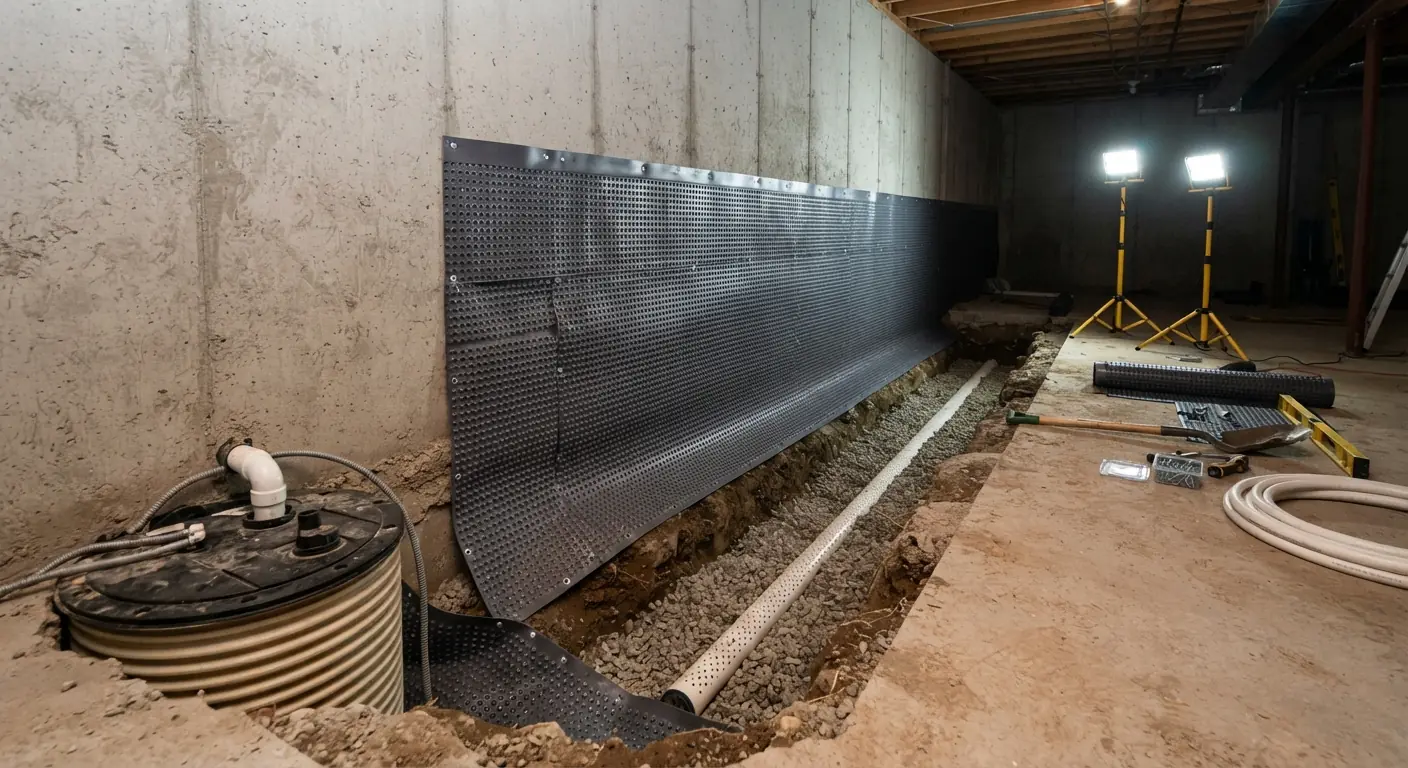
Start outside, where the fixes cost least. Keep gutters clear, extend downspouts away from the foundation, make sure the soil slopes away from the house and go easy on watering foundation plantings.52 If the salt still returns, the fix moves to drainage and the foundation itself. HomeGuide lists sump pumps, interior French drains, crack injection, exterior drains and waterproof membranes as the common methods.4 You can compare the main basement waterproofing methods before you talk to a contractor.
Why bleach won't help
Bleach does nothing to salt or to the water behind it. One homeowner on the DoItYourself forums treated a white, fluffy growth on the floor with a bleach and water solution several times, and it kept showing back up.6 EPA doesn't recommend bleach as a routine step even for mold cleanup, and it warns never to mix bleach with cleaners that contain ammonia.2
How to know it's fixed
Brush the slab clean and write down the date. Check it again after heavy rain and across a full season. New salt means water is still moving. A slab that stays clean through a wet season is ready for the next step in your finishing plan.
What if the white fluff turns out to be mold?
If it's mold, clean it up and fix the moisture. EPA says you can usually handle a patch under about 10 square feet yourself: scrub hard surfaces with detergent and water, dry them completely and throw out moldy porous items like carpet if needed.2 For bigger growth, EPA points to its fuller remediation guidance and to contractors with mold experience. Water from sewage calls for a professional, and health concerns call for a talk with a health professional before cleanup.2
Wear gloves, goggles and an N-95 respirator while you work.2 Scrub the growth off after any spray, because EPA says dead mold may still cause allergic reactions.2 Vinegar sprays fall under the same rule. Modern Maids, a cleaning company, tells readers to spray undiluted white vinegar on white mold and leave it at least an hour.7 You still have to scrub off what's left and dry the area.
Look past the visible patch. EPA lists the back of paneling and drywall and the underside of carpet pads as places mold hides. Opening those up can release spores, so EPA suggests an experienced professional when you suspect hidden mold.2 Testing is rarely needed first. EPA says sampling is usually unnecessary when you can see the growth.2
Mold on boxes over a slab that also grows salt likely shares one moisture source with it. Fix that source, and both problems have less to work with.
What does fixing the moisture cost?
Fixing the water behind efflorescence runs from a few hundred dollars to five figures. HomeGuide's national cost guide, dated January 23, 2026, puts interior waterproofing at $6,000 to $12,000 and exterior waterproofing at $10,000 to $18,000 on average.4 Downspout and grading fixes sit at the low end.
| Fix | HomeGuide national average | What it addresses |
|---|---|---|
| Replace downspouts | $220 to $625 total4 | Roof water landing at the foundation |
| Regrade around the house | $1,000 to $5,0004 | Surface water flowing toward the walls |
| Waterproof paint or concrete sealer | $2 to $10 per sq ft4 | Minor dampness; won't stop water under pressure |
| Sump pump installation | $600 to $2,500+4 | Pumping collected water away from the house |
| Interior French drain | $4,000 to $17,0004 | Water at the floor edge, piped to a sump |
| Exterior waterproofing membrane | $4 to $7 per sq ft installed4 | Water at the outside of the foundation walls |
| Dehumidifier | $130 to $300 portable; $1,500 to $3,500 installed whole-house4 | Damp air |
| Mold remediation | $1,500 to $15,0004 | Mold growth |
All figures are HomeGuide national averages from the same January 2026 guide. HomeGuide notes that labor and material costs vary by region, and homes with high water tables or heavy rainfall may need more extensive systems.4 Your own job is priced at your estimate.
What should a waterproofing quote show before you finish?
A good quote names where the water comes in, the fix for that source and how you'll know the slab is dry enough to finish. HomeGuide suggests asking how water is getting in, which methods the contractor recommends and why, and whether the estimate covers materials, labor and cleanup.4
Before you sign, check that the quote covers each of these:
- The contractor's written answer to "How is water getting into my basement?"4
- The method, with the reason it suits that source.4
- Any structural concern, such as walls that could fail, and the next step for it.4
- What's included: materials, labor, delivery fees and cleanup.4
- An itemized estimate, contract and warranty in writing before work begins.4
- When the slab should be ready to finish, and which flooring suits it once it's dry.
When the tests point to water, start with basement waterproofing before you finish. Basement Remodeling Co. sends your request to one vetted, licensed basement contractor for your metro. You get a free on-site estimate and a written, itemized quote, and nothing starts until you sign. You can find the contractor who covers your ZIP code, or go straight to basement finishing in Atlanta, basement finishing in Denver, basement finishing in Colorado Springs or basement finishing in Fort Collins.