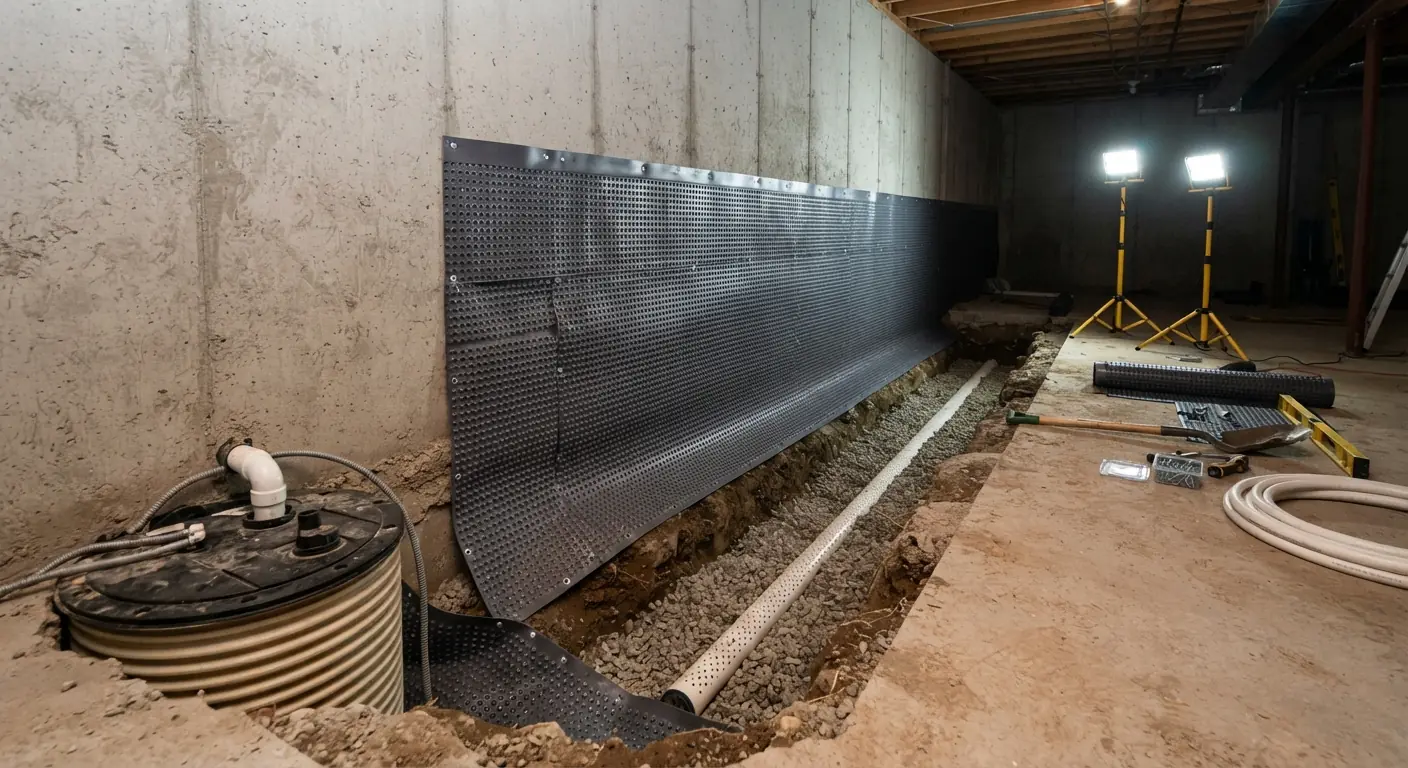
A dehumidifier fixes damp air. Mold spores struggle to grow when basement humidity stays below 60 percent (ideally 30 to 50 percent).1 A dehumidifier can't keep up with liquid water, though. Seepage through walls, puddles after storms and water rising through the slab need a drainage or waterproofing fix first. It also leaves existing mold in place, so moldy surfaces still need cleaning or removal.
TL;DR
- Use a dehumidifier when the air is the problem: a musty smell, a damp feel, sweating pipes or humidity readings above 60 percent.1
- Fix liquid water at the source with gutters, grading, drains or waterproofing. The dehumidifier then removes the moisture that dries into the room.2
- Clean existing mold off hard surfaces. Porous materials such as carpet and ceiling tiles may have to go, and dead mold can still cause allergic reactions.1
- Dry wet materials within 24 to 48 hours of a leak.1 A musty smell that lasts through a week of dehumidifying points to established mold.3
- Settle moisture before you finish the space. Interior plastic vapor barriers on basement frame walls often lead to odor and mold problems.2
Will a dehumidifier help a moldy basement?
Yes, if damp air is feeding the mold. A dehumidifier pulls relative humidity down to the range where mold struggles, and that helps prevent new growth on walls, stored boxes and framing. It helps far less when liquid water is getting in. It does nothing to mold already on a surface, so treat it as prevention.1
Mold needs moisture. Spores float through indoor and outdoor air all the time, and none of the many types of mold will grow without water or moisture.1 EPA sums up its advice in one line: the key to mold control is moisture control.1
EPA advises keeping indoor humidity below 60 percent, ideally between 30 and 50 percent relative humidity.1 ENERGY STAR calls 30% to 50% the optimum range for a building and says anything above it may promote mold growth.4 In colder climates during the heating season, ENERGY STAR suggests 30% to 40% to prevent window condensation.4
Basements are hard to hold in that range. The walls sit against the ground and stay cold. In summer, warm moist air meets basement surfaces below its dewpoint and condenses on them.2 Rim joists are a common trouble spot because they stay cold in both summer and winter.2
Buy a humidity meter before you buy anything else. EPA says a moisture or humidity meter costs $10 to $50 at many hardware stores.1 Check it on dry days and again after heavy rain. A reading that jumps after storms is your first clue that water is coming through the foundation.
Is it a humidity problem or a water problem?
Look at where the wet shows up. Damp air, a musty smell and beads of water on cold pipes point to humidity, which a dehumidifier handles. Puddles, water stains, white chalky residue on walls or floors and wet spots after storms point to liquid water coming through the foundation. Liquid water needs a drainage or waterproofing fix.
EPA treats condensation on windows, walls or pipes as a sign of high humidity.1 HomeGuide lists standing water, water stains, white or gray chalky residue, damp walls, musty odors, mold, bowed walls and cracks as signs a basement may need waterproofing.5 Some signs sit on both lists. A musty smell can come from either cause, so use the pattern of where and when things get wet.
ENERGY STAR sorts spaces into three conditions and recommends a dehumidifier capacity for each.4 The last column is our read of what each condition needs beyond the machine.
| Condition (ENERGY STAR) | Relative humidity | Capacity, space under 2,000 sq ft4 | Capacity, space over 2,000 sq ft4 | What it needs beyond a dehumidifier |
|---|---|---|---|---|
| Slightly to moderately damp: feels damp, musty odor that may come and go | 50% to 75% | 20 to 30 pints per day | 30+ pints per day4 | Usually nothing more. Check dryer venting and gutters. |
| Very damp: consistently feels and smells damp, damp spots on walls and floors | 75% to 90% | 25 to 40 pints per day | 40+ pints per day4 | Find out why the damp spots form. Check for condensation or seepage. |
| Wet: walls or floor sweat, or seepage is present | 90% to 100% | 30 to 50 pints per day | 50+ pints per day4 | Stop the seepage first. The dehumidifier handles the moisture left in the air. |
Condensation on cold surfaces
Condensation is a humidity problem. Water vapor already in the air turns to liquid on cold concrete, cold water pipes or the rim joist. EPA suggests reducing humidity, adding air movement and insulating cold surfaces such as cold water pipes.1 A dehumidifier is the right tool here.
Groundwater and seepage
Groundwater moves as free-flowing liquid. It can also wick through soil and concrete by capillary flow.2 Water that enters through cracks, gaps around pipes or deteriorating mortar joints is a liquid water problem.5 A dehumidifier will pull some of it out of the air. The source keeps refilling.
Rising damp through the footing and slab
Wet soil can wick moisture up through the footing into the wall. Building scientists call this "rising damp" and control it with a capillary break over the footing.2 Capillary breaks over footings were not common in the past, and without one, moisture keeps migrating through the foundation.2 Under the slab, crushed stone acts as a capillary break and polyethylene sheeting in contact with the slab acts as a vapor barrier.2
Leaks from inside the house
Plumbing leaks, a leaking water heater or an overflowing washer are liquid water too. EPA's first cleanup step is to fix plumbing leaks and other water problems as soon as possible and dry all items completely.1
Why can't a dehumidifier dry out a leaking basement?
Because the water keeps coming. A dehumidifier removes water vapor from the air in the room. When groundwater pushes through a crack, wicks up through the footing or pools after rain, the unit is drying a supply that refills itself. The fix is to stop the water outside or collect it and pump it away.
Building science has a clear order for basements. Liquid and capillary water should be kept out with surface drainage, below-grade drainage layers, perimeter drains and capillary breaks.2 The walls are then built to dry inward, where moisture can be removed by ventilation or dehumidification.2 The dehumidifier comes last in that sequence. It removes the moisture that makes it through a controlled wall.
Start outside, where the fixes cost least. Roof water should not saturate the ground beside the foundation, and the grade should slope away from the house.2 ENERGY STAR notes that better drainage around the foundation may lower basement humidity. Its list covers extending downspouts, keeping gutters clear, sloping soil away from the house and not over-watering foundation plantings.4
If the outside fixes don't stop it, the next step is a waterproofing system. Our guide to basement waterproofing methods walks through those options. One warning about sealers: HomeGuide notes they won't stop water under pressure and work best for minor dampness.5
These national averages come from HomeGuide's cost guides. Our basement waterproofing cost guide breaks the waterproofing figures down further. Your own house is priced at your estimate.
| Fix | What it handles | Typical cost |
|---|---|---|
| Portable dehumidifier | Damp air in one space | $130 to $3005 |
| Whole-house dehumidifier | Damp air through the ducts | $1,500 to $3,500 installed5 |
| Replacing downspouts | Roof water dumping at the foundation | $220 to $6255 |
| Regrading | Soil sloping toward the house | $1,000 to $5,0005 |
| Epoxy crack injection | Minor wall cracks that leak | $250 to $800+ per crack5 |
| Waterproof paint or sealer | Minor dampness only | $2 to $10 per square foot5 |
| Sump pump | Water collected in a basin in the floor | $600 to $2,500 installed6 |
| Interior French drain | Water collected in a gravel trench and perforated pipe in the floor | $4,000 to $17,0005 |
| Interior waterproofing overall | Pumps, drains, sealers and crack filling | $6,000 to $12,0005 |
| Exterior waterproofing overall | Grading, drains and membranes | $10,000 to $18,0005 |
| Mold remediation | Established mold after water damage | $1,500 to $15,0005 |
How long does it take to dry out a damp basement?
There isn't one drying time. It depends on where the water comes from. Wet materials need to be dry within 24 to 48 hours to head off mold.1 After that, watch the smell. If a musty odor lasts through a week of steady dehumidifying, you likely have established mold that needs to be found and removed.3
EPA's 24 to 48 hour window is the one that matters most. If wet or damp materials are dried within that time after a leak or spill, in most cases mold will not grow.1 Past that point, drying stops being prevention and becomes cleanup.
| Stage | Timeline |
|---|---|
| Drying after a leak, spill or flood | Within 24 to 48 hours1 |
| Musty smell while dehumidifying | Persists after a week: likely an established colony3 |
| Seasonal humidity | Basements often need dehumidification from late spring through early fall3 |
| Simple sump pump installation | 8 to 10 hours6 |
| Waterproofing system life | 10 to 30 years or more5 |
| Exterior membranes | 10 to 15 years5 |
| Interior French drains and sump pumps | 20 to 30 years with regular upkeep5 |
| Pedestal sump pumps | 10 to 30 years6 |
| Submersible sump pumps | 5 to 20 years6 |
For a humidity problem, drying is ongoing work. Once the space reaches the humidistat setting, the unit cycles on and off to hold it there.4 Mold Solutions, a remediation company, advises running it continuously through the humid months.3
For a liquid water problem, nothing dries for good until the water stops. New concrete adds its own load. The BSD-103 digest notes that several thousand pounds of water in freshly placed concrete attempts to dry inward.2 Give a patched slab or new drain trench time to dry before you cover it.
Will a dehumidifier remove mold?
No. A dehumidifier changes the air, and mold that's already growing stays where it is. EPA's rule is to clean up the mold and fix the water problem. If you clean up the mold without fixing the water, the mold problem will most likely come back. Run the dehumidifier after cleanup to keep the area dry.1
Small patches you can clean yourself
EPA says that if the moldy area is less than about 10 square feet (roughly a 3 ft. by 3 ft. patch), in most cases you can handle the job yourself.1 Its basic steps:
- Scrub mold off hard surfaces with detergent and water, and dry completely.1
- Expect to throw away absorbent or porous materials such as ceiling tiles and carpet if they become moldy.1
- Wear an N-95 respirator, long gloves and goggles without ventilation holes. EPA puts N-95 respirators at about $12 to $25.1
- Expect some staining. Mold can cause cosmetic damage that cleaning may not reverse.1
When mold is hidden
A musty smell with no visible source can mean hidden mold. EPA lists the back side of drywall, the underside of carpets and pads, and areas inside walls around leaking or condensing pipes.1 Opening those areas can release a lot of spores. EPA suggests considering an experienced professional if you believe you have a hidden mold problem.1
Is it safe to live in a house with mold in the basement?
It depends on who lives there and how much mold there is. EPA says molds produce allergens, irritants and in some cases potentially toxic substances. Allergic reactions are common, and mold can set off asthma attacks in people with asthma who are allergic to mold. Clean it up promptly and fix the water problem.1
EPA also notes that mold exposure can irritate the eyes, skin, nose, throat and lungs of both mold-allergic and non-allergic people.1 If anyone in the house has health concerns, EPA says to consult a health professional before starting cleanup.1
Bring in a professional in these cases:
- Large areas. Mold covering more than 10 square feet, or a lot of water damage, calls for EPA's commercial remediation guidance.1 If you hire a contractor, EPA says to check that they have experience cleaning up mold.1
- Sewage. Water damage from sewage or other contaminated water needs a professional with experience in contaminated water.1
- The HVAC system. EPA says not to run the HVAC system if you know or suspect it is contaminated with mold, because it could spread mold throughout the building.1
You usually don't need a test to confirm mold you can see. EPA says sampling is unnecessary in most cases when visible mold growth is present, and no federal limits exist for mold or mold spores.1
How do I get rid of mold in my basement permanently?
Fix the water, then the mold, then keep the air dry. EPA says it's impossible to remove every mold spore indoors, but spores won't grow without moisture. So "permanent" means the basement stays dry enough that the spores left behind can't start again. It takes a water fix, a proper cleanup and ongoing humidity control.1
1. Find and stop the water
Decide which kind of moisture you have using the humidity and water signs above. Fix leaks, gutters and grading first. Move to drains, a sump pump or waterproofing if water still gets in.
2. Clean or remove moldy materials
Scrub hard surfaces and remove porous materials that can't be cleaned. In a finished basement that often means wet drywall, carpet and insulation.
3. Dry everything completely
Run the dehumidifier and fans until surfaces are dry to the touch and the humidity meter holds steady. EPA says to clean and dry surfaces before painting, because paint applied over moldy surfaces is likely to peel.1
4. Hold humidity in range
Set the dehumidifier's humidistat inside EPA's 30 to 50 percent range and leave it running.1 Vent the clothes dryer outside and run bathroom and kitchen fans.4
5. Check the result
EPA's test for a finished cleanup has four parts.1
- The water or moisture problem is completely fixed.
- No visible mold or moldy odors remain.
- A return visit shortly after cleanup shows no new water damage or mold growth.
- People can use the space without health complaints or physical symptoms.
How should you size and set up a basement dehumidifier?
Pick the capacity from both the size of the space and how damp it is. ENERGY STAR recommends 30 to 50 pints per day for a wet space under 2,000 square feet.4 It says it's better to oversize than undersize. Drain it by hose to a floor drain or sump, keep doors and windows closed and set the humidistat.4 Our basement dehumidifier sizing guide goes further on capacity.
A few setup details make a big difference in a basement:
- Temperature. Frost can form on the coils if the air drops below 65 degrees, and the compressor can cycle without removing moisture. ENERGY STAR suggests considering a model specified for lower temperatures. Some units have an anti-frost sensor that shuts them off when the air gets too cold.4
- Drainage. A hose from the bucket fitting to a floor drain or sump pump means you never empty a bucket. Keep the unit close enough to avoid a long hose.4
- Placement. Units without top-mounted discharge need space from walls and furniture. Keep them away from dust sources like woodworking tools, which can clog coils.4
- Electrical safety. Use a properly grounded outlet. Keep drain hoses away from cords and connections.4
- Humidistat. ENERGY STAR dehumidifiers include a built-in humidistat. If yours doesn't show humidity levels, hang a separate hygrometer near it.4
- Cleaning. The drain pan, reservoir and filter can grow mold themselves if they stay damp. A musty-smelling unit is often the source of the smell.3
ENERGY STAR certified models remove the same amount of moisture as similar conventional units with 20% less energy.4 A whole-home unit ties into the ducts and suits homes in humid climates with central air. ENERGY STAR points to relatively well sealed homes that see readings above 55% throughout the house.4 Its drain should be routed by an HVAC professional during installation.4
What should you settle before finishing a damp basement?
Settle the water first. Then choose wall materials that let the foundation dry toward the room. The BSD-103 building science digest notes that frame walls covered with an interior plastic vapor barrier often lead to odor, mold, decay and corrosion problems. Moisture that dries inward can then be removed by ventilation or a dehumidifier.2
The digest's advice for basement finishing is specific:
- Use insulation that isn't sensitive to water and keeps room air off the cold concrete and rim joist. Rigid foam or spray foam is recommended because it allows drying and does not support mold growth.2
- Skip interior plastic vapor barriers so the wall can dry inward.2
- Pick finishes that let basement walls and floors dry. Vinyl wall coverings, oil paints and vinyl floor coverings inhibit inward drying and typically lead to mold growth.2
- Choose finishes on the lower walls with possible flooding in mind from appliances, plumbing or outside water.2
The digest also warns that most interior insulation systems can't tolerate even minor groundwater leakage.2 Even a small, occasional seep can soak the batt insulation behind a finished wall. If your basement is already finished and has mold behind the walls, remodeling the basement usually starts with removing the wet materials and finding where the water comes from.
What should you ask a waterproofing contractor?
Ask how water is getting in before you ask about price. A good quote names the water source, the method chosen for it and why. HomeGuide's checklist also suggests asking about structural problems. Get an itemized estimate, contract and warranty in writing before work begins.5
Questions worth asking, drawn from HomeGuide's contractor checklist:5
- How is water getting into my basement?
- Which waterproofing methods do you recommend for my basement and why?
- Are there structural problems that could cause the walls to fail?
- Does your estimate cover materials, labor, delivery fees and cleanup?
- How long will the waterproofing process take?
- Do you offer a warranty on your work?
A quote that recommends a large dehumidifier for a basement with standing water after storms is treating the symptom. A quote that sells a full interior drain system for condensation on cold pipes may be more than you need. The answer to the first question should decide the rest.
When you're ready, get a written quote for waterproofing your basement. Basement Remodeling Co. sends your request to one vetted, licensed basement contractor for your metro. The contractor checks moisture and ceiling height at a free on-site estimate. You get a written, itemized quote, and nothing starts until you sign. You can also find the basement contractor for your ZIP code. If you plan to finish the space afterward, see what's involved in finishing a basement in Denver or finishing a basement in Atlanta.