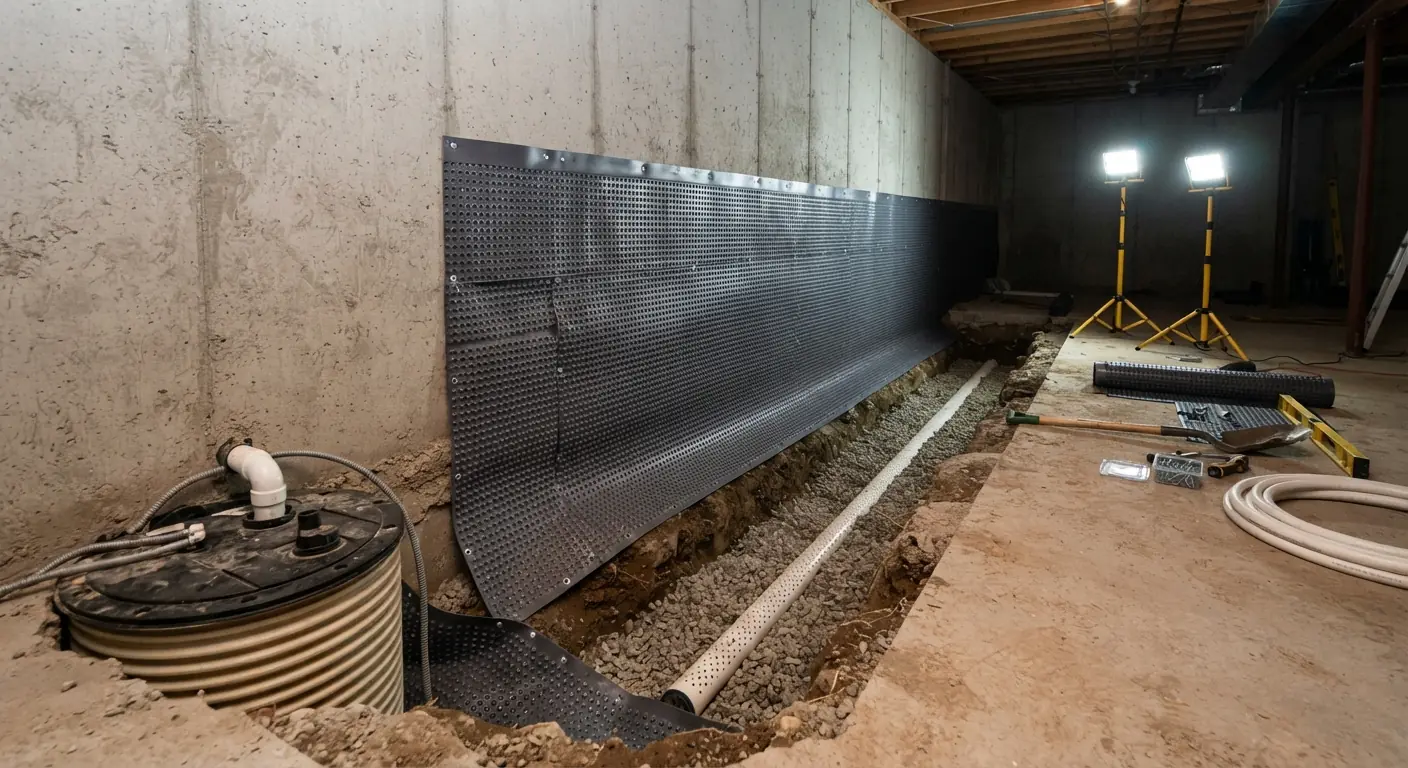
Waterproofing paint and sealers can stop dampness on a basement wall. They won't reliably stop water that's pushed through by wet soil, cracks or a high water table.1 That job needs drainage outside or inside the wall. Use a masonry waterproofer on bare block or concrete that's only damp. Use a penetrating sealer when you want the concrete to stay breathable. Use a damp-wall primer only to prep for paint. Fix gutters and grading first.
TL;DR
- A coating on the inside of a basement wall is damp-proofing. Waterproofing means drainage and exterior membranes that keep water off the wall in the first place.21
- Find the source before you buy anything. Condensation, roof runoff, cracks and water under pressure each need a different fix.
- By wall type: a masonry waterproofer for damp bare block or concrete, a penetrating sealer for bare concrete you want breathable, and a damp-wall primer only as prep. Strip a painted wall first or skip the coating.3
- Paint is wasted on active leaks, over old paint, mold or white salt deposits, and anywhere bad gutters or grading cause the water.34
- Rough budget: about $96 to $128 in paint per 100 square feet of wall for two DIY coats by our math, $2 to $10 per square foot hired, and $6,000 to $12,000 for interior waterproofing with drains and pumps.531
Will waterproofing paint stop water on basement walls?
Only when the problem is dampness. HomeGuide's cost guide says sealers "won't stop water under pressure" and work for minor dampness.1 The Home Depot's pro guide calls interior sealants alone "only a temporary measure."2 So treat any coating on the inside of the wall as damp-proofing. Waterproofing means keeping water away from the wall.
The two words get mixed up on paint cans, so here's the split.
Damp-proofing slows moisture that wicks through concrete from wet soil. Building Science Corporation explains that water from wet soil can "wick (capillary flow) and move by diffusion" through the materials used to build basements. It adds that exterior damp-proofing is often a fluid-applied coating of bitumen.6
Waterproofing handles liquid water, including water pressed against the wall by saturated soil. It usually means an exterior membrane plus drainage. HomeGuide prices a liquid or sheet membrane at $4 to $7 per square foot installed.1 It says the membrane forms an impermeable barrier between the foundation and the soil, and that the work needs digging around the house.1 Building Science Corporation pairs that barrier with free-draining backfill or a drainage mat that sends water down to a perimeter drain.6
What about the 15 psi claims on the can?
Some masonry waterproofers claim more than damp-proofing. Drylok says its Extreme Masonry Waterproofer was tested to ASTM D-7088 and earned "a PSI rating of 15, which equates to stopping a wall of water that is 33 feet tall."3 That test evaluates coatings that resist water passing through concrete blocks under hydrostatic pressure.3 Drylok also says the product can go on the inside or the outside of a below-grade wall.3 Other brands print the same number. One Amazon listing advertises "15 PSI Hydrostatic Pressure Resistance."7
That's a lab result for the coating itself. Your wall also has cracks and holes, and paint "will not plug existing cracks on its own," according to The Home Depot.2 When the manufacturer and the independent cost guide disagree, we'd plan from the independent view. Count on a coating to handle dampness. Plan for drainage if water comes through under pressure.
There's a second reason to be careful. The Home Depot tells pros to put sealants on both sides of a foundation "to prevent water from getting trapped in the concrete and damaging it over time."2 A coating on the inside face alone leaves the outside of the wall wet.
How do I stop water from seeping through my basement walls?
Work from the outside in. Clean the gutters, extend the downspouts and make sure the soil slopes away from the foundation. Plug cracks and holes next. Add a coating only once the wall stays dry. If water still gets in, the fix is drainage: an interior drain with a sump pump, or exterior membrane work.
1. Find where the water comes from
Dry the floor first. Drylok warns that standing water can hide a leak coming from the floor instead of the wall, and that leak needs a different fix.3
Then work out what kind of wet you have. Summer condensation fools a lot of people. Building Science Corporation says the main problem with below-grade walls "comes during the summer when warm moist air comes in contact with basement cold surfaces."6 A simple check helps. Tape a square of clear plastic tightly to the bare wall, leave it in place, then look at both sides. Beads on the room side point to condensation. Moisture under the plastic points to water coming through the wall.
Condensation is a humidity problem, and paint won't touch it. EPA suggests keeping indoor humidity below 60 percent, ideally 30 to 50 percent.4 ENERGY STAR sizes dehumidifiers by how damp a space is. Its "Wet" category covers rooms where "walls or floor sweat, or seepage is present."8
2. Fix the outside
Roof water that soaks the soil next to the house can build up and seep into the basement.2 Building Science Corporation puts it plainly: "Roof and façade water should not saturate the ground beside foundations."6 EPA advises cleaning gutters and making sure the ground slopes away from the foundation.4 ENERGY STAR adds two more: extend downspouts away from the house and don't overwater foundation plantings.8
Gutter work is usually one of the cheaper steps. The Home Depot notes that a basement needing only damp-proofing may be solved with better gutters, and that gutter jobs cost much less than exterior waterproofing.2
3. Plug cracks and holes
Drylok's own steps plug holes and cracks with hydraulic cement once the wall is clean and dry.3 Seal window wells too, since Drylok calls them a common entry point for water.3 For minor cracks that don't threaten the structure, HomeGuide prices epoxy injection at $250 to $800 or more per crack.1
Bowed walls are on HomeGuide's list of warning signs.1 A bowing wall or a wide crack that keeps growing is a structural question. Have a structural engineer or foundation contractor look at it before anyone paints.
4. Coat the wall, if it still makes sense
If the wall is only damp after steps 1 to 3, a coating is reasonable. Drylok's instructions set the bar:
- Remove efflorescence, the white powdery salt left by water, so the paint can bond.3
- Remove old paint or other coatings with a wire brush, sandpaper or chemical stripper.3
- Paint at 50°F or warmer, with at least two coats.3
- Use a 3/4 inch nap roller or a good nylon brush, and allow two to three hours between coats.3
- Check for pinholes once the wall is dry and touch them up.3
Clean off any mold before a coating goes on. EPA says to clean the mold and dry the surface first, because paint over moldy surfaces is likely to peel.4
5. Drain what still gets through
If water still comes in, add a drain. An interior system means cutting a trench around the floor, laying a French drain and connecting it to a sump pump. The Home Depot notes that interior French drains don't push water out on their own. They rely on the pump.2 HomeGuide puts an interior French drain at $4,000 to $17,0001 and a sump pump at $600 to $2,500 installed.9 Our guide to interior drains, exterior membranes and other basement waterproofing methods compares them in more detail.
Which sealer fits your wall type?
Match the product to the wall. A masonry waterproofer is a thick paint that forms a film, and it suits bare block or poured concrete. A penetrating sealer soaks into bare concrete and leaves no film. A damp-wall primer preps a damp surface for paint. None of them replaces drainage.37
This table is our own selection by wall type, built from manufacturer instructions and the building science sources below. It isn't a lab test.
| Wall | Masonry waterproofer | Penetrating sealer | Damp-wall primer | Our pick |
|---|---|---|---|---|
| Bare poured concrete, damp only | Good fit. Two coats minimum | Good fit if the wall stays bare | Prep only, under a topcoat | Masonry waterproofer, or penetrating sealer if you'll leave it bare |
| Bare concrete block | Good fit. Drylok's test is for coatings on block | Soaks the block face, but seams and joints still need repair | Prep only | Masonry waterproofer after joint and crack repair |
| Already painted | Strip the old paint first | Can't soak through paint | Check the label | Strip it, or skip the coating |
| White powder on the surface | Remove it first | Remove it first | Remove it first | Clean it, then find the water source |
| Stone or rubble | Hard to coat evenly | Hard to cover evenly | Hard to cover evenly | Get a contractor's assessment |
| Wall you'll frame and insulate | Ask how it fits the insulation plan | Leaves the wall able to dry | Not needed | Settle this with your contractor first |
The table rests on a few specific points. Drylok's hydrostatic test covers coatings on concrete block.3 HomeGuide says block foundations have more seams and joints where water can enter, and that stone is the hardest to treat because of its irregular surface.1 Drylok says old paint and efflorescence must come off before its waterproofer goes on.3
Masonry waterproofer
This is the Drylok and KILZ category. Drylok describes it as a waterproof coating that creates a barrier against water seeping in.3 On September 29, 2026, Lowe's listed a gallon of Drylok Original at $35.48 and a gallon of Drylok Extreme at $47.98.5 The same day, Amazon listed a gallon of KILZ Basement and Masonry Waterproofing Paint at $48.00.7
Here's the paint math for Drylok Extreme. A gallon covers about 75 to 100 square feet, and you need at least two coats.3 That works out to 2 to about 2.7 gallons for 100 square feet of wall. Lowe's listed the gallon at $47.98.5 At that price, our math comes to about $96 to $128 in paint. Crack filler, etching cleaner and rollers are extra.
Penetrating sealer
A penetrating sealer soaks into the concrete instead of sitting on top. Silicate, silane and siloxane products all work this way. One silane siloxane product on Amazon is sold as a "Penetrating Concrete Sealer" that is "Breathable."7 Because there's no film, there's nothing to peel. The tradeoff is that it only works on bare, unpainted concrete, and it won't bridge a crack.
The Home Depot puts silicate and epoxy sealants at up to $5 to $7 per square foot, against $3 to $4 for acrylic sealants.2 Breathability matters if you plan to finish the room. Building Science Corporation warns that impermeable interior wall finishes, such as oil or alkyd paints, "inhibit inward drying and typically lead to mold growth."6
Damp-wall primer
A damp-wall primer is a prep coat. Zinsser's WaterTite Damp Wall Primer is listed as a product you can "Apply Directly To Damp Concrete" for "Basement Wall Preparation." It sold for $25.98 a quart on Amazon on September 29, 2026.7 Buy it when you want a regular topcoat to stick to a slightly damp wall. For water coming through the wall, use the fixes above.
The same goes for mold-killing primers. EPA says mold has to be cleaned up and the water problem fixed, or the mold will most likely come back.4 A primer doesn't do either of those jobs.
When is waterproofing paint wasted money?
Paint is wasted when the water has a cause the coating can't touch. That covers active leaks, water under pressure, bad gutters or grading, condensation, a leak through the floor, and walls with old paint, mold or white salt deposits left on them. Fix the cause first.
Here's each case with the reason:
- Active leaks and water under pressure. Sealers won't stop water under pressure, according to HomeGuide.1 Plug the leak and add drainage.
- Gutters and grading. If roof water soaks the soil at the wall, it will keep coming. Fix the downspouts and slope first.46
- Condensation. Summer moisture on cold walls comes from the room air.6 A dehumidifier and humidity control address it.48
- A leak through the floor. Drylok warns that standing water can hide a floor leak, which needs a different fix.3
- Old paint. Drylok's waterproofer needs old paint or coatings removed first.3 If you won't strip the wall, don't buy the waterproofer.
- Mold. Paint over moldy surfaces is likely to peel.4
- Efflorescence left on. The white salt must come off to get proper adhesion.3 Its presence also tells you water is moving through the wall.
- A wall you'll finish with the wrong coating. Building Science Corporation rules out oil, alkyd and epoxy paint systems on basement walls designed to dry inward.6
What is the cheapest way to waterproof basement walls?
The cheapest fix is usually outside: clean gutters and extended downspouts.2 Regrading the soil so it slopes away from the house costs more, $1,000 to $5,000 per HomeGuide.1 If the wall is still damp after that, a DIY masonry waterproofer works out to roughly $96 to $128 in paint per 100 square feet of wall for two coats, by our math from the Lowe's price and Drylok's coverage above. Drainage systems cost thousands.1
| Fix | Typical cost | What's included | Source |
|---|---|---|---|
| DIY masonry waterproofer, two coats | About $96 to $128 per 100 sq ft of wall (our math) | Paint only. Our math from a $47.98 gallon and 75 to 100 sq ft per gallon per coat53 | Lowe's price, Drylok coverage |
| Waterproof paint | $1 to $6 per sq ft2 | Scope not stated | The Home Depot |
| Waterproof paint or concrete sealing, hired | $2 to $10 per sq ft1 | Labor and materials | HomeGuide |
| Acrylic concrete sealant | $3 to $4 per sq ft2 | Scope not stated | The Home Depot |
| Silicate or epoxy sealant | Up to $5 to $7 per sq ft2 | Scope not stated | The Home Depot |
| Replace downspouts | $220 to $625 total1 | Downspouts | HomeGuide |
| Regrade around the house | $1,000 to $5,0001 | Drainage fix at the soil | HomeGuide |
| Epoxy crack injection | $250 to $800+ per crack1 | Minor, non-structural cracks | HomeGuide |
| Sump pump | $600 to $2,5009 | Installed | HomeGuide |
| Interior waterproofing | $6,000 to $12,0001 | Pumps, drains, sealers, crack filling | HomeGuide |
| Exterior waterproofing | $10,000 to $18,0001 | Grading, drains, membranes | HomeGuide |
The two paint figures don't match. The Home Depot says $1 to $6 per square foot and calls paint the least expensive way to waterproof a basement.2 HomeGuide says $2 to $10 per square foot, including labor and materials.1 If you're hiring the job out, budget from HomeGuide's range, because it states what it includes. If you're doing it yourself, the paint math above is closer to your real spend.
A cheap fix that fails costs more than it saves. Paint over a wall that needed a drain has to be stripped before any future coating can go on.3 And the water will still find its way in.
What is the best basement wall sealer?
For a damp, bare block or concrete wall, a masonry waterproofer is the practical pick. Drylok Extreme is the one we'd start with because its maker publishes a below-grade water test. KILZ sells a similar basement waterproofing paint. For bare concrete you'll leave exposed, a penetrating sealer avoids peeling.37
This is our own selection from the products and specifications in our research. It isn't an independent test or award, and we didn't test these products on a wall.
Which is better for basement walls, KILZ or Drylok?
For the same job, they're close. KILZ Basement and Masonry Waterproofing Paint is sold for concrete, brick and cinder block walls, inside or out.7 Drylok Extreme is sold for the same use.3 On September 29, 2026, the gallon prices were $48.00 for KILZ on Amazon and $47.98 for Drylok Extreme at Lowe's.57
Drylok gets the edge here only because its maker publishes a hydrostatic test result, and the KILZ listing we checked doesn't state one.37 Before you buy either, read the label for three things: a hydrostatic test for below-grade walls, interior use on your wall type, and coverage per gallon.
If the comparison you have in mind is a KILZ primer against Drylok, those are different products. A primer preps a surface for a topcoat. A masonry waterproofer is meant to be the coating that resists water.
What is better than Drylok?
For water that comes through under pressure, drainage beats any coating. An interior drain and sump pump, or exterior membrane work, handles what paint can't.1
The Home Depot lists the exterior options: liquid synthetic membranes such as polyurethane and rubberized asphalt, synthetic sheet membranes, bentonite sheets and cementitious coatings.2 It says polyurethane can protect concrete "for up to 25 years" and that bentonite typically lasts the lifetime of the concrete it's attached to.2 Those go on the outside of the wall, which means digging.
Inside, the alternatives depend on the wall. A penetrating sealer suits bare concrete you want to stay breathable.7 A flexible elastomeric coating is another option. One such product listed on Amazon at $59.95 a gallon is sold as a crack filler and basement waterproofing coating.7 None of them fix a drainage problem.
Can I waterproof basement walls myself?
Yes, for the coating and small-crack work. The Home Depot notes that paints and sealants usually need no special equipment or training. Excavation, interior drains and sump pits are different. They need heavy tools and may require permits or licenses.2 Leave structural cracks, bowed walls and big mold jobs to pros.
A homeowner can reasonably handle:
- Cleaning gutters, extending downspouts and watching the grade.48
- Running a dehumidifier sized to the space.8
- Plugging small holes with hydraulic cement.3
- Minor crack repair with a DIY kit. One urethane crack repair kit was listed on Amazon at $163.99.7
- Cleaning, etching and rolling two coats of masonry waterproofer.3
Call in help for the rest. EPA says a moldy area under about 10 square feet is usually a DIY job, and larger or water-damaged areas call for its remediation guidance.4 Bowed walls and growing cracks need a structural engineer or foundation contractor. Trenching the floor for a drain and pump means breaking concrete with a jackhammer.2 Permit rules vary by city, so ask the contractor what yours requires.
What a good waterproofing quote shows
A good quote names the water source, the fix for it and why. It lists each method with its own line, what's included and what isn't. It says what happens to the wall finish later. If a quote is just "seal walls," ask how water gets in before you sign. Our guide to choosing a basement contractor covers the rest of the vetting.
HomeGuide's question list is a good start.1 Ask:
- How is water getting into my basement?
- Which methods do you recommend, and why?
- Are there structural problems that could cause the walls to fail?
- Does the estimate cover materials, labor and cleanup?
- Can I get the itemized estimate, contract and warranty terms in writing before work begins?
Add one of your own if you plan to finish the space: how does the coating or drain fit with the wall insulation? Building Science Corporation recommends rigid foam or spray foam against basement walls because it lets the wall dry and doesn't support mold.6 Your contractor should explain how the moisture plan and the finish plan work together.
That's where water sealing meets finishing your basement. Basement Remodeling Co. matches you with one vetted, licensed basement contractor for your metro. They give a free on-site estimate and a written, itemized quote, and they check moisture during the visit. When you're ready, you can get a written quote for basement waterproofing before you finish. The basement contractor finder shows whether your ZIP is covered. Local pages cover basement finishing in Atlanta, basement finishing in Denver, basement finishing in Colorado Springs and basement finishing in Fort Collins.