Test the slab before you buy a product. Tape plastic to the bare concrete, and add a calcium chloride or RH probe test if new flooring needs a measured reading. Then match the fix to the result. A sealer helps with minor dampness, but it won't stop water under pressure.1 Seepage and puddles need drainage, usually an interior drain tile and a sump pump.1
The plastic test costs almost nothing, and it tells you whether a sealer is worth buying at all.
TL;DR
- Water on top of the plastic means humid air is condensing on cold concrete. Dry the air and fix gutters and grading. No floor product is needed.
- Damp concrete under the plastic with no puddles means vapor is rising through the slab. A sealer can help here, if the floor finish on top still lets the slab dry.
- Water at the wall-floor joint, puddles after rain or a leaking crack means water under pressure. Budget for an interior drain and sump pump. A coating won't hold it back.1
- HomeGuide's national averages run $2 to $10 per square foot to seal concrete and $6,000 to $12,000 for interior waterproofing.1 An interior French drain cut into the slab runs $4,000 to $17,000 on its own.1
- Which product beats Drylok depends on your test result. Once water is under pressure, drainage beats any coating.1
Why does the test come before the product?
The same damp floor can have three causes, and each needs a different fix. Humid room air can condense on cool concrete. Vapor can rise up through the slab from wet soil. Or liquid water can push in under pressure. A sealer only addresses the second cause, and only when it's mild.
Water doesn't need a crack to reach your floor. Water from wet soil can wick up by capillary flow and move by diffusion through the soil and through the concrete itself.2 New concrete adds its own load, because freshly placed concrete holds several thousand pounds of water that tries to dry inward.2
A well-built slab sits on crushed stone, which acts as a capillary break, with a sheet of polyethylene in direct contact with the concrete as a vapor barrier.2 You can't see from above whether your slab has either one, so test before you spend.
Look for the warning signs too. White or gray chalky residue on floors, damp walls, musty odors and cracks in the floor all point to moisture that needs a fix.1
How do you test a basement floor for moisture?
Start with a sheet of plastic taped to the bare concrete. It costs almost nothing and shows whether the moisture comes from the room air or from the slab. If you plan to lay flooring that needs a measured number, add a calcium chloride test or an RH probe test. The flooring maker's instructions set the passing number.
The plastic sheet test
Cut a square of clear plastic sheeting and tape all four edges tightly to bare concrete. Pick a spot away from heat vents and direct sun. Leave it down for a day or more, then lift it and look at both sides.
- Moisture on top of the plastic and dry concrete underneath: humid air is condensing on the cool floor.
- Darkened concrete or droplets under the plastic: moisture is coming up through the slab.
- Both at once: you have both problems.
Run it more than once if you can. A floor that tests dry in a dry month can test wet after a week of rain.
The calcium chloride test
This test puts a small dish of calcium chloride under a sealed dome on the slab. The salt absorbs the vapor coming off the concrete, and the weight it gains shows how much moisture the slab gives off over the test period. Flooring installers use it because some flooring makers set a limit for it.
The RH probe test
This test drills a hole into the slab and places a sensor inside. The probe reads the relative humidity within the concrete, which shows what flooring glued or laid on top will sit against. Ask which of the two measured tests your flooring or coating maker names in its instructions, and get the reading in writing.
Check the room air too
EPA recommends keeping indoor humidity below 60 percent, ideally between 30 and 50 percent.3 A humidity meter to check it costs about $10 to $50 at many hardware stores.3 If the room reads high and the plastic sweats on top, the air is your problem.
| Test | Who runs it | What it tells you | Use it when |
|---|---|---|---|
| Plastic sheet | You | Whether moisture comes from the room air or from the slab | Always, first |
| Calcium chloride | Flooring installer or contractor | How much vapor the slab surface gives off over a set time | Your flooring or coating maker lists a limit for it |
| RH probe | Flooring installer or contractor | Relative humidity inside the concrete | Your flooring or coating maker lists a limit for it |
| Humidity meter | You | Relative humidity of the room air | Any time the floor or walls sweat |
Which fix matches your test result?
Match the fix to what your moisture test found. Condensation calls for drier air. Light vapor through the slab can take a sealer plus flooring that tolerates it. Standing water, puddles after rain or seepage at the wall joint call for drainage. A leaking crack needs its own repair, usually alongside drainage. Our basement floor cracks guide covers those repairs.
| Test result | What it usually means | Fix that fits | National cost (HomeGuide) |
|---|---|---|---|
| Wet on top of the plastic, dry underneath | Humid air condensing on cool concrete | Dehumidifier, venting, gutters and grading | $130 to $300 portable dehumidifier; $1,500 to $3,500 whole-house1 |
| Damp concrete under the plastic, no puddles | Vapor rising through the slab | Sealer on a clean, dry slab, plus a floor finish that lets it dry | $2 to $10 per square foot for concrete sealing1 |
| Measured reading above the flooring maker's limit | Too much vapor for that flooring | A flooring the maker approves for that reading, or a different floor plan | Priced at your estimate |
| Water at the wall-floor joint or puddles after rain | Water under pressure from wet soil | Interior perimeter drain (drain tile) to a sump pump | $4,000 to $17,000 interior drain1; $600 to $2,500 sump pump4 |
| Water from one crack | The crack is an entry point | Crack repair, often with drainage | $250 to $800+ per crack for epoxy injection1 |
The dehumidifier, sealer, drain and crack figures come from HomeGuide's basement waterproofing cost guide, dated January 2026.1 The sump pump figure comes from HomeGuide's sump pump cost guide, dated August 2023.4
For the condensation row, size the dehumidifier to the space. ENERGY STAR lists 30 to 50 pints per day for a wet space under 2,000 square feet, where floors sweat or seepage is present.5 It also suggests a model rated for low temperatures if the space usually stays below 65 degrees.5
Is a sealer enough to waterproof a basement floor?
A sealer is enough only when the problem is light vapor with no liquid water. Sealers work well for minor dampness, but they won't stop water under pressure.1 A floor that seeps or puddles after rain needs drainage first. After that, a sealer can serve as an extra layer of protection.
Waterproof paint and sealers slow moisture through fairly dry concrete. Where water pushes through from below, the coating can bubble and peel, and a coating rolled onto a wet slab bonds poorly. For a closer look at coating types, see our guide to basement waterproof paint and sealers.
Two more cautions apply before you roll anything on:
- Clean up any mold and dry the surface first. EPA says not to paint or caulk moldy surfaces, because paint over mold is likely to peel.3
- Think about what goes on top. Building Science Corporation warns against impermeable floor finishes such as vinyl coverings in basements, because they block drying and typically lead to mold.2
Some sealers soak into the concrete and some form a film on the surface. Before you put either under new flooring, ask the maker how its product handles vapor from below.
How do I fix water seeping through my basement floor?
Stop as much water as you can outside, then give the rest a path out. Clean the gutters, extend the downspouts and make the ground slope away from the house. If water still comes in, an interior perimeter drain feeding a sump pump is the standard fix. Patching the wall-floor joint rarely lasts.
Fix the outside first
EPA advises making sure the ground slopes away from the foundation so water doesn't collect around it, and keeping gutters clean.3 ENERGY STAR adds extending downspouts away from the foundation and not over-watering foundation plantings.5 HomeGuide puts regrading at $1,000 to $5,000 and replacing downspouts at $220 to $625.1 Regrading alone is occasionally enough, but it's often paired with other methods.1
Add an interior drain and a sump pump
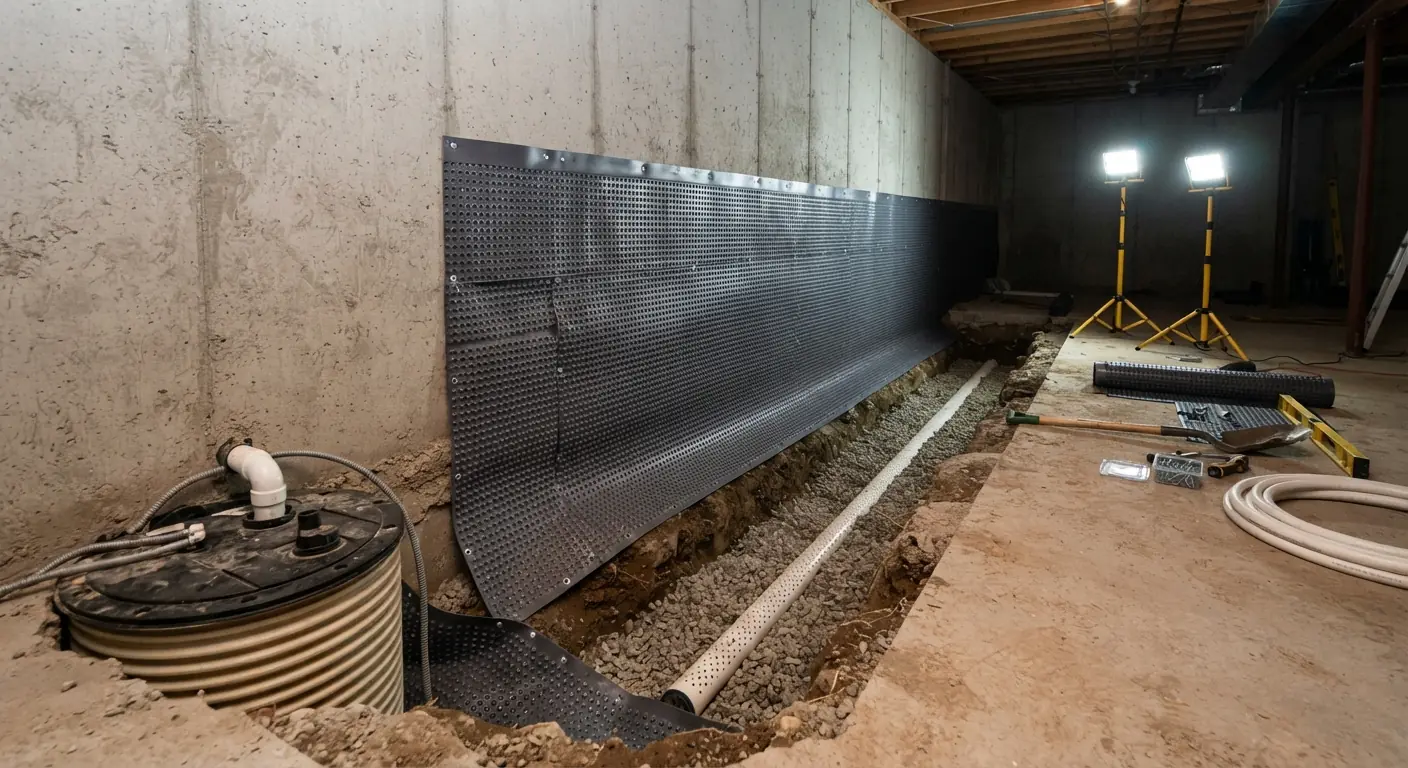
An interior drain collects the water and carries it away. HomeGuide describes the job as digging a trench in the basement floor, filling it with gravel and a perforated pipe, and connecting it to one or more sump pumps.1 Water that enters at the walls, floor or wall-floor joint runs through the pipe to the sump pit, and the pump sends it out of the house.
If your basement has no sump pit, the installer has to break the concrete to set one. HomeGuide says that can push a sump install to $2,500 to $5,000.4 It also suggests a battery backup so the pump keeps working when the power goes out.4
New construction handles this under the slab. Building Science Corporation recommends a crushed stone drainage layer under the slab, connected through the footings to the perimeter drain.2 That layer also holds water for a while during heavy rain if the sump pump fails in a power outage.2
Why a hydraulic cement patch rarely lasts
Hydraulic cement or caulk along the wall-floor joint is a common DIY attempt, and it rarely holds. The patch does nothing about the water pressure behind it, so water keeps pushing at the joint and can find a way around the patch.
Dry out fast after water gets in
EPA says wet areas dried within 24 to 48 hours will, in most cases, not grow mold.3 Porous materials such as carpet may have to be thrown away if they get moldy.3 If mold covers more than about 10 square feet, EPA points you to its Mold Remediation in Schools and Commercial Buildings guidance, and any contractor you hire should have experience cleaning up mold.3
What is the average cost to waterproof a basement floor?
Interior basement waterproofing averages $6,000 to $12,000 and exterior work $10,000 to $18,000, based on HomeGuide's national figures.1 Sealing a floor costs far less, at $2 to $10 per square foot installed.1 An interior French drain cut into the slab runs $4,000 to $17,000 on its own.1
| Item | Cost | Source and scope |
|---|---|---|
| Concrete sealing or waterproof paint | $2 to $10 per sq ft, labor and materials1 | HomeGuide, national, January 2026 |
| Epoxy crack injection | $250 to $800+ per crack1 | HomeGuide, national, January 2026 |
| Sump pump, installed | $600 to $2,5004 | HomeGuide sump pump guide, national, August 2023 |
| Sump pump where concrete must be broken out | $2,500 to $5,000 total4 | HomeGuide sump pump guide, national, August 2023 |
| Interior French drain | $4,000 to $17,0001 | HomeGuide, national, January 2026 |
| Interior waterproofing overall | $6,000 to $12,0001 | HomeGuide, national, January 2026 |
| Exterior waterproofing | $10,000 to $18,0001 | HomeGuide, national, January 2026 |
HomeGuide's figures are national averages.14 Use them to budget, and let your written quote replace them.
Here's how the sealer math works on an example 1,000-square-foot floor. At $2 to $10 per square foot1, that works out to about $2,000 to $10,000. That floor size is only an illustration.
HomeGuide lists what moves the price: foundation type, basement size, how severe the problem is, the method and where you live.1 For sump pumps, labor often makes up 65% to 80% of the total.4
Can you waterproof your basement from the inside?
Yes, you can waterproof a basement from the inside. Interior systems collect water at the edge of the floor and pump it out. Exterior waterproofing puts a membrane on the outside of the foundation walls, which needs excavation and costs more. For a wet floor in an existing home, the interior route is usually where the work starts.
HomeGuide says a liquid or sheet membrane costs $4 to $7 per square foot installed and requires digging around the home's perimeter.1
Going inside doesn't remove the need to manage the air. Building Science Corporation describes the traditional approach as keeping water out and letting the basement dry inward, where ventilation or dehumidification removes the moisture.2 So an interior drain and a dehumidifier often work as a pair. For a side-by-side of every approach, see our guide to basement waterproofing methods.
What are the best options for waterproof basement flooring?
Choose basement flooring after you test the slab for moisture. A waterproof top surface doesn't stop moisture below it, and an impermeable layer on a damp slab can trap that moisture. Pick finishes that can survive a flood from a leak or failed plumbing, and add a floor membrane where drainage is already in place.
Building Science Corporation says basement floor finishes should be chosen with flooding in mind, from leaky appliances, failed plumbing, overflowing sinks or surface water.2 The same digest warns against impermeable finishes such as vinyl coverings, because they block drying and typically lead to mold.2 It was first published in 2006. Read it for the building physics, since it doesn't review current products.
When a product is sold as waterproof flooring, the label describes its top surface. Ask the maker which slab moisture test and reading its warranty accepts, and compare that with your result.
A floor membrane underlayment is one way to protect the finish. Laid under the flooring and tied into an interior drain, it lets water that gets under the floor run back to the drain and sump pump. That only works if the drain exists.
For a full comparison of materials, see our basement flooring options guide.
Can I waterproof my basement floor myself?
You can handle a basement floor's testing, humidity control and outside drainage yourself. You can also seal a clean, dry slab that shows only light vapor. Cutting a drain into the floor and setting a sump pump is a job for a pro. It means breaking concrete and adding a pump that has to work in the worst storm.
Jobs most homeowners can handle:
- The plastic sheet test and a humidity meter reading.
- A dehumidifier. ENERGY STAR notes some models take a hose that drains straight into a floor drain or sump.5
- Cleaning gutters and extending downspouts.
- Sealing a dry, clean slab that tests for light vapor only.
Jobs to hand to a contractor:
- An interior perimeter drain, which means digging a trench in the basement floor.1
- A new sump pit in a concrete floor, which takes a jackhammer or concrete saw.4 HomeGuide says experienced plumbers install sump pumps.4
- Any new electrical circuit for the pump, which belongs with a licensed electrician.
- Mold covering more than about 10 square feet, where EPA points to professional remediation guidance.3
Some jurisdictions require a permit for drainage or electrical work, and local rules vary. Ask your contractor whether your job needs one.
What a good waterproofing quote shows
A good waterproofing quote names where the water comes from and the test or inspection behind that answer. Basement Remodeling Co. treats that diagnosis as the first thing to check, because a quote that skips it can't show a sealer is enough. Each method should carry its own price, with inclusions and any warranty in writing.
HomeGuide recommends getting an itemized estimate, contract and warranty in writing before work begins.1 Its list of questions for waterproofing contractors is a good start.1 Here's a version built around the floor:
- How is water getting into my basement, and what did you test to find out?
- Which methods do you recommend for my floor, and why each one?
- If you recommend a sealer, what did the test show that makes a sealer enough?
- Does the estimate cover materials, labor, concrete patching and cleanup?
- Are there structural problems that could cause the walls to fail?
- What warranty comes with the work, and what does it exclude?
If you'd like one contractor to check the floor before you commit, Basement Remodeling Co. matches you with one vetted, licensed basement contractor for your metro. The contractor books a free on-site estimate, checks moisture and gives you a written, itemized quote, and nothing starts until you sign. You can get a written quote for basement waterproofing or find a basement contractor by ZIP code.
If the plan is to finish the space once the floor is dry, basement finishing is the next step. Homeowners in Georgia can start with basement finishing in Atlanta, and Colorado homeowners with basement finishing in Denver.