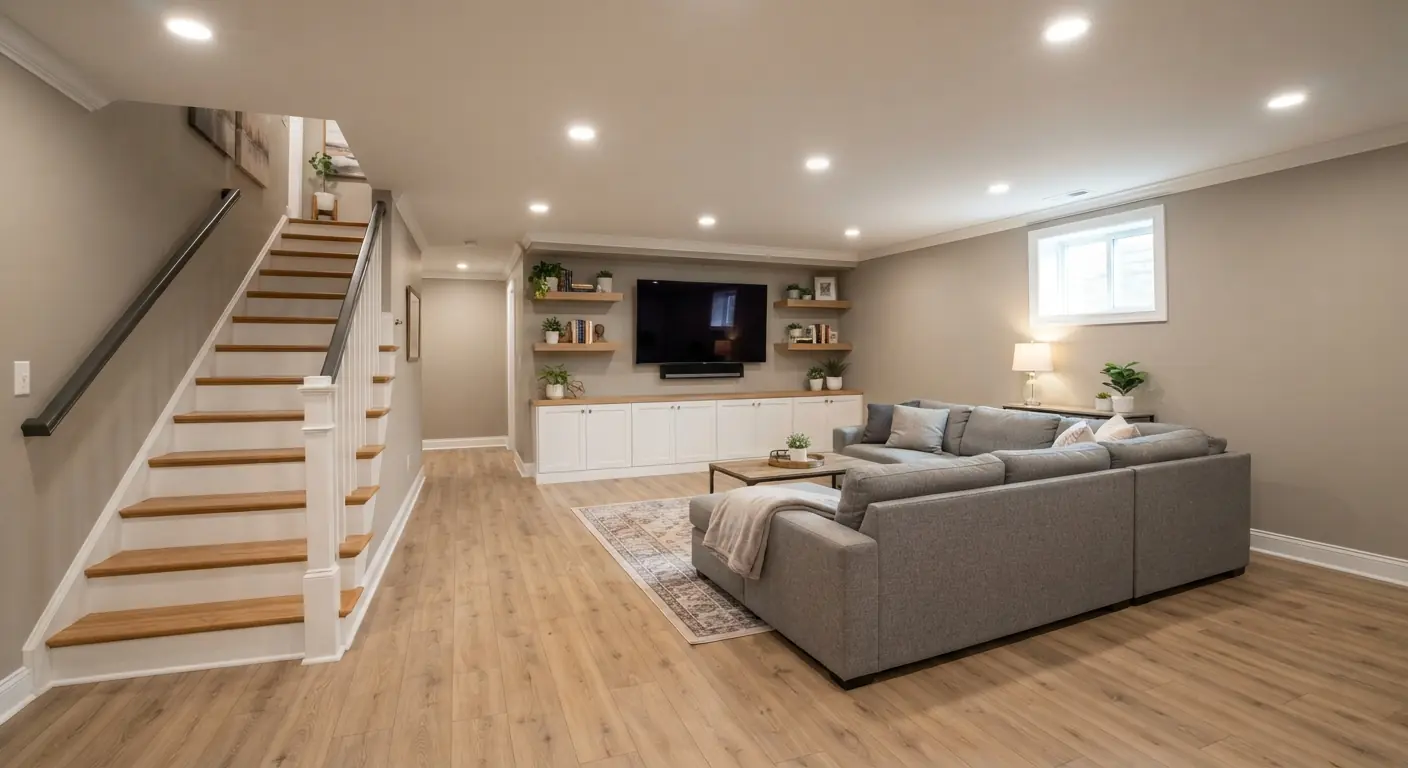
Pick the floor your slab's moisture allows, then pick the look. On a slab that checks dry, floating luxury vinyl plank over a dimpled subfloor panel is the safest living-room floor.1 If the basement gets water, use porcelain tile bonded to the slab, sealed concrete or raised modular tiles. Carpet, laminate and wood belong only on slabs that stay dry.
TL;DR
- Moisture rules out floors before budget does. Concrete wicks ground moisture upward, and an impermeable floor on top traps it. That's how mold starts under vinyl and inside carpet pad.21
- Dry slab, living space: luxury vinyl plank over a dimpled subfloor panel is the best all-round pick at $4 to $16 per square foot installed.13
- Water history: tile, sealed concrete or raised modular tiles. Skip floating vinyl plank there, even the waterproof kind, because water can get underneath it.
- Warmest: tile with electric floor heat over rigid foam, or carpet over an insulated subfloor panel if you don't want heat.1
- Cheapest: sealing the bare slab at $1 to $3 per square foot, then vinyl sheet or carpet at the low end of installed pricing.3
Why should moisture decide your basement floor first?
Moisture decides first because a concrete slab passes ground moisture up toward the room. Water in wet soil can wick and diffuse through the soil and the concrete.2 If the floor on top blocks that moisture from drying into the room, it collects underneath. Building Science Corporation warns that impermeable finishes such as vinyl "typically lead to mold growth."2
What's under your slab matters too. Building Science Corporation's guidance is crushed stone as a capillary break, then plastic sheeting in direct contact with the concrete.2 Where a sand layer sits between that plastic and the slab, it can soak up water that can only dry upward through the concrete. That "typically results in damaged interior floor finishes."2 You can't see which build your house has. That's why the slab gets checked before anyone orders flooring.
The money makes the same argument. Mold removal runs $15 to $30 per square foot, according to HomeGuide's national cost guide.3 The same guide puts installed luxury vinyl plank at $4 to $16 per square foot.3 A failed floor can cost more to clean up than the floor cost to buy.
Which basement floors hold up at each moisture level?
Tile, sealed concrete and raised modular tiles tolerate the most moisture. Floating vinyl plank sits in the middle and needs a subfloor panel on a damp slab. Carpet, laminate and wood sit at the bottom. The table below is our own ranking, built from the sources cited, and shows how each floor fails.
Costs are HomeGuide's national installed ranges per square foot unless marked.3
| Floor (our moisture rank) | Installed cost per sq ft | Slab checks dry | Slab damp or sweats in summer | Basement gets water | How it fails |
|---|---|---|---|---|---|
| 1. Porcelain or ceramic tile, set in mortar | $10 to $503 | Good | Good, with sealed grout | Best finished floor | Cracks on an unlevel slab; cold underfoot |
| 2. Sealed or polished concrete | $1 to $3 sealing; $3 to $15+ polished3 | Good | Good once sealed properly | Nothing on top to soak up water | Cold and hard underfoot |
| 3. Raised modular tiles (vinyl, carpet or PVC top on a plastic base) | Not in HomeGuide; priced at your estimate | Good | Built for it | Sold as the pick for wet conditions | Vendor claims, not independent tests |
| 4. Luxury vinyl plank or tile, floating | $4 to $163 | Best all-round, over a subfloor panel | Only over a subfloor panel | Avoid with a flooding history | Traps moisture or condensation underneath |
| 5. Rubber tiles or rolls | Not in HomeGuide; priced at your estimate | Good for gyms | Water-resistant | Water-resistant, not waterproof | Visible seams, rubber smell at first |
| 6. Epoxy coating | $4 to $103 | Good | Risky | Surface sheds spills | Bubbles or peels from moisture below |
| 7. Waterproof-rated laminate | $4 to $143 | Budget option | Avoid | Avoid | Swells; rigid planks need a very flat slab |
| 8. Wall-to-wall carpet | $2 to $8, plus pad3 | Only over a subfloor panel | Avoid on bare concrete | Avoid | Hidden condensation in the pad, musty smell |
| 9. Standard vinyl sheet, glued down | $2 to $73 | Storage rooms | Avoid | Avoid | Seals the slab; mold grows beneath |
| 10. Engineered hardwood | $7 to $203 | Only if dry year-round | Avoid | Avoid | Cups as moisture changes |
| 11. Solid hardwood | $11 to $253 | Avoid | Avoid | Avoid | Not suited to a basement at all |
Where each rating comes from: the carpet, vinyl plank and subfloor panel ratings follow a builder's basement flooring video, and so does the flat-slab warning for laminate.1 The vinyl sheet rating follows Building Science Corporation's warning about impermeable floor finishes.2 The humid-space warning for laminate is HomeGuide's.3 The other ratings are our editorial judgment of how each material handles water.
What do you need to know about your basement before you choose?
You need four answers: what the slab moisture check showed, how likely water is to reach the floor, what the room is for and what you can spend per square foot. Settle them in that order. A floor that fits your budget but fails the first two answers is the expensive choice.
The slab moisture check
Your contractor checks moisture during the free on-site estimate. Ask what the reading was, where it was taken and what it means for the floor you want. Check in summer too. Warm, humid basement air that reaches cold concrete can condense. That happens inside carpet pad without the carpet ever feeling wet.1 For planning, sort the result into three bands: dry, damp or sweating, and wet.
Flood risk
Moisture from below is one risk. Water from above is the other. Building Science Corporation lists leaky appliances, failed plumbing, overflowing sinks and exterior surface flooding as reasons to pick floor finishes carefully.2 A failed sump pump or a burst washing machine hose belongs on the same list. If any of those has happened in your basement, plan as if it will happen again.
Room use
A home gym, a bedroom and a laundry room want different floors. A gym wants impact protection. A bedroom wants warmth. A laundry room wants a floor that shrugs off a leak. The room-by-room section below matches floors to uses.
Budget per square foot
HomeGuide's national average for new flooring is $4 to $15 per square foot installed, with labor at $2 to $8.3 Budget for the layer under the floor too. Underlayment adds $0.50 to $3.50 per square foot installed.3 Carpet pad adds $0.75 to $1.75.3 For small rooms, many contractors charge a minimum project fee of $200 to $500 or more.3
What is the best type of flooring for a basement over concrete?
For a finished living space on a slab that checks dry, floating luxury vinyl plank over a dimpled subfloor panel is the best all-round choice. It's inorganic, tough and flexible enough to follow a wavy slab.1 If the slab is wet or the basement floods, porcelain tile bonded to the concrete is the better finished floor.
Luxury vinyl plank earns the top spot on dry slabs for three reasons. It won't rot or feed mold, because it's inorganic.1 It clicks together and floats, so no glue has to hold against the slab.1 And it bends. Basement slabs are rarely poured perfectly flat, and a flexible plank follows small dips that would stop rigid laminate.1
The subfloor panel is what makes it work. The dimpled plastic underside leaves an air gap above the concrete. That stops warm, moist room air from reaching the cold slab and condensing.1
Tile is the answer for the wetter half of the table. It's bonded down with thinset mortar and doesn't absorb water, so it handles a wet slab and a humid room.1 The tradeoffs are cost, a cold surface and cracking. An uncoupling membrane under the tile allows a little movement and helps prevent cracks.1 HomeGuide's installed range is $10 to $50 per square foot.3
Is carpet or LVP better in a basement?
Luxury vinyl plank is better for most basements. Carpet traps condensation in its pad when laid on bare concrete, and that hidden damp is a common cause of musty basement smells.1 Carpet is cheaper and warmer, so it can work in a dry basement if it goes over a basement subfloor panel.31
Here's what happens with carpet laid straight on the slab. In summer, humid air moves through the carpet and pad and meets cool concrete. It cools enough to condense inside the pad. The carpet never feels squishy, but it doesn't take much moisture to start mold and mildew.1 A subfloor panel with a foam layer stops the moist air before it reaches the concrete.1
On price, carpet runs $2 to $8 per square foot installed and vinyl plank runs $4 to $16.3 HomeGuide calls carpet comfortable underfoot and still a common choice for bedrooms and finished basements.3 If you want a soft floor in a basement with any water history, carpet tiles are the safer route. Interlocking carpet tiles can be lifted out to dry after a leak, and raised versions sit on a plastic base above the slab.
Will mold grow under vinyl flooring?
Mold can grow under vinyl flooring when moisture gets trapped between the vinyl and the slab. The vinyl itself won't feed mold, because it's inorganic.1 The problem is that vinyl stops the slab drying into the room. Building Science Corporation says impermeable floor finishes such as vinyl typically lead to mold growth.2
Two sources look like they disagree here, but they describe different installs. Building Science Corporation is warning about vinyl sealed against a slab that needs to dry upward.2 The builder in the Bailey Line Road video recommends luxury vinyl plank installed over a dimpled subfloor panel, which leaves an air gap and blocks condensation.1 Both point the same way. Vinyl glued straight to a damp slab is the risky version.
To keep mold out from under vinyl, get the slab checked first. Then float the planks over a dimpled subfloor panel.1 If the basement has a flooding history, skip vinyl plank. If you already see mold, have it assessed by a mold professional before any new floor goes down.
Which basement flooring is the most mold-resistant?
The most mold-resistant basement floors are inorganic surfaces with nothing absorbent underneath: tile, sealed concrete and vinyl. Vinyl won't feed mold because it's inorganic.1 Carpet and pad are the weakest.1 What touches the slab matters too. Building Science Corporation says materials contacting the slab should not support mold growth.2
That's why foam shows up so often in basement floor build-ups. Building Science Corporation recommends rigid or spray foam against basement concrete because it allows drying, isn't damaged by moisture and doesn't support mold growth.2 Closed-cell foam tiles work on the same idea, because their sealed cells don't soak up spills or dampness.
Cork is an interesting outlier. HomeGuide calls it naturally mold-resistant and insulating.3 None of the sources we checked test cork on a damp basement slab, so treat it as a dry-slab option and ask your contractor before choosing it.
Remember the difference between a mold-resistant material and a mold-resistant floor. A tile surface won't grow mold, but cement grout is porous and needs sealing. A vinyl plank won't grow mold, but the space beneath it can.2
What is the best flooring for a basement that gets water?
For a basement that gets water, the best floors are porcelain tile set in mortar, sealed concrete and raised modular tiles. Tile is naturally waterproof and bonded to the slab. Raised tiles sit on small plastic feet so air flows underneath and water can evaporate. Fix the water source before paying for any finished floor.
Raised tiles are built to let water under the floor dry out. The strongest claims for them come from the companies that sell them. The removable versions have a second advantage: after a leak you can lift the tiles, dry them and put them back.
Floating floors are the wrong bet here, even when the plank is sold as waterproof. Water that gets in through the seams and edges is trapped against the slab.
The bigger fix is outside the floor. Building Science Corporation's basics are gutters that carry roof water away, ground that slopes away from the house and a perimeter drain.2 HomeGuide puts basement waterproofing at $6,000 to $18,000.3 Spend on stopping the water first, then pick the floor.
What is the warmest flooring over a concrete slab?
The warmest floor over a concrete slab is tile with electric floor heating over rigid foam board. The warmest unheated option is carpet over an insulated basement subfloor panel.1 Tile, concrete and epoxy feel cold without heat. Insulation between the floor and the slab helps, but only heat makes a floor warm to bare feet.1
The builder in the Bailey Line Road video is blunt about it. Insulation gets you part of the way, but bare-feet warmth needs heat.1 The setup shown uses electric heating cables clipped into Schluter's Ditra-Heat uncoupling membrane. That sits on Kerdi-Board rigid foam, so the heat goes up into the tile rather than down into the slab.1 HomeGuide prices radiant floor heating at $7 to $17 per square foot installed.3
Without heat, carpet feels warmest and HomeGuide notes it helps keep a home warm in cold months.3 Put it over a subfloor panel with a foam layer, which adds insulation and blocks condensation.1 Luxury vinyl plank feels warmer and softer than tile. Cork is insulating.3 Closed-cell foam tiles also insulate against cold concrete. If your slab is being poured new, insulation under the slab helps comfort and moisture resistance, and Building Science Corporation calls it critical for radiantly heated slabs.2
What is the cheapest way to cover or finish a concrete basement floor?
The cheapest way to finish a concrete basement floor is to seal the bare slab, which HomeGuide prices at $1 to $3 per square foot.3 The cheapest way to cover it is standard vinyl sheet at $2 to $7 or carpet at $2 to $8 installed.3
"Finish" and "cover" are different jobs. Finishing keeps the concrete as the floor and protects it. Sealing is the entry point, and polished concrete runs $3 to $15 or more per square foot, not counting the slab.3 Epoxy costs $4 to $10 per square foot installed and gives a glossy, easy-clean surface.3 It takes a while to cure.3 On a slab with moisture coming up from below, epoxy can bubble or peel.
Covering puts a new material on top. HomeGuide suggests vinyl sheet as the budget choice for storage-only basements.3 The catch is that glued vinyl sheet is exactly the impermeable finish Building Science Corporation warns about.2 On a slab that checks damp, the cheap cover can become the costly one.
For a living space on a tight budget, compare the low ends. Sealing starts at $1 per square foot, and every covering in HomeGuide's cost table starts at $2 or more.3 Add rugs where you want softness. Vinyl plank starts at $4 per square foot installed.3 It works on dry slabs, and on damp ones over a subfloor panel, but not in a basement that floods.1
Which floor suits each basement room?
Match the floor to the room once moisture has narrowed the list. Family rooms and bedrooms suit vinyl plank or carpet on dry slabs. Gyms suit rubber or foam. Bars and bathrooms suit tile. Laundry and storage rooms suit sealed concrete, tile or vinyl sheet on a slab that checks dry.
Family room or media room
The builder in the Bailey Line Road video calls luxury vinyl plank one of the very best basement floors, and it suits a family room on a dry slab.1 On a slab that stays dry year-round, engineered hardwood is the premium wood-look choice. Pick it only if you'll watch humidity.
Bedroom
Carpet is a common bedroom choice because it's cost-effective and comfortable.3 In a basement, lay it over a subfloor panel.1 Where water is a risk, carpet tiles you can lift and dry are the safer soft floor.
Home gym or playroom
Rubber tiles or rolls cushion dropped weights and protect the slab. New rubber can smell for a few days, so air the room out. Closed-cell foam tiles give kids a cushioned floor that won't soak up dampness. PVC tiles are a waterproof option for workout rooms.
Bar, kitchenette or bathroom
Porcelain tile is the most common bathroom floor, according to HomeGuide.3 Tile suits a bar too. Choose textured or matte tile, because tile can be slippery when wet.
Laundry, utility or storage room
Leaky appliances and failed plumbing are two of the flood sources Building Science Corporation says to plan floors around.2 These rooms hold both, so pick a floor that shrugs off a leak. Sealed or polished concrete suits utility rooms. Vinyl sheet is HomeGuide's budget pick for storage-only space.3
What should your contractor's flooring quote show?
A good flooring quote shows the moisture check result, the layer between the slab and the floor, any slab leveling and the floor itself as separate lines. If it only lists the floor, ask what sits underneath and what happens where the floor meets the sump pit or laundry area.
Ask these questions before you sign:
- What did the moisture check show, where was it taken and which band does that put my slab in?
- Is a vapor barrier or subfloor panel included, and what product is it?
- Does the slab need leveling for this floor? Rigid laminate needs a flatter slab than flexible vinyl plank.1
- Is underlayment or carpet pad a separate line?3
- What exactly does the estimate include, and what does the warranty cover?3
- If this floor gets wet, can it be lifted and dried, or does it come out?
If you're still at the planning stage, Basement Remodeling Co. matches you with one vetted, licensed basement contractor for your metro. You get a free on-site estimate and a written, itemized quote. The contractor checks moisture and ceiling height during that visit. Nothing starts until you sign. When you're ready, you can get a written quote for finishing your basement or find the basement contractor who covers your ZIP code.
Replacing a floor in a basement that's already finished is a remodel, and the moisture check matters even more when the old floor failed. See how remodeling an already finished basement works, or plan a wider basement renovation if the walls and layout are changing too.
Flooring is one line inside a full finish. HomeGuide puts the national cost to finish a basement at $15,000 to $75,000.3 The site's published metro ranges, checked September 2026, run $45,000 to $80,000 for a typical full finish in metro Atlanta, $30,000 to $90,000 in metro Denver, $30,000 to $75,000 for a typical 1,000 sq ft finish in Colorado Springs and $50,000 to $110,000 for a typical full finish in Fort Collins. Compare local detail on basement finishing in Atlanta, basement finishing in Denver, basement finishing in Colorado Springs and basement finishing in Fort Collins.