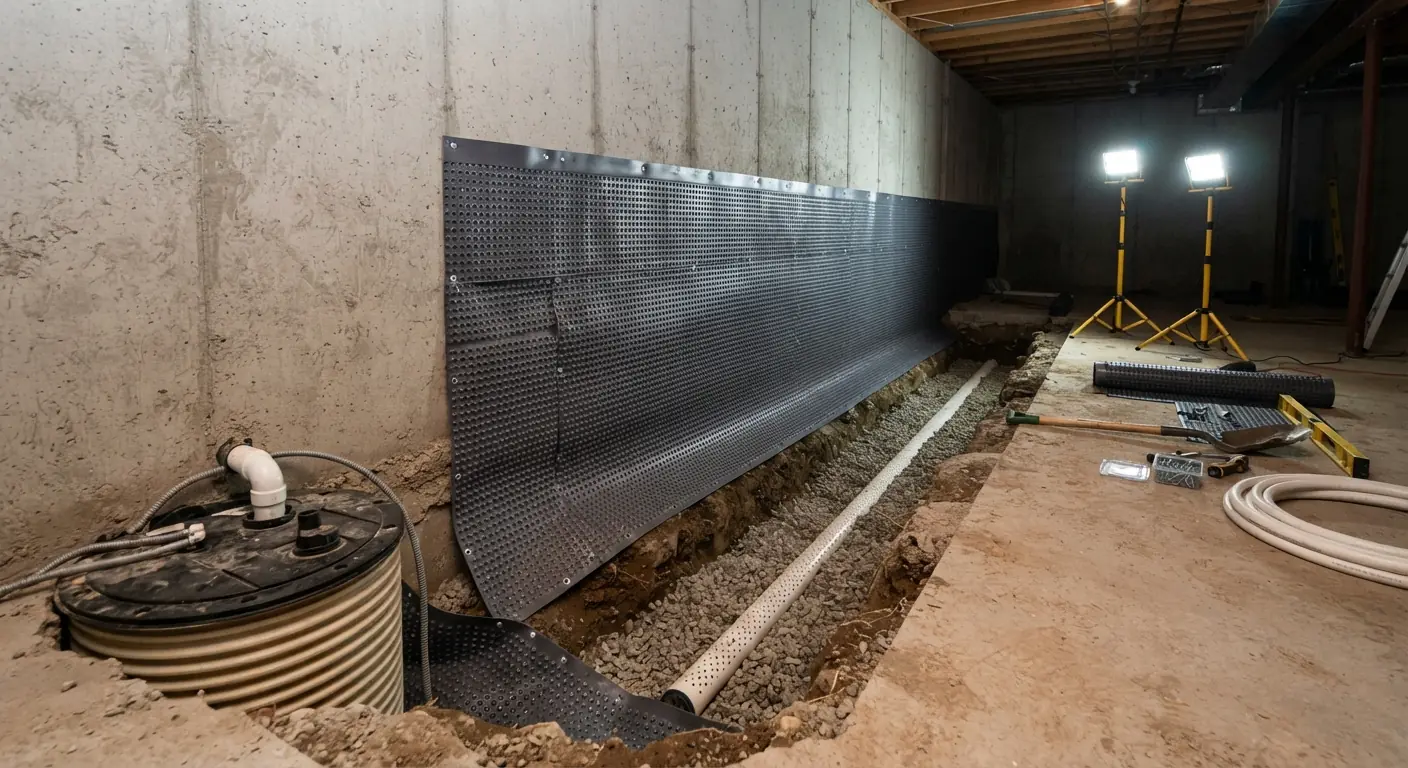
Yes, you can add a sump pump to an existing basement. The work runs in one order: cut the slab, dig and set a basin, install the pump, run a discharge line outside and power it from its own outlet. Most installs cost $600 to $2,500.1 Cutting through a concrete floor pushes the total to $2,500 to $5,000.1 Labor is most of that bill, and labor is what doing it yourself saves.
TL;DR
- Budget from the concrete-floor figure. A basement with a slab usually lands at $2,500 to $5,000 installed, above the $600 to $2,500 typical range.1
- DIY saves the labor, which runs $500 to $1,700 and makes up 65% to 80% of a typical bill.1 The slab cut and any new circuit are the two steps most homeowners should hand off.
- Start at 1/3 hp for a basement that takes on water. Go to 1/2 hp when it floods often or the discharge run is long.1
- Plan on replacing the pump every 7 to 10 years.2 Fix gutters and grading first, because a pump only handles water that has already reached the slab.
- Put the pump in before you frame and drywall. Moving the pit, the discharge line or the circuit later means opening finished walls and floors.
Can you add a sump pump to an existing basement?
Yes. A basement that never had a sump pump can get one. The installer cuts through the slab at the low point where water collects, digs a pit and sets a basin in a gravel bed.2 A jackhammer or concrete saw does the cutting, which is why slab jobs cost more than dirt-floor ones.1
A pit only drains the water that reaches it. Building science guidance calls for a crushed stone drainage layer under the slab, connected to a perimeter drain.3 If your slab sits on stone like that, water under the floor has a path to a new pit. If water comes in along the base of the walls instead, your contractor may suggest an interior drain around the perimeter that feeds the pit.
An interior drain is a much bigger job. HomeGuide's January 2026 waterproofing guide puts an interior French drain at $4,000 to $17,000.4 Its older sump pump guide, dated August 2023, puts a new or updated drainage system at $4,000 to $12,000.1 We'd budget from the 2026 figure. It's newer and it describes the exact job.
Do it before you finish the basement
If you plan to finish the space, the pump goes in first. EPA says water-damaged areas need drying within 24 to 48 hours to prevent mold.5 It also warns that porous materials such as carpet and ceiling tiles may have to be thrown away once they get moldy.5 A dry slab is the base that basement finishing is built on. If your basement is already finished, adding a pit means cutting through flooring and patching around it, which puts the job closer to basement remodeling.
The pump is also small next to the finish itself. Published finishing ranges from one local firm per metro, checked September 2026, run $45,000 to $80,000 for finishing a basement in metro Atlanta, $30,000 to $90,000 for finishing a basement in metro Denver, $30,000 to $75,000 for a typical 1,000 sq ft finish in Colorado Springs and $50,000 to $110,000 in Fort Collins.
What does a basement sump pump installation cost?
Plan on $600 to $2,500 installed for a typical job.1 For a basement with a concrete floor, budget $2,500 to $5,000, because the slab has to be broken up with a jackhammer or cut with a saw.1 Replacing a pump in a pit you already have costs $400 to $700, with no digging or electrical work.1
| Cost line | Range | Source and date |
|---|---|---|
| Pump unit only | $100 to $8001 | HomeGuide, August 2023 |
| Installation labor | $500 to $1,7001 | HomeGuide, August 2023 |
| Typical installed total | $600 to $2,5001 | HomeGuide, August 2023 |
| Installed total with a concrete floor to cut | $2,500 to $5,0001 | HomeGuide, August 2023 |
| Replace a pump in an existing pit | $400 to $7001 | HomeGuide, August 2023 |
| Check valve, parts only | $15 to $301 | HomeGuide, August 2023 |
| Float switch, materials only | $35 to $701 | HomeGuide, August 2023 |
| Battery-powered pump | $150 to $8001 | HomeGuide, August 2023 |
| Interior French drain feeding the pit | $4,000 to $17,0004 | HomeGuide, January 2026 |
Figures come from HomeGuide's sump pump cost guide1 and its basement waterproofing cost guide.4 The 2026 waterproofing guide still lists sump pump installation at $600 to $2,500+, so the older range hasn't moved much on paper.4 Your written quote is the number that counts.
What moves the price
- The floor. Dirt floors dig fast. Concrete means a jackhammer or saw and a patch afterward.1
- Access. A crawl space or a hard-to-access basement costs more than a large space or a walkout basement.1
- An existing basin. You may pay less if there's already a basin, though your installer may suggest replacing one that's old, cracked, warped or flimsy.1
- Pump material. Metal pumps are more durable than plastic ones but cost about double.1
- Water already in the basement. Your contractor may need to dry the space before the install.1
- Labor rates. Plumbers charge $45 to $80 per hour or more.1
How is a sump pump installed, from slab cut to discharge line?
A new sump pump goes in over eight steps: plan the spot and power, cut the slab, dig the pit, set the basin, prepare the pump, fit the check valve, run the discharge line and test. A simple install takes 8 to 10 hours. Cutting concrete, new plumbing or electrical work adds time.1
One plumbing firm quotes 2 to 4 hours for a professional install.2 Neither source explains the gap. For a slab basement, plan around HomeGuide's longer figure.
1. Pick the spot and check the power
Pick the low point where water naturally collects.2 The pump needs power close by. Ferguson's install guide says the pump cord is typically 8 to 10 feet long, the outlet should sit on a dedicated circuit at least 4 feet off the floor and you should never use an extension cord.6 The outlet should be GFCI protected.7 If there's no suitable outlet, a licensed electrician adds the circuit.
Keep the pit clear of where finished walls will go and leave room to lift the pump out later. Before anyone cuts, check the slab for radiant heat tubing or buried lines.
2. Cut the slab
The installer breaks the concrete with a jackhammer or cuts it with a concrete saw.1 The opening has to fit the pit. Ferguson says the pit should ideally be at least 22 inches deep and more than 14 inches in diameter, with 18 inches recommended, so the float can move freely.6 A plumbing firm's guide gives a similar size: about 2 feet deep and at least 18 inches in diameter.2
3. Dig the pit
Dig below the slab to the basin's depth, then lay gravel in the bottom for drainage.2
4. Set the basin
Lower the basin into the hole, backfill around its sides with gravel and check that it sits level.2 The concrete then gets patched around the rim.
The pump itself needs a solid base. Ferguson warns against placing a pump directly on earth or gravel. The pit needs a hard, level bottom such as bricks or concrete, or the impeller can wear or jam.6 Gravel goes under and around the basin. The pump sits on the basin's solid floor.
5. Prepare the pump
Thread a male adapter into the pump's discharge port without overtightening, because the fittings can crack.6 Test the float by lifting it for a few seconds.6
Then drill a weep hole. Ferguson's method uses a 3/16-inch bit, about two fingers' width above the discharge adapter, drilled at a 45-degree angle pointing down. The hole prevents an air lock, which can make the pump run dry and fail.6
6. Fit the check valve
The check valve stops pumped water from falling back into the pit.7 A broken one makes the pump work too hard, which can damage it.1 If you're replacing a pump more than five to seven years old, fit a new check valve too.6
7. Run the discharge line
Ferguson's parts list calls for 1.5-inch Schedule 40 PVC.6 The line leaves the house and should carry water at least 10 feet from the foundation.2 Slope it away from the pit so water flows freely.7 Drilling through a foundation wall is a step where professional help prevents structural or water damage.2
Where the water lands matters as much as the pump. Building science guidance says roof water shouldn't saturate the ground beside a foundation and the grade should slope away from it.3 Pumped water deserves the same treatment. Common endpoints are higher ground, a drainage ditch or a storm drain.71 Rules on where discharge may go vary by city, so confirm yours before the line is fixed. A frozen hose extension is one of the problems that needs repair later, so keep the outside run clear in winter.1
8. Secure, test and cover
Zip-tie the pump and float cords to the discharge pipe so they don't touch or catch the float. The highest tie must sit below the outlet, so water running down a cord can't reach it.6 Fill the pit with a bucket of water. The pump should start, empty the pit and shut off, and the check valve should close fully.6 Finish with a sturdy lid.6
A sealed lid also matters for air. The slab acts as the air barrier that controls soil gas coming into the basement.3 A new hole in it needs closing. If your home has a radon mitigation system, tell your contractor before the slab is cut, and have a certified radon professional confirm the system still works afterward.
Which steps can you do yourself, and which should you hire out?
A handy owner can do the pump, weep hole, check valve and discharge piping. The slab cut and any new circuit are the steps to hire out. Doing everything yourself saves the $500 to $1,700 labor line, and labor is 65% to 80% of a typical bill.1
| Step | Reasonable DIY? | Cost if you hire it |
|---|---|---|
| Swap a pump in an existing pit | Yes. Ferguson says it can take as little as an hour. | $400 to $7001 |
| Choose the location | Yes | Part of the install |
| Cut the slab and dig the pit | Hard. Heavy tools, dust and buried lines. | Drives the total to $2,500 to $5,0001 |
| Fit pump, weep hole and check valve | Yes | Part of the $500 to $1,700 labor1 |
| Drill the foundation wall for the discharge | Only with experience | Priced at your estimate |
| Add a dedicated circuit | No. Hire a licensed electrician. | Priced at your estimate |
| Interior drain tile to the pit | No | $4,000 to $17,0004 |
Hired-cost figures come from HomeGuide.14 The one-hour estimate is Ferguson's, and it covers replacing a pump.6
On the parts side, a pump alone runs $100 to $800 and a check valve $15 to $30.1 On September 29, 2026, Ferguson listed 1/3 hp cast iron submersible pumps from Zoeller, Little Giant and PROFLO with starting prices from $209.50 to $224.25.6
A few conditions push the whole job to a pro:
- Existing water damage or mold. EPA says a homeowner can usually handle mold under about 10 square feet.5 Beyond that, or after a lot of water damage, it points to its remediation guidance, and damage from sewage needs a professional.5
- Electrical work near water. One plumbing firm's guide says a licensed electrician can help if you're unfamiliar with working around water and electricity.2
- A slab with radiant heat or unknown lines. Cutting into either is expensive to fix.
Should you get a 1/3 hp or 1/2 hp sump pump?
Start at 1/3 hp for a basement that takes on water. Go to 1/2 hp when it floods often or the pump has to push water a long way. HomeGuide puts drier homes at 0.25 hp and homes with frequent flooding at 0.33 to 0.5 hp.1
The longer the distance the water has to travel, the more horsepower you need.1 So a basement that floods now and then with a short run outside is a 1/3 hp job. A wet lot with a long discharge run points to 1/2 hp. For scale, one common 1/3 hp cast iron pump, the Zoeller Mighty Mate M53, is rated at 43 GPM.6 Ask your contractor to size the pump from how much water reaches the pit and where the line ends.
Pump type is the other choice after horsepower.
| Pump type | Unit cost | Typical life | Tradeoff |
|---|---|---|---|
| Pedestal | $100 to $400 | 10 to 30 years1 | Cheaper and easy to reach, but loud and bulky |
| Submersible | $100 to $800 | 5 to 20 years1 | Quiet and space-saving, but harder to repair |
| Battery-powered | $150 to $8001 | Batteries every 3 to 5 years | Runs in an outage |
| Water-powered | $100 to $7001 | Needs annual inspection | No electricity, uses municipal water, harder to install |
Figures from HomeGuide.1 Submersibles are quieter than pedestal pumps.2 Quiet usually matters most in a basement you plan to finish.
How long does a sump pump last?
Plan on 7 to 10 years from a typical pump with regular maintenance.2 HomeGuide gives a wider 5 to 30 years, with pedestal pumps at 10 to 30 years and submersibles at 5 to 20.1 We'd budget from the shorter figure, because a surprise failure costs you a wet basement.
HomeGuide's waterproofing guide says interior French drains and sump pumps can function for 20 to 30 years with regular upkeep.4 Our reading is that this describes the system, with pumps replaced inside it over time.
Signs a pump is near the end: strange or loud noises, higher electricity use than usual and a history of repairs.1 Routine care is simple. Test the pump every few months by pouring water into the basin, clean the intake screen and check the check valve and discharge pipe for leaks or blockages.2 Repair and maintenance cost $200 to $870, and maintenance plans cost $100 to $250 per year.1
Why do sump pumps fail?
Power loss in a storm is the failure basement designers plan around. Building science guidance adds a stone reservoir under the slab for the case where pumps fail during an outage.3 The other causes are mechanical: a failed float switch, a broken check valve, an air lock, debris clogging the pump or a frozen discharge line.16
Each one has a known fix:
- Power outage. A battery backup keeps pumping when the power goes out.1 An alarm can alert you, and smart alarms can send the alert to your phone.6
- Float switch. If the pump struggles to turn on and off, the float switch may need replacing, at $35 to $70 in materials.1 A pit that's too small lets the float catch on the walls or piping.6
- Check valve. A broken one overworks the pump. Parts cost $15 to $30.1
- Air lock and running dry. The weep hole prevents an air lock. A pump that runs without water can burn out.6
- Bad base. A pump sitting on earth or gravel can wear or jam its impeller.6
- Clogs and freezing. Debris clogging the pump and a frozen hose extension both show up on repair lists.1 Cleaning the intake screen prevents clogs.2
After-hours emergency repairs cost $50 to $150 more than a normal visit.1
Is there anything better than a sump pump?
Yes, when the water can be stopped before it reaches the slab. Gutters that carry roof water away, soil that slopes away from the foundation and drainage to daylight all work without power.3 A pump is the answer when gravity can't carry the water off the site.
HomeGuide suggests a sump pump when moisture or flooding can't be fixed by regrading the yard or updating drainage.1 ENERGY STAR's list of drainage fixes is short: extend downspouts away from the foundation, keep gutters clear, make sure soil slopes away and avoid over-watering foundation plantings.8
| Option | What it deals with | Typical cost |
|---|---|---|
| Replace downspouts | Roof water dumping at the foundation | $220 to $6254 |
| Regrade around the house | Surface water pooling at the walls | $1,000 to $5,0004 |
| Sump pump | Water under or at the slab | $600 to $2,500+4 |
| Interior waterproofing | Pumps, drains, sealers and crack filling | $6,000 to $12,0004 |
| Exterior waterproofing | Grading, drains and membranes | $10,000 to $18,0004 |
Figures from HomeGuide's January 2026 waterproofing guide.4 Our guides to basement waterproofing methods and basement waterproofing cost compare these in more depth.
If the basement is damp but never wet, a dehumidifier sized for your basement may be the better tool. EPA recommends keeping indoor humidity below 60 percent, ideally between 30 and 50 percent.5 A dehumidifier hose can drain straight into a floor drain or sump pump.8
What should a good sump pump quote show?
A good quote names every part of the job, so you can see what's included and what isn't. Basement Remodeling Co. matches you with one vetted, licensed basement contractor who gives a free on-site estimate and a written, itemized quote. Hold that quote, or any other, to the list below.
- The pump. Make, model, horsepower and type, pedestal or submersible.
- The pit. Location, depth and diameter, the basin, the gravel and how the slab gets cut and patched.
- The check valve and weep hole. Both listed as parts of the install.
- The discharge route. Where the line leaves the house, how it crosses the wall and where it ends. At least 10 feet from the foundation is a common target.2
- The power. A dedicated circuit and GFCI outlet, and who does the electrical work.
- Permits. Whether your city requires one for this work. Local rules vary. When you go through Basement Remodeling Co., your contractor pulls the permit and books the inspections.
- The lid. A sealed, sturdy cover.
- Options priced separately. Battery backup, alarm and any interior drain tile.
- Drying and cleanup. Whether drying out existing water is included.
- Warranty and payment terms. In writing, with a payment plan instead of full payment before the job is done.1
If water is already getting in, get a written quote for basement waterproofing so the pump is scoped as part of the fix. To see who covers your area, find the basement contractor for your ZIP code. The contractor contacts you to book the estimate.