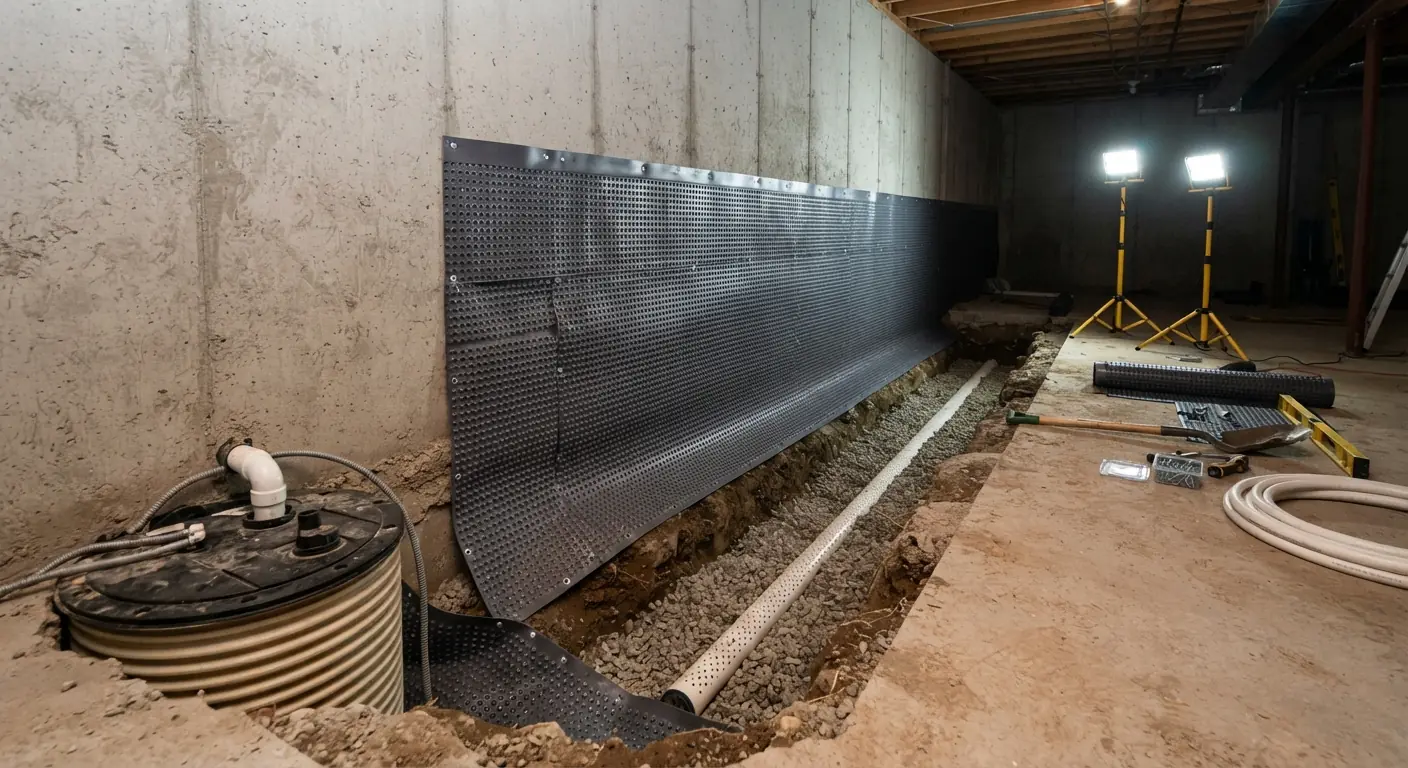
Most basement waterproofing jobs cost $6,000 to $12,000 for an interior system and $10,000 to $18,000 for exterior work.1 Small fixes cost less. A sealer runs $2 to $10 per square foot, and crack injection costs $250 to $800+ per crack.1 Your price moves with the length of leaking wall, your foundation type and the water pressure. Fix the water before you frame. Moldy carpet and ceiling tiles may have to be thrown away.2
TL;DR
- Price the perimeter. Drains and membranes are priced by the linear foot or by the square foot of wall, so two 1,000 sq. ft. basements with different shapes get different quotes.
- An exterior drain costs $30 to $90 per linear foot installed. Interior drain systems come as a $4,000 to $17,000 job total.1
- Sealers suit light dampness. They won't hold back water under pressure.1
- Start with gutters, downspouts and grading. Replacement downspouts cost $220 to $625, a fraction of any drain system.1
- Waterproof before you finish. A metro Denver finish runs $30,000 to $90,000 (one local builder's 2026 guide, checked September 2026), so the fix protects a much bigger spend.
What does basement waterproofing cost by method?
Each waterproofing method has its own price unit. HomeGuide's January 2026 cost guide puts sealers at $2 to $10 per square foot and membranes at $4 to $7 per square foot. Exterior drains run $30 to $90 per linear foot. Crack injection costs $250 to $800+ per crack. Interior drain systems cost $4,000 to $17,000 per job.1
| Method | Price unit | Typical price | Best for | Limits |
|---|---|---|---|---|
| Waterproof paint or sealer | Per sq. ft. of wall | $2 to $101 | Minor dampness, or an extra layer | Won't stop water under pressure |
| Epoxy crack injection | Per crack | $250 to $800+1 | Minor cracks that don't threaten the structure | Treats one crack at a time |
| Interior French drain (drain tile) | Per job | $4,000 to $17,0001 | Water at the floor edge, sent to a sump | Needs one or more sump pumps |
| Sump pump | Per install | $600 to $2,5003 | Pumping collected water away | Needs power, so consider a battery backup |
| Exterior drain | Per linear foot | $30 to $901 | Catching water before it reaches the wall | Excavation raises labor |
| Exterior membrane | Per sq. ft. of wall | $4 to $71 | A barrier on the outside face of the wall | Excavation around the house |
| Regrading | Per job | $1,000 to $5,0001 | Surface water that pools by the house | Often paired with other methods |
| Foundation leak repair | Per job | $250 to $5,000+ minor, $4,500 to $15,000+ major1 | Cracks, pipe gaps, failing mortar joints | Comes before other waterproofing |
Prices come from HomeGuide's basement waterproofing guide1 and its sump pump guide.3
Most jobs combine methods. HomeGuide's $6,000 to $12,000 interior range covers pumps, drains, sealers and crack filling. Its $10,000 to $18,000 exterior range covers grading, drains and membranes.1
Many cost pages lead with one national average. That single number blends a $250 crack repair1 with a full dig around the house. It can't tell you if your quote is fair. The per-unit prices can, once you know how much wall your contractor plans to treat.
How do you price waterproofing by the linear foot?
Measure the wall length that needs work, then multiply by the unit price. A 24-by-30-foot basement has 108 feet of perimeter. At HomeGuide's $30 to $90 per linear foot,1 an exterior drain around it works out to about $3,240 to $9,720. Membrane and landscaping come on top.
Shape changes the bill as much as floor area does. Two basements with the same 1,000 sq. ft. show it.
| Basement footprint | Perimeter | Exterior drain at $30 to $90 per linear foot |
|---|---|---|
| 25 by 40 feet (1,000 sq. ft.) | 130 feet | $3,900 to $11,7001 |
| 20 by 50 feet (1,000 sq. ft.) | 140 feet | $4,200 to $12,6001 |
| 24 by 30 feet (720 sq. ft.) | 108 feet | $3,240 to $9,7201 |
The footprints are examples. The drain rate is HomeGuide's,1 and the totals are simple multiplication. Run the same math on your own measurements.
Wall-area methods work the same way. At HomeGuide's rates,1 that works out to $400 to $700 of exterior membrane or $200 to $1,000 of sealer for every 100 square feet of wall. Your contractor measures wall height at the estimate. Ask for the square footage on the quote.
The drain rate alone understates a full exterior job. In a 2010 forum post, one contractor described a 35-linear-foot exterior repair. The crew dug down to the footing, waterproofed the outside of the wall, added a drainage protection layer and ran a drain to a sump. It cost $8,500 and took three days of hand digging and backfill.4 That works out to about $243 per linear foot. Treat 2010 prices as a guide to proportions only.
Interior systems price differently. HomeGuide gives a job range of $4,000 to $17,000 that moves with basement size and layout.1 In the same forum thread, an Iowa homeowner with a 720 sq. ft. block basement paid $4,300 in 2010. That bought an interior perimeter drain and a sump pump with battery backup.4 Ask your contractor to write the linear feet of drain on the quote. Then divide to compare bids per foot.
What drives a waterproofing quote up?
Quotes rise with foundation type, basement size, water pressure, excavation and repairs found along the way. Block and stone foundations cost more to waterproof than poured concrete. Digging around the house raises labor. Add-ons stack up fast, and mold remediation alone runs $1,500 to $15,000.1
Foundation type
Poured concrete is usually the easiest and cheapest to waterproof. Block walls have more seams and joints where water can enter. Stone foundations cost the most because of their irregular surfaces.1
Water pressure and entry points
Minor dampness costs less to fix than flooding. Homes with several entry points or strong hydrostatic pressure need bigger systems. High water tables and heavy rainfall push the price the same way.1
Digging and concrete cutting
Exterior methods need excavation around the perimeter, and that raises labor.1 Inside, a new sump pit in a concrete floor means a jackhammer or concrete saw. HomeGuide puts that install at $2,500 to $5,000, against $600 to $2,500 for a typical sump pump job.3
Repairs and cleanup
Major foundation leak repairs run $4,500 to $15,000+. Replacing sod and plants after exterior work adds $300 to $1,000+.1 If your contractor finds rot, mold or a bowed wall, the quote grows before any waterproofing starts.
Where you live
Labor and material prices vary by region. Urban areas with a higher cost of living usually pay more.1
Is waterproofing a basement worth it before you finish?
Yes, when water is getting in. Basement Remodeling Co.'s planning rule is to settle moisture before framing, because the finish costs far more than the fix. Most waterproofing runs $6,000 to $18,000.1 A metro Denver basement finish runs $30,000 to $90,000, per one local builder's 2026 guide (checked September 2026).
Finished walls fail in a known way. Building Science Corporation's BSD-103 digest says most interior insulation systems use moisture-sensitive materials such as fiberglass batts. They can't tolerate even minor groundwater leakage.5 A frame wall with insulation behind an interior plastic vapor barrier often leads to odor, mold, decay and corrosion problems.5 EPA puts the rest plainly. If you clean up mold but leave the water problem, the mold will most likely come back.2
Published finish ranges from other metros, all checked September 2026:
- Metro Atlanta: $45,000 to $80,000 for a typical full finish, from one Atlanta design-build firm's published range. See what finishing a basement in Atlanta involves.
- Colorado Springs: $30,000 to $75,000 for a typical 1,000 sq. ft. finish, from one local contractor's 2026 guide. See basement finishing in Colorado Springs.
- Fort Collins: $50,000 to $110,000 for a typical full finish, from one Colorado construction firm's published range. See basement finishing in Fort Collins.
So when is it worth paying? HomeGuide lists the warning signs: standing water or leaks, water stains, white or gray chalky residue, damp walls, musty odors, mold, bowed walls or warped doors, and cracks.1 If you see several of them, get the water fixed first. If you see none, your contractor may only need to confirm the walls are dry and the grading works.
Budget waterproofing as protection for the finish. HomeGuide says you may not recoup the full cost at resale.1 If your walls pass, the next step is planning the finish itself.
Should you waterproof your basement from the inside or outside?
Choose by where the water comes from and whether digging is practical. Exterior work stops water at the outside of the wall and typically costs $10,000 to $18,000. Interior systems collect water that gets in and pump it out for $6,000 to $12,000.1 Your contractor may recommend a mix of both.
The building-science case favors the outside. BSD-103 describes the traditional approach: barrier and control layers on the outside, with the wall drying to the inside.5 It also places the perimeter drain outside the foundation, wrapped in filter fabric.5
The practical case often favors the inside. Exterior work means excavating around the house, and you then pay again to replace sod and plants.1 An interior French drain is a trench in the basement floor with gravel and perforated pipe, tied to one or more sump pumps.1 Interior systems typically cost less because they skip the excavation.1
Contractors disagree, and homeowners hear both pitches. In a 2021 DC-area forum thread, waterproofing companies told one homeowner with groundwater seepage to excavate, seal and add an exterior French drain.6 Another poster in that thread said exterior drain tile is close to obsolete for existing homes.6 In a 2010 thread, a waterproofer with 20 years in the trade said water rising from below the house needs an interior French drain. The same poster put outside work at about double to triple the cost.4
Use this as a starting point for the conversation with your contractor:
| What you see | Likely direction | Why |
|---|---|---|
| Water enters at the wall-floor joint or rises through the floor | Interior drain and sump pump | The drain collects water where the slab meets the wall |
| One wall leaks, and the yard on that side is open | Exterior work on that wall | Stops the water at the wall with one run of digging |
| Water pools near the house after rain | Gutters, downspouts and grading first | The cheapest water to stop |
| A wall is bowed or has wide cracks | Structural check first | Leak repairs come before waterproofing |
One forum poster made the single-wall point directly: if one side of the basement has no drain and takes on water, exterior work would be best there.6 HomeGuide treats leak repairs as essential before other waterproofing.1 For how each system is built, read the guide to basement waterproofing methods.
Is it good to seal basement walls?
Sealing is good for light dampness and as an extra layer. It won't stop water under pressure. HomeGuide prices waterproof paint and concrete sealers at $2 to $10 per square foot, including labor and materials. It says they suit minor dampness and work as one layer in a larger system.1 Active leaks need drainage.
Check two things before you coat a wall you plan to finish.
First, check how the wall dries. For basement walls designed to dry to the inside, BSD-103 warns against impermeable interior wall finishes such as vinyl wall coverings and oil, alkyd or epoxy paint systems.5 These layers inhibit inward drying and typically lead to mold growth.5 Ask your contractor how the product you're buying affects drying, and how the finished wall will dry after framing.
Second, clean first. EPA says to clean up mold and dry the surface before painting. Paint applied over moldy surfaces is likely to peel.2
What is the cheapest way to waterproof basement walls?
Keep water away from the wall. Clean the gutters, extend the downspouts and slope the soil away from the foundation. ENERGY STAR lists all three steps, and EPA lists gutter care and grading.27 HomeGuide prices replacement downspouts at $220 to $625 and regrading at $1,000 to $5,000.1 Both cost far less than a drain system.
BSD-103 traces the idea back to the Romans: drain the site and drain the ground. Roof water should not soak the ground beside the foundation, and the grade should slope away from the house.5 ENERGY STAR adds two small habits. Keep gutters and downspouts clear, and water foundation plantings sparingly.7
On the wall itself, a sealer at $2 to $10 per square foot is the cheapest product. Epoxy injection at $250 to $800+ fixes a single minor crack.1
Surface fixes have a limit. They handle rain that runs toward the house. The Iowa homeowner in the 2010 thread had already routed the gutters away and regraded. The soil sank, and water still came in where the block wall met the floor.4 Groundwater at the footing needs a drain.
Can you seal your basement yourself?
You can seal and patch a basement yourself, and it helps with dampness. It rarely stops water that pushes in at the wall-floor joint. One Iowa homeowner patched holes with hydraulic cement and rolled on three coats of masonry waterproofer. Water still came in where the block wall met the floor.4
The homeowner's test was smart. They left the bottom 4 to 5 inches of wall unpainted.4 The next good rain showed exactly where the water entered.4 A reply in the thread explained why patches struggle: hydraulic cement only covers the surface while water pressure pushes from behind.4 In July 2010 the homeowner had an interior perimeter drain installed with a battery-backup sump pump. Three months later they reported no problems.4
Know where DIY stops:
- Mold: EPA says you can usually clean a moldy patch under about 10 square feet yourself. For more than that, or after heavy water damage, EPA points to its remediation guidance and an experienced contractor.2
- Structure: bowed walls and warped doors are on HomeGuide's warning list.1 Have a licensed contractor or structural engineer look at them before any sealer goes on.
- Sump pumps: HomeGuide notes that experienced plumbers install sump pumps.3 A new pit in a concrete floor also means cutting the slab.
What a good waterproofing quote shows
A good quote names where the water enters, the method for each wall and the measurements behind the price. It lists the feet of drain, the square feet of membrane or sealer, the crack count, the sump pump, the digging and the cleanup. Those numbers let you compare bids line by line, alongside the checks in how to choose a basement contractor.
Ask these questions at the estimate:
- How is water getting into my basement?
- Which methods do you recommend for my basement, and why?
- Are there structural problems that could cause the walls to fail?
- Does the estimate cover materials, labor, delivery fees and cleanup?
- Will I get an itemized estimate, contract and warranty in writing before work begins?1
- How many linear feet of drain and how many square feet of wall does the price cover?
- Does the sump pump have a battery backup for power outages?3
Plan for upkeep too. HomeGuide lists sump pump maintenance plans at $100 to $250 per year.3
When you're ready, Basement Remodeling Co. matches you with one vetted, licensed basement contractor for your metro. The contractor checks moisture at a free on-site estimate and gives you a written, itemized quote. Nothing starts until you sign. Read how basement waterproofing fits into a finish, find a basement contractor by ZIP code or request your free quote.