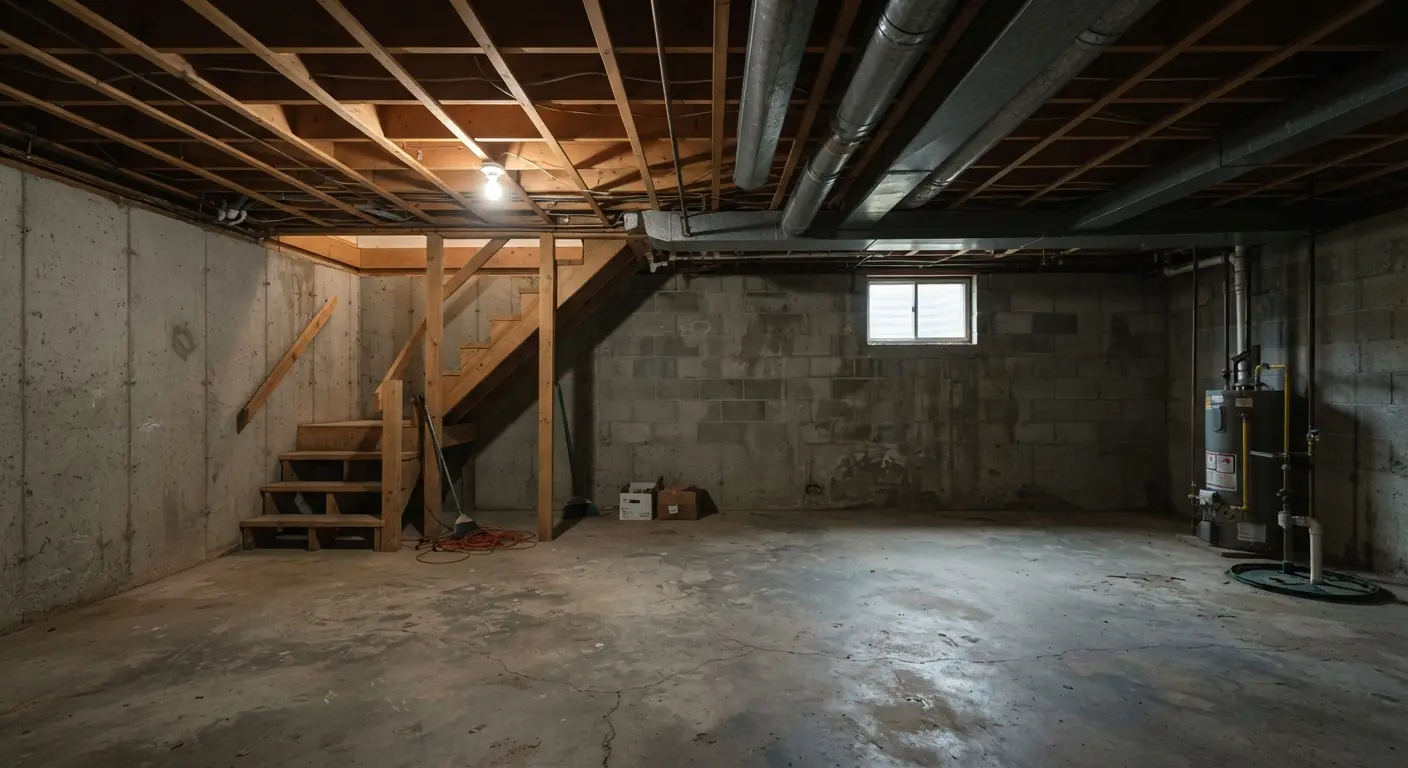
Painting an open-joist basement ceiling is a manageable DIY job if you spray it. Finish any wiring first, clean the joists and mask the room. Then spray a bonding primer and a flat or eggshell latex. The other route is a water-based dryfall paint, whose overspray dries before it hits the floor.1 Buy paint for the joist sides as well as the floor area, because they add a lot of surface.
TL;DR
- Spray the ceiling. A brush and roller leave small misses on every joist, pipe and wire.2
- For one small room, a cheap handheld sprayer can do the work. For hundreds of square feet, rent an airless sprayer.2
- Dryfall pays off on a big ceiling over floors or walls you can't fully protect, as long as you want a light color. Latex over a bonding primer handles any color, black included.1
- Count both sides of every joist when you buy paint. In the worked example below, the joists more than double the area.
- One blogger's DIY ceiling cost about $575 with a $300 sprayer.1 HomeGuide lists painters at $20 to $50 per hour.3
Is painting your basement ceiling a good idea?
Yes, for most unfinished basements where you want headroom, access and a low cost. Paint keeps every inch of height and leaves pipes, wires and ducts reachable for repairs. It also pulls mismatched materials together under one color. Expect an industrial look, and less sound control if you pull out the insulation between the joists.14
Speed is the other draw. One DIY blogger sprayed her whole basement studio ceiling in about 3 hours, breaks for drying included, and noted drywall would have taken days.1 She kept access to pipes she knew would need work later. She also noted that bare joists give pests nowhere to live.1
Height decided it for a second blogger. Her basement had a ceiling height of 6 feet 7 inches, with plumbing and HVAC ducts across it.4 She didn't like how a drop ceiling would look, and she was advised against drywall that blocked the water lines. Paint let her keep the height.4
Here is how painted joists compare with the two covered options on cost and access.
| Ceiling | What you see | Access to pipes and wires | Cost per square foot | Source and scope |
|---|---|---|---|---|
| Painted exposed joists | Joists, pipes and ducts in one color | Open | About $0.77 in DIY materials, sprayer excluded1 | One blogger's own math for her room |
| Drop ceiling | Grid and tiles hung below the joists | Tiles lift out | $4 to $20 installed3 | HomeGuide national cost guide, 2023 |
| Drywall ceiling | Flat finished surface | Closed | $2 to $4 installed3 | HomeGuide national cost guide, 2023 |
The painted figure is one household's materials. The other two are installed prices, so they include labor. The basement ceiling options guide walks through all the choices in more depth.
Can you leave a basement ceiling exposed?
Yes. Painted open ceilings are common on commercial jobs, and the ductwork, wiring and plumbing up there take paint without trouble.2 Check two code points before you commit: minimum ceiling height and fire separation. Both come from the 2021 International Residential Code, and local adoption and amendments vary.
On height, section R305.1 of the 2021 International Residential Code requires habitable basement space to have a ceiling of at least 7 feet.5 Beams, girders, ducts and other obstructions may project down to within 6 feet 4 inches of the finished floor.5 An exposed ceiling adds nothing below the joists. A drop ceiling needs at least 3 inches of clearance between its framework and the joists, and more around pipes and ducts.3 In a tight basement, those inches decide whether a room counts as habitable.
Fire separation matters if the basement becomes a second unit. Section R302.3 of the 2021 International Residential Code requires dwelling units in a two-family dwelling to be separated by wall and floor assemblies with at least a 1-hour fire-resistance rating. A 1/2-hour rating is allowed where the building has an automatic sprinkler system throughout.5 Paint on bare joists isn't a tested fire-rated assembly. If you're planning a basement apartment or in-law unit, ask your contractor and building department what your ceiling needs before you paint.
Insulation between the joists is a judgment call. The second blogger covered her exposed insulation with Thermo Pan, cut to fit, and painted it.4 The first blogger pulled hers out, and said in a reply that insulation helps with sound absorption from the floor above.1
If the ceiling is one part of a full basement finishing project, your contractor pulls the permit and books the inspections.
What kind of paint do you use on a basement ceiling?
Use an interior latex in flat or eggshell over a bonding primer, or a water-based dryfall paint. The primer is what makes latex grip wood, copper, PVC, wiring and metal ducts on one ceiling. Keep the sheen low, because higher sheens show every flaw on a busy ceiling.12
The primers named in the DIY write-ups were Zinsser 123 and Kilz Adhesion.14 The first blogger sprayed three coats of primer to get full coverage before any color went on.1 Bill Wichers, an expert member on Green Building Advisor, recommends flat or at most a step or two above it.2
Color changes the primer.
- White or light colors: Seal the wood first with a shellac-based primer. Without it, knots and yellow tannins from the pine framing bleed through. White also needs more coats.1
- Black or dark colors: Prime everything anyway, and tint the primer gray for better coverage.1 One blogger went dark in her 6 foot 7 inch basement with a satin finish from the Sherwin-Williams Emerald line.4
- Concrete sections: Where part of the ceiling is concrete, Peter Engle on Green Building Advisor suggests a masonry paint, which adheres better than latex.2
A real paint store helps here. Tell the staff what surfaces you have and they can recommend a paint that works on them.2
Is dryfall paint worth it?
Dryfall is worth it on a large ceiling over a room you can't fully clear, as long as you want a light color. Its overspray is dry by the time it reaches the floor, so cleanup is far easier. The cost is coverage: about 75 square feet per gallon, by one veteran painter's estimate.1
That estimate comes from a commenter on the first blogger's post who described 40 years as a professional painter. He suggested water-based dryfall in place of primer plus top coats. He said it can be tinted to light colors and is sold by Sherwin-Williams in 5-gallon buckets. He added that water-based dryfall can go on galvanized surfaces without a primer.1
| Water-based dryfall | Latex over bonding primer | |
|---|---|---|
| Primer | Can go on galvanized surfaces without primer1 | Primer first so paint sticks to mixed surfaces1 |
| Overspray | Dry before it reaches the floor1 | Wet, so tarp everything1 |
| Colors | Tints to light colors1 | Any color, including black14 |
| Coverage reported | About 75 square feet per gallon, joist area counted1 | About 2 to 3 gallons for three coats in a 12 by 25 foot room, after priming1 |
| Best fit | Big ceilings over finished floors or walls | Dark ceilings and rooms you can empty and tarp |
The two coverage numbers come from different jobs, so read them with care. The dryfall figure is a rough rule that counts the joist sides. The latex figure is one room where three coats of primer had already soaked into the wood.1 For dark colors in dryfall, the painter's comment gives no guidance, so ask the paint store before you plan a black dryfall ceiling.
What is the best paint sprayer for painting a basement ceiling?
For most open-joist basements, renting an airless sprayer is the fastest route for a one-time job. For a single small room of a few hundred square feet, a cheap handheld HVLP sprayer can do the work if you thin the paint.2
| Sprayer | Suits | Price reported | Watch for |
|---|---|---|---|
| Cheap handheld or HVLP, such as a Wagner Power Painter | A small job, like one reader's 400 square foot basement | Under $1002 | Thin the paint. A cup pointed up may not feed and can leak.2 |
| Larger DIY sprayer bought for the job | A 12 by 25 foot room | About $3001; a reader found a sprayer for $204 on a weekly store special1 | The stock hose tangles, so a flexible hose helps.1 |
| Rented airless sprayer | Hundreds of square feet2 | Ask the rental counter | An extension on the gun lets you work from the floor.2 |
The first blogger already owned a small sprayer and bought a bigger one for the ceiling. Holding a bucket of paint overhead and refilling it every few minutes didn't appeal. She called the bigger sprayer worth every penny.1
Bill Wichers, an expert member on Green Building Advisor, describes how commercial jobs are usually done. A painter in a Tyvek suit walks the floor with an extension on the sprayer to get closer to the ceiling.2 Clean the nozzle with a wire brush as you go.1
Is it better to roll or spray paint a ceiling?
Spray an open-joist ceiling and keep the roller for touch-ups. Joists, pipes and wires create edges everywhere, and a brush and roller leave small misses on all of them. A mini roller makes sense only for a small area.2
The second blogger painted a 650 square foot ceiling and said they would never have finished by brush or roller. After spraying, they went back with a brush and a small roller for the spots that were missed or thin.4
A flat drywall ceiling is a different job. With no joists or pipes to wrap around, a roller works well there.
How much paint does an open-joist ceiling take?
Measure the floor area, add both sides of every joist, then divide by your paint's coverage rate. A veteran painter's rule for dryfall is about 75 square feet per gallon with the joist area counted.1 Multiply the result by the number of coats you plan.
A worked example
The measurements here are an example. Use your own tape measure.
- Floor area: the first blogger's room was about 12 by 25 feet.1 That works out to 300 square feet.
- Joist sides: say you count 19 joists, each 12 feet long and 9 inches (0.75 feet) deep. Both sides of every joist work out to 19 × 2 × 12 × 0.75 = 342 square feet.
- Total per coat: 300 + 342 works out to 642 square feet.
- Dryfall: the painter's rule is about 75 square feet per gallon.1 At that rate, 642 square feet works out to about 8.6 gallons per coat.
What real jobs used
The first blogger's 12 by 25 foot room took about 2 to 3 gallons of latex for three coats. She reported about 3 gallons in one reply and about 2 in another.1 Her primer went on first, and the wood soaked up a lot of it, so the color coats needed much less paint.1 The second blogger's 650 square foot ceiling went through four cans of primer and two gallons of paint.4
Those reports sit far below the dryfall math. Budget from the 75 square foot rule if you use dryfall, because it counts the joist sides and comes from someone who sprayed it for a living. For latex, apply the coverage printed on your can to the full surface area, joists included.
How do you prep, mask and spray an open-joist ceiling?
The job runs in seven steps: finish rough-in work, clean, mask, suit up, prime, spray and touch up. Timing varies a lot. One blogger sprayed a 12 by 25 foot room in about 3 hours. Another needed four very long days for a 650 square foot ceiling with many coats.14
1. Finish wiring and plumbing first
Do the electrical work before you paint. The first blogger rewired her room after painting and said she'd reverse the order next time.1 Hire a licensed electrician for new circuits or rerouted wiring. If a gas line runs across the joists, mark it. The blogger said she would tag gas lines with a small label.1 Keep paint off gas valves, shutoff handles, smoke alarms and equipment labels.
2. Clean the joists
Go over everything with a wand-type duster, then vacuum with a brush attachment.2 A broom and shop vacuum also work. Compressed air cleaned best for one blogger, but it made a huge mess.1
3. Mask the room
- Remove everything you can, and tarp whatever stays.1
- Cover the floor. Contractor's paper is a good idea over nice flooring.1
- Tarp the window and shut every door in the room. Wrap switched-off lights in plastic bags.1
- Take off switch plate covers, and remove or tape baseboard and trim you're not painting.4
- Protect finished walls with plastic.1
- In older houses with gaps in the floor boards, tape the gaps so paint doesn't come through upstairs.1
4. Protect yourself
Wear goggles, a respirator, gloves and coveralls. Shoe covers stop you tracking dried paint around the house.1 A hat keeps paint out of your hair.4 Overspray falls on you the whole time, so plan for it.
5. Prime, unless you're using dryfall
Spray the bonding primer and let each coat dry. Move quickly. If you stay in one place too long, you get drips.1
6. Spray the color
Move your arm and keep your wrist still.1 Spray the first coat in one direction and the second coat across it for even coverage. If the paint spits, thin it a little.4 In the first blogger's basement, each coat took about 30 minutes to dry.1
7. Touch up
Walk the room with a brush and small roller and fill any spot the sprayer missed.4 The first coat may drip, and a brush smooths the drips.1
How much does it cost to have a basement ceiling painted?
Expect a painter to bill $20 to $50 per hour, or $1 to $6 per square foot, based on HomeGuide's 2023 figures for painting a drop ceiling grid and tiles.3 An open-joist ceiling has more surface than its floor area, so expect the price to be set once someone measures it. One blogger's DIY job cost about $575.1
Here is what that DIY money bought, at the prices in her post, which search results date to 2019.
| Item | Cost |
|---|---|
| Paint sprayer | $3001 |
| Primer (5-gallon bucket) | $841 |
| Paint (5-gallon bucket) | $1501 |
| Drop cloths | $121 |
| Paint respirator | $301 |
| Total | About $5751 |
Source: the first blogger's own list.1 She put the materials at about $0.77 per square foot with the sprayer left out.1 The sprayer carries over to later projects.
For a hired job, other trades can add to the bill. HomeGuide's 2023 figures list these rates.3
| Trade | Rate | When you'd need it |
|---|---|---|
| Painter | $20 to $50 per hour, or $1 to $6 per square foot (grid and tile painting)3 | The painting itself |
| Handyman | $50 to $80 per hour3 | Small fixes before painting |
| Electrician | $40 to $100 per hour, plus a $75 call-out fee3 | Rewiring before you paint |
| General contractor | $50 to $150 per hour3 | When the ceiling is part of a larger remodel |
HomeGuide's per square foot painter rate covers a drop ceiling grid and tiles, which is a flatter surface than joists. Budget from the hourly rate for an open-joist ceiling, since joist sides add hours that a floor-area price can miss. If the ceiling is one piece of a bigger basement remodeling project, expect it to be priced inside that quote.
What a good quote for a painted ceiling shows
A good quote spells out the surface area with joist sides included, the primer and paint by product name, and the number of coats. It lists what gets masked and what stays bare. It says who handles wiring changes first. It also says whether the price is hourly or per square foot, a question HomeGuide suggests asking.3
Ask these before you sign:
- Is the square footage the floor area, or floor plus joist sides?
- Dryfall or latex over primer? Which primer, and how many coats?
- How will finished walls, floors, windows and lights be protected?
- Which items stay unpainted, such as gas valves, labels and smoke alarms?
- Does the price include rewiring or pipe moves, or are those separate trades?
- Do you charge an hourly rate or by the square foot?3
If the ceiling is part of a larger basement project, Basement Remodeling Co. matches you with one vetted, licensed basement contractor. That contractor gives you a free on-site estimate and a written, itemized quote, and nothing starts until you sign. You can get a written quote for your basement ceiling or find the contractor for your ZIP code. Local pages cover basement finishing in Denver and basement finishing in Atlanta.