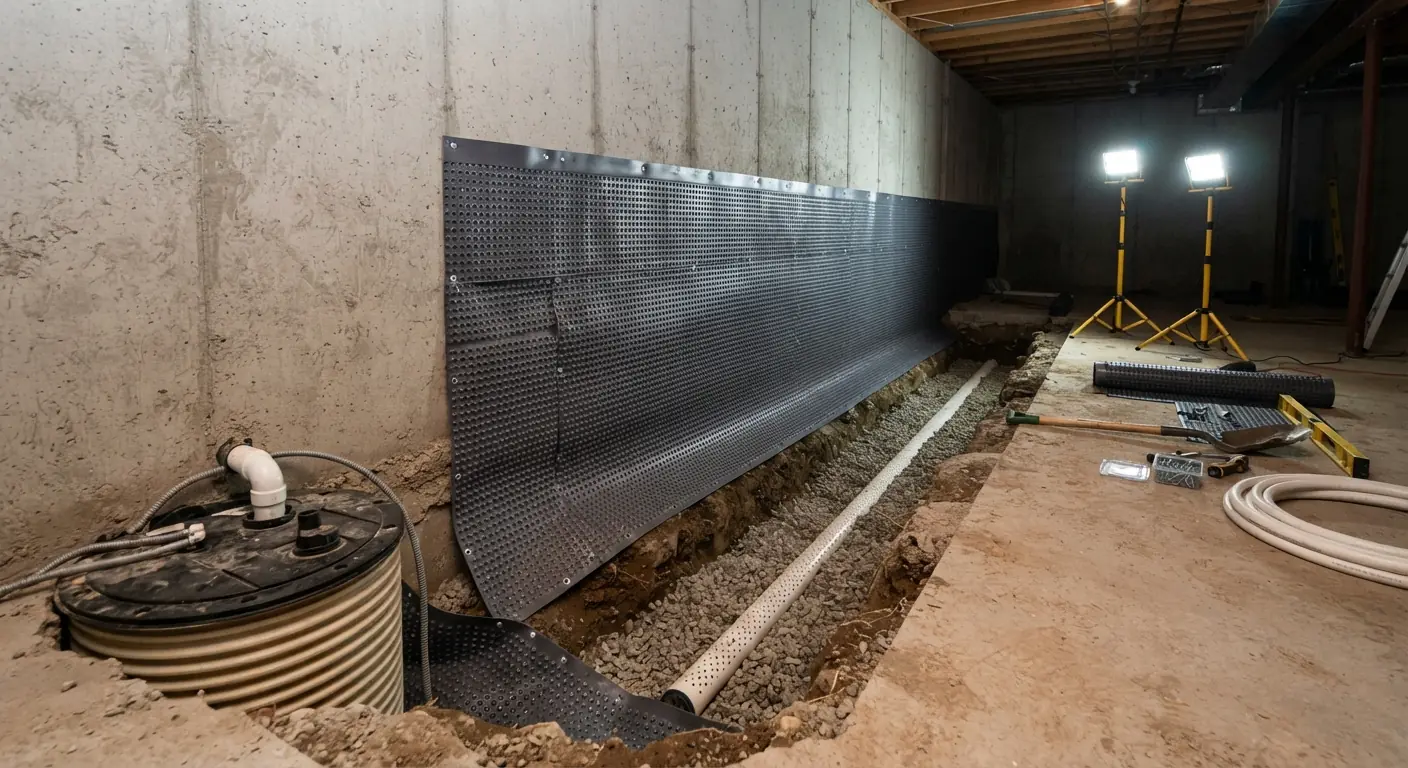
Yes. Use drywall labeled both mold resistant and moisture resistant on basement walls. At Lowe's online prices, that upgrade works out to about $7 to $10 more per 4 by 8 sheet than regular board.1 The label still matters less than two other jobs. Keep water out of the basement. Then keep the bottom edge of every sheet off the concrete floor, because a leak reaches the bottom of the wall first.2
TL;DR
- Buy panels labeled both mold resistant and moisture resistant for finished basement walls. On September 29, 2026, Lowe's listed CertainTeed M2Tech at $23.58 and Gold Bond PURPLE XP at $25.98 per sheet, against $16.38 for regular board.1
- Face color is a brand choice. Read the printed label and the test it names, such as ASTM D3273 for mold.1
- Hang the board with a gap above the slab and cover the gap with trim that tolerates water. The gap keeps the sheet out of the shallow water a leak or backup leaves on the floor.34
- Put foam insulation against the concrete and leave plastic sheeting out of the wall. Foam keeps humid air off the cold wall and still lets the wall dry inward.2
- Fix water and humidity first. EPA advises keeping indoor humidity below 60 percent, ideally 30 to 50 percent.5
Should you use moisture-resistant drywall in a basement?
Yes, for most finished basements. Basement air tends to run damper than the floors above, and in summer warm indoor air can condense on the cold concrete walls.32 A panel rated for moisture and mold gives the wall more margin in that air.1 It costs a few dollars more per sheet. No panel will rescue a basement that leaks.6
Building codes in the US are adopted and amended locally, and your permit sets the rules for your job.
Joseph Lstiburek's BSD-103 digest on basements explains the physics. Concrete below grade stays cold because it touches the ground. The worst season is summer, when warm moist air meets basement surfaces that sit below its dew point.2 The rim joist, where the floor framing sits on the foundation, stays cold in winter too.2 Your drywall hangs in front of that cold wall.
Opinions on the question split in builder forums. One Fine Homebuilding forum member wrote in 2007 that he would use moisture-resistant drywall even with no sign of water, because "Most basements will have a higher humidity level than most houses."3 He added a story about a homeowner who said her basement was "always dry" as the automatic dehumidifier kicked on.3 A 2011 forum post put the other side plainly. If the basement is dry enough for drywall, regular board is fine. If it isn't, "nothing you hang on the studs will make it so."6
Both posters are right. The rated panel costs little and adds margin against damp air. Water on the floor needs a different fix.
What's the difference between moisture-resistant and mold-resistant drywall?
Moisture-resistant drywall is made for rooms with moisture exposure, such as bathrooms. Mold-resistant drywall adds protection against mold and mildew growth, and Georgia-Pacific ties its ToughRock claim to a lab test, ASTM D3273. Many panels now carry both labels. For a basement, buy a panel whose label names both.1
Several specialty panels on Lowe's drywall pages carry both claims in the product name.1 CertainTeed says its M2Tech board "combines moisture and mold resistance" and is built for interior walls and ceilings "where enhanced mold resistance is preferred."1 Georgia-Pacific says its ToughRock Fireguard board gives extra protection against mold and mildew compared with traditional paper-faced board in high-humidity areas.1 Both descriptions are about damp rooms. None of these listings claims a board survives standing water.
| Panel | Example at Lowe's | What the label claims | Price per 1/2 in. 4 by 8 sheet | Extra over regular (our arithmetic) |
|---|---|---|---|---|
| Regular | CertainTeed Regular | Standard interior board | $16.381 | None |
| Mold and moisture resistant | CertainTeed M2Tech | Mold resistant, moisture resistant | $23.581 | $7.20 |
| Mold and moisture resistant | Gold Bond PURPLE XP | Mold resistant, moisture resistant | $25.981 | $9.60 |
| Paperless | Ask your contractor | Check the maker's spec sheet | Priced at your estimate | Priced at your estimate |
Prices are Lowe's online prices, checked September 29, 2026. Lowe's notes that its local stores do not honor online pricing.1
Green board, purple board and blue board
Green board is the old trade name for moisture-resistant board with a green face paper. Today the color tells you the brand more than the rating. Gold Bond sells PURPLE XP, labeled mold resistant and moisture resistant. American Gypsum's M-Bloc makes the same two claims with a "mold and moisture resistant blue face paper."1 Read the printed label and the spec sheet. A green, purple or blue face proves nothing by itself.
Paperless drywall
Paperless panels swap the paper facing for a fiberglass mat. Paper is organic. Mold breaks down organic matter, and it starts growing indoors when spores land on a wet surface.5 Removing the paper removes that food source from the face of the board. One homeowner on the Fine Homebuilding forum chose paperless board to rebuild a basement office after a sewer backup.3 Ask your contractor to price it next to a mold- and moisture-resistant panel.
Why the gap at the floor matters more than the board
Basement Remodeling Co.'s view is simple: the bottom inch of the wall decides whether basement drywall lasts. Water from a leak, a backed-up drain or a failed appliance spreads across the slab first. Board that touches the concrete wicks that water upward. A small gap, covered by water-tolerant trim, keeps the sheet's edge out of shallow water.34
BSD-103 says the finishes on the lower part of basement walls should be chosen with flooding in mind. It names "leaky appliances, failed plumbing, overflowing sinks, or exterior surface flooding."2 Most of those put water on a basement floor first.
The Fine Homebuilding story shows the stakes. The poster had a "completely dry" basement office until the sewer backed up. He wrote that "only 1 inch of water can ruin a whole wall" of drywall.3 His rebuild put 2-inch strips of Hardie tile backer along the floor to stop future wicking, with paperless drywall above. The baseboard hid the extra seam.3 A 2018 woodworking forum answer was shorter: "Put some kind of PVC trim around the base to cover the gap."4
Speed matters once water gets in. EPA says wet materials dried within 24 to 48 hours usually won't grow mold.5 Porous materials that do go moldy may have to be thrown away, because mold fills their crevices and may be impossible to remove.5 HomeGuide puts mold remediation at $1,500 to $15,000.7 Next to that, a gap at the floor and a per-sheet upgrade that works out to $7.20 to $9.60 at Lowe's online prices are cheap insurance.1
Your contractor sets the gap size and the trim detail. Ask to see both in the quote.
What type of drywall is best for basements?
For most finished basements, the best choice is a panel labeled both mold resistant and moisture resistant, hung with a gap at the floor. Consider paperless board on the lower wall where water has reached the floor before. Regular board suits only a basement that stays dry all year.6
The right call depends on what your basement has already shown you.
If the basement has always been dry
Buy the rated panel anyway. At Lowe's September 2026 online prices, the upgrade works out to $7.20 to $9.60 per sheet, or $72 to $96 across 10 sheets.1 A dry basement can still take a burst pipe or a sewer backup. The forum homeowner with the "completely dry" office lost a whole wall to one sewer backup.3
If the air is damp or the walls sweat
Dry the air before you hang anything. EPA's target is indoor humidity below 60 percent, ideally 30 to 50 percent, and a humidity meter costs $10 to $50.5 ENERGY STAR says humidity above the 30 to 50 percent range may promote mold growth.8 Its sizing guide for portable dehumidifiers in spaces under 2,000 square feet looks like this:8
| Basement condition | Relative humidity | Dehumidifier capacity, pints per day |
|---|---|---|
| Slightly to moderately damp, musty odor at times | 50 to 75 percent | 20 to 308 |
| Very damp, damp spots on walls and floors | 75 to 90 percent | 25 to 408 |
| Wet, walls or floor sweat, or seepage present | 90 to 100 percent | 30 to 508 |
ENERGY STAR advises buying a bigger unit over a smaller one. In a basement that stays below 65 degrees F, pick a model rated for low temperatures, because frost can form on the coils.8 A hose to a floor drain or sump saves you emptying the bucket.8 HomeGuide puts a portable unit at $130 to $300 and an installed whole-house unit at $1,500 to $3,500.7 Our basement dehumidifier sizing guide walks through choosing a unit.
If walls or the floor show seepage, a dehumidifier treats the symptom. Fix the water first.
If the basement has taken water
Fix the water before anyone frames a wall. HomeGuide's January 2026 guide puts interior waterproofing at $6,000 to $12,000 and exterior waterproofing at $10,000 to $18,000 on average.7 Our comparison of basement waterproofing methods explains which approach fits which leak. When you need the work done, start with waterproofing before you finish the basement.
After the water is under control, use the rated panel everywhere and consider paperless board on the lower wall. Keep the gap at the floor in every case.
What is the best moisture barrier for basement walls?
For a basement finished on the inside, the best moisture control is foam insulation against the concrete, with no plastic vapor barrier behind the drywall. BSD-103, Joseph Lstiburek's basement digest, says interior plastic stops the wall drying inward and often leads to odor, mold, decay and corrosion. The foam keeps humid room air off the cold concrete.2
The digest splits the job in two. Outside the wall, water control starts with gutters, ground that slopes away from the house and a perimeter drain. The wall is damp-proofed on the exterior, and a capillary break over the footing stops "rising damp."2 EPA gives the same advice on grading and gutters.5
Inside the wall, the digest recommends foam because it allows drying, tolerates moisture and does not support mold.2 It lists four foam options that meet its drying requirements:2
- Up to 2 inches of unfaced extruded polystyrene (R-10)2
- 4 inches of unfaced expanded polystyrene (R-15)2
- 3 inches of closed-cell spray foam (R-18)2
- 10 inches of open-cell spray foam (R-35)2
A stud wall can sit in front of rigid foam, with unfaced fiberglass or damp-spray cellulose in the cavity and no vapor barrier.2 The rim joist needs air-impermeable insulation. Spray foam must be covered with a fire or ignition barrier.2 The digest also rules out vinyl wall coverings and oil, alkyd or epoxy paint on basement walls, because they block inward drying.2 Our guide to rigid foam on basement walls has more on the board options.
BSD-103 dates from October 25, 2006, and it notes that many jurisdictions make basement insulation a code requirement.2 Required insulation levels are set locally, so your contractor confirms them with the permit.
Waterproof paint and sealers on bare concrete are a smaller tool. HomeGuide prices them at $2 to $10 per square foot and says they won't stop water under pressure.7 They suit minor dampness.
What to ask your contractor about basement drywall
Ask four things before framing starts: which panel goes on the walls, how big the gap at the floor is, what trim covers it, and what sits between the drywall and the concrete. A good written quote answers all four with product names. A quote that says only "drywall" leaves the most important choices open.
Useful questions for the estimate:
- Which panel, by brand and product line, goes on the basement walls and any basement bathroom?
- What gap do you leave at the floor, and what baseboard covers it?
- What insulation goes against the concrete, and is there any plastic sheeting in the wall?
- How will you insulate the rim joist?
- What did the moisture check find, and what has to be fixed before framing?
Basement Remodeling Co. sends your request to one vetted, licensed basement contractor for your metro. The contractor checks moisture and ceiling height at a free on-site estimate, then gives you a written, itemized quote. Your contractor pulls the permit and books the inspections. When the water plan makes sense, get a written quote for finishing your basement, or find the contractor who covers your ZIP code.
Local climate and soils change the moisture picture. See basement finishing in metro Atlanta, finishing a basement in Denver, basement finishing in Colorado Springs or basement finishing in Fort Collins. If you're replacing wet drywall in a basement that's already finished, read about remodeling a finished basement.