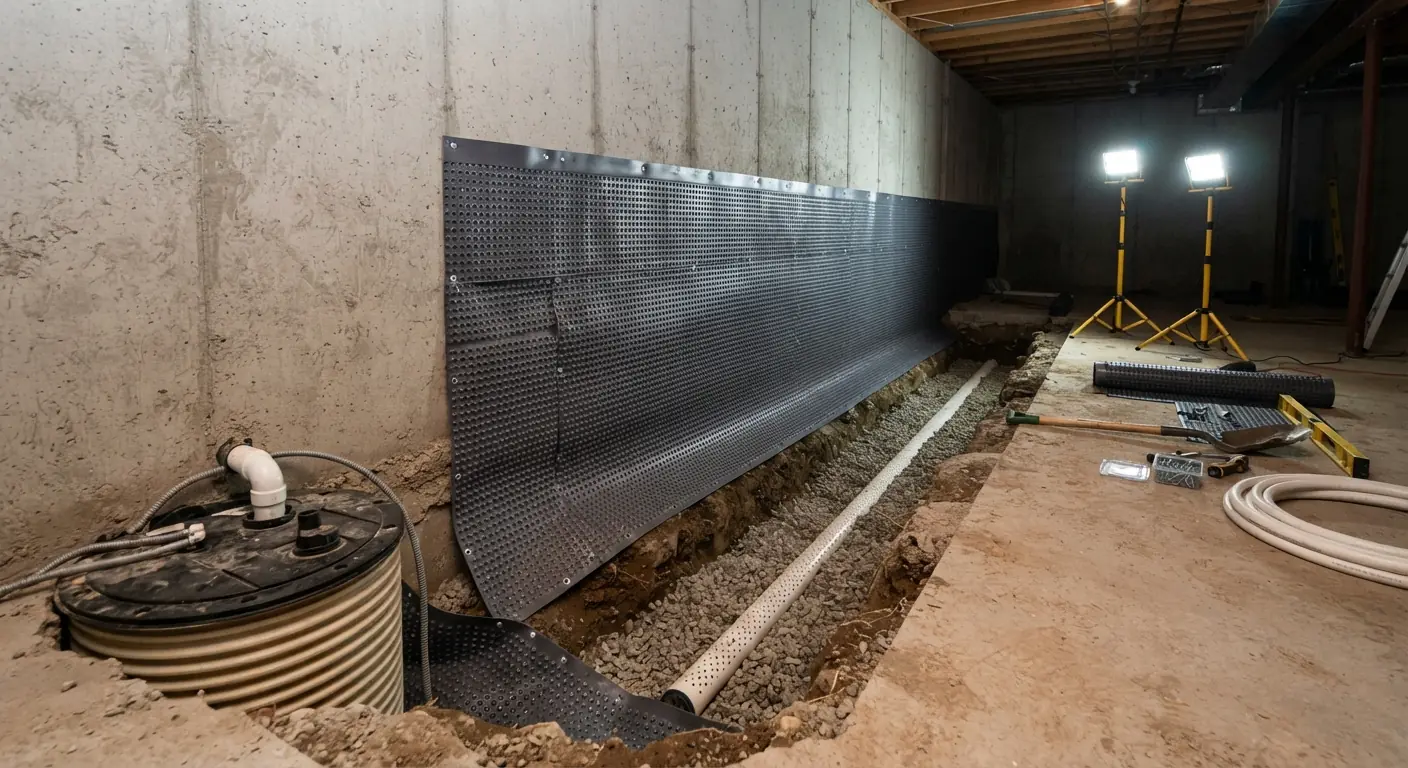
Waterproofing from the outside stops water before it reaches your foundation wall.1 It's also the most expensive and disruptive option. Your contractor digs down to the footing, seals the wall and lays new drainage, which averages $10,000 to $18,000.1 Try the cheap fixes first: grading, gutters and downspouts.2 If water still gets in, weigh a full dig against an interior drain and sump pump, which avoids the excavation.
TL;DR
- Exterior waterproofing averages $10,000 to $18,000, and interior systems average $6,000 to $12,000.1 Budget extra to put the yard back afterward.1
- Fix the surface water first. Clean gutters, extended downspouts and soil that slopes away cost far less than a dig, and regrading is sometimes enough on its own.1
- Dig when water is pushing through the walls and you want it stopped before it reaches the foundation, or when the yard is being redone anyway.3 Choose an interior drain and sump pump when an excavation isn't practical.
- Budget an exterior membrane at 10 to 15 years.1
- Settle the water before anyone frames or insulates the walls. Once drywall is up, fixing a leak means opening finished work.
How much does it cost to waterproof a basement from the outside?
Exterior basement waterproofing averages $10,000 to $18,000, according to HomeGuide's January 2026 cost guide.1 That price covers grading, drains and membranes. It moves with your basement's size, the foundation type, how bad the water problem is and where you live. Putting sod and plants back afterward adds $300 to $1,000 or more.1
HomeGuide also prices the job line by line. Use these averages to check the shape of a quote, not to predict your exact bill.1 For every method side by side, see the basement waterproofing cost guide.
| Line item | HomeGuide average | What it pays for | Needs a trench to the footing? |
|---|---|---|---|
| Waterproof membrane, liquid or sheet | $4 to $7 per square foot installed1 | An impermeable barrier between the foundation and the soil | Yes |
| Exterior French drain | $30 to $90 per linear foot installed1 | A drain that catches water before it reaches the wall | Yes |
| Regrading around the house | $1,000 to $5,0001 | Reshaping soil so water runs away from the foundation | No |
| Replacing downspouts | $220 to $625 total1 | Moving roof water away from the basement | No |
| Landscaping after the work | $300 to $1,000+1 | Replacing sod and plants dug up for grading or drains | No |
| Foundation leak repair | $250 to $5,000+ minor, $4,500 to $15,000+ major1 | Fixing cracks, gaps around pipes and failing mortar joints | Sometimes |
A worked example
Here's how those unit prices stack up on an example house. The house is invented. The unit prices are HomeGuide's, and the totals are our own arithmetic.1
- The house has 150 feet of foundation wall, 8 feet from grade to footing, which works out to 1,200 square feet of wall to coat.
- At $4 to $7 per square foot, the membrane works out to $4,800 to $8,400.
- At $30 to $90 per linear foot, a drain along 150 feet works out to $4,500 to $13,500.
- Together that works out to $9,300 to $21,900 before landscaping.
HomeGuide's $10,000 to $18,000 average sits inside that range.1 By our math, most of the spread comes from the drain: the membrane swings by $3,600 from low to high, while the drain swings by $9,000. So when two quotes are far apart, ask each contractor to explain their drain price per foot first.
What pushes the price up
- Foundation type. Poured concrete is usually easier and cheaper to waterproof than block, which has more seams and joints. Stone costs the most because of its irregular surface.1
- Where the water goes. The drain needs an outlet. If it can't run to daylight or a storm system, it has to be pumped out.4 A sump pump averages $600 to $2,500 installed.5
- Where you live. Labor and material costs vary by region, and homes with high water tables or heavy rainfall may need bigger systems.1
- Damage already done. If water has been getting in for a while, mold remediation runs $1,500 to $15,000 on top.1
What does exterior waterproofing involve?
Your contractor excavates around the house down to the footing, repairs the exposed wall, coats it, adds a drainage layer and a perimeter drain, then backfills and regrades. The work needs heavy equipment.3 Expect the strip of yard along the foundation to be dug up until the trench is closed.
Here's the sequence, and what to ask about at each step.
1. Dig to the footing
The trench runs the full height of the wall. A contractor on one trade forum advises going a few inches deeper, to the bottom of the footing or slightly below it, so the drain can pull water away from the wall.4 Plantings, walkways and anything else tight against the house are in the way and may need to come up.
2. Clean and repair the wall
With the wall exposed, cracks, gaps around pipes and failing mortar joints get fixed before any coating goes on. HomeGuide calls these repairs essential before other waterproofing work.1
3. Coat the wall
There are two levels of coating, and your quote should say which one you're getting. Building Science Corporation's basement guidance calls for the outside of the wall to be damp-proofed and vapor-proofed, often with a fluid-applied bitumen coating.6 A liquid or sheet waterproofing membrane goes further. It forms an impermeable barrier between the foundation and the soil.1
4. Add a drainage layer
The same guidance calls for free-draining backfill or a drainage board or mat, so water that reaches the wall runs down to the perimeter drain.6 One contractor on the forum says an insulating drainage board keeps pressure from building against the walls.4
5. Lay the perimeter drain
The drain sits outside the foundation and is wrapped in filter fabric to keep soil out.6 One contractor describes 4" perforated PVC set in rock with separator fabric, beside the footing and not on top of it.4
Then the water needs somewhere to go: daylight, a storm system or a sump that pumps it out.4 Contractors in the same thread warn against counting on a dry well, because it fills up when the ground is saturated, which is exactly when you need it. They also say to keep downspout water out of the foundation drain, or a heavy rain floods the foundation.4
6. Backfill and grade
When the soil goes back, the yard and flower beds should slope away from the house.3 Building Science Corporation also recommends an impermeable layer over the ground next to the building.6
Before you sign, ask how long the work will take and whether you can stay in the house while it happens. HomeGuide lists both among the questions to ask a waterproofing contractor.1
Is it better to waterproof a basement from the inside or outside?
Outside is better at keeping water out of the foundation wall. Inside is cheaper and leaves the yard alone. Exterior drains catch water before it reaches the wall. Interior systems let it reach the wall, then collect it in a floor drain and pump it out.1 Plenty of homes need some of both.3
| Outside (exterior) | Inside (interior) | |
|---|---|---|
| Average cost | $10,000 to $18,0001 | $6,000 to $12,0001 |
| What it does with water | Stops it at the outside of the wall and drains it away | Lets it reach the wall, then drains it to a sump and pumps it out |
| Where the digging happens | A trench around the house down to the footing | A trench in the basement floor |
| What gets disrupted | The yard, plantings and anything against the foundation | The basement, including finished floors and walls along the edge |
| Lifespan (HomeGuide) | Membranes 10 to 15 years1 | French drains and sump pumps 20 to 30 years with upkeep1 |
| Needs power | Only if the drain empties to a sump | Yes, the sump pump runs on electricity or a battery backup |
| Best fit | Water pushing through the walls, a yard being redone anyway, or finished walls you don't want to open | An unfinished basement, a tight lot or a smaller budget |
Costs and lifespans in this table are HomeGuide's.1 The "best fit" row is our judgment.
Why outside is the traditional answer
Building Science Corporation describes the traditional approach as putting the barrier and control layers on the outside of the wall and letting it dry toward the inside.6 That keeps liquid water out of the concrete itself. Any moisture that does get through can dry into the basement, where a dehumidifier removes it.
Why inside is so common
Interior systems like sump pumps and French drains usually cost less than exterior methods that need excavation.1 BuildDirect's guide also calls interior work the easier process.3 The trade-off is that the water still reaches the wall, and the pump has to keep running. If the power goes out during a storm, a pump without a backup stops. Battery-powered sump pumps cost $150 to $800, and their batteries need replacing every 3 to 5 years.5
How to choose
Pick outside when water is coming through the walls, when you want the foundation itself kept dry, or when the yard is getting new landscaping anyway. BuildDirect suggests exactly that timing for an exterior coating.3 Pick inside when the lot is tight, the budget is the limit or the basement isn't finished yet. If you're unsure, a contractor who explains where the water is getting in before recommending a method is the one to trust.
How do you stop water leaking into a basement from outside?
Start with the water above ground, before you pay for a trench. Keep gutters clean, extend downspouts away from the foundation, and make sure the soil slopes away from the house so water can't collect against the wall. The EPA and ENERGY STAR both recommend these steps, and they cost a fraction of an excavation.72
BuildDirect names poor drainage around the house as the most common cause of basement leaks, and lists clogged gutters sending water toward the house among the other common causes.3 Building Science Corporation puts the principle simply: roof water shouldn't saturate the ground beside the foundation.6
Gutters and downspouts
Clean and repair gutters regularly.7 Keep downspouts clear and extend them away from the foundation.2 If the downspouts themselves are the problem, HomeGuide puts replacement at $220 to $625 total.1
Grading
The soil should slope away from the foundation so water doesn't pool around the house.2 Regrading costs $1,000 to $5,000.1 HomeGuide says it's occasionally enough to stop water on its own, though it's often paired with an exterior drain or membrane.1
Watering and outdoor faucets
Two small habits help. Water foundation plantings sparingly, and fix leaking outdoor faucets.2
Watch it rain
Look at the house during a storm or in the hours after one. If that's when water comes in, drainage may be the root problem.3 If the walls sweat on humid days with no rain, you may be looking at condensation instead, which can be a sign of high humidity.7 The EPA suggests keeping indoor humidity below 60 percent, ideally between 30 and 50 percent.7 Condensation calls for a dehumidifier, and a trench won't help with it.
Deal with visible cracks
Minor cracks that don't threaten the structure can be sealed with epoxy injection, at $250 to $800+ per crack.1 Bowed walls are a different matter. HomeGuide lists them among the signs a basement needs waterproofing.1 Have a licensed structural engineer assess them before anyone waterproofs over them.
Can you waterproof a basement without digging?
Yes. An interior French drain and sump pump deal with water that's already reaching the walls, with no digging outside. HomeGuide puts that drain at $4,000 to $17,000.1 Crack injection and waterproof paint help with minor seepage and dampness, but sealers won't stop water under pressure.1
The surface fixes above are no-dig options too. If they haven't been tried, try them before anything on this list.
Interior French drain and sump pump
Your contractor cuts a trench in the basement floor, fills it with gravel and a perforated pipe, and connects it to one or more sump pumps.1 The pump averages $600 to $2,500 installed on its own, and a replacement pump later runs $400 to $700.5 Ask about a battery backup at the same time. Some pumps run on electricity with a battery system for power outages.5
Crack injection
Epoxy injection costs $250 to $800+ per crack and seals minor cracks that don't threaten the home's structure.1 It fixes the leak at that crack. It does nothing about water pressing on the rest of the wall.
Waterproof paint and sealers
Waterproof paint or concrete sealing costs $2 to $10 per square foot, including labor.1 It works for minor dampness and as an extra layer, but it won't stop water under pressure.1 If you plan to finish the basement, there's another catch. Building Science Corporation warns that impermeable interior wall finishes, such as oil (alkyd) paints, stop the wall drying inward and typically lead to mold.6 The guide to basement waterproofing paint and sealers covers which types to use.
Dehumidifier
A dehumidifier treats damp air, and a leak still needs a drainage fix. For a space where walls or the floor sweat or seepage is present, ENERGY STAR recommends 30 to 50 pints per day of capacity for a room under 2,000 square feet.2
How long does exterior basement waterproofing last?
Budget 10 to 15 years for an exterior membrane, HomeGuide's typical figure.1
HomeGuide's wider range for quality waterproofing systems is 10 to 30 years or more. Life depends on the materials, the installation, the soil and the upkeep.1 Interior French drains and sump pumps can run 20 to 30 years with regular upkeep.1 The pump inside that system wears out sooner. Pedestal pumps average 10 to 30 years and submersible pumps 5 to 20.5
What makes it last
Installation matters most. Contractors on the trade forum say installation is the key and attention to detail makes all the difference.4 The drain has to stay open, which is why it gets wrapped in filter fabric.6 Once mud gets into the stone around the pipe, drainage stops.4 Clean gutters and separate downspout lines keep extra water off the system.74
Ask for any warranty in writing, with the estimate and contract, before work begins.1 Read what it covers. A lifespan estimate and a written warranty are two different things.
Settle the water before you finish the basement
Settle the water before anyone frames a wall. Basement Remodeling Co. treats this as the first planning step for any finish, because most interior insulation is water sensitive. Building Science Corporation warns that systems built with fiberglass batts can't tolerate even minor groundwater leakage.6 Once drywall is up, fixing a leak means opening finished work.
The water also changes how the walls get built. Building Science Corporation recommends rigid foam or spray foam against basement walls because they allow drying, aren't damaged by moisture and don't support mold.6 It also rules out interior plastic vapor barriers over framed walls.6 Those are decisions for the framing stage, and they only work on a wall that's already dry. Our basement finishing page walks through that build-out, and the guide to basement waterproofing methods compares every option side by side.
If your contractor is digging anyway, ask about insulating the outside of the wall while it's open. Building Science Corporation calls the outside the most logical place for basement insulation from a building physics view.6 It also flags two practical problems: the foam needs protecting for its whole life, and in the South it can give insects a direct path into the structure.6 If you're planning a basement finish in Atlanta, raise termite control before you choose it. If you're planning a basement finish in Denver, ask your contractor how the foam will be protected.
If your basement is already finished and the water showed up later, the job becomes a remodel. The basement remodeling page covers reworking a finished space.
What should a good exterior waterproofing quote show?
A good quote says where the water is getting in and how each part of the system deals with it. It should list the dig depth, the coating, the drainage layer, the drain and its outlet, the backfill and grading, and who puts the yard back. Get it itemized and in writing, with any warranty.1
Questions to ask before you sign:
- How is water getting into my basement?1
- Are there structural problems that could cause the walls to fail?1
- Is the wall getting damp-proofing or a full waterproof membrane?
- Does the trench go to the bottom of the footing?
- Where does the drain empty: daylight, a storm system or a sump? If it's a sump, is there a battery backup?
- Are the downspouts piped separately from the foundation drain?
- Is landscaping restoration in the price, or is it mine to arrange?
- Does my area require a permit for this work? Rules vary locally, so have your contractor confirm and pull it.
- How long will the work take, and can we stay home during it?1
Basement Remodeling Co. matches you with one vetted, licensed basement contractor for your metro. They book a free on-site estimate, check moisture, and give you a written, itemized quote. Nothing starts until you sign. When you're ready, you can request a quote for basement waterproofing. If you're not sure your area is covered yet, the basement contractor finder by ZIP code will tell you.