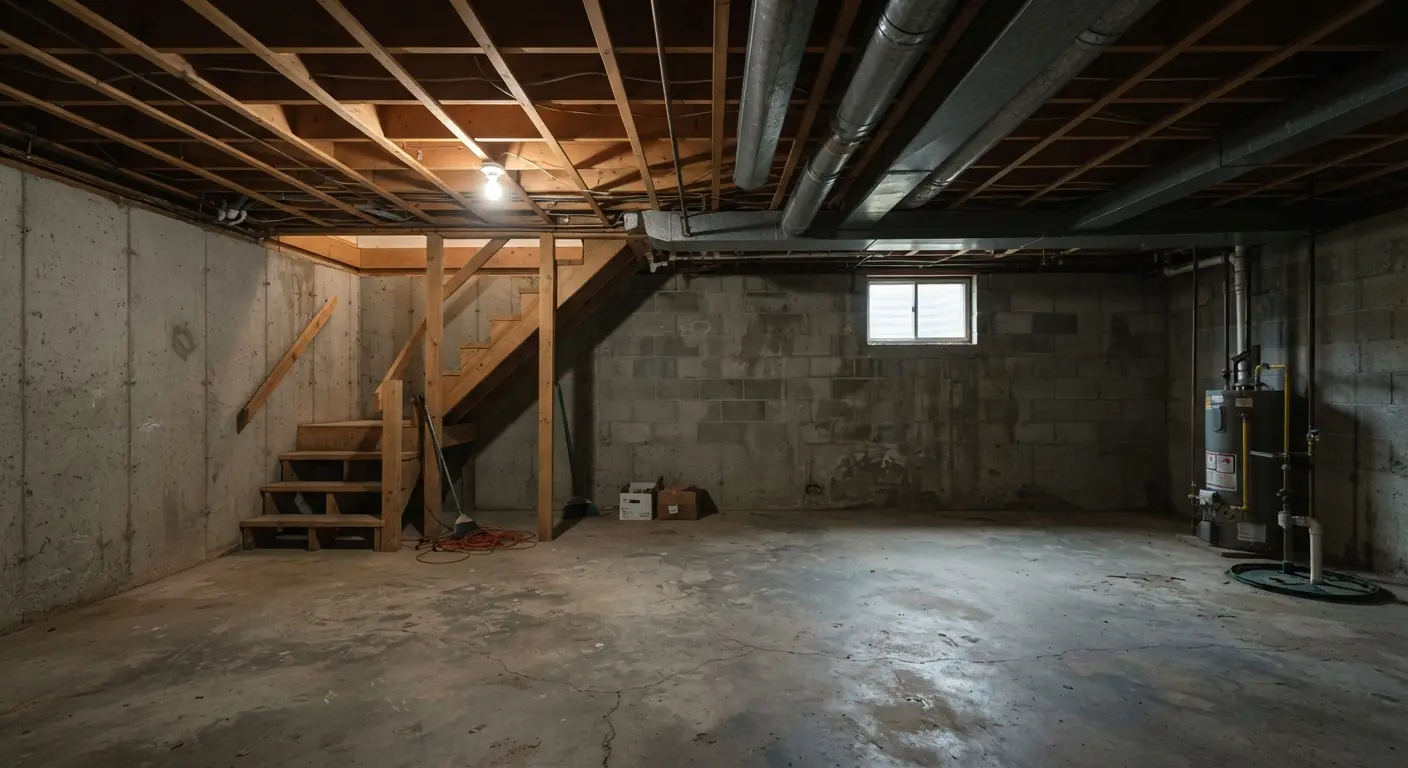
Paint it black if the ceiling is low with open joists and the room is for movies, games or a bar. Black hides pipes and ducts and costs you no headroom.12 Pick white for rooms that need bright, even light.3 Pick dark gray for most of the effect with softer contrast.1 Whichever you choose, a dark ceiling only works with extra light.
TL;DR
- Black suits low, open-joist basements used at night for movies, games or a bar. Paint takes no height. Most drop ceilings need at least 3 inches of clearance under the joists.3
- White suits offices, playrooms and workshops. A white ceiling bounces light back into the room and cuts how much fixture light you need.3
- Dark gray gives most of the black effect and sits better beside your wall color and flooring.1
- Plan the lighting before the paint. Black soaks up light, so budget for recessed cans, spotlights or fixtures and get new wiring in first.1
- DIY paint can cost less than $50 for a small room.4 A painter prices the surface, and open joists have about three times the floor area to cover.1
Is it okay to paint a basement ceiling black?
Yes. You can paint open joists, ducts and pipes black and treat that as the finished ceiling, and it keeps every inch of height.2 Check three things first: the room meets ceiling height rules, exposed insulation gets covered, and your local fire rules allow an open joist ceiling. Your contractor or building department can confirm the fire rules.
Start with height. The 2021 International Residential Code (IRC), section R305.1, sets a 7-foot minimum ceiling height for habitable space in basements. Beams, girders and ducts may hang down to within 6 feet 4 inches of the finished floor.5 Local adoption and amendments vary, so ask what your city enforces. Our basement ceiling height code guide covers the rule in more detail.
Paint adds nothing below the joists. Most drop ceilings need at least 3 inches between the grid and the joists, and a drop ceiling lowers the room by several inches.3 In a basement close to the 7-foot line, those inches decide what you can build.
Fire rules come next. In a 2012 DIYChatroom thread, a New York City poster wrote that the city requires 5/8-inch drywall on basement ceilings for fire code. The same poster warned that your insurer may not like exposed joists.1 Rules differ by city. Get an answer from your building department or your contractor before you commit.
Insulation is the third check. If batts sit between the joists, cover them before you paint. One DIY couple said they would have put up board over any insulation first.4 Another homeowner cut Thermo Pan to fit over hers and then painted it.2
An open ceiling also keeps plumbing and wiring easy to reach.4 One homeowner with a 6-foot-7-inch ceiling was advised against drywall that would block access to the water lines. She painted the joists black instead.2 Whatever you paint, keep gas valves, water shut-offs and junction box covers easy to find.
Why do people paint their basement ceiling black?
People paint basement ceilings black to make pipes, ducts and wires fade from view without losing height. A black ceiling draws little attention, which is why restaurants and industrial buildings use it.1 It is also a cheap, simple way to finish a ceiling, and it keeps plumbing and wiring within reach.4
A DIY couple who painted their basement pub ceiling listed their reasons: easy access to plumbing and wiring, an industrial look, low cost and an easy DIY job. The biggest was hiding "ugly basement ceiling stuff" like pipes, wires and shut-offs.4 They worried a dark color would make the room feel low. They were surprised by how much taller it looks.4 The black even hid a speaker they tucked up between the joists.4
Height is the other big reason. The owner of a basement with a 6-foot-7-inch ceiling said painting let them keep the full height and made the room feel intentional.2 She found the dark ceiling made a windowless space feel warm and cozy for games.2
Both accounts describe how the room feels. The measured height stays the same. A dark ceiling visually recedes, so your eye settles on the lights and walls.41
Which is better for a basement ceiling, white, black or gray?
Basement Remodeling Co.'s rule of thumb is to pick the color by what the room does. Black is better for low, open-joist rooms used at night, like a theater, bar or game room. White is better where you read, work or craft, because it reflects light.3 Dark gray suits mixed-use family rooms.
| Deciding factor | Black | Dark gray | White |
|---|---|---|---|
| Ceiling height | Best for low ceilings with open joists | Good for low ceilings with open joists | Works at any height |
| Light | Absorbs the most light, so plan extra fixtures | Absorbs less light than black | Reflects light and brightens the room |
| Room use | Theater, bar, game room | Family room, mixed use | Office, playroom, workshop, laundry |
| Pipes and ducts | Fade from view | Mostly fade | Stay visible |
| Walls and floor | Stark beside most colors | Easier to pair | Neutral |
By ceiling height
A low ceiling favors paint of any color, because paint takes no height. Between dark and light, dark wins in a low room with open joists. White paint still shows each pipe and duct as its own shape. A black ceiling goes largely unnoticed, even against light walls.1 If your joists are already covered with drywall, height stops being the deciding factor.
By lighting
White ceilings help your lights do their job. HomeGuide rates white fiberboard ceiling tiles as highly light reflective, and it says a white drop ceiling reduces how much artificial light a room needs.3 Black works the other way. A painter who did black ceilings for art gallery clients warned homeowners about the amount of light they would lose. His clients made up for it with lots of specialized lighting.1 If your basement is dim and you can't add fixtures, choose white or a light gray.
By room use
Dim rooms suit black. HomeGuide calls black acoustic ceiling tiles ideal for home theaters with dim lighting, because they reflect less light.3 Paint follows the same logic in a theater, bar or game room. Rooms that need bright, even light suit white: a home office, a kids' playroom, a hobby bench or a laundry area.
Gray sits in between. The gallery painter called black "very unforgiving and stark" next to other colors and suggested a dark warm or cool gray. In his view you get the same effect, and your wall color and flooring look much better.1 Gray is the safer pick for a family room that hosts both movie night and homework.
Drywall and drop ceilings are the other ways to finish the space. Our guide to basement ceiling options compares them with paint.
What lighting do you need to make a black ceiling work?
A black ceiling needs more fixture light because it reflects little back into the room.3 Plan three layers before you paint: general light across the whole room, task light over desks, bars and tables, and accent spots. Run any new wiring first so the paint covers the new boxes and cables.
General light
Recessed cans spread light across a whole room. HomeGuide puts recessed lighting at $125 to $300 per can light.3 Surface spotlights are another route on an open ceiling. One DIY couple mounted adjustable spotlights on their black ceiling. The lights blend into the black, and the couple uses them like potlights.4 Those lights also come in a plug-in version for spots where hardwiring isn't possible.4
Task and accent light
Aim light where people do things. The same couple points one spotlight at a sign and two down at their bar table.4 Another homeowner added light fixtures to draw the eye up to her dark ceiling.2 A pendant over a bar or game table does both jobs at once.
Light walls
Light walls give the light something to bounce off. One homeowner paired her dark ceiling with SW Alabaster walls. In a second, smaller basement with a ceiling under 8 feet, white walls kept the room feeling cozy and not cramped.2
The code minimum is low
The 2021 IRC sets a floor for light, and it is low. Where a habitable room skips the required windows under an exception in section R303.1, its artificial light must give an average of 6 footcandles at 30 inches above the floor.5 Section R303.7 requires interior stairs to be lit to at least 1 footcandle at the treads and landings.5 Local adoption and amendments vary. Treat these as legal minimums and plan a black-ceiling room well above them.
Wiring comes before paint
One DIY couple pulled out old wiring and ran clean new runs for their lights before they painted. They advise calling a pro if shutting off breakers and re-running wires makes you uneasy.4 For new circuits, hire a licensed electrician. HomeGuide lists electricians at $40 to $100 per hour, plus a $75 call-out fee.3 For fixture choices and layouts, read our basement lighting guide.
What are the downsides of painting a basement ceiling black?
The main downsides are lost light, paint that scuffs and barely washes, and a slow, messy job. Bare wood soaks up primer and paint, and spraying means covering everything below.24 Black can also look stark beside light walls and floors, and some cities may require a covered ceiling.1
Scuffs and cleaning
A painter who did black ceilings for art gallery clients said the matte black ceiling paints he used show any scuff mark instantly and have "zilch washability."1 Keep the leftover paint and a brush for touch-ups. One DIY couple kept theirs handy for at least a week and kept finding missed spots.4
Time and paint
Bare wood drinks paint. One homeowner's 650-square-foot ceiling took four cans of primer and two gallons of paint. With drying time between coats, the job took four very long days.2 A small room goes faster. One DIY couple rolled their room of about 10 by 10 feet in less than 2 hours for the first coat, after prep and cleaning.4 The second coat took less than an hour.4
Prep and overspray
A sprayer is the fastest way to coat open joists.1 It also demands perfect prep: you tape and tarp everything you don't want painted.4 Paint the ceiling before walls and floors go in, and you can be less meticulous.4 For the job step by step, see our guide to painting an exposed basement ceiling.
Contrast and rules
Black is stark next to light walls and floors, so one forum painter suggests a dark warm or cool gray.1 Some cities may require drywall on basement ceilings for fire protection, and insurers may dislike exposed joists.1 Check both before you paint.
Dust is one worry that didn't show up. Asked whether dust shows on their dark ceiling, one DIY couple said they hadn't noticed it.4
What black paint should you use on a basement ceiling?
Use a flat black interior latex, ideally a factory-mixed black, over a primer that grips wood and metal. Flat hides flaws in rough joists.4 Factory blacks work better than a store-tinted base.1 Skip dryfall paint in most basements, because most dryfalls need at least a 12-foot drop to dry before they land.1
Sheen
Flat is the safe default. One DIY couple called a flat finish essential, because any shine reflects light and draws attention to flaws.4 Another homeowner used Sherwin-Williams Emerald in a satin finish and loved the result.2 On rough joists and ducts, flat forgives more.
Primer
Experienced painters disagree here. One forum painter says to seal and prime all wood and metal, or the paint is likely to flake. For black, he suggests a gray primer or regular primer tinted with 50 percent black.1 Another says latex will stick to bare wood without primer, just not as well, and a ceiling nobody scrubs can live with that.1
Two real projects show the middle ground. One homeowner used Kilz Adhesion primer over bare wood and metal ductwork.2 A DIY couple used a paint with primer in it and one paint for wood, pipes and ducts. It has held up.4 Their one rule for pipes and metal ducts: make sure they are very clean.4 If your contractor paints, ask which primer goes on bare wood and which on metal.
Factory black or tinted
A forum painter found store-mixed blacks don't work as well as factory-mixed blacks. A real paint store should be able to order one within a couple of days.1
Dryfall
Dryfall paint is meant to dry in the air so overspray lands as dust. Most dryfalls need at least a 12-foot drop for that, and temperature and humidity change the result.1 It has to go on with an airless sprayer.1 It's cheap but usually sold only in 5-gallon containers.1 Under a basement ceiling, a black latex dryfall and an interior latex black wall paint do the same job.1
Colors homeowners used
Black paints carry undertones, so sample several. One homeowner tried six colors before choosing.2
| Color | Where it was used | How the owner described it |
|---|---|---|
| Sherwin-Williams Black Fox | A basement pub ceiling of about 10 by 10 feet4 | Rich and warm with no blue undertones |
| Sherwin-Williams Urbane Bronze | A 650-square-foot game room ceiling, in satin2 | Dark and moody, picking up some green tones |
| Sherwin-Williams Iron Ore | A theater ceiling in a 100-plus-year-old house2 | A soft black |
The same homeowner also likes SW 6990 Caviar, Benjamin Moore 2127-20 Black Ink, Benjamin Moore 2124-10 Wrought Iron, Valspar 4011-2 Dark Kettle Black, Farrow & Ball 256 Pitch Black and SW 7675 Sealskin.2
Test samples where the paint will live. One DIY couple spends a couple of days on a color so they can see it at different times of day, in daylight and under bulbs.4 In a basement, your bulbs matter most.
How much does it cost to paint a basement ceiling black?
A DIY black ceiling can cost little more than the paint. One couple spent less than $50 on one can for a room about 10 by 10 feet.4 A hired job depends on the surface to cover, and open joists have about three times the floor area.1
| Cost item | Figure | Scope | Source |
|---|---|---|---|
| DIY paint, small room | Less than $50, one can of paint4 | About 10 by 10 feet, rolled by the owners4 | Frugal Family Times |
| DIY paint, large room | Four cans of primer and two gallons of paint2 | 650-square-foot ceiling, sprayed | A Life Unfolding |
| Hired painter | $20 to $50 per hour, or $1 to $6 per square foot3 | Painting a drop ceiling grid or tiles | HomeGuide |
| Recessed lighting | $125 to $300 per can light3 | Installed | HomeGuide |
| Electrician | $40 to $100 per hour, plus a $75 call-out fee3 | Rewiring | HomeGuide |
| Drywall ceiling | $2 to $4 per square foot3 | Installing a drywall ceiling | HomeGuide |
| Drop ceiling | $4 to $20 per square foot3 | Installed, grid and tiles | HomeGuide |
Work out the surface first
A forum painter's rule of thumb for exposed joists is to triple the floor area, then allow about 20% waste when spraying.1 For a 500-square-foot basement, that works out to about 1,500 square feet of surface, or paint for about 1,800 square feet once you add spray waste.
Which rate to budget from
HomeGuide's $1 to $6 per square foot covers painting a flat drop ceiling grid or tiles.3 Open joists have far more surface and more corners than a flat grid. Use that rate for flat surfaces only. For a hired open-joist job, budget from the hourly rate and your painter's own surface count.
Add the lighting
Lighting can cost more than the paint. For example, six recessed cans at HomeGuide's $125 to $300 per can light works out to about $750 to $1,800.3 Add an electrician's time for any new circuit.
Compare the alternatives
DIY paint is the cheapest finish in this table. Installed drywall runs $2 to $4 per square foot, and a drop ceiling runs $4 to $20 per square foot installed.3 Both come before any lighting changes.
What should a quote for a black ceiling show?
A good quote for a black ceiling lists prep, products and lighting as separate lines. It shows how the painter will clean and mask the room, which primer and paint go on, how many coats, and who handles any wiring or pipe moves. A single "paint ceiling" line hides most of the work.
Look for these lines:
- Cleaning the joists, pipes and ducts before any paint. One DIY couple vacuumed, dry-wiped, vacuumed again and finished with a wet cloth.4
- Masking and floor protection, especially if the painter sprays.
- How exposed insulation gets covered.
- The primer for bare wood and for metal ducts, by product name.
- The black paint by brand, color and sheen, and whether it is factory-mixed.
- The number of coats, and whether the painter sprays or rolls.
- Which pipes, wires or ducts move first, and which licensed trade moves them.
- New lights by number and type, and whether the electrical work needs a permit.
- A touch-up visit after the paint cures.
With Basement Remodeling Co., one vetted, licensed basement contractor comes out for a free on-site estimate. They measure the space and check moisture and ceiling height. Then you get a written, itemized quote, and nothing starts until you sign. When you're ready, get a written quote for your basement ceiling.
If the ceiling is part of a bigger build, see what basement finishing covers, or find a basement contractor by ZIP code. In metro Atlanta or Denver, start with basement finishing in Atlanta or basement finishing in Denver.