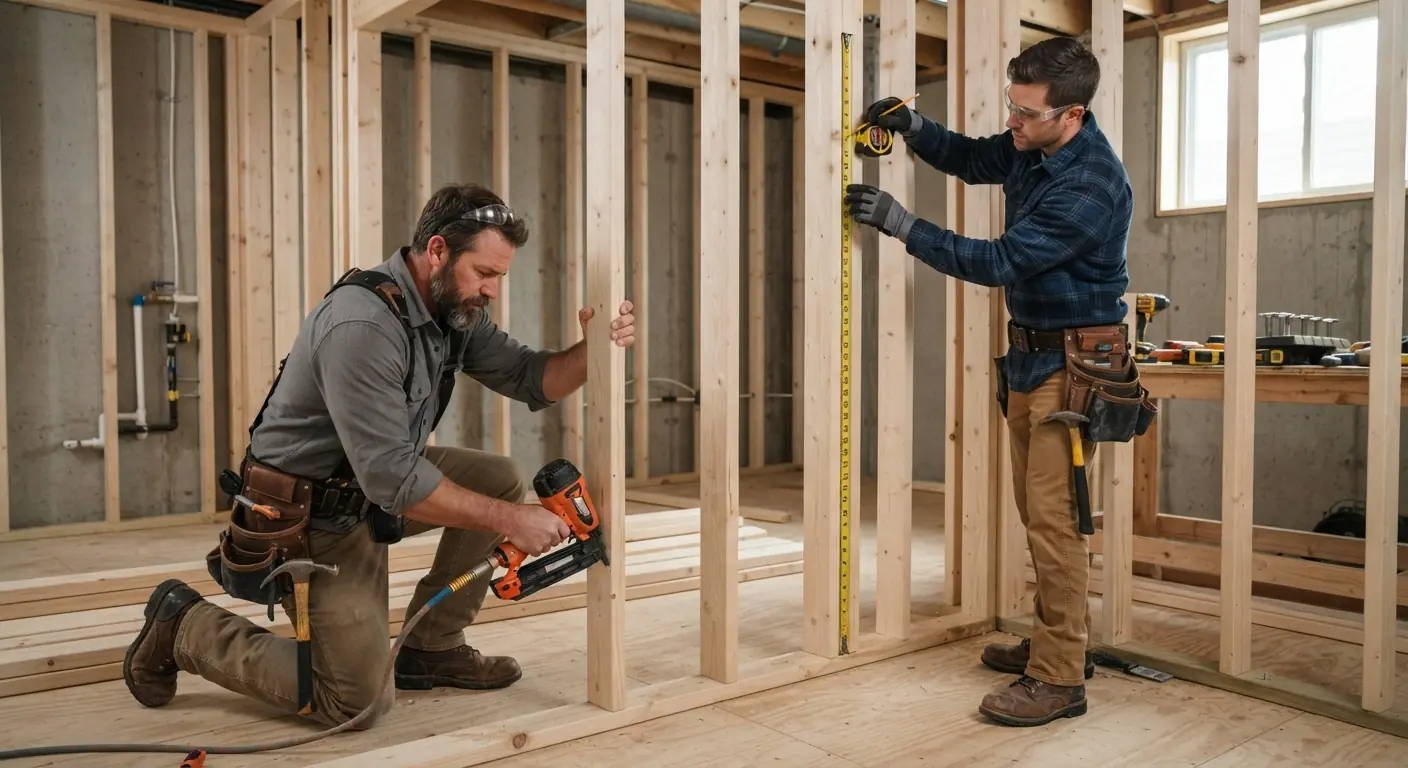
Spray foam is worth it on basement walls that run damp or uneven, and on the rim joist. On a dry, flat wall, rigid foam board behind an insulated stud wall usually does the job for less.1 Installed spray foam runs about $1.50 to $5.00 per square foot of wall.2 Board runs $1.20 to $3.70.2 The gap buys down moisture risk, so your wall decides.
TL;DR
- Closed-cell spray foam gives the best moisture control of any interior basement wall insulation, and building scientists rate spray foam the least risky interior option.31
- Rigid foam board behind an insulated stud wall is the most cost-effective approach, as long as every panel sits tight to the concrete with sealed seams.13
- For the concrete itself, pick closed-cell. By our arithmetic from BSD-103's figures, open-cell needs about 1.7 times the thickness for the same R-value, and more still for vapor control.13
- No foam fixes a leak. Mold follows water, so the water gets solved before anything goes on the wall.32
- Compare quotes by cost per R, not cost per square foot. Ask for the installed R-value and divide.
Is spray foam insulation good for basement walls?
Yes. Spray foam, closed cell or open cell, is the least risky way to insulate a basement wall from the inside. It doesn't mind water, it's simple to install and it lets the wall dry inward.1 Department of Energy research found closed-cell spray foam gives the best moisture control of all interior foundation insulations.3
The reason comes down to cold concrete. A basement wall sits against the ground, so it stays cool. In summer, warm and humid indoor air reaches that cold surface and condenses.1 That water is what feeds mold behind a finished wall.
Most interior systems don't stop it. Fiberglass batts aren't airtight, so room air slips through to the concrete.1 When fiberglass or cellulose touches a basement wall, it can soak up moisture and stay damp for good.3 Spray foam bonds to the wall. Indoor air can't reach the concrete or the rim joist, so there's no cold surface for it to condense on.1
The payoff is bigger than comfort. Basements can account for 10% to 30% of a home's total heat loss.3
"Good" still isn't the same as "best value." The same Building Science Corporation digest that ranks spray foam least risky says the most cost-effective approach is rigid insulation plus an insulated stud wall.1 That tension is the whole decision. For the other insulation options, see the basement insulation guide.
How do closed-cell, open-cell and rigid foam board compare?
Closed-cell spray foam gives the most R-value per inch and the best moisture control.1 Open-cell spray foam seals air just as well but needs far more thickness to control vapor.3 Rigid foam board costs less installed and performs well when every panel sits tight to the wall with sealed seams.23
| Material | R-value per inch (calculated) | Most it can be and still let the wall dry inward (BSD-103) | Installed cost per sq ft of wall (HomeGuide, Feb 2026) | Moisture behavior (DOE Building America) |
|---|---|---|---|---|
| Closed-cell spray foam | 61 | 3 in (R-18)1 | $1.50 to $5.00 (spray foam, both types)2 | Best moisture control of interior options; can be a Class I, II or III vapor retarder depending on thickness3 |
| Open-cell spray foam | 3.51 | 10 in (R-35)1 | $1.50 to $5.00 (same range, not split by type)2 | Excellent air barrier; must go on thicker to control vapor3 |
| XPS board | 51 | 2 in (R-10)1 | $1.20 to $3.70 (all rigid board)2 | Must adhere fully to the wall with no air gaps and sealed seams3 |
| EPS board | 3.751 | 4 in (R-15)1 | $1.20 to $3.70 (all rigid board)2 | Same install rule as XPS3 |
The R-value per inch column is our arithmetic from the thicknesses in the Building Science Corporation digest BSD-103. For example, 3 inches of closed-cell at R-18 works out to R-6 per inch.1 HomeGuide's own ranges line up: 3.5 to 7.0 per inch for spray foam and 3.6 to 5.0 for rigid board.2
The thickness column needs a word. BSD-103 says foam against a basement wall should stay at least slightly vapor permeable, so moisture in the concrete can dry into the room. It lists those four thicknesses as meeting that rule.1 Go much thicker with closed-cell or XPS and you should ask your contractor how the wall will dry.
Polyiso (polyisocyanurate) board is the third rigid option the DOE names for interior basement walls.3 Whichever board you use, BSD-103 calls for it without foil or plastic facing.1
The sources don't agree on open-cell. HomeGuide says open-cell is best if you plan to finish the walls with drywall.2 The DOE says open-cell must be applied more thickly to get vapor protection.3 We'd follow the DOE for foam that touches concrete. Its advice comes from foundation moisture research, and HomeGuide's cost guide gives no moisture reason for its pick.
What does it cost to spray foam basement walls?
Installed spray foam costs about $1.50 to $5.00 per square foot of wall area in HomeGuide's February 2026 cost guide.2 Foam type, R-value and project size move the price. Rigid foam board runs $1.20 to $3.70 in the same guide.2 Both prices count wall area, not floor space.2
Labor is a big part of the spread. HomeGuide puts basement insulation labor at $40 to $80+ per hour.2 It notes spray foam needs special equipment and training, which pushes labor higher.2
For a whole basement across all insulation types, HomeGuide gives two figures for a 1,000 sq ft basement. The headline says $1,300 to $5,000.2 Its size table says $1,300 to $5,800.2 We'd budget from $5,800 at the top. It's the more cautious of the two, and it comes from the table built by basement size.
Worked example: a 1,000 sq ft basement
This is an illustration built on HomeGuide's ranges. It isn't a quote. Picture a basement 25 feet by 40 feet. By our arithmetic, that's 1,000 sq ft of floor and 130 linear feet of wall. With 8 foot walls, that works out to 1,040 sq ft of wall to insulate.
The 2021 IECC says insulated basement walls get insulation from the top of the wall down to 10 feet below grade or to the floor, whichever is less.4 On an 8 foot wall, that means the full height.
| Line item | Rate (HomeGuide) | Low | High |
|---|---|---|---|
| Spray foam, 1,040 sq ft of wall | $1.50 to $5.00 per sq ft2 | $1,560 | $5,200 |
| Rigid foam board, 1,040 sq ft of wall | $1.20 to $3.70 per sq ft2 | $1,248 | $3,848 |
| Framing, 130 linear ft | $18 to $24 per linear ft2 | $2,340 | $3,120 |
| Drywall, 1,040 sq ft of wall | $1.50 to $3.50 per sq ft2 | $1,560 | $3,640 |
Rates from HomeGuide. The low and high totals are our arithmetic: wall area or length times each rate.2
By our arithmetic, the insulation lines differ by $312 at the low end and $1,352 at the high end. Framing and drywall land on top of either choice if you're finishing the room. Spray foam has to be covered by an ignition barrier anyway, and ½-inch gypsum board counts.3 So in a finished basement, the drywall you were buying does that job too.
How to turn a quote into cost per R
Divide the installed price per square foot of wall by the installed R-value. The lower number buys more insulation for each dollar. Do this for every quote before you compare totals.
It matters because square-foot prices hide thickness. A cheap spray foam price may be a thin coat. A higher board price may be twice the R-value. HomeGuide's ranges don't split closed-cell from open-cell, so the cost per R for each type comes from your own quotes.
One unit trap to watch: HomeGuide's table lists rigid board per square foot, but its text says "per board foot."2 A board foot is one square foot one inch thick. Ask your contractor which unit the quote uses.
How much insulation does code require on basement walls?
Under the 2021 International Energy Conservation Code, basement wall insulation depends on climate zone. Zone 3 calls for R-5 continuous or R-13 cavity insulation. Zone 4 (except Marine) calls for R-10 continuous or R-13. Zones 5 and Marine 4 call for R-15 continuous, R-19 cavity, or R-13 cavity plus R-5 continuous.4 Local adoption and amendments vary.
"Continuous" means an unbroken layer on the wall, like foam. "Cavity" means insulation between studs.4
Here's where the metros Basement Remodeling Co. serves fall in the 2021 IECC climate zone table.5
- Metro Atlanta: Fulton, DeKalb, Cobb and Gwinnett counties are zone 3A. See basement finishing in Atlanta.
- Denver: Denver, Arapahoe, Jefferson and Adams counties are zone 5B. See basement finishing in Denver.
- Colorado Springs: El Paso County is zone 5B. See basement finishing in Colorado Springs.
- Fort Collins: Larimer County is zone 5B. See basement finishing in Fort Collins.
Now turn those R-values into thickness. This table is our arithmetic, using the R-per-inch figures above.
| Continuous R-value needed | Closed-cell spray foam | Open-cell spray foam | XPS board | EPS board |
|---|---|---|---|---|
| R-5 (zone 3)4 | 0.8 in | 1.4 in | 1 in | 1.3 in1 |
| R-10 (zone 4)4 | 1.7 in | 2.9 in | 2 in | 2.7 in1 |
| R-15 (zone 5)4 | 2.5 in | 4.3 in | 3 in | 4 in1 |
Open-cell at these thicknesses meets the R-value. It won't reach the 10 inches BSD-103 lists, so it gives less vapor control.13
This table changes the math by market. In zone 3, the continuous option is R-5, about an inch of XPS. Spray foam's premium buys less there. In zone 5, the "R-13 cavity plus R-5 continuous" path lets about an inch of XPS behind an R-13 stud wall meet code.4 That's the board-plus-stud-wall assembly BSD-103 calls most cost-effective.1
The code table also has a footnote: basement wall insulation isn't required in Warm Humid locations, as the IECC defines them.4 Your contractor pulls the permit and books the inspections, and the permit office confirms which rules apply to your address.
Can mold grow behind spray foam insulation?
Mold can grow behind spray foam only if water reaches the wall. Spray foam bonded to the wall keeps humid indoor air off the cold concrete, so summer condensation has nowhere to form. Foam itself does not support mold growth.1 A leak is different. Foam can't stop groundwater coming through the wall or footing, so fix the water first.13
Building scientist Joseph Lstiburek put it plainly in DOE's Building America profile: "Mold is a water problem. No water, no mold."3
Water reaches a basement wall in a few ways. Indoor air carries vapor that condenses on cold walls. Rain or groundwater can wick through footings or walls if moisture barriers are missing. Fresh concrete in a new home can hold a lot of moisture too.3 BSD-103 adds capillary rise through the footing and plain groundwater leaks to the list.1 Spray foam handles the first one well. It can't do much about the rest.
Spray foam also lets the wall dry. BSD-103 describes interior spray foam as vapor semi-permeable, so moisture can still move inward.1 Keep that drying path open when you finish the wall. The DOE says to keep plastic sheeting, vinyl or foil wallpaper, and epoxy, oil or alkyd paint off the inside of basement walls. They're Class I vapor retarders and trap moisture in the wall.3
HomeGuide puts it simply: address moisture problems before insulating a basement. The cost of skipping that step shows up later. HomeGuide lists mold remediation at $15 to $30 per square foot.2
If you already see mold or smell a musty odor, bring in a licensed mold professional before any insulation goes up. Wet drywall, carpet and insulation can grow mold, and the pro can tell you what has to come out.
What are the downsides of spray foam on basement walls?
Spray foam costs more up front, needs a trained installer with spray equipment and must be covered with an ignition barrier.23 Open-cell needs a thick layer to control vapor, which eats floor space. None of these rule spray foam out. They decide whether its moisture benefit is worth paying for on your wall.
Price. HomeGuide calls spray foam the most expensive option up front. It says the moisture protection and energy savings can offset that over time.2 "Can" is doing work in that sentence. The DOE says basement insulation savings depend on climate, fuel cost, heating system and how you live.3
No DIY. Spray foam needs special equipment and training. That's why its labor costs more.2
It can't stay bare. Spray foam must be covered with ignition-barrier paint or ½-inch gypsum board.3 BSD-103 says the same: spray foam must be covered with a fire or ignition barrier.1 In an unfinished basement, budget for the paint.
Open-cell eats space. BSD-103 lists 10 inches of open-cell against 3 inches of closed-cell to meet its permeability rule.1 That works out to 7 more inches off every wall.
Pests. The insect warnings in the building-science sources are about exterior foundation insulation. BSD-103 calls exterior insulation an "insect interstate" into the house, particularly in the south.1 The DOE says exterior insulation should not be used where termites are a problem.3 Neither source addresses pests in interior spray foam. If you're in metro Atlanta, ask your contractor how the foam will be detailed with termites in mind.
When rigid foam board is the better buy
Rigid foam board is the better buy on a dry, flat basement wall where every panel can sit tight to the concrete. Building Science Corporation's BSD-103 digest calls rigid insulation behind an insulated stud wall the most cost-effective interior approach.1 In zone 5, about an inch of XPS behind an R-13 stud wall meets the 2021 IECC.4
Board has to be installed well to earn that. The DOE rules are strict. The panels must adhere fully to the wall with no air gaps behind them. Edges and seams need acrylic-latex caulk, foam sealant or mastic. Leave at least a ½-inch gap between the drywall and the floor.3 A bowed or rough wall makes the no-gap rule hard to meet. That's where spray foam starts to earn its price.
The stud wall in front of the board gets unfaced fiberglass or damp-spray cellulose, with no plastic vapor barrier.1 The foam board keeps that fiberglass off the concrete, which matters. The DOE says fiberglass or cellulose shouldn't touch foundation walls.3
Then there's the rim joist. That's the wood band on top of the foundation wall. BSD-103 says it's cold in summer and winter. It must be insulated with air-impermeable insulation.1 Spray foam is an excellent air barrier.3 So a split makes sense: board on the walls and spray foam at the rim joist. You pay the spray foam premium only on the part that most needs an air seal.
What a good spray foam quote shows
Basement Remodeling Co. asks homeowners to judge insulation quotes on the R-value delivered, not the square footage alone. A good quote names the foam type, thickness, installed R-value, wall area priced and how the foam gets covered. Without those, two quotes can't be compared on cost per R.
HomeGuide gives similar advice. Ask for a detailed quote with the insulation type and brand, the R-value and the depth or thickness.2 Here's what to look for line by line:
- Foam type. Closed-cell or open-cell, and the brand.
- Thickness and installed R-value. It should meet the code for your climate zone.
- Wall area and unit. Square feet of wall, and whether board is priced per square foot or per board foot.
- Rim joist. What goes there and how it's sealed.
- Covering. Drywall or ignition-barrier paint over the foam.
- Water first. What moisture your contractor found at the estimate and what gets fixed before any foam goes on.
- Permit. Your contractor pulls the permit and books the inspections.
Basement Remodeling Co. matches you with one vetted, licensed basement contractor for your metro. You get a free on-site estimate and a written, itemized quote, and the contractor checks moisture while measuring. When you're ready, get a written quote for finishing your basement. You can also check whether your ZIP code is covered. If your walls are already finished and you're opening them up, see what a basement remodel involves.