Start by working out where the water comes from. A cheap humidity meter and a few notes on when and where the dampness shows up will tell you.1 Sweat on cold walls and pipes in humid weather points to condensation.2 Water after rain or a damp band along the bottom of the wall points to seepage.2 Fix the source first, then use a dehumidifier and insulation to hold the air dry.2
TL;DR
- Test before you buy anything. Humidity above 60% plus sweat on cold surfaces in summer points to condensation.1 Water that follows rain points to seepage.2
- Fix sources in order: indoor moisture, humid outside air, then grading and downspouts, then drainage. University of Minnesota Extension puts the cheap fixes first because they may solve the problem on their own.2
- 70% humidity is too high for a basement: EPA says keep it under 60% and aim for 30% to 50%.13
- A dehumidifier treats damp air. It won't stop water coming through a wall.2 DampRid's Amazon listing titles don't say how much water a tub holds.4
- Source fixes cost less. On national figures, new downspouts run $220 to $625 and regrading $1,000 to $5,000.5 Full waterproofing runs $6,000 to $18,000.5
How can you tell if a basement has a moisture problem?
You have a moisture problem if you see water, notice a stale smell or find damage that keeps coming back. The common signs are damp air, a musty odor, sweating walls in summer and a wet ring at the base of block walls. Water stains, white chalky residue and rotting wood count too.25
University of Minnesota Extension lists these symptoms.2
- Water trickling out of walls or standing on the floor.
- A saturated band of dampness at the base of concrete block walls.
- Damp, humid air and condensation on cold walls and floors in summer.
- Odor, mold and mildew.
- Carpet or wood that breaks down, and rot in joists, sill plates or posts.
- Stained or blistered wall coverings.
- Efflorescence (white, powdery salt deposits) and flaking concrete or masonry.
HomeGuide's list adds bowed walls, warped doors and cracks in walls or floors.5 Treat bowed walls as a structural question. Have a licensed contractor or structural engineer look at them before you spend money on moisture control.
Each sign points to a different source. The next test sorts them out.
Is your basement moisture condensation or seepage?
Condensation shows up on cold surfaces when the air is humid, mostly in summer. Seepage shows up after rain, often low on the walls or where the wall meets the floor. Many homeowners mistake summer condensation for a leaking wall, so check before you pay for waterproofing.2
Basements get moisture from three places: rain and groundwater, sources inside the house, and humid outside air that condenses on cool surfaces.2 This three-step check tells you which one you're fighting.
Step 1: measure the humidity
Buy a humidity meter (also called a hygrometer). EPA says they cost about $10 to $50 at hardware stores.1 Leave it in the basement for a week and note the readings. Readings that stay above 60% are over EPA's limit, and condensation on walls or pipes is a sign of high humidity.1
Step 2: note when it gets wet
Wetness that follows rain points to water from outside. A 1-inch rain drops about 1,250 gallons on the roof of a 2,000-square-foot house, and poor grading or gutters send some of it to the basement.2 Wetness on humid summer days points to condensation, especially if you open the basement windows. Warm, humid air condenses on the cool wall and floor.2
Step 3: note where it gets wet
Look at the pattern. Sweat on cold water pipes and rust on a drainpipe are signs of condensation.1 A damp ring at the base of the wall comes from water wicking up through the footing and slab, which is common at the joint between them.2 Water trickling from cracks or pooling on the floor is liquid water getting in from outside.2
You can also run a plastic sheet check. Tape a sheet of plastic tight against a bare section of wall and look at it after a stretch of humid weather. Moisture on the room side means condensation. Moisture under the plastic means water is coming through the wall.
What your results mean
| What you see | When it shows up | Likely source | First fix |
|---|---|---|---|
| Beads of water on walls, floor or pipes; rusty pipes | Humid summer days, windows open | Condensation from humid air2 | Close windows in humid weather, dehumidify, insulate cold pipes1 |
| Water trickling from walls or pooling on the floor | After rain | Rain or groundwater2 | Gutters, downspouts and grading, then drainage2 |
| Damp band along the bottom of block walls | Most of the year | Water wicking up through footing and slab2 | Drainage at the wall base2 |
| White powdery deposits on concrete | Builds over months | Moisture moving through concrete or masonry2 | Find and stop the liquid water source |
| Musty smell and damp air with no visible water | Year round | Indoor moisture or humid air drawn in through cracks and open sump pits2 | Vent the dryer and baths outside, cover the sump, dehumidify2 |
Is 70% humidity in a basement bad?
Yes. EPA says to keep indoor humidity below 60% and ideally between 30% and 50%.1 ENERGY STAR gives the same 30% to 50% target and says anything above it may promote mold growth.3 A 70% reading falls inside ENERGY STAR's "slightly to moderately damp" band.3
ENERGY STAR describes that band as 50% to 75% relative humidity, where a space feels damp and has a musty odor that may come and go.3 Above 75% it calls a space "very damp," with damp spots on walls and floors.3
Mold is the main reason the number matters. EPA says the key to mold control is moisture control, and no mold will grow without water or moisture.1 In cold climates during the heating season, ENERGY STAR suggests 30% to 40% to prevent window condensation.3
How do you reduce moisture in a basement? Fixes ranked by source
Fix the cheapest source first and work up. University of Minnesota Extension's order is: control indoor moisture, stop ventilating with humid summer air, correct grading, gutters and downspouts, then add a drainage system.2 A dehumidifier and the right insulation then hold the air dry. They don't stop water that is getting in.26
| Rank | Fix | Moisture source it targets | Use it first when |
|---|---|---|---|
| 1 | Vent the dryer, bath and kitchen to the outside | Indoor moisture2 | Musty air, no visible water |
| 2 | Keep humid summer air out and seal the sump lid | Humid outside air and air leaks2 | Walls and pipes sweat in summer |
| 3 | Regrade soil and extend downspouts | Rain around the foundation2 | Wet after rain |
| 4 | Dehumidifier sized to the dampness | Water vapor in the air3 | Humidity stays above 60% after fixes 1 to 31 |
| 5 | Foam insulation on walls and rim joists | Condensation on cold concrete6 | Planning to finish the space |
| 6 | Interior or exterior drainage | Groundwater and seepage2 | Water still gets in after fix 3 |
1. Cut indoor moisture sources
This is the cheapest step. Humidifiers, unvented clothes dryers, showers and cooking all add moisture, and finishing a basement adds more of them.2 Vent the dryer to the outdoors and run fans in bathrooms and kitchens.3 Fix leaking outdoor faucets too.3
A newer house has one more source. Fresh concrete holds about 0.2 gallons of water per square foot of wall and 0.1 gallons per square foot of floor. It can take months or even years to dry out.2
2. Keep humid summer air out
Opening basement windows on a warm, humid day lets that air condense on the cool walls and floor.2 Keep them shut in humid weather. University of Minnesota Extension recommends ventilating through an air conditioning system or a desiccant-type heat exchanger.2 If you have central air, ENERGY STAR suggests adding an A/C vent in the humid space.3
Air also gets pulled in from below. Warm air rising through the house puts the basement under slight suction, which draws moist air through cracks and open sump pits. Give the sump pit an airtight cover.2
Ventilation advice varies by source. A trade article written by the president of a basement ventilation company argues for mechanical ventilation as part of a complete waterproofing system.7 The university advice is more cautious about bringing in outside air in summer. Ventilate the moisture sources to the outside. Ask your contractor to show how any ventilation system handles humid outdoor air.
3. Fix grading, gutters and downspouts
If the ground slopes toward the house, rain runs into the basement.2 University of Minnesota Extension says to slope the soil away from the foundation at least 1 inch per foot for at least 6 feet.2 A Waterproof! Magazine article gives a gentler minimum of 6 inches over 10 feet.7 Plan from the university figure. It is the steeper of the two and comes from a non-commercial source.
For the roof water, University of Minnesota Extension calls for at least one downspout per 50 feet of roof edge.2 Extensions should drop the water at least 4 feet from the wall.2 A downspout without an extension or splash block is worse than no downspout at all.2 Keep gutters clear and avoid overwatering the plantings along the foundation.3
Check your window wells as well. A badly built well acts like a drain right next to the wall.2
These fixes come before any drainage system because they may solve the problem by themselves.2
4. Run a dehumidifier sized to the dampness
A dehumidifier dries the air. University of Minnesota Extension says it reduces humidity and odor but is not a permanent or complete fix. In a basement with a water problem, drying the air can pull moisture in faster and cause efflorescence and flaking concrete.2
Size it with ENERGY STAR's chart. Capacity is measured in pints of water removed per day.3 For more detail, see our guide to sizing a basement dehumidifier.
| Condition without a dehumidifier | Space under 2,000 sq ft3 | Space over 2,000 sq ft3 |
|---|---|---|
| Slightly to moderately damp: feels damp, musty odor, 50% to 75% RH | 20 to 30 pints per day | 30+ pints per day3 |
| Very damp: smells damp, damp spots on walls and floors, 75% to 90% RH | 25 to 40 pints per day | 40+ pints per day3 |
| Wet: walls or floor sweat or seepage present, 90% to 100% RH | 30 to 50 pints per day | 50+ pints per day3 |
Source: ENERGY STAR dehumidifier buying guidance.3 ENERGY STAR says it's better to oversize than undersize.3
A few setup details make a big difference. Pick a model with a built-in humidistat so it cycles to hold your target.3 Run a hose to a floor drain or sump so you aren't emptying a bucket.3 Keep the basement doors and windows closed while it runs.3 If your basement stays below 65°F, frost can form on the coils, so look for a model rated for lower temperatures.3 Plug it into a properly grounded outlet and keep the drain hose away from electrical cords.3 ENERGY STAR certified units use about 20% less energy than similar standard models.3
5. Insulate so humid air can't reach cold concrete
Basement walls stay cold because the concrete touches the ground. In summer, warm, moist air condenses on any surface below its dew point. Rim joists are a trouble spot in summer and winter.6 Building Science Corporation recommends foam insulation that keeps room air off the concrete and the rim joist.6
The same guide warns against a common mistake. A framed wall with batt insulation and a plastic vapor barrier on the room side often leads to odor, mold, rot and corrosion.6 It lists foam layers that let the wall dry inward: up to 2 inches of unfaced extruded polystyrene (R-10), 4 inches of unfaced expanded polystyrene (R-15) or 3 inches of closed-cell spray foam (R-18).6 Spray foam must be covered with a fire or ignition barrier.6 Walls must be dry before you insulate them.2 Wrap cold water pipes with insulation too.1
This step matters most if you plan to finish your basement into living space. Your contractor should settle moisture before any framing goes up.
6. Add drainage when water still gets in
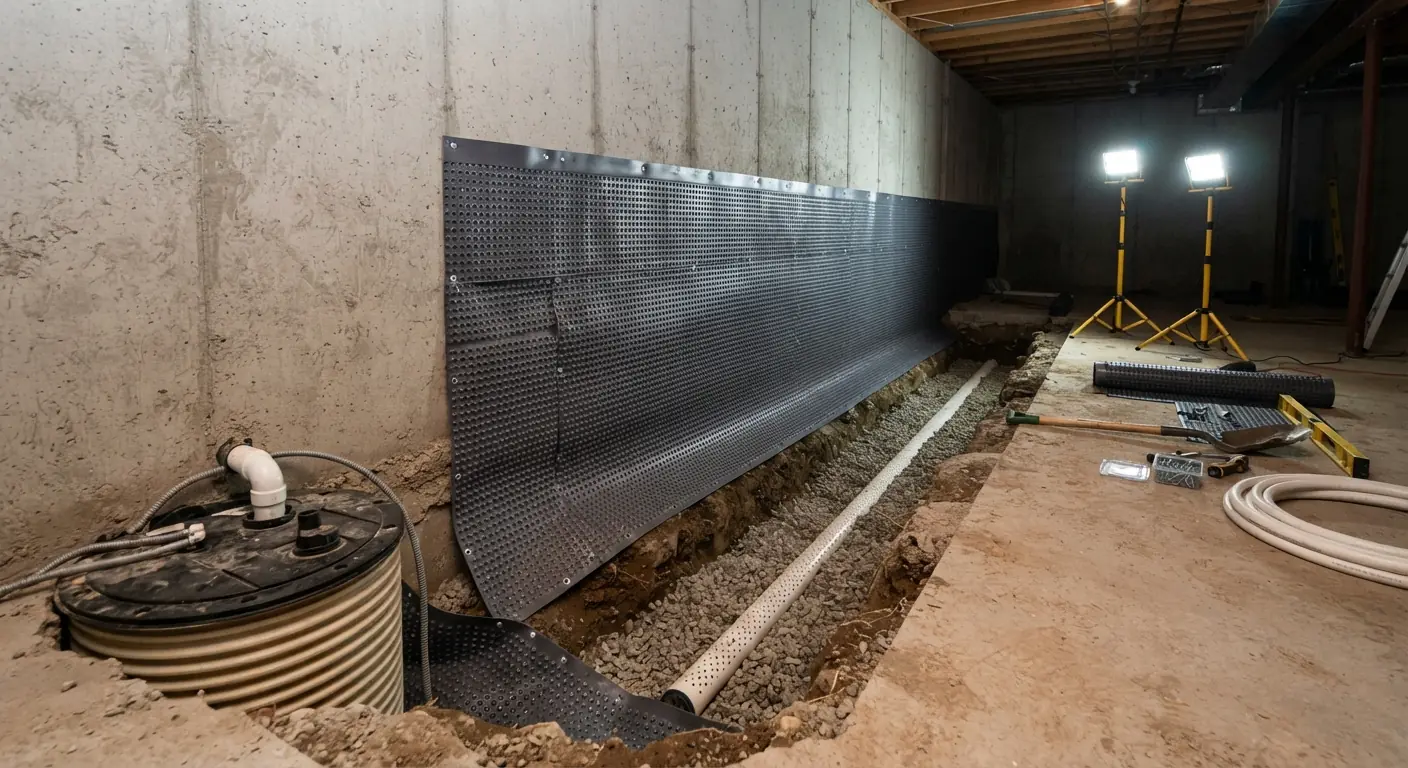
If water still gets in after the grading and downspout work, the next step is a drainage system.2 An exterior system is the most costly and the most effective. It means digging out around the foundation.2 Inside, the most effective option is perforated pipe under the slab edge that drains to a sump with an airtight, childproof cover.2 A membrane or coating on the inside of the wall is a temporary fix, because the water is still there.2
For the full range of drainage and sealing options, see our guide to basement waterproofing methods.
Will DampRid work in a basement?
DampRid and similar absorber tubs trap some moisture from the air around them. They do nothing about rain, groundwater or humid air that keeps coming in, and those are the sources that make basements damp.42 For a whole basement, a dehumidifier sized to the dampness is the practical tool.3
The two products are sold in different units, which makes them hard to compare. A DampRid listing on Amazon sells an 18-ounce tub by the time it lasts: "Lasts Up To 60 Days."4 A two-pack of DampRid's 2 lb. 15.5 oz. buckets listed at $28.76 when we checked on September 29, 2026.4 None of the listing titles in that search says how much water a tub holds.4 Dehumidifiers are rated in pints removed per day, and ENERGY STAR's smallest recommendation for a damp basement under 2,000 square feet is 20 to 30 pints per day.3 A portable dehumidifier costs about $130 to $300.5
Use absorber tubs in a closet or a closed storage bin if you like them. Measure the result with your humidity meter. If the basement still reads above 60%, the tubs aren't keeping up.1
How do you know if moisture is behind drywall?
Suspect hidden moisture when a finished basement smells moldy and you can't see the source. EPA names the back side of drywall and paneling, the underside of carpet and pad, and walls behind furniture where condensation forms. Walls around leaking or sweating pipes are another common spot.1
Look for the signs you can see from the room side. Stained or blistered wall coverings, breaking-down carpet and rot in wood near the floor all point to water.2 A finished wall built with a plastic vapor barrier over batt insulation is a known risk. That setup often leads to odor, mold, rot and corrosion because the wall can't dry.6
Be careful about opening the wall yourself. EPA warns that disturbing hidden mold can release a large burst of spores and suggests hiring an experienced professional if you suspect hidden mold.1 If visible mold covers more than about 10 square feet, EPA points you to its professional remediation guidance.1 Clean up the mold and fix the water problem together. Otherwise the mold will most likely come back.1 Don't paint or caulk over mold.1
How much does it cost to fix moisture in a basement?
Costs run from about $10 for a humidity meter to $18,000 for exterior waterproofing.15 The source sets the price. A humidity meter and a portable dehumidifier cost a few hundred dollars at most. Seepage that needs a drainage system runs into the thousands.15
These are national averages. Your local price comes from your contractor's written estimate. For a closer look at the drainage and sealing line items, see our guide to basement waterproofing cost.
| Fix | Typical national cost | Source and date |
|---|---|---|
| Humidity meter | $10 to $501 | EPA |
| Portable dehumidifier | $130 to $3005 | HomeGuide, Jan. 2026 |
| Whole-house dehumidifier, installed | $1,500 to $3,5005 | HomeGuide, Jan. 2026 |
| Replacing downspouts | $220 to $625 total5 | HomeGuide, Jan. 2026 |
| Regrading around the house | $1,000 to $5,0005 | HomeGuide, Jan. 2026 |
| Epoxy crack injection | $250 to $800+ per crack5 | HomeGuide, Jan. 2026 |
| Waterproof paint or sealer | $2 to $10 per sq ft5 | HomeGuide, Jan. 2026 |
| Sump pump, installed | $600 to $2,5008 | HomeGuide, Aug. 2023 |
| Interior French drain | $4,000 to $17,0005 | HomeGuide, Jan. 2026 |
| Interior waterproofing, total | $6,000 to $12,0005 | HomeGuide, Jan. 2026 |
| Exterior waterproofing, total | $10,000 to $18,0005 | HomeGuide, Jan. 2026 |
| Mold remediation | $1,500 to $15,0005 | HomeGuide, Jan. 2026 |
Four things move the price. Poured concrete walls cost less to waterproof than block walls, and stone foundations cost the most.5 Bigger basements need more material and labor. Exterior work that needs digging costs more than interior work. Labor rates also vary by region.5 A sump pump costs more when the installer has to break up a concrete floor, with totals of $2,500 to $5,000 in that case.8
Waterproof paint looks like the cheap answer. HomeGuide notes that sealers won't stop water under pressure and work only for minor dampness.5 Match the spend to the source you found in the test.
What should a good quote for moisture work show?
A good quote names where the water comes from and explains why each fix matches that source. It should be itemized, list materials, labor and cleanup, and put the warranty in writing.5 A quote that starts with a drainage system before anyone has checked your gutters and grading skips the cheap steps.2
Ask these questions before you sign. HomeGuide suggests most of them.5
- How is water getting into my basement?
- Which methods do you recommend for my basement, and why?
- Are there structural problems that could cause the walls to fail?
- Does the estimate cover materials, labor, delivery and cleanup?
- What warranty do you offer, and is it in writing?
- If you add a sump, does the pit get an airtight cover?2
If the test points to water getting in, get a written, itemized quote for waterproofing your basement. Basement Remodeling Co. sends your request to one vetted, licensed basement contractor for your metro. That contractor contacts you, books a free on-site estimate and checks moisture during the visit.
Already have a finished basement that smells damp? A basement remodeling project can open up the problem walls and rebuild them to dry properly. You can also find a basement contractor by ZIP code. If you live in metro Atlanta or Denver, start with basement finishing in Atlanta or basement finishing in Denver.