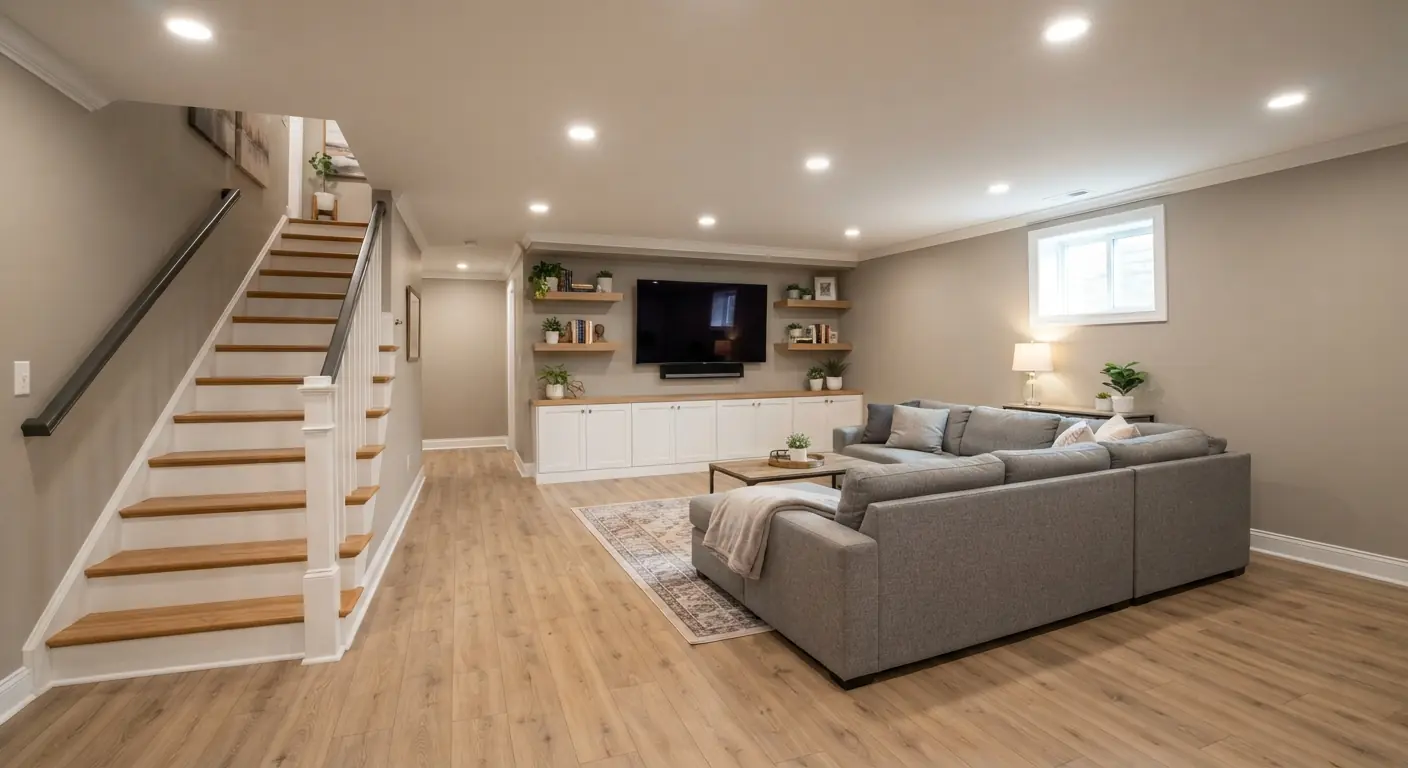
Yes, you can keep concrete as the finished floor in a basement, as long as the slab stays dry. Seal it if you want the cheapest finish that keeps the plain concrete look.1 Stain it for color. Polish it for the hardest-wearing sheen. Resurface it with an overlay when the slab is too rough for the other three. None of them makes the floor warmer, and seal, stain and polish all show whatever is already in the slab.
TL;DR
- Moisture decides this before looks do. Fix a damp slab first, and keep impermeable finishes off any slab with a moisture question, because they stop it drying.2
- Sealing costs $1 to $3 per square foot.1 Polished concrete costs $3 to $15+ per square foot, not including the slab.1 Stain and overlay work is priced at the on-site estimate.
- Stain suits a sound slab with few patches. It adds color and hides nothing.
- Polish is worth it on a flat, sound slab in a room that takes hard use. It stays hard and cold.
- A skim coat or overlay can resurface old concrete that is sound and dry. It won't fix cracks that keep moving or water coming up from below.
Can a finished basement have concrete floors?
Yes. A sealed, stained or polished slab is a legitimate finished floor. The deciding factor is water. Basement flooring should be waterproof or water-resistant unless the space is finished and sealed,1 and bare concrete handles a leaking water heater far better than carpet or wood does.
Building scientist Joseph Lstiburek's basement digest says floor finishes in a basement should be chosen with the possibility of flooding in mind, from leaky appliances, failed plumbing, overflowing sinks or surface water.2 A finished concrete floor survives a wet day. Carpet and pad usually don't.
The catch is what you can't see. The same digest says a basement slab should sit on a capillary break of crushed stone or coarse gravel, with sheet polyethylene in direct contact with the underside of the concrete as the vapor barrier.2 Whether yours has one depends on how it was poured, and you can't tell by looking. The digest also warns that a slab left able to dry only upward, for example with wet sand trapped between it and the plastic, typically ends up with damaged floor finishes.2
So the order is simple. Get the slab checked for moisture first, and fix a damp slab before anything else; our guide to waterproofing a basement floor covers the options. Pick the finish second. If radon is a concern where you live, test before you finish, and use a licensed radon mitigation contractor if the result calls for a system. The slab itself is part of the soil gas defense: Lstiburek describes a slab sealed to the perimeter wall as the air barrier that controls soil gas.2
How do stain, polish, seal and overlay compare?
Sealing is the cheapest and changes the look least. Staining adds translucent color. Polishing grinds the slab to a hard sheen and costs more than sealing. An overlay puts a fresh cement layer over a rough slab. All four stay as cold as the slab underneath.
Epoxy is the other common concrete finish, so it is in the table too.
| Finish | Installed cost per sq ft | Look | Warmth | Moisture tolerance |
|---|---|---|---|---|
| Seal only | $1 to $31 | Plain concrete, a little darker or glossier depending on the sealer | Cold as the slab | Depends on the sealer. Ask whether it lets the slab dry. |
| Stain plus sealer | Priced at the on-site estimate | Mottled, translucent color; patches and cracks show through | Cold as the slab | Set by the sealer on top |
| Polish | $3 to $15+, not including the slab1 | Smooth sheen, from low luster to high gloss | Cold and hard | No thick film to peel, but it needs a sound slab |
| Overlay or skim coat | Priced at the on-site estimate | A new, even surface that can then be stained or colored | Cold as the slab | Only as good as its bond to a clean, dry slab |
| Epoxy coating | $4 to $101 | Solid color or flakes, usually glossy | Cold as the slab | A film on top; impermeable films stop the slab drying upward |
The cost column uses HomeGuide's national installed ranges from its February 2026 flooring cost guide.1 They are national averages, so your local price will differ. Stain and overlay work depends on the slab, so it is priced at the on-site estimate.
For a whole basement, HomeGuide puts polished concrete at $1,500 to $22,500 for 500 to 1,500 square feet.1 The same table lists carpet at $1,000 to $12,000, epoxy at $2,000 to $15,000 and luxury vinyl plank at $2,000 to $24,000.1
How can I make my concrete basement floor look good?
Start with the slab's condition. Clean off glue and residue, repair cracks and level low spots, then choose the finish. A floor with few flaws suits stain or polish. A patched, pitted or uneven slab looks better under an overlay or a covering. Rugs soften the rest.
The pages that rank for this search right now are mostly photo boards and forum threads. The photos show the floor on the day it was finished. They rarely show the slab underneath, or what it looked like a wet spring later.
Before you look at pictures, count the cracks, check for uneven spots and look for built-up residue. A sleek concrete finish needs a clean, smooth surface first. Prep usually means grinding, pressure washing and removing old adhesive. If you are pulling up old carpet or tile in a basement that was finished years ago, that adhesive is the first thing your contractor deals with. That job is covered on our basement remodeling page for already finished basements.
Color is the next decision. Stains and dyes come in warm, cool and neutral tones. Test any color on a hidden spot first, because the same product reads differently on different slabs.
Then soften it. Area rugs mark out a TV zone or a play area and take the chill off bare feet. A floor that is concrete everywhere except under the sofa is a normal, practical finished basement.
What are the downsides of concrete flooring?
Concrete in a basement is cold, hard and unforgiving. It sits against the ground, so it stays cool underfoot. Dropped glasses break. Any finish that lets you see the slab also shows its cracks, patches and stains. And if the slab gets damp, that moisture reaches whatever finish sits on top.
The warmth problem has a real fix, but only on a new slab. Lstiburek's digest says basement slabs are best insulated underneath with rigid polystyrene insulation, which gives a significant improvement in comfort and in resistance to moisture damage, including summertime condensation.2 It also says the energy savings are smaller than from insulating the walls.2 An existing slab can't get that layer without being torn out.
Surface layers don't change the temperature much. A forum thread that ranks for this search makes the point bluntly: leveler, a new layer of concrete or tile gives you a durable surface that is just as cold as the floor you started with. If warm floors matter most, radiant floor heating runs $7 to $17 per square foot installed,1 which is a separate project from any concrete finish.
Hardness is the other trade. Concrete is tough on knees in a kids' play area and hard on anything dropped. That is why rugs, gym mats and carpet tiles show up in so many concrete basements.
Should I stain my concrete basement floor?
Stain it if the slab is dry, sound and mostly free of patches, and you like the look of concrete. Stain adds color without adding a layer, so it won't hide flaws. If the slab is patched, pitted or marked with old glue, plan on an overlay first or pick another floor.
Stain works into the top of the concrete and colors it. It does not level, fill or cover. A common homeowner question on concrete forums runs like this: the basement would need leveling before new flooring, so why not just stain or epoxy it instead? Stain follows the slab's shape. A dip stays a dip.
Stain also needs a sealer on top, and the wrong sealer can mean stripping and redoing the floor later. So a stain quote is really a stain and sealer quote. Ask which sealer, how many coats and when it will need recoating.
Stain work is priced at the on-site estimate, so ask for the prep and the sealer as separate lines.
What are the downsides of stained concrete floors?
- It shows everything. Patches, crack repairs, old paint and glue residue take stain differently from the concrete around them.
- The color is hard to predict. Two parts of the same slab can come out different shades. Test first.
- The sealer wears. Traffic lanes dull before the corners do, and the sealer needs recoating on a schedule your contractor should state.
- It doesn't stop water. Moisture tolerance comes from the slab and the sealer. Stain adds none.
- It is still cold and hard. Stain changes the color, nothing else.
Is polishing concrete floors worth it?
Polishing is worth it when the slab is flat and sound and you want a hard floor you'll rarely have to maintain. It costs $3 to $15+ per square foot, not including the slab, so it can cost more than carpet.1 It doesn't fix a cold, cracked or damp slab.
Polished concrete is common in busy commercial spaces because the surface is durable and low maintenance. At home it suits rooms where you don't want scuffs or spills changing the look of the floor. In a basement, that points to bars, game rooms, gyms and hallways that see boots and wet feet.
The value question is mostly about the slab you already have. A flat, sound slab with little patching gives a polish its best result. A slab full of repairs, cracks or old adhesive costs more to prep, and the repairs still show after grinding.
Compare it with covering the floor. At basement scale, HomeGuide's ranges put polished concrete at $1,500 to $22,500 against $1,000 to $12,000 for carpet.1 At the top of that range you are paying for a floor that a leaking pipe won't ruin.
What are the downsides of polished concrete floors?
- Prep and grinding are professional work. It is heavy machine grinding, and it is dusty and loud.
- Flaws stay visible. Grinding exposes what is in the slab. Cracks, patches and color changes remain part of the look.
- It still needs the right sealer. A polished floor is usually sealed, and the product has to match how the room is used.
- It is cold and hard. Polishing does nothing for comfort.
- The cost range is wide. $3 to $15+ per square foot, not including the slab,1 depending on the gloss level, prep and color.
Is sealing alone enough for a basement slab?
Sealing alone is enough if you like plain concrete and mainly want the surface protected and easier to clean. It is the cheapest finish here, at $1 to $3 per square foot.1 The product matters more than the price, and the right one depends on how the floor is used. Ask whether the sealer lets moisture in the slab dry out upward.
Here is the tension you should know about. Some coating companies sell polyaspartic coatings as an impermeable surface that works as a moisture barrier. Lstiburek's digest points the other way: impermeable interior floor finishes, with vinyl coverings as the example, should be avoided because they block inward drying and typically lead to mold and other moisture problems.2 His digest names vinyl, not coatings. But a coating sold as impermeable blocks drying for the same reason.
On a slab that has never shown a damp patch, a coating may be fine. On a slab with any moisture history, ask your contractor why the product they recommend won't trap water under it. HomeGuide also notes that epoxy floors take a while to cure and don't suit extreme temperatures.1
Can you put a skim coat of concrete over old concrete?
Yes, if the old slab is sound, clean and dry. A contractor grinds or scrubs the surface, repairs cracks, then bonds a thin cement-based overlay or self-leveling layer over it. The new layer copies any crack that keeps moving, and it won't stop moisture coming up through the slab.
An overlay is the answer for a slab that is too ugly for stain or polish but still structurally fine. It gives you a clean, even surface, and that surface can then be stained, colored or sealed. It stands or falls on the prep, the same clean and smooth starting point any concrete finish needs.
Some overlays also fix shape. A sloping mix can re-slope a floor toward its drain before it is coated.
An overlay is the wrong tool when the slab is heaving, badly cracked or wet. Those slabs need the moisture, crack or structural problem fixed first. Sometimes the answer is a new slab poured over a capillary break and a polyethylene vapor barrier,2 which is excavation work, not resurfacing.
Overlay work is priced at the on-site estimate.
What should a good quote for a concrete floor finish show?
A good quote names the prep, the product and the moisture result. It should list grinding or cleaning, crack and patch repair, the stain or overlay system, the sealer by name and how many coats, and what the moisture check found. If a line just says "finish floor," ask for detail.
Questions worth asking:
- How did you check this slab for moisture, and what did you find?
- Which sealer or coating are you using, and does it let the slab dry?
- How will existing cracks and patches look after the finish?
- When will the sealer need recoating, and what does that cost?
- How long before we can walk on it and move furniture back?
- Does the floor go in before or after the drywall and trim?
That moisture check is part of how Basement Remodeling Co. works. You're matched with one vetted, licensed basement contractor, who books a free on-site estimate, measures, checks moisture and ceiling height, and gives you a written, itemized quote. Nothing starts until you sign. When you're ready, get a written quote for finishing your basement, or use the ZIP finder to see which basement contractor covers your area.
Local pages cover the same process by metro: basement finishing in Denver, Colorado Springs, Fort Collins and metro Atlanta.