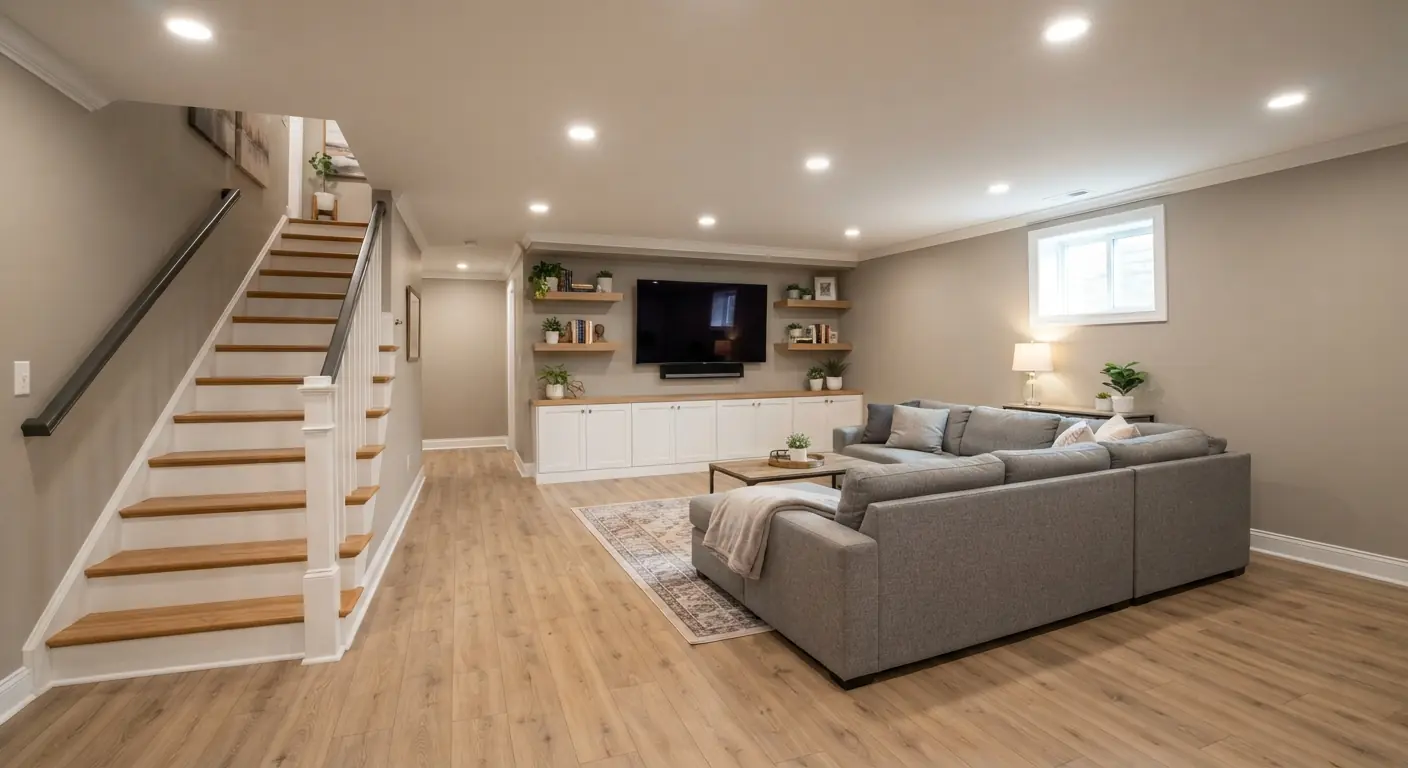
Tile is a good basement floor when the slab is dry, flat and stable. For most basements, porcelain is the tile to buy because it's dense and low in porosity.1 Tile-look vinyl costs less and feels warmer underfoot,21 but it can hold slab moisture in.3 Ceramic suits dry, lightly used rooms on a tighter budget.1
Get the slab checked before you choose a floor. That one step decides more than the tile does.
TL;DR
- Porcelain is the safest tile for a finished basement. It's dense and low in porosity, and it stands up to damp and heavy use.1
- Ceramic is the budget tile for dry rooms. It's more porous than porcelain, and one tile retailer says it needs sealing every 1 to 3 years.1
- Tile-look vinyl is the warm, lower-cost choice. HomeGuide puts luxury vinyl tile at $4 to $16 per square foot installed, against $10 to $50 for tile.2 A building-science digest warns that vinyl floor coverings can stop a slab from drying.3
- Any rigid tile can crack when the slab under it moves. Deal with water and moving cracks first, then plan the floor.
- We found no data showing that any of the three adds more resale value in a basement. Choose for dryness, use and comfort.
Is it a good idea to tile a basement floor?
Yes, if your basement stays dry and your slab is sound. Tile can go straight onto concrete. It won't warp in damp the way real wood can, and it's easy to clean.1 The tradeoffs are real, though. Tile is cold and hard underfoot. It costs more than vinyl,2 and it can crack if the slab moves.
A basement floor takes more abuse than the floors upstairs. A building-science digest on basements says floor finishes should be chosen with flooding in mind, from leaky appliances and failed plumbing to water coming in from outside.3 Tile handles that well. A tile floor can be cleaned and dried after a leak. Wet carpet and pad usually have to come out.
Tile is a poor fit in three situations:
- The slab gets wet. If you see seepage, damp patches or white mineral staining, a new floor won't fix it. Find where the water comes from first, then see the fixes in our guide to waterproofing a basement floor.
- The slab is cracked and still moving. Rigid tile and grout will follow the crack.
- You want a soft, warm floor. A playroom where kids sit on the floor may suit vinyl or carpet better.
How do porcelain, ceramic and tile-look vinyl compare?
Porcelain wins on moisture and wear. Tile-look vinyl wins on warmth and price. Ceramic sits between them as the budget tile for dry rooms. Porcelain and vinyl both come in realistic wood looks.1
| Point | Porcelain tile | Ceramic tile | Tile-look vinyl (LVT) |
|---|---|---|---|
| Warmth underfoot | Cold and hard on a slab. Add radiant heat or rugs. | Cold and hard. A retailer says underlayment improves comfort.1 | Softer and warmer than tile.1 |
| Slab movement and cracking | Rigid. A moving crack can carry up through tile and grout. | Rigid. Same risk as porcelain. | Flexible PVC plastic,4 so small movement is less likely to crack it. |
| Moisture | Dense and low in porosity.1 | Slightly more porous. A retailer says to seal it.1 | Waterproof surface, but an impermeable layer that can stop the slab drying.3 |
| Installed cost per sq ft | $10 to $50 (all tile)2 | $10 to $50 (all tile)2 | $4 to $162 |
| Resale evidence | None found for basements | None found for basements | None found for basements |
| Best for | Most finished basements, bathrooms, damp-prone areas | Dry rooms with light traffic | Family rooms and playrooms over a slab proven dry |
HomeGuide's tile range covers all tile types, and it names ceramic and porcelain as the popular budget-friendly choices.2 We found no national price that splits the two, so get both priced at your estimate for the exact tile lines you like.
What type of tile is best for a basement floor?
Porcelain is the best tile for most basement floors. It's denser and less porous than ceramic, it resists water getting in and it handles heavy use without cracking or losing its finish.1 Pick tile-look vinyl only where warmth or budget matters more and the slab is proven dry. Save ceramic for dry, lightly used rooms.
If you're still weighing tile against carpet, laminate or epoxy, our guide to basement flooring options compares the wider field.
Porcelain
Porcelain is the default for a finished basement. It copes with damp, it copes with furniture and foot traffic, and it keeps its look.1 It's also the most common bathroom floor,2 so a basement bathroom and the rooms next to it can share one floor.
Wood-look porcelain is worth a look if you want a timber feel downstairs. It gives you the grain without the risk of real wood warping in the damp.1
Ceramic
Ceramic is the budget tile. A tile retailer describes it as a popular, budget-friendly basement option that's slightly more porous than porcelain and resists moisture well once sealed.1 That makes it fine for a dry hobby room or a storage area that gets little traffic. It's a weaker pick next to a sump pit or in a basement with any history of damp.
Tile-look vinyl
Luxury vinyl tile copies the look of stone or ceramic in a softer, warmer product. A tile retailer describes it as fully waterproof, with realistic wood and stone finishes.1 It's also much cheaper to install than real tile.2
Here's the catch the product pages skip. Joseph Lstiburek's digest on basements for Building Science Corporation says impermeable floor finishes such as vinyl floor coverings should be avoided, because they stop the slab drying inward and typically lead to mold and other moisture problems.3 "Waterproof" describes the top of the floor. The digest is worried about what happens underneath it. On a slab that's dry year-round, vinyl can work well. On a slab that breathes moisture, it's the riskiest of the three.
Stone and plastic modular tiles
Natural stone such as slate or granite is durable, but it needs regular sealing.1 Interlocking plastic tiles are a different product again. Greatmats says raised-base tiles let air move underneath and suit areas with seepage.4 Those suit a gym or utility space better than a finished family room.
Is it better to have ceramic or porcelain tiles?
For a basement, porcelain is the better buy. It's denser and less porous than ceramic, which matters on a slab that can get damp.1 Ceramic still works in a dry room with light traffic, and it's sold as the budget-friendly option.1 Both are rigid, so both need a flat, stable slab underneath.
The difference shows up over time. The same tile retailer says porcelain needs minimal maintenance, while ceramic and natural stone need sealing every 1 to 3 years to prevent moisture damage and stains.1 In a bathroom upstairs that's a small chore. In a basement with a damp spring every year, it's a job you can't skip.
Price is where ceramic makes its case. We found no national price that separates the two, so ask your contractor to price both lines side by side for your room. If the gap is small, porcelain is the easy call.
What are the downsides of ceramic tile flooring?
Ceramic's main downsides in a basement are porosity, cold and cracking. It's more porous than porcelain, and one tile retailer says it should be sealed to resist moisture.1 It feels cold and hard on a concrete slab. Like any rigid tile, it can crack if the concrete under it shifts.
Here's how those play out:
- Upkeep. A retailer advises resealing ceramic every 1 to 3 years.1 Miss it and stains and moisture get a foothold.
- Comfort. The same retailer suggests underlayment to improve comfort and insulation under ceramic.1 Without it, you're standing on cold concrete with a glaze on top.
- Slipping. Moisture makes basement floors slippery, so choose a textured or anti-slip finish.1
- Repair cost. A cracked or failed floor has to come out. HomeGuide puts tile removal at $2 to $7 per square foot.2 If your basement is already finished and the old floor is failing, the fix becomes a basement remodeling project.
Will tile crack if your basement slab moves?
It can. Tile and grout are rigid, so a slab that cracks, shrinks or heaves can pass the crack up through the floor. Vinyl and plastic tiles are more forgiving. They're made of flexible plastic such as PVC,4 so they bend where grout would crack. Before tiling, get existing cracks looked at and ask your contractor how the floor will handle movement.
Not every crack is a problem. Fine hairline cracks that aren't growing are common in concrete, and our guide to basement floor cracks shows how to tell which ones matter. A crack that's widening, offset from one side to the other or letting water in is a structural or water question first. Have a structural engineer or foundation specialist look at it before any floor goes down.
Floating walls in your plans are a useful clue. A floating wall hangs from the floor joists with a gap at the bottom, so the slab can move without pushing the wall up. If the walls are built to allow for slab movement, rigid tile on that same slab needs a plan for movement too.
That plan usually means an isolation membrane between the slab and the tile. It lets the slab move a little without the tile going with it. Ask your contractor whether they'd use one and which cracks it can and can't handle. Large tiles raise the stakes. A tile retailer notes that large-format tile needs a flat subfloor and proper installation to prevent cracking.1
Can you put porcelain tile directly on concrete?
Yes. Porcelain is usually set straight onto a clean, sound basement slab with a cement-based mortar, with no wood subfloor in between. The slab has to be ready first. It needs to be dry, free of moving cracks and flat enough for the tile size. Large-format tile needs an especially flat surface to avoid cracking.1
Dry is the hard part to judge by eye. The Building Science Corporation digest recommends a capillary break and vapor barrier under basement slabs,3 but you usually can't see whether yours has one. A new slab brings its own water too. The digest notes that several thousand pounds of water in freshly placed concrete tries to dry inward.3 Your contractor should check moisture at the estimate before anyone orders tile.
Skip the plastic subfloor panels for tile. ModuTile markets its interlocking basement subfloor for carpet, carpet squares, vinyl planks and laminate.5 Tile isn't on that list, and a rigid floor belongs on a rigid base.
If you're pouring a new slab, that's the one chance to insulate under it. The digest says basement slabs are best insulated underneath with rigid insulation, which improves comfort and resistance to moisture damage.3
Can mold grow under tile flooring on concrete?
Yes, mold can grow under flooring on concrete when moisture gets trapped there. Humid basement air can condense on the cooler slab.5 Building Science Corporation warns that impermeable floor finishes such as vinyl stop the slab drying and typically lead to mold.3 The risk climbs with anything organic in the layers between.
Porcelain, ceramic and cement-based mortar give mold little to feed on. The trouble spots are what gets layered in between or on top: carpet pad, wood-based panels, glue and trapped dust. Foam is another one. Greatmats says its EVA foam tiles act as a vapor barrier and must be lifted after significant moisture so everything can dry.4
The digest's broader advice is to let the basement dry inward to the room, where ventilation or dehumidification can remove the moisture.3 In practice, that means keeping the space dehumidified and keeping the layers over the slab breathable.
If you already smell must or see growth, stop and have a mold professional assess it before new flooring goes in. New flooring over mold only hides the problem. HomeGuide puts mold removal at $15 to $30 per square foot.2
How warm will a tile basement floor feel?
Cold, unless you add heat or insulation. Concrete is a naturally cool surface,5 and tile passes that coolness to your feet. HomeGuide notes that tile can help a home feel cooler in warm climates.2 If warmth matters most, vinyl feels softer and warmer,1 or you can put radiant heat under tile.
You have four ways to make a tile floor comfortable:
- Radiant floor heat. HomeGuide puts radiant floor heating at $7 to $17 per square foot with installation.2 It suits a basement bathroom or a TV room you use every evening.
- Insulation under a new slab. Only possible when the slab is poured, and the digest says it improves comfort and moisture resistance.3
- Underlayment. A tile retailer suggests it for ceramic to improve comfort and insulation.1 Ask your contractor which products are rated to go under tile.
- Rugs. The simplest fix. Lay a large rug where people sit and keep the tile for traffic paths.
What does basement floor tile cost?
HomeGuide's national ranges put tile at $10 to $50 per square foot installed and luxury vinyl tile at $4 to $16.2 Tile material alone runs $2 to $30 per square foot.2 The tile line you choose, local labor rates and the work needed on the slab move the number most.
| Floor | Material per sq ft | Installed per sq ft | 800 sq ft basement, installed (our math) |
|---|---|---|---|
| Tile (porcelain, ceramic and other tile) | $2 to $30 | $10 to $502 | $8,000 to $40,000 |
| Luxury vinyl tile (tile-look vinyl) | $2 to $10 | $4 to $162 | $3,200 to $12,800 |
| Standard vinyl tile | $1 to $5 | $2 to $102 | $1,600 to $8,000 |
Source for the first three columns: HomeGuide's flooring cost guide.2 The last column is our own arithmetic: 800 square feet times the installed range.
HomeGuide's basement table tells the same story at room scale. For a 500 to 1,500 square foot basement it lists tile at $5,000 to $75,000 and luxury vinyl plank at $2,000 to $24,000.2
A few lines move a tile quote more than the tile itself:
- Labor. Flooring labor averages $2 to $8 per square foot, but HomeGuide says it can reach $20 per square foot for heavy tile.2
- Removal. Tile removal runs $2 to $7 per square foot.2
- Underlayment for vinyl. HomeGuide says underlayment costs $0.50 to $3.50 per square foot and is typically needed under vinyl.2
- Slab repair and membranes. These depend on your slab, so they're priced at your estimate.
Flooring is one line in a larger job. A typical full finish in metro Atlanta runs $45,000 to $80,000 on one local design-build firm's published range, and metro Denver runs $30,000 to $90,000 on one local builder's 2026 cost guide, both checked September 2026. See how the whole job fits together on the pages for basement finishing in Atlanta and basement finishing in Denver.
Does basement tile add resale value?
We found no data that measures what basement tile adds at sale, so treat any resale promise as general. HomeGuide says new flooring can raise home value when the old floor is worn, and the amount depends on floor type, quality and the local market.2 It names new hardwood as the usual best return.
Treat any product page that promises a return on a new floor as a sales claim with no numbers behind it.
Choose the floor for the room you'll use and the slab you have. If the new floor is part of a bigger rework of an older basement, start with basement renovation planning so the floor gets decided alongside moisture, walls and layout.
How do you make a basement floor look nice?
Pick one floor that suits the room's light and use, then carry it through the space. Wood-look porcelain gives a warm look without real wood's moisture risk.1 Large-format tile cuts grout lines and makes a small basement feel bigger.1 Use a textured finish wherever the floor might get damp.1
Wood-look porcelain planks
This is the go-to for a family room or rec room. You get the look of timber with the durability of porcelain.1 Long planks laid parallel to the longest wall make a narrow basement read longer.
Large-format tile for a bigger-feeling room
Big tiles mean fewer grout lines, which makes a small basement look more spacious and easier to clean.1 They also need a very flat slab, so budget for prep.1
Lighter, reflective finishes for a dark basement
Basements are short on daylight. A tile retailer notes that marble brightens a space by reflecting light.1 Light-colored porcelain does a similar job for less upkeep. Balance shine against grip, since polished surfaces get slippery when damp and textured tiles cut the risk of falls.1
Stone-look vinyl for a relaxed family room
Where the slab is dry and budget is tight, vinyl gives you realistic wood and stone looks.1 It feels softer for kids and pets on the floor.
Modular tiles for a gym or playroom
Modular plastic tiles come in many colors and patterns. They suit a home gym or playroom better than a formal living space.
Grout and transitions
Grout close to the tile color hides the grid and makes the floor look calmer. A mid-tone grout hides dirt in a busy rec room. Plan where the tile meets carpet or the stairs, so the change happens at a doorway or a clear edge.
What should you ask your contractor before tiling a basement?
Ask how the slab will be checked, how cracks and movement will be handled and exactly what the quote includes. A good quote lists the tile, setting materials, any membrane, slab prep and removal as separate lines. Those details decide whether the floor lasts.
Take these questions to the estimate:
- How will you check the slab for moisture, and what result would stop you tiling?
- Which cracks will you repair, and will you use an isolation membrane?
- Is my slab flat enough for the tile size I want, or does it need leveling?
- Are you pricing porcelain or ceramic, and can you price both lines?
- What goes under the floor, and is it rated for tile?
- If I want warmth, what would radiant heat add to the quote?
- How will the floor meet the stairs, doorways and other floors?
Basement Remodeling Co. matches you with one vetted, licensed basement contractor for your metro. Your contractor gives you a free on-site estimate and a written, itemized quote. They check moisture and ceiling height during that visit, and nothing starts until you sign. When you're ready, get a written quote for finishing your basement, or find the matched contractor for your ZIP code.