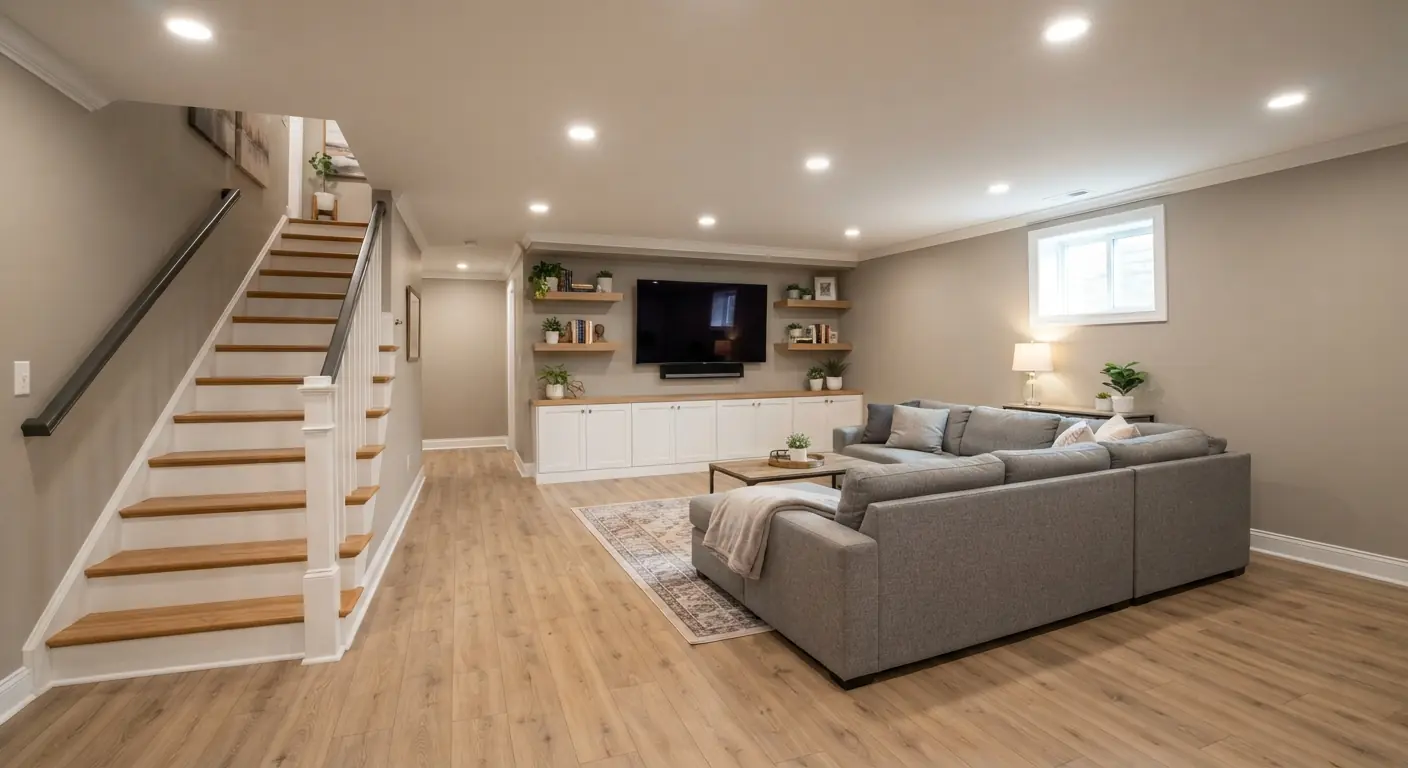
Carpet is a good basement floor when the slab stays dry and every layer touching the concrete resists mold. Pick a synthetic fiber such as olefin, polyester or triexta.1 Lay it over a synthetic rubber or foam pad.2 If the slab ever runs damp, put rigid foam and a subfloor panel under the pad, or use raised-base carpet tiles you can lift and dry.345 Fix any water problem before you buy any of it.
TL;DR
- Carpet works in a basement that stays dry. Fix leaks and seepage first, because floods, leaky pipes and seepage can ruin roll carpet.6
- Choose olefin, polyester, triexta or moisture-treated nylon over a synthetic rubber or foam pad. Leave natural fibers such as wool for the floors upstairs.172
- On a dry slab, pad and carpet can go straight onto the concrete. On a slab that runs cool or damp, add rigid foam or a raised base first.34
- Pick carpet tiles over wall-to-wall anywhere water might reach the floor. You can lift them, dry the slab and put them back.5
- Wall-to-wall carpet runs $2 to $8 per sq ft installed, so a 1,000 sq ft basement comes to about $2,000 to $8,000 before pad, removal and stairs.8
Is carpet in a basement a good idea?
Carpet in a basement is a good idea when the slab stays dry and every water source is under control. It's warm underfoot and still a common choice for finished basements.89 It's a poor choice over a slab that seeps, floods or sweats, because a flood, leaky pipes or seepage can ruin roll carpet.6
Water ruins finished basements. Wet carpet and pad can grow mold and often need to come out. So the useful question is where water could come from in your basement, and how often.
Building Science Corporation's basement digest lists the water sources to plan floors around: leaky appliances, failed plumbing, overflowing sinks and surface flooding from outside.10 Walk your basement with that list. Mark the water heater, the washer, the sump pit and any bar sink. Carpet can still work in a basement that has all four. The few feet around each one is where carpet tiles or a hard floor make more sense.
The cost of getting it wrong is lopsided. HomeGuide prices mold removal at $15 to $30 per sq ft.11 Clearing a 200 sq ft corner at that rate works out to about $3,000 to $6,000, more than the low end for carpeting a whole 1,000 sq ft basement.
If water damage is what's pushing you to replace the floor, treat it as part of a basement renovation that starts with the water source.
Can mold grow under carpet on concrete?
Yes. Mold can grow under carpet on concrete when moisture reaches the pad and can't dry out. That moisture comes from three places: water moving up through the slab, humid summer air condensing on cool concrete, and leaks or spills from above.121310 A pad that stays wet gives mold time to grow.
Moisture from below
Building Science Corporation says a capillary break and a vapor barrier belong under every basement slab.14 You can't see whether yours has them. The digest also describes what goes wrong when a sand layer sits between the plastic and the slab. The sand can stay wet, the slab can only dry upward, and that typically damages the floor finish on top.12 In a carpeted basement, carpet and pad are that floor finish.
Condensation in summer
Concrete below grade stays cool. In summer, warm, moist air meets basement surfaces that sit below its dew point, and water condenses on them.15 The digest makes that point about walls. It also credits insulation under a slab with better resistance to summertime condensation.13 On a slab with no insulation under it, the top of the concrete under your pad is a likely place for that water to collect.
Leaks and spills from above
A spill soaks down through the carpet into the pad. What happens next depends on whether the moisture can leave. The digest's approach is to let a basement dry into the room, where ventilation or dehumidification removes the moisture.16 Carpet One gives the same advice for carpet: run dehumidifiers and keep air moving, because even water-resistant carpet can't take constant moisture.17
If you pull up a corner and find mold over more than a small patch, or a musty smell returns after the floor dries, have a licensed mold professional assess it before any new floor goes down.
What type of carpet is best for basements?
The best basement carpet is a low-pile synthetic: olefin (polypropylene), polyester, triexta, or nylon with a moisture treatment. Synthetic fibers handle damp conditions better than natural fibers such as wool.1 Low pile holds less moisture and dries faster than high pile, which counts after a spill or a humid week.18
| Fiber | How it handles moisture | Where it fits in a basement |
|---|---|---|
| Olefin (polypropylene) | Highly moisture resistant and doesn't absorb water19 | Rec rooms and slabs with some damp risk |
| Polyester | Less absorbent than natural fibers; suits areas that get damp but aren't constantly wet20 | Bedrooms and family rooms on a dry slab |
| Triexta | Similar to polyester, with more durability and moisture resistance21 | Family rooms that take heavy traffic |
| Nylon | Not moisture resistant on its own; many are treated to repel moisture and resist mold7 | High-traffic rooms, if the quote names the treatment |
| Wool | A natural fiber; synthetics are preferred in damp conditions1 | Leave it for the floors upstairs |
Fiber is only half the choice. A fiber that sheds water still fails on a pad that soaks it up. Carpet One's basement guide makes the same turn, telling buyers to look at backing and pad next.22
If you want plush, keep it away from the water heater, laundry and sump, or use a plush tile you can clean. Some plush carpet tiles, with a 1-inch pile, are machine washable after a water problem.23
Which pad and subfloor keep carpet dry on a slab?
Every layer that touches a basement slab should resist moisture damage and not support mold growth. Building Science Corporation's basement digest calls those essential traits for any material in contact with the floor slab.3 For carpet, that means a synthetic rubber or foam pad, plus rigid foam or a raised base on a slab that runs damp.2
Match the build-up to the slab you have. Layers are listed from the concrete up.
| Slab condition | Layers from the concrete up | Why it works | Watch for |
|---|---|---|---|
| Dry, no water history, passes your contractor's moisture check | Tack strip, synthetic rubber or foam pad, synthetic carpet | Rubber and foam pads resist moisture and mold2 | Summer humidity, so run a dehumidifier17 |
| Cool or damp to the touch at times, no liquid water | Rigid foam, subfloor panel, pad, carpet | Rigid foam allows drying, isn't sensitive to moisture and doesn't support mold3 | Extra height at doors and the bottom stair |
| Occasional seepage or small floods | Raised plastic-base carpet tiles, or tiles with a waterproof foam base | Air under a raised base lets moisture evaporate4 | Fix the water source anyway |
| Standing water or ongoing leaks | No carpet yet | Even water-resistant carpet can't take constant moisture17 | Waterproofing and drainage come first |
The moisture-barrier pad question
Carpet One recommends backing and pad with a moisture barrier to protect the carpet and the floor below.22 Building Science Corporation warns that impermeable floor finishes, such as vinyl coverings, stop a basement drying inward and typically lead to mold.24 Both points hold. A barrier keeps a spill from soaking into the pad. It also traps any moisture that comes up through the slab.
Our reading of the two: use a barrier pad only on a slab that passed a moisture check. On a slab that runs damp, give the moisture a way out with a raised base or a foam layer that allows drying.
New concrete needs time
Fresh concrete holds a lot of water. The digest puts it at several thousand pounds in a freshly placed pour, all of it trying to dry inward.25 If your finish includes new slab work, such as patching the floor after plumbing rough-in, let your contractor decide when the pad can go down.
Can you put carpet directly on a concrete basement floor?
Yes, if the slab is dry. Wall-to-wall carpet goes over a pad on tack strip fastened to the concrete, and many carpet tiles are made to go straight over concrete.26 On a slab that sweats or seeps, carpet laid straight on the concrete holds moisture against the pad, so add rigid foam or a raised base first.
"Dry" should come from a test. Your contractor should check the slab for moisture before pricing the floor. Timing matters too. A slab that looks dry in March can behave differently in August, because condensation on cool basement surfaces is a summer problem.15
The pad also does a comfort job on concrete. HomeGuide notes that carpet padding helps insulate, protects the subfloor and makes carpet more comfortable to walk on.27 On a bare slab, that cushion is most of what makes a basement floor feel like the rest of the house.
When do carpet tiles beat wall-to-wall carpet?
Carpet tiles beat wall-to-wall whenever water might reach the floor. You can lift wet tiles, let the slab dry and put them back.5 Roll carpet can be ruined by the same flood, leaky pipe or seepage.6 Wall-to-wall wins on a slab that has proven dry, where you want one soft surface over a cushioned pad.
| Factor | Wall-to-wall carpet | Carpet tiles |
|---|---|---|
| What touches the slab | A separate pad on tack strip | A waterproof foam base, or a raised plastic base with pegs2829 |
| After a leak | Floods, leaky pipes and seepage can ruin roll carpet6 | Lift the tiles and dry the slab; some tiles are machine washable523 |
| Material cost | $1 to $5 per sq ft (HomeGuide)30 | About $1 to $9 per sq ft (Greatmats)31 |
| Installed cost | $2 to $8 per sq ft (HomeGuide)8 | DIY options exist; pro install is priced at your estimate32 |
| Size | Cut from a roll to fit the room | Usually 1 by 1 ft to 2 by 2 ft squares33 |
Many basements need both. Put wall-to-wall in bedrooms and the family room on the dry side of the floor. Put tiles around the sump pit, the laundry and any bar sink, where the water sources on Building Science Corporation's list tend to sit.10
Leave traditional peel-and-stick carpet tiles out of any basement with a chance of moisture.34
Is it cheaper to lay carpet or carpet tiles?
Roll carpet has the lower price ceiling for material, and tiles can come out cheaper overall if you lay them yourself. HomeGuide puts carpet material at $1 to $5 per sq ft and installed carpet at $2 to $8.308 Greatmats lists basement carpet tiles at about $1 to $9 per sq ft.31
The cheapest tiles are the wrong ones for a basement. Greatmats says its least expensive designs have a peel-and-stick backing,31 and it tells buyers to avoid traditional peel-and-stick tiles where moisture is possible.34
The fair comparison is roll carpet plus pad against a tile with its own foam or raised base. Carpet labor can run as low as $0.50 per sq ft.35 A separate pad adds $0.75 to $1.75 per sq ft installed.27 On Greatmats' listing captured September 29, 2026, at sale prices, its foam-base interlocking tile was $2.94 per sq ft and its raised plastic-base tile was $8.14 per sq ft.3637 A foam-base tile you lay yourself lands inside the installed range for roll carpet. The raised tile costs slightly more than the top of it.
Small rooms cost more per foot either way, because many contractors charge a $200 to $500+ minimum project fee.38
How much does it cost to carpet a 1,000 sq ft basement?
Plan on about $2,000 to $8,000 to carpet a 1,000 sq ft basement with wall-to-wall carpet, using HomeGuide's installed range of $2 to $8 per sq ft.8 Pad, removal of old carpet and stairs can add to that. At Greatmats' range of about $1 to $9 per sq ft for carpet tiles, material alone for the same floor works out to about $1,000 to $9,000.31
| Line item | Rate | 1,000 sq ft total | Source and scope |
|---|---|---|---|
| Wall-to-wall carpet | $2 to $8 per sq ft | $2,000 to $8,0008 | HomeGuide, installed |
| Carpet pad, if quoted separately | $0.75 to $1.75 per sq ft | $750 to $1,75027 | HomeGuide, installed |
| Removing old carpet | $0.70 to $1.60 per sq ft | $700 to $1,60039 | HomeGuide, labor |
| Carpeting one staircase | $150 to $600 | $150 to $60040 | HomeGuide, average per staircase |
| Carpet tiles, any type | About $1 to $9 per sq ft | $1,000 to $9,00031 | Greatmats, material only |
| Foam-base interlocking tile | $2.94 per sq ft | $2,94036 | Greatmats sale price, September 29, 2026 |
| Raised plastic-base tile | $8.14 per sq ft | $8,14037 | Greatmats sale price, September 29, 2026 |
The two sources measure different things. HomeGuide's rates are installed or labor prices. Greatmats' rates are one retailer's material prices. The totals column is our own arithmetic at 1,000 sq ft and assumes no waste or cuts. HomeGuide's own basement table puts carpet for 500 to 1,500 sq ft at $1,000 to $12,000, which matches the per-foot math.41 Budget from the $2 to $8 range and ask whether the pad is inside it.
If the carpet is part of a full basement finish, it's one line in a much larger budget. The typical full-finish ranges Basement Remodeling Co. publishes, checked September 2026, are $45,000 to $80,000 for basement finishing in metro Atlanta, $30,000 to $90,000 for basement finishing in metro Denver and $30,000 to $75,000 for a 1,000 sq ft finish in Colorado Springs. Each range comes from one local firm's published figures.
Is it better to have carpet or LVP in a basement?
Carpet is better for warmth and comfort in bedrooms and family rooms on a dry slab, and it costs less to install. LVP suits the spots near spills, wet shoes and the laundry. HomeGuide prices carpet at $2 to $8 per sq ft installed and LVP at $4 to $16.842 Neither floor makes a wet slab safe.
| Factor | Carpet | LVP |
|---|---|---|
| Installed cost per sq ft (HomeGuide) | $2 to $88 | $4 to $1642 |
| 500 to 1,500 sq ft basement (HomeGuide) | $1,000 to $12,00041 | $2,000 to $24,00043 |
| Comfort | Soft, and helps keep a home warm in cold months9 | Hard surface |
| After a spill | Soaks into the pad unless the pad has a barrier | Wipes off the surface |
HomeGuide says basement flooring should be waterproof or water-resistant unless the space is finished and sealed.44 Read alone, HomeGuide's rule points toward luxury vinyl plank in an unfinished or damp space. Building Science Corporation adds a warning that cuts the other way. Impermeable floor coverings such as vinyl stop the slab drying inward and typically lead to mold.24 A vinyl floor over a damp slab moves the problem underneath, where you can't see it.
So dry the slab first, then choose the floor room by room. For the other options side by side, see the guide to basement flooring options.
What a good basement carpet quote shows
A good basement carpet quote names what the moisture check found, the fiber, the pad and every layer between pad and slab. Every contractor Basement Remodeling Co. matches checks moisture at the free on-site estimate, so that reading belongs at the top of the flooring lines. Removal, stairs and transitions should be separate lines.
Look for these on the page:
- The moisture reading, and where on the slab it was taken.
- The fiber by name: olefin, polyester, triexta or treated nylon.
- The pad material, and whether it has a moisture barrier.
- The layer under the pad: none, rigid foam and a subfloor panel, or tiles with their own base.
- Whether the pad sits inside the per-foot carpet price or on its own line.
- Old carpet removal, stairs, trim and the transitions to other floors.
Two questions from HomeGuide's installer checklist are worth asking word for word. "What exactly does the estimate include?"45 And "How will the flooring be finished at the edges where it meets other flooring?"46
When you're ready to price the whole job, get a written quote for finishing your basement. You get a free on-site estimate and a written, itemized quote from one vetted, licensed basement contractor, and nothing starts until you sign. If your basement is already finished and the carpet is the part that failed, start with remodeling an existing basement. To check coverage for your area, find basement contractors by ZIP code.