You can fix a lot of basement dampness yourself when the water comes from the roof, the yard or humid air. Clean gutters, extend downspouts, slope soil away from the wall, patch small cracks and run a dehumidifier. Sealer paint helps with light dampness on a clean wall.1 Get a pro when walls bow, water pushes up at the floor joint in storms, cracks keep growing or mold covers more than about 10 square feet.2
TL;DR
- Work from the outside in. Moving roof water and sloping the soil away cuts off water before it reaches the wall.3 Gutter work is typically much cheaper than exterior waterproofing.4
- Measure humidity before you buy a coating. A wall that sweats in summer is usually condensation from humid air3, and a dehumidifier holding 30 to 50 percent relative humidity handles that.5
- Sealer paint and crack patches are finishing touches for light dampness. Sealers won't stop water under pressure, so don't count on paint for a wall that pushes water.1
- Hand anything structural and anything that needs a jackhammer or excavator to a pro.4 The same goes for large mold or sewage cleanup.2
- Professional systems average $6,000 to $12,000 inside and $10,000 to $18,000 outside, so a weekend of cheap fixes is worth trying first.1
How do you tell what kind of water problem you have?
Watch where and when the water shows up. Damp walls in humid summer weather with no puddles point to condensation, which a dehumidifier handles.3 Wet patches after rain point to roof or yard water. Water at the floor-wall joint during long storms points to saturated soil pushing water in under pressure, which is harder to fix.
Buy a humidity meter before anything else. EPA says one costs about $10 to $50 at a hardware store.2 It recommends keeping indoor humidity below 60 percent and ideally between 30 and 50 percent.2 EPA also notes that condensation on walls or pipes can be a sign of high humidity.2
Building Science Corporation explains why summer is the worst season for it. Warm, moist air meets basement walls that sit below its dew point, and water forms on the concrete.3 That water looks like a leak. Sealer paint won't stop it because it never came through the wall.
ENERGY STAR sorts basements into three conditions. "Slightly to moderately damp" means a musty smell that comes and goes. "Very damp" means damp spots on walls and floors. "Wet" means walls or floor sweat, or seepage is present, at 90 to 100 percent relative humidity.5
Look for the other clues too. HomeGuide's warning signs include water stains, musty odors, damp walls and white or gray chalky residue on walls or floors.1 That chalky residue is efflorescence. DRYLOK tells you to remove it before any coating goes on.6
Which basement water fixes can you do yourself?
Five fixes sit in homeowner territory: clearing gutters and extending downspouts, sloping soil away from the foundation, patching small cracks, rolling masonry waterproofer onto clean walls and running a dehumidifier. Do them roughly in that order. Outside fixes stop water before it reaches the wall.3 Inside fixes only manage what gets through.
Here's the triage in one table. Costs are the published figures in each named source, so check whether a figure is DIY materials or a pro's installed price.
| What you see | DIY fix | Cost reference | Stop sign |
|---|---|---|---|
| Musty air, walls sweat in summer | Dehumidifier and a humidity meter | Portable dehumidifier $130 to $300 (HomeGuide)1; meter about $10 to $50 (EPA)2 | Humidity stays high with a correctly sized unit running |
| Wet spots near a corner after rain | Clear gutters, extend downspouts | Replacing downspouts $220 to $625 total (HomeGuide)1 | Water still gets in after roof water is moved away |
| Soil or paving slopes toward the house | Add and pack soil at low spots | Pro regrading $1,000 to $5,000 (HomeGuide)1 | The whole lot tilts toward the house |
| A small crack that seeps | Hydraulic cement patch | Pro epoxy injection $250 to $800+ per crack (HomeGuide)1 | The wall bows or the crack keeps growing |
| Light dampness on bare masonry | Masonry waterproofer, two coats | $2 to $10 per sq ft with labor (HomeGuide)1 | The wall is more than damp or water runs |
| Seepage where floor meets wall | Bonded baseboard channel to a sump or floor drain | Sump pump $600 to $2,500 installed, if you need an outlet (HomeGuide)7 | No drain outlet, or standing or running water |
Clear gutters and extend downspouts
Roof water is the first thing to move. Building Science Corporation's basic rule is to collect roof runoff in gutters and drain it away from the foundation so it doesn't soak the ground beside the wall.3 ENERGY STAR gives the same advice: extend downspouts away from the foundation and keep gutters and downspouts clear.5
Home Depot's pro guide says a basement that only needs damp-proofing may be fixed by making the gutters work better. It adds that gutter jobs are typically much cheaper than exterior waterproofing.4 The options it lists are moving gutters farther out from the roof edge, extending downspouts away from the home or tying a downspout into an existing drain.4
Walk the house in a heavy rain. Look for overflowing gutters and downspouts that dump right beside the wall. Fix those spots first and watch the basement through the next storm before you spend more.
Slope the soil away from the house
Both EPA and Building Science Corporation say the ground should slope away from the foundation so water doesn't collect there.23 Building Science Corporation also recommends an impermeable layer over the ground next to the house.3 ENERGY STAR adds a quieter one: go easy on watering the plantings along the foundation.5
Filling and packing soil at a low spot is shovel work. A yard that tilts toward the house is a bigger job. HomeGuide puts professional regrading at $1,000 to $5,000.1 It says regrading is occasionally enough on its own but is often paired with an exterior drain or membrane.1
Patch small cracks
Fill cracks before you paint. Home Depot says waterproof paint won't plug existing cracks and goes on after all cracks are filled and dry.4 DRYLOK's own prep steps include repairing cracks and holes, and it sells a hydraulic cement for that job.6
Epoxy injection is the pro version. HomeGuide prices it at $250 to $800+ per crack and describes it as a fix for minor cracks that don't threaten the home's structure.1 That limit applies to your patch too. A crack in a wall that is bowing or shifting is a structural question for a licensed pro before it's a water question.
Roll on masonry waterproofer
Sealer paint is the classic weekend job, and our guide to basement waterproof paint and sealers compares the product types. DRYLOK says that if you can paint a wall, you can apply its masonry waterproofer.6 Its steps run like this:
- Clean off dirt, dust, loose paint and efflorescence. Repair cracks and holes.6
- Stir the product well.6
- Brush or roll the first coat evenly, starting at the top and working down.6
- Let the first coat dry at least four hours.6
- Apply the second coat and let it dry at least 24 hours before it sees moisture.6
If a wall is more than damp, DRYLOK says the waterproofer won't cure properly without its wet-wall bonding primer.6 A wall that never dries out is telling you something about the water behind it.
Never paint over mold. EPA says to clean the mold and dry the surface first, because paint applied over moldy surfaces is likely to peel.2
Run a dehumidifier
Size it to the room's condition. For a room under 2,000 square feet, ENERGY STAR recommends 20 to 30 pints per day for slightly to moderately damp space, 25 to 40 for very damp and 30 to 50 for wet.5 Set the humidistat to hold 30 to 50 percent relative humidity.5 Our dehumidifier sizing guide walks through the choice in more detail.
If the basement runs below 65 degrees F, look for a model rated for lower temperatures. ENERGY STAR says coils can frost below that point.5 Hook a hose to a floor drain or sump so you're not emptying a bucket, and keep drainage away from electrical cords and outlets.5 HomeGuide puts a portable unit at $130 to $300 and a whole-house unit at $1,500 to $3,500 installed.1
Try a baseboard channel for seepage at the floor joint
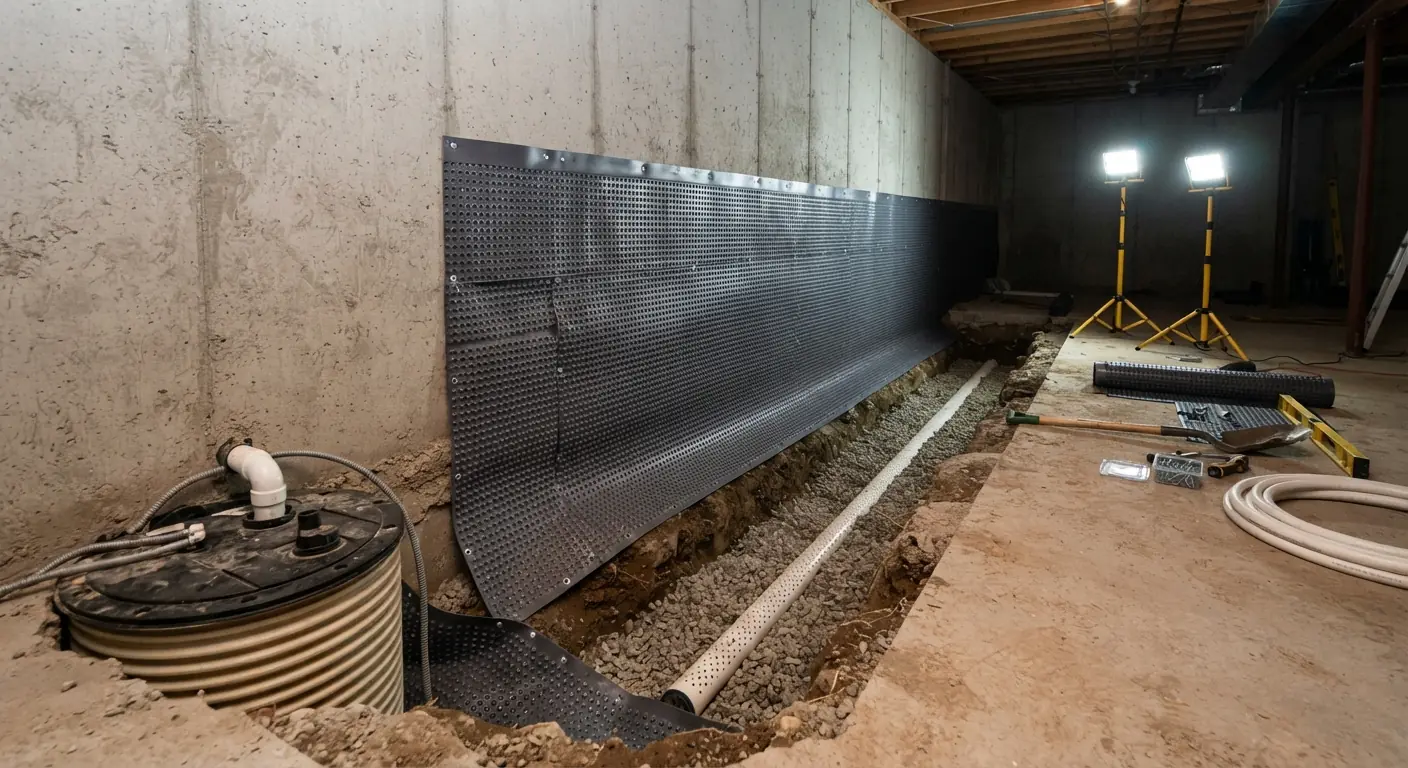
Water that seeps in where the floor meets the wall has a DIY option. A hollow baseboard channel bonds to the concrete floor along the wall, collects the seepage and carries it to a sump pump or floor drain. It bonds only to clean concrete, and it's no fix for standing or running water.
The channel only moves water, so it needs an outlet. If you don't have a sump pit, that part is a pro job. HomeGuide says sump installation runs $2,500 to $5,000 when crews must jackhammer or saw through a concrete floor.7
When should you stop and call a pro?
Stop when the problem is structural, when water arrives under pressure, when the fix needs heavy equipment or new wiring, or when the damage has outgrown a small cleanup. A DIY patch on any of these can hide a problem that keeps getting worse behind a dry-looking wall. Here are the signs to watch.
- Bowed walls or warped doors. HomeGuide lists bowed walls and warped doors among the warning signs.1 A moving wall needs a structural assessment by a licensed pro before anyone waterproofs it.
- Cracks that widen or leak again after a patch. A crack that keeps moving is a structural question first.
- Water pushing up at the floor joint or through the slab after storms. Saturated soil builds hydrostatic pressure that pushes water in at that joint. HomeGuide says homes with significant hydrostatic pressure need more comprehensive solutions.1
- Standing water or sewage. EPA says damage from sewage or other contaminated water calls for a professional experienced with contaminated water.2
- Mold over about 10 square feet. EPA says you can usually handle a patch under that size yourself.2 Past it, or after a lot of water damage, it points you to professional remediation guidance.2 Don't run the furnace or air conditioning if you suspect mold has reached the system.2
- Anything that needs an excavator or a jackhammer. Home Depot notes these jobs may require permits or licenses.4 Exterior waterproofing starts with digging around the perimeter down to the foundation.4
- New wiring. A sump pump or whole-house dehumidifier may need a new circuit, and that's a licensed electrician's job. ENERGY STAR says a whole-home dehumidifier drain should be routed by an HVAC professional during installation.5
Should you waterproof from the inside or the outside?
Outside, when you can. Exterior drainage and coatings keep water out of the wall, which is how basements have traditionally been built.3 Inside systems manage water after it has entered the wall. For DIY, your outside work is surface work: gutters, downspouts and grading. Digging down to the footings is a pro job.
Building Science Corporation describes the traditional approach as putting the barrier and control layers on the outside and letting the wall dry toward the inside.3 Home Depot's pro guide says the most thorough jobs combine inside and outside work. It also warns that interior sealants alone are only a temporary measure.4 Sealing or coating the inside won't protect the foundation from water on the outside.4
| Inside | Outside | |
|---|---|---|
| What it does | Collects water that gets in and pumps it out | Keeps water off the wall |
| Typical methods (HomeGuide) | Pumps, drains, sealers, crack filling | Grading, drains, membranes |
| Average pro cost (HomeGuide) | $6,000 to $12,0001 | $10,000 to $18,0001 |
| Your DIY share | Crack patches, sealer, baseboard channel, dehumidifier | Gutters, downspouts, hand grading |
Figures and method lists in the table come from HomeGuide.1 An interior French drain means cutting a trench in the basement floor, filling it with gravel and perforated pipe, and connecting it to one or more sump pumps.1 The exterior version means excavation, and HomeGuide adds $300 to $1,000+ for replacing sod and plants afterward.1
For the full comparison of drains, membranes and sump systems, see our guide to basement waterproofing methods.
How much does it cost to waterproof a 1,000 sq ft basement?
DIY fixes cost hundreds of dollars and a professional system costs thousands. HomeGuide puts the average professional job at $6,000 to $18,000.1 In a 1,000 sq ft basement, floor area matters less than wall area, perimeter length and the cause of the water. Those decide the method, and the method sets the price.
Here's a worked example. Say the basement is 25 by 40 feet with 8-foot walls. That works out to a 130-foot perimeter and about 1,040 square feet of wall. The worked costs below are our own multiplication of each published rate by those quantities. Each row keeps its own source because the scopes differ.
| Job | Published rate (source) | Quantity | Worked cost |
|---|---|---|---|
| Waterproof paint | $1 to $6 per sq ft (Home Depot, scope not stated)4 | 1,040 sq ft of wall | $1,040 to $6,240 |
| Sealer, labor and materials | $2 to $10 per sq ft (HomeGuide)1 | 1,040 sq ft of wall | $2,080 to $10,400 |
| Exterior French drain, installed | $30 to $90 per linear foot (HomeGuide)1 | 130 ft | $3,900 to $11,700 |
| Exterior membrane, installed | $4 to $7 per sq ft (HomeGuide)1 | 1,040 sq ft of wall | $4,160 to $7,280 |
Add the pieces that don't scale by the foot. A sump pump costs $600 to $2,500 installed.7 An interior French drain runs $4,000 to $17,000 depending on basement size and layout.1 The membrane also needs excavation around the house before anyone can apply it.1
Few basements need every wall treated. The price should follow the walls and runs where water actually gets in. That's why the on-site estimate should measure and check moisture before anyone quotes.
How long does basement waterproofing last?
A good professional system lasts 10 to 30 years or more, according to HomeGuide.1 The parts age at different rates. Exterior membranes typically last 10 to 15 years, and interior French drains and sump pumps can run 20 to 30 years with regular upkeep.1 Interior sealants alone are a temporary measure.4
The sources don't agree on membranes. Home Depot says polyurethane coatings can protect concrete for up to 25 years and bentonite typically lasts the life of the concrete.4 That's longer than HomeGuide's 10 to 15 years for exterior membranes.1 Budget from HomeGuide's shorter figure. It covers membranes in general, and you won't know the product until you see a quote.
Pumps need the most attention. HomeGuide says a sump pump lasts 5 to 30 years. Pedestal pumps average 10 to 30 years and submersible pumps 5 to 20.7 Battery backup pumps need new batteries every 3 to 5 years.7
The DIY fixes last only as long as you keep them up. EPA says to clean and repair gutters regularly.2 DRYLOK says to keep checking the basement for moisture after waterproofing.6
What are the downsides of DIY waterproofing?
The big one is treating a symptom. A coat of sealer can make a wall look dry while water keeps soaking the foundation from outside.4 The other risks: a coating that traps moisture in the wall, paint that fails over mold, and a patch that hides a structural problem until it costs more to fix.
Paint and pressure
HomeGuide says sealers won't stop water under pressure and work well for minor dampness.1 Home Depot calls interior sealants alone a temporary measure.4 Treat a wall that pushes water as a drainage problem. Save paint for walls that are only damp.
Coatings that trap moisture
Building Science Corporation warns against impermeable interior wall finishes such as oil or alkyd paints and vinyl wall coverings. It says they stop the wall drying inward and typically lead to mold.3 Its conclusions add epoxy paint systems to that list.3 Before you coat a wall that will later sit behind a finished wall, check how the product affects drying.
Mold and hidden damage
Paint over mold is likely to peel.2 Mold can also hide behind drywall and paneling or under carpet pads.2 A dry-looking surface doesn't mean the wall behind it is sound.
Costs you may not get back
HomeGuide says you may not recoup the full cost of waterproofing at resale.1 Treat it as protection for the house, and budget for upkeep such as pump batteries. A sump pump also depends on power. Building Science Corporation notes pumps can fail during outages3, and HomeGuide suggests a battery backup.7
Can you waterproof a basement that is already finished?
Yes. The outside fixes never touch your finished walls. Gutters, downspouts and grading work the same in a finished basement as a bare one. Interior drains are the hard part. They need access to the floor edge and the base of the wall, so trim, drywall or paneling may come off and go back on afterward.4
Home Depot's steps for interior work end with sealing the walls and replacing any wall material that was removed, such as wood paneling.4 Baseboard channel kits are one way around the demolition. They sit on the floor at the base of the wall, so they need clean, bare concrete there to bond to.
If water has already reached the finishes, speed matters. EPA says wet materials dried within 24 to 48 hours usually won't grow mold.2 Porous materials such as carpet and ceiling tiles may have to be thrown out once moldy.2
Opening a wet wall is also a chance to rebuild it properly. Building Science Corporation says framing a wall, insulating the cavity and covering it with an interior plastic vapor barrier often leads to odor, mold, decay and corrosion problems.3 It recommends rigid or spray foam against the concrete because foam allows drying and doesn't support mold growth.3 Reworking a finished basement like this is basement remodeling. If yours is still bare, settle the water before finishing the basement.
What a good waterproofing quote shows
A good quote starts with where the water comes from and prices a fix for that cause. It itemizes materials, labor and cleanup, lists which walls or linear feet are covered, and says what happens to your finishes. If it jumps to the most expensive system without explaining the diagnosis, ask why.
HomeGuide recommends getting an itemized estimate, contract and warranty in writing before work starts.1 Ask your contractor:
- How is water getting into my basement, and what did you check to decide that?1
- Would gutter, downspout or grading work fix part of this first?
- Are there structural problems that could cause the walls to fail?1
- Does the price cover materials, labor, delivery fees and cleanup?1
- Does this job need a permit, and who pulls it?
- What upkeep does the system need, and what keeps the sump running in a power outage?
- What's covered in writing if water comes back?
If you're fixing water ahead of a finish, Basement Remodeling Co. matches you with one vetted, licensed basement contractor for your metro. The contractor checks moisture during a free on-site estimate and gives you a written, itemized quote. You can get a written quote for waterproofing before you finish, or find the contractor who covers your ZIP code. Service is live in metro Atlanta, Denver, Colorado Springs and Fort Collins. See basement finishing in Atlanta or basement finishing in Denver for local detail.