The best sump pump for your basement is one sized to two numbers: how fast water fills the pit and how high the pump must lift it. For most homes that means a submersible pump in the 1/3 to 1/2 hp range, checked against the maker's flow chart.1 If a storm outage would flood a room you care about, add a battery or water-powered backup.
The horsepower printed on the box tells you less than you'd think.
TL;DR
- Size the pump from inflow (gallons per hour into the pit) and head height (feet of lift plus pipe run). Then check the pump's curve at your head height.1
- A 1/3 hp pump suits most average homes with average water tables. Step up to 1/2 hp for a higher water table or longer pipe runs, and to 3/4 or 1 hp for flood plains, low-lying lots and deep basements.1
- Bigger isn't safer. A pump sized wrong for the pit cycles constantly and burns out early.1
- A submersible pump fits most basements, especially finished ones.1 A pedestal pump costs less and lasts longer but it's louder and bulkier.2
- Settle the backup before you finish the space. Battery units need new batteries every 3 to 5 years. Water-powered units run on municipal water and need a yearly inspection.2
How do you size a sump pump by inflow and head height?
You size a sump pump with two measurements. Inflow is how many gallons per hour reach the pit in a hard rain. Head height is how far the pump must push that water to where it leaves the house. Ferguson's sizing guide lists flow and head pressure next to horsepower, the float switch and backup.1
Horsepower is only a rough label for those two things. Every submersible pump has its own pump curve, so two pumps with the same rating can move different amounts of water at the same height.1
Step 1: measure inflow
The best time to measure is during a heavy storm, when the pump is cycling on and off. Watch the pit right after the pump shuts off. Mark the water level. Then time how long the water takes to rise to the point where the pump kicks on again, and measure that rise in inches.
Next, turn inches into gallons. Zoeller lists its basement basins as 18 by 22 inches and 18 by 30 inches.3 By our math, a round pit 18 inches across holds about 1.1 gallons per inch of depth: 3.14 × 9 × 9 gives about 254 cubic inches per inch of depth, and a gallon is 231 cubic inches.
Here's a worked example. It's an illustration, with made-up numbers. Say the water climbs 6 inches in 1 minute in an 18-inch pit. That works out to about 6.6 gallons a minute, or roughly 400 gallons an hour. Your pump has to move more than that at your head height.
Measure in the heaviest rain you can, and repeat it in another season if you get the chance. If the pit fills faster than you can safely watch it, leave the measuring to your contractor.
Step 2: measure head height
Head height starts with vertical lift. That's the height in feet the water must be pushed up out of the pit to the point it exits your home.1 Measure from the bottom of the pit to where the discharge pipe goes through the wall.
The horizontal run counts too. Longer runs add friction, and that takes more power to overcome.1 Ferguson's 1/3 hp guidance assumes one 90-degree elbow and 3 to 25 feet of horizontal pipe. With a lift of 10 to 15 feet or a run of 30 to 150 feet, you may lose flow and need more capacity.1
Pipe size matters as well. Wexford Insurance, which insures plumbing contractors, lists undersized discharge piping among the common installation mistakes.4
Step 3: read the pump curve
The maker's spec sheet shows each pump's output in gallons per hour at different lift heights.1 Find your head height on that chart and read the flow at that point. If it clears your inflow with room to spare, the pump fits. If it only just matches, look at the next size up or at a model with a stronger curve at your height.
Which horsepower does your basement need?
Most average homes with an average water table do fine with a 1/3 hp pump. Choose 1/2 hp for an above-average water table, a lift of 10 to 15 feet or a long horizontal run.1 Save 3/4 or 1 hp for high water tables, flood plains, low-lying lots and deeper basements.1
Three published guides split the range like this. Each column keeps one source's own wording.
| Horsepower | Ferguson Home (retailer sizing guide) | HomeGuide (cost guide, updated August 2023) | Wexford Insurance (plumbing trade guide) |
|---|---|---|---|
| 1/4 hp | Not listed | Drier areas (0.25 hp)2 | Not listed |
| 1/3 hp | Average home, average water table. Handles 7 to 10 feet of lift with one 90-degree elbow and 3 to 25 feet of horizontal pipe1 | Homes with frequent flooding (0.33 to 0.5 hp)2 | Most residential homes4 |
| 1/2 hp | Above-average water table. Pumps about 35% to 40% more than 1/3 hp and handles higher lifts1 | Homes with frequent flooding (0.33 to 0.5 hp)2 | Higher water volumes4 |
| 3/4 to 1 hp | High water tables, flood plains, low-lying areas, deeper basements1 | Not listed | 3/4 hp or higher for heavy-duty use4 |
Sources: Ferguson Home1, HomeGuide2 and Wexford Insurance.4
The guides agree at the low end and split at the top. HomeGuide treats 0.33 to 0.5 hp as enough for homes with frequent flooding.2 Ferguson moves high water tables and flood-prone lots up to 3/4 or 1 hp.1 We'd plan from Ferguson's bands because they're tied to lift and pipe run, which you can measure. Then let the pump curve settle it.
What's better, 1/3 hp or 1/2 hp?
Neither is better on its own. A 1/2 hp pump generally moves about 35% to 40% more water than a 1/3 hp pump and handles higher lifts.1 That only matters if your inflow or head height calls for it. If a 1/3 hp curve clears your inflow at your lift, the smaller pump is the right one.
Do you need a 1/2 hp or 3/4 hp sump pump?
Go to 3/4 hp when the house sits in a high water table area, a flood plain or a low-lying spot, or when the basement is deep.1 Otherwise 1/2 hp covers an above-average water table.1 If you're torn between the two, the curve decides. Pick the smaller pump if it clears your inflow at your head height.
Can a sump pump be too powerful?
Yes. Ferguson calls pump selection a critical sizing exercise and warns against treating it as a bigger-is-better guess. A pump sized wrong for the pit can cycle constantly and burn out early.1 An oversized pump drains a small pit in moments, shuts off, then starts again as soon as the water returns.
Every start wears the motor and the switch. That's why the float switch matters. A reliable one prevents short cycling so the pump only runs when it's needed.1 Heat is the other enemy. Cast iron dissipates heat better than plastic and usually lasts longer.4
A bigger pump also pushes more water through the pipe. With higher-horsepower pumps, Ferguson says to pay attention to discharge pipe diameter to prevent friction problems and premature wear.1
If your measurements point to a strong pump and a small pit, a bigger basin can help. Zoeller offers its 18 by 30 inch basin for when additional capacity is desired.3 A deeper pit gives the pump more water per cycle, so it runs longer and starts less often.
Submersible or pedestal: which is best for a basement?
Ferguson calls a submersible pump the preferred choice for most homes.1 It sits fully underwater in the pit, runs quietly and saves space, which makes it the usual pick for a finished basement.2 A pedestal pump costs less and lasts longer. The trade-off is noise, bulk and less power.2
| Submersible | Pedestal | |
|---|---|---|
| Where the motor sits | Fully underwater in the basin | Above the basin, on a submerged base |
| Unit cost | $100 to $800 | $100 to $4002 |
| Typical life | 5 to 20 years | 10 to 30 years2 |
| Noise | Quiet | Loud |
| Power | More powerful | Less power |
| Space | Saves space | Bulky |
| Repairs | Hard to repair | Easy to access |
Source: HomeGuide's sump pump cost guide, last updated August 2023.2
A pedestal pump can still make sense in an unfinished utility corner. There, noise doesn't matter and you may want the motor easy to reach. Under a finished floor next to a media room or bedroom, the quiet submersible usually wins.
Pump body material
Wexford says professionals generally prefer cast iron or stainless steel, with thermoplastic as the budget option.4 Cast iron dissipates heat better and usually lasts longer.4 Metal pumps cost about double what plastic ones do.2
Float switch
Vertical floats work well in narrow basins.4 Ferguson often recommends electronic switches because they take up less space in the pit.1 Whatever the type, the float needs room to move. Improper float clearance is another common installation mistake.4
Pump stand
A pump stand lifts the pump off the bottom of the basin. That keeps debris from clogging the intake.3
Do you need a battery or water-powered backup?
If the basement is finished or holds anything you'd hate to lose, yes. Power outages often hit during the same severe storms that bring the highest flood risk.4 Without power, a primary pump can't run and the basement is exposed to flooding.3 A backup covers that gap.
Once water reaches drywall and carpet, the clock starts. EPA says that if wet or damp materials are dried within 24 to 48 hours, in most cases mold won't grow.5 That's a short window if you're away when the pump stops.
| Battery backup | Water-powered backup | |
|---|---|---|
| Unit cost | $150 to $800 | $100 to $7002 |
| Runs on | Battery | Flow of municipal water, no electricity |
| Pumping power | Powerful | Less powerful |
| Installation | Easy | Usually harder |
| Upkeep | New batteries every 3 to 5 years | Annual inspection2 |
| Monitoring | Can connect to an app for alerts | Not listed |
Source: HomeGuide's sump pump cost guide, last updated August 2023.2
Battery backup
A battery backup is a second pump that works alongside the main one in the same pit. Zoeller describes its battery system as one that should be paired with a primary pump in the basement sump, so it can remove water during an outage.3 You can buy the backup on its own or as a combination system with the primary pump included.1 The weak point is the battery. Plan to replace it every 3 to 5 years.2 Test the backup when you test the main pump.4 Ask your contractor how long the battery will run at your inflow rate.
Water-powered backup
A water-powered backup uses the flow of municipal water to create suction, so it needs no electricity at all.2 There's no battery to wear out. The downsides are real, though. It's usually harder to install, less powerful and needs an annual inspection.2 Because it runs on city water, it won't suit every house. If you're on a private well, ask your contractor what will work. Ask as well what your local plumbing code requires for the water connection.
Alarms, generators and drainage
A high-water alarm tells you when something's wrong. Wi-Fi models can call, text or email you, which matters when nobody's home to hear a beep.1 Ferguson recommends a backup system to cover a power outage when a generator isn't available.1 If you already have a standby generator, talk through with your contractor whether it covers the pump.
Good drainage under the slab buys time too. Building Science Corporation describes the crushed stone layer under a basement slab as a temporary reservoir during downpours if sump pumps fail in an outage.6
If you're about to finish the space, settle the pump and backup before anyone frames a wall, then plan the basement finishing. Reworking a finished basement that has flooded before is a basement remodeling job.
What's better than a sump pump?
Keeping water away from the foundation beats pumping it out, and the driest basements do both. Clean gutters, downspouts extended away from the house and ground that slopes away from the foundation cut how much water reaches the pit.57 A sump pump then handles what's left.
Building scientist Joseph Lstiburek sums up groundwater control as "drain the site and drain the ground."6 Roof water shouldn't soak the ground beside the foundation.6 If you're still deciding whether you need a sump pump at all, HomeGuide suggests adding one when moisture or flooding can't be fixed by regrading the yard or updating the drainage.2
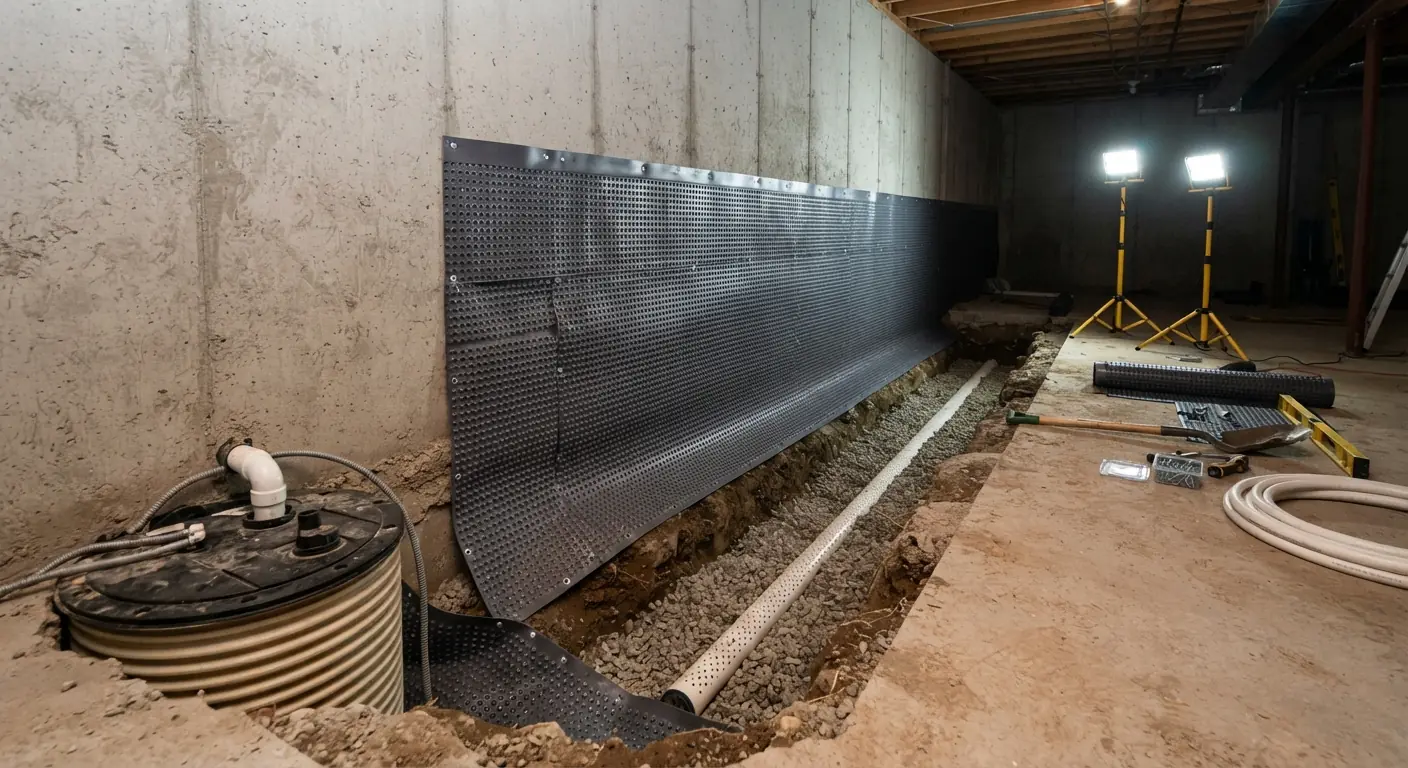
Where water keeps coming in, the pump usually works as part of a system. An interior French drain is a trench in the basement floor, filled with gravel and perforated pipe, that feeds one or more sump pumps.8 HomeGuide's January 2026 waterproofing guide gives these national averages:8
- Regrading around the house: $1,000 to $5,0008
- Exterior French drain: $30 to $90 per linear foot installed8
- Interior French drain: $4,000 to $17,0008
- Sump pump installation: $600 to $2,500 or more8
Treat those as national averages. Your own price comes from a written estimate. Our guide to basement waterproofing methods covers the full range of fixes.
What should a sump pump quote show?
A good quote names the pump's horsepower and its flow at your measured head height. It lists the basin, check valve, discharge route and any backup as separate lines. HomeGuide advises getting a written, detailed estimate before installation.2 Labor should be its own line because it's usually the bigger cost.
HomeGuide's sump pump guide, last updated August 2023, puts a typical sump pump installation at $600 to $2,500.2 The pump itself runs $100 to $800 and labor $500 to $1,700.2 Labor often makes up 65% to 80% of the total.2 Cutting a new pit through a concrete floor with a jackhammer or saw can push the total to $2,500 to $5,000.2 Replacing a pump in an existing pit costs $400 to $700.2
Before you replace a whole pump, check the cheap parts. A float switch runs $35 to $70 in materials and a check valve $15 to $30 in parts.2 The check valve stops water flowing back into the pit when the pump is off. A broken one makes the pump work too hard.2
Questions to ask your contractor
- What inflow and head height did you measure, and what does this pump deliver at that height?
- Why this horsepower and not the next size down?
- Which float switch, and does it have room to move in this basin?
- Where does the discharge pipe end, and what size is it?
- Is the pump on a GFCI-protected outlet? Missing GFCI protection is a common installation mistake.4 If a new circuit is needed, that's a job for a licensed electrician.
- Which backup do you recommend, and what upkeep does it need?
- Does this work need a permit where I live?
If water is already getting in, get a written quote for waterproofing your basement. Basement Remodeling Co. sends your request to one vetted, licensed basement contractor for your metro. The contractor books a free on-site estimate, checks moisture and gives you a written, itemized quote. Nothing starts until you sign. You can also look up the contractor for your ZIP code, or start from the Atlanta basement finishing page or the Denver basement finishing page.