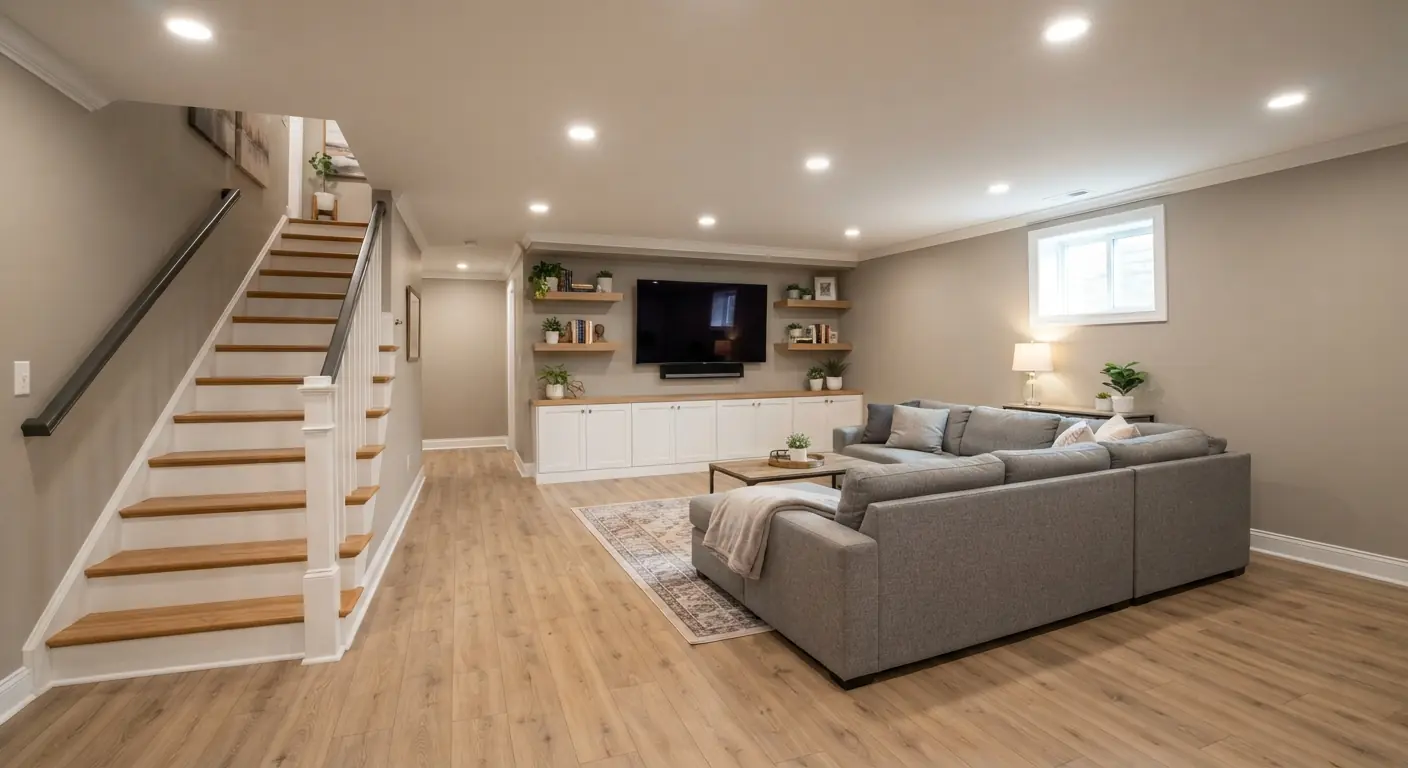
Luxury vinyl plank (LVP) is a sound basement floor when the concrete under it is dry and stays dry. It handles damp air better than laminate, which a national cost guide calls unsuitable for humid spaces.1 What goes under it matters more than the plank you pick. Vinyl doesn't let a slab dry upward, so the vapor barrier belongs under the concrete.2 On top, follow the plank maker's instructions. Get the slab tested for moisture first.
TL;DR
- LVP suits a finished basement with a dry slab. Laminate is a poor fit for humid spaces.1 Wet carpet usually has to come out.
- The vapor barrier belongs under the slab, in direct contact with the concrete.2 Plastic laid on top keeps moisture off the planks but gives it nowhere to go.
- Test the slab before you buy planks. Vinyl on a damp slab is where mold problems start.2
- For most basements, a rigid SPC core with an attached pad is the practical pick. WPC is softer and warmer underfoot.
- Plan for a leak before it happens. Click-lock planks can come up so the slab can dry.
Is LVP a good choice for basements?
Yes, for most finished basements with a dry slab. LVP shrugs off humidity and spills, and it costs about the same as laminate once installed. The one serious warning comes from building science. Vinyl is impermeable, so it stops a damp slab from drying into the room. On a slab with a history of water, fix the water first.
A national cost guide says basement flooring should be waterproof or water-resistant unless the space is finished and sealed.1 LVP clears that bar. The same guide puts LVP at $4 to $16 per square foot installed, against $4 to $14 for laminate and $2 to $8 for carpet.1
The warning is worth reading closely. Building Science Corporation's basement digest, BSD-103, says impermeable floor finishes such as vinyl should be avoided in basements. It says they block inward drying and typically lead to mold growth and other moisture problems.2 The digest dates from 2006 and covers the whole basement assembly. Its logic still applies to a plank floor. A slab that picks up moisture from the ground needs somewhere to send it. BSD-103's approach is to let it dry into the basement, where ventilation or a dehumidifier removes it.2 A vinyl floor closes that path.
So the deciding question is whether your slab is dry. A slab with a vapor barrier under it, no history of water and a clean moisture test is a good base for LVP. A slab that sweats, shows white mineral stains or has flooded before needs the water problem solved first. The basement floor waterproofing guide covers the fixes.
What goes under LVP on a concrete basement floor?
Three layers matter. The vapor barrier sits under the slab, in direct contact with the concrete. The slab itself must be dry, clean and flat. Between slab and plank goes only what the plank maker's instructions allow. With many rigid-core planks, that's a pad already attached to the plank. Add a separate layer only if those instructions call for it.
Under the slab: the vapor barrier
BSD-103 puts the moisture control under the slab. Crushed stone or coarse gravel acts as a capillary break. Sheet polyethylene in direct contact with the concrete acts as the vapor barrier.2 In an existing house you usually can't see whether that sheet is there or still intact. That's why the moisture test matters more than anything you lay on top.
On top of the slab: what your plank allows
Most click-lock LVP floats. It isn't glued or nailed down, so it rests on whatever is under it. A second pad under an attached-pad plank can make the floor bouncy and strain the locking joints. Some makers call for a plastic sheet over concrete. Others build moisture protection into the attached pad. Read the concrete section of the installation guide for the exact planks you're buying, and follow it.
A separate underlayment runs $0.50 to $3.50 per square foot installed and is typically needed under vinyl, laminate, linoleum and hardwood.1 On an attached-pad plank, that line may not belong in your quote at all.
A plastic sheet on top of the slab is a different thing from a vapor barrier under it. It keeps slab moisture off the back of the planks. It doesn't help the slab dry, so it doesn't fix a damp slab.
If you're pouring a new slab
If your contractor is pouring a new slab, BSD-103's order is rigid foam insulation, then sheet polyethylene, then concrete. The polyethylene should touch the concrete. A sand layer should never go between them. Sand there can soak up water that can only dry upward through the slab, which typically damages the floor finish.2 Fresh concrete also needs time. Several thousand pounds of water in freshly placed concrete tries to dry inward.2 Your plank maker's instructions say how dry the slab must be before install.
What type of LVP is best for a basement?
For most basements, a rigid-core plank with a stone-plastic composite (SPC) core and an attached pad is the practical pick. It's dense and stable, and it bridges small dips in concrete better than thin glue-down vinyl. Wood-plastic composite (WPC) is softer and warmer underfoot. Pick the wear layer by how hard the room gets used.
| Spec | SPC rigid core | WPC core | Thin glue-down vinyl |
|---|---|---|---|
| Core | Dense stone-plastic composite | Foamed wood-plastic composite | No rigid core |
| Feel underfoot | Hard and cooler | Softer, warmer and quieter | Takes the shape of the slab |
| Heavy furniture and gym gear | Resists denting well | Dents more easily | Depends on the product |
| Small dips in the slab | Bridges them | Bridges them | Shows every flaw |
| Best basement use | Family rooms, gyms, rooms near laundry or the sump | Bedrooms and theater rooms where comfort counts | Utility and storage areas on a very flat slab |
The wear layer is the clear top film that takes the scuffs. Spec sheets list it in mils. A thicker wear layer costs more and lasts longer under traffic. Compare the mil rating across planks in your price range, and match it to the room. A basement gym or kids' playroom deserves more than a guest room.
Plank beats sheet for a living space. Vinyl sheets are the cheapest but also the least durable, while planks and tiles typically look better and last longer.1 For a storage-only basement, vinyl sheet is still a budget-friendly choice.1
What happens to vinyl plank flooring if the basement floods?
Waterproof planks often survive. The problem is the water trapped under them. A floating click-lock floor can be lifted so the slab and pad dry. Left in place, water under vinyl has almost nowhere to go, and that's when odor and mold start. Wet carpet and pad usually have to come out.
BSD-103 says basement floor finishes should be chosen with flooding in mind. That means leaky appliances, failed plumbing, overflowing sinks and surface water from outside.2 LVP is one of the better answers to that list, because the planks themselves can take water. What they can't do is dry the slab.
After water gets in:
- Stop the source and get the standing water out.
- Pull up the planks in the wet area. Click-lock boards come apart. Glue-down planks rarely come up clean.
- Dry the slab and any pad fully with fans and a dehumidifier before you relay anything.
- Check the plank maker's guidance on reusing wet planks.
- If you see or smell mold, bring in a mold professional before the floor goes back down.
If the water came from a failed sump pump, a crack or poor drainage, fix that before any new floor. A basement renovation that reworks a damaged space usually starts with the water problem.
Will mold grow under vinyl plank flooring?
It can, if moisture gets trapped between the plank and the slab. Mold needs moisture and something to feed on, and dust or a pad can serve. BSD-103 says impermeable floor finishes like vinyl typically lead to mold growth in basements because they block inward drying.2 A dry, tested slab is the prevention.
The risk sits at the slab, out of sight. BSD-103 says materials that touch the basement slab and walls should allow drying, resist moisture damage and not support mold growth.2 Vinyl planks resist water. They fail the drying test.
Lower the odds three ways:
- Test the slab for moisture before install, and fix any water problem first.
- Keep basement humidity down with a dehumidifier sized for the space. BSD-103 relies on ventilation or dehumidification to remove the moisture that dries into the room.2
- Watch for a musty smell or planks that feel damp at the edges. Lift a board near the problem and look.
If you find mold across a large area, hire a mold professional and have it cleared before any floor goes back down.
How does LVP compare with carpet and laminate in a basement?
LVP holds up best to basement moisture of the three. Laminate is not suitable for humid spaces and is difficult to repair.1 Carpet costs the least and feels warmest, but water usually ruins it. For most finished basements LVP is the balanced choice. Area rugs add warmth and lift out after a leak.
| Luxury vinyl plank | Laminate | Carpet | |
|---|---|---|---|
| Material cost per sq ft | $2 to $10 | $1 to $6 | $1 to $51 |
| Installed cost per sq ft | $4 to $16 | $4 to $14 | $2 to $81 |
| Installed, 500 to 1,500 sq ft basement | $2,000 to $24,000 | $2,000 to $21,000 | $1,000 to $12,0001 |
| Humid basement air | Handles it | Not suitable for humid spaces | Pad and fibers hold moisture |
| After a leak | Lift, dry, often relay | Usually replaced | Usually removed |
Cost rows and the laminate humidity note come from HomeGuide's flooring cost guide, February 2026.1 The other rows are general flooring practice.
Carpet still has a place. It's comfortable underfoot and remains a common choice for bedrooms, finished basements and offices.1 It makes most sense in a basement that has never taken water. Laminate looks like wood for less, but its humidity weakness is the wrong trait for a below-grade room.1
For tile, epoxy, engineered wood and the rest, the basement flooring options guide compares each one against basement moisture.
What are the common mistakes when installing vinyl plank in a basement?
The costly mistakes with basement LVP mostly happen before the first plank goes down. A plank floor can be pulled up and relaid. A wet slab under it can't be fixed from above. So the list below starts with the slab and ends with the details that cause gaps, lifting and blocked drains.
- Skipping the moisture test. Vinyl hides a damp slab until the smell shows up.
- Laying over an active leak or a slab with a water history. Fix the water first.
- Treating a sheet on top as the vapor barrier. It protects the planks. It doesn't dry the slab.
- Not flattening the slab. Grind the high spots and fill the low ones to the maker's flatness spec. Rigid planks bridge small dips but not ridges.
- Doubling the pad. A second pad under an attached-pad plank can strain the joints.
- Leaving no expansion gap. Floating floors move. They need a gap at walls, posts and stairs.
- Pinning the floor down. Bar cabinets, kitchen islands and wall framing set on top of a floating floor stop it moving.
- Skipping acclimation. If the instructions say to let boxes sit in the room first, do it.
- Covering the floor drain or sump lid. Keep both open and reachable.
- Ignoring humidity after install. A dehumidifier helps the slab dry the way it needs to.
If you're replacing an old floor in a basement that's already finished, that's basement remodeling of an existing space. The same slab checks apply.
What to ask your contractor before the planks go down
Ask how they'll test the slab, what the result was and what the plank maker's concrete instructions require. A good quote names the plank, its core type and wear layer, any pad or sheet, the slab prep and the moisture test. If a line is vague, ask for it in writing before you sign.
Questions worth asking:
- How will you test the slab for moisture, and can I see the result?
- Is there a vapor barrier under this slab? How do you know?
- Which plank are you quoting, and is it SPC or WPC?
- What wear layer does it have?
- Does it have an attached pad? Are you adding anything under it, and why?
- How will you flatten the slab, and is that priced in?
- Where will the expansion gaps and transitions go?
- How will you keep the floor drain and sump accessible?
Basement Remodeling Co. matches you with one vetted, licensed basement contractor for your metro. That contractor checks moisture at a free on-site estimate and gives you a written, itemized quote. Nothing starts until you sign. If you're ready, start on the basement finishing page, where you request that free estimate. Homeowners in Colorado can see local detail on the Denver basement finishing page. In Georgia, see Atlanta basement finishing.