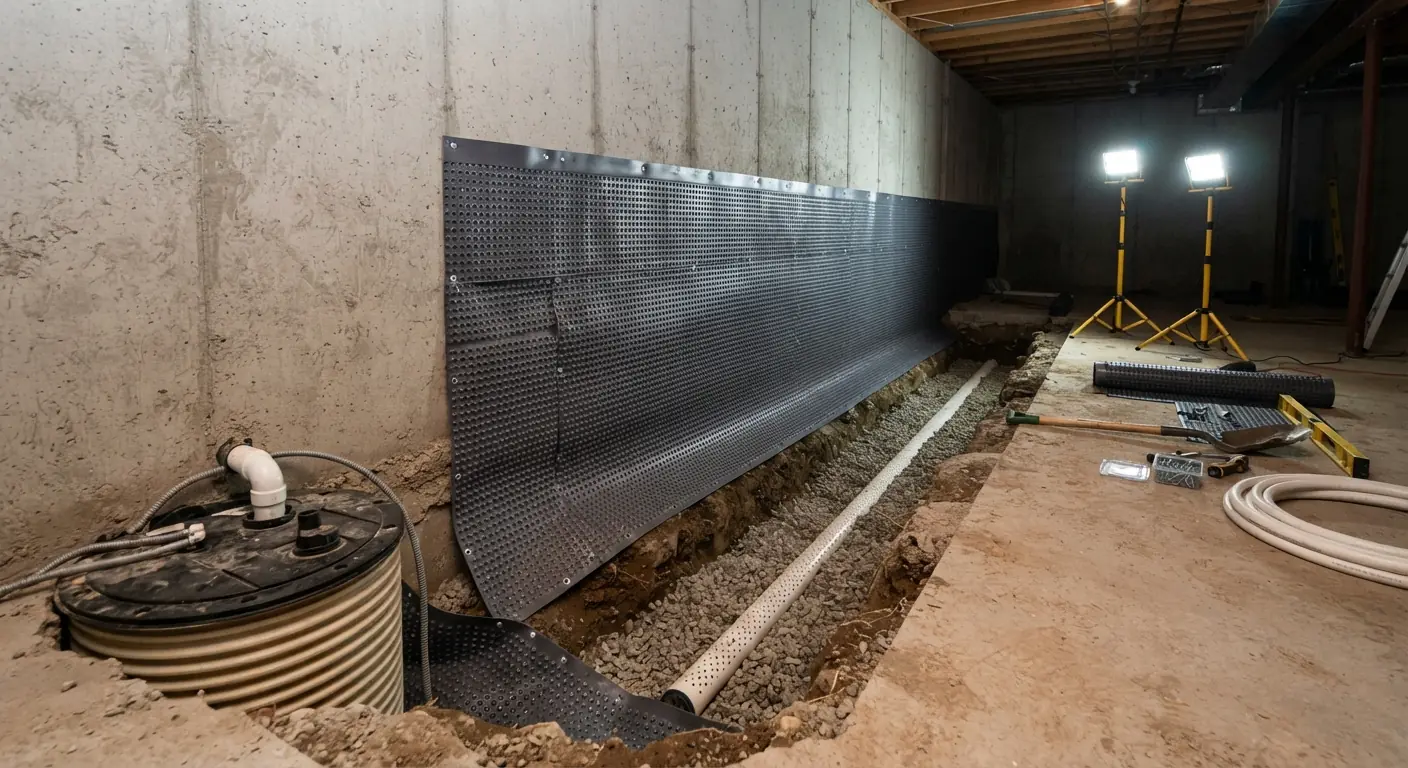
Put the sump pump in its own small closet or behind a removable panel, sized so the pump lifts straight out of the pit. Cover the pit with a sealed lid. Keep carpet, drywall and wood trim back from the pit edge. Mount the high-water alarm where you'll hear it from the finished rooms. Settle the pump and backup before framing starts, because replacing them later means opening finished walls.
TL;DR
- Treat the sump as a service zone. A closet, cabinet or bench works if its door or top opens fully and nothing is screwed shut over the pit.
- A submersible pump is the quieter choice beside living space. A pedestal pump lasts longer but is louder.1
- An open pit connects your room to the gravel and drain pipe under the slab and leaves a gap in the slab's soil-gas barrier.2 Seal the lid and have the basement tested for radon before you finish.
- A new pump installed runs $600 to $2,500, or $2,500 to $5,000 when the installer has to cut through a concrete floor.1
- Add a battery backup and an alarm you can hear.1 Storms that cut power are the moments the pump matters most.2
Where should the sump pump go in a finished basement layout?
Leave the sump where it is and design the room around it. The pit is tied into the drain pipe under your floor, so moving it means cutting slab and rerouting drainage. Most layouts wrap a small closet, cabinet or bench around the existing pit, with a door or lid that opens fully and room to lift the pump straight up.
Interior drain systems run gravel and perforated pipe in a trench under the floor and connect it to one or more sump pumps.3 The choice you actually make is which enclosure fits the room.
A framed utility closet
A closet is the most forgiving option. It can hold the pump, the discharge pipe, the check valve, a battery backup and a dehumidifier in one place. A dehumidifier hose can drain straight into a floor drain or sump pump, so nobody has to empty a bucket.4 ENERGY STAR advises placing the unit close enough to the sump to avoid a long hose.4 For unit sizing and drain setups, see the basement dehumidifier guide.
Plan the outlet with the hoses in mind. ENERGY STAR says never to set up water drainage near electrical circuits or devices and to keep drain hoses away from cords and connections.4 In a closet that means the outlet goes high on the wall and the hoses run low on the other side. A licensed electrician decides the circuit and outlet type.
Size the door for the job. Someone will carry a new pump and a battery box in and out of this space, so a narrow door that barely clears the pit will fight them every time.
A removable wall panel or base cabinet
When the pit sits against a wall that becomes a finished room, a removable panel or a base cabinet with an open bottom can hide it. The panel must come off without tools or with a few screws, never tape and mud. Anything that needs drywall repair to reach the pump will get skipped during routine checks.
A bench or floor hatch
A low bench or hatch works in an open rec room. One member of the DoItYourself forum described building a cover from pressure-treated lumber in two halves, with a hole cut between them to feed the outlet hose and wiring through.5 Hinge the top so it swings clear of the pit.
Check the pit height before the floor goes down. In the same thread a homeowner found the top of the basin sat about 5 inches below the floor.5 The forum moderator's answer was that the fix normally happens at install, with crushed rock under the basin or a deeper pit liner.5 Your contractor should settle how the lid will seat before any slab patch or flooring is poured or laid.
Floor finishes at the pit
Choose finishes near the pit that can survive getting wet. Building Science Corporation says floor finishes and the lower parts of basement walls should be chosen with flooding from failed plumbing or surface water in mind.2 The same digest warns against impermeable floor coverings such as vinyl, because they block inward drying.2 EPA notes that carpet and other porous materials may have to be thrown away once they grow mold.6
How do you keep a sump pump quiet next to finished rooms?
Start with a submersible pump. It sits under the water in the pit and runs quietly, while a pedestal pump is louder.1 Then build the enclosure like a small mechanical room. Insulate the closet walls, hang a solid door that closes tight, and keep the discharge pipe from touching the framing.
HomeGuide's comparison lists pedestal pumps as loud, bulky and less powerful, and submersible pumps as powerful but quiet.1 Beside a bedroom, office or theater, pick the quieter pump.
How often the pump starts matters too. A member on the DoItYourself forum pointed out that a deeper basin holds more water below the drain pipe ends before the pump kicks on, which gives longer run times and fewer starts.5 Fewer starts means fewer noise events in the room next door.
A failing check valve works against you. The valve stops water flowing back into the basin when the pump shuts off, and a broken one makes the pump work too hard.1 If the pump seems to run more than it used to, ask for the valve to be checked.
Why does the sump lid matter for radon and moisture?
An open sump pit connects your finished room to the gravel and drain pipe under the slab. Building Science Corporation treats a slab sealed to the foundation wall as the air barrier that controls soil gas.2 An open pit is a hole in that barrier. A sealed lid closes it and still lets you reach the pump.
The same digest describes a crushed stone layer under the slab connected to the perimeter drain.2 It also notes that soil gas often enters at the joint where the slab meets the perimeter wall.2 The sump pit opens straight into that zone.
Radon
Test for radon before you finish. If the result calls for mitigation, a licensed radon professional designs the system. Some radon mitigation systems use the sump pit, so ask the mitigation pro before your contractor builds the closet. The lid, the pipe penetrations and the pump access all need to work with that system.
Humidity
An open pit also puts standing water into the room air. EPA recommends keeping indoor humidity below 60 percent and ideally between 30 and 50 percent.6 ENERGY STAR gives the same 30 to 50 percent range and says anything above it may promote mold growth.4 A sealed lid and a dehumidifier draining into the pit work together here.
Make sure the lid has sealed openings for the discharge pipe and the cords. A lid that has to be pried off and resealed with caulk every time is a lid that stays off.
Where should the alarm and battery backup go?
Mount the high-water alarm where someone will hear it from the living space, either outside the closet or on the closet wall that faces the room. Put the battery backup on a shelf beside the pit, above the floor. Once the room is finished the pump is out of sight, so the alarm is your only warning.
Power loss needs its own plan. Building Science Corporation describes the stone layer under the slab as a temporary reservoir for high groundwater if sump pumps fail during electrical outages.2 A reservoir only buys time. HomeGuide recommends a battery backup so the pump keeps working when the power goes out.1
Some battery-powered pumps can connect to an app for monitoring and alerts.1 An app alert reaches you when you're away from home. The batteries need replacing every 3 to 5 years, so write the install date on the battery box where you'll see it.1
A few placement rules make the alarm useful:
- Put the sensor at the lowest point near the pit so it trips before water reaches the finished floor.
- Keep the alarm unit and any backup control panel high enough on the wall to read without opening the lid.
- Route alarm wiring through the same sealed lid openings as the pump cords.
What are the common problems with sump pumps for a basement?
The common problems are clogging from dirt and debris, a float switch that won't turn the pump on or off, a broken check valve, a frozen hose extension and power loss. HomeGuide also flags strange noises, continuous running and pooling water as signs you need a repair.1 Each is cheaper to fix when the pump is easy to reach.
Check the small parts before replacing the whole pump. A float switch costs $35 to $70 in materials, and HomeGuide suggests it may need replacing when the pump has trouble turning on and off.1 A check valve costs $15 to $30 in parts.1 Sump pump repair and maintenance runs $200 to $870, and emergency after-hours calls add $50 to $150.1
Some problems are bigger than the pump. Standing water, water stains, white chalky residue, damp walls and musty odors can all point to a basement that needs waterproofing.3 If you see those, sort the water source through basement waterproofing before finishing so the new walls are not the first thing to get wet.
What not to do when finishing a basement around a sump?
Wait until the basement has stayed dry through a wet season, and build walls that can dry out. Building Science Corporation warns that insulated framed walls covered with an interior plastic vapor barrier often lead to odor, mold, decay and corrosion problems.2 Skip vinyl wall coverings and oil paints on foundation walls for the same reason.2
Here are the mistakes that matter most around a sump:
- Finishing too soon. A Houzz commenter (not a pro) said they would live with a basement through a few good rain storms and the spring before putting in carpet and drywall.7 The wait shows whether the pump keeps up.
- Putting fiberglass against concrete. Most interior insulation systems use moisture-sensitive materials such as fiberglass batts that cannot tolerate even minor groundwater leakage.2 Foam-based insulation that lets the wall dry inward is the lower-risk choice.2
- Skipping the rim joist. It should be insulated with air-impermeable insulation because the rim joist area stays cold in both summer and winter.2
- Drywalling over the pit. A pump sealed behind finished drywall is a pump nobody checks.
- Leaving wet materials to dry on their own. EPA says water-damaged areas should be dried within 24 to 48 hours to prevent mold growth.6
For the drainage and sealing options that come before any of this, see the comparison of basement waterproofing methods.
What does it cost to install a sump pump in a basement?
A new sump pump installed typically costs $600 to $2,500.1 The pump itself runs $100 to $800 and labor runs $500 to $1,700.1 If the installer has to break up a concrete floor to dig the pit, the total rises to $2,500 to $5,000.1
Replacing an existing pump in an existing pit costs $400 to $700.1 Labor is most of the bill. HomeGuide puts it at 65% to 80% of the total project cost.1 Its national average for an installed pump is $1,600.1
| Sump item | Typical cost | Source and date |
|---|---|---|
| New sump pump, installed | $600 to $2,5001 | HomeGuide sump pump guide, Aug 26, 2023 |
| Install where a concrete floor must be broken up | $2,500 to $5,000 total1 | HomeGuide sump pump guide, Aug 26, 2023 |
| Replace an existing pump | $400 to $7001 | HomeGuide sump pump guide, Aug 26, 2023 |
| Battery-powered pump, unit | $150 to $8001 | HomeGuide sump pump guide, Aug 26, 2023 |
| Float switch, materials | $35 to $701 | HomeGuide sump pump guide, Aug 26, 2023 |
| Check valve, parts | $15 to $301 | HomeGuide sump pump guide, Aug 26, 2023 |
| New or updated drainage system | $4,000 to $12,0001 | HomeGuide sump pump guide, Aug 26, 2023 |
| Interior French drain | $4,000 to $17,0003 | HomeGuide waterproofing guide, Jan 23, 2026 |
| Whole-house dehumidifier, installed | $1,500 to $3,5003 | HomeGuide waterproofing guide, Jan 23, 2026 |
The two drainage rows describe different scopes, so they don't add together. The $4,000 to $12,000 figure covers digging or updating a drainage system for a pump.1 The $4,000 to $17,000 figure covers a full interior French drain trenched around the basement.3 Budget from whichever one matches what your contractor finds.
The closet framing, door, sealed lid and alarm are part of the finishing work, so they belong on your contractor's itemized finishing quote.
How long does a basement sump pump last?
A sump pump typically lasts 5 to 30 years, depending on its type and how often it runs. Submersible pumps last 5 to 20 years and pedestal pumps 10 to 30 years on average.1 If the pump will sit in a finished room, budget from the lower submersible figure.
HomeGuide's waterproofing guide gives a longer number, saying interior French drains and sump pumps can function for 20 to 30 years with regular upkeep.3 The waterproofing figure groups the pump with the drain system around it. The pump is the part with a motor, so the type-specific range from the sump pump guide is the safer planning number.
Battery backups have their own clock. Their batteries need replacing every 3 to 5 years.1
If your existing pump is well into its range, replace it before the walls go up. A straight swap costs $400 to $700.1 The same swap later means working through a finished closet.
What should your contractor's quote show for the sump area?
A good quote lists the sump work as its own line items: the enclosure, the access door or panel, the lid, the alarm and any pump or backup changes. It says who does the electrical work and who pulls the permit. Items left vague on paper tend to turn into change orders once framing starts.
Ask your contractor these questions at the estimate:
- Will the existing pump be tested or replaced before framing, and what is its age?
- How big is the access opening, and can the pump lift straight out through it?
- What lid goes on the pit, and how are the discharge pipe and cords sealed through it?
- Where do the alarm, the battery backup and the dehumidifier drain go?
- Has the basement been tested for radon, and does any mitigation system use the sump?
- Which finishes go around the pit, and will they survive a wet floor?
- Which code edition has your city or county adopted for this work?
Code rules for pump circuits, lids and radon systems depend on the model code edition your jurisdiction has adopted and any local amendments. Your contractor pulls the permit and books the inspections, so ask them to name the rules they are building to.
Basement Remodeling Co. matches you with one vetted, licensed basement contractor for your metro. You get a free on-site estimate and a written, itemized quote, and nothing starts until you sign. When the sump plan is clear, get a written quote for finishing your basement. You can also find the contractor who covers your ZIP code or read what finishing involves in Denver and Atlanta.
If your basement is already finished and the pump is walled in, opening up access is a basement remodeling job.