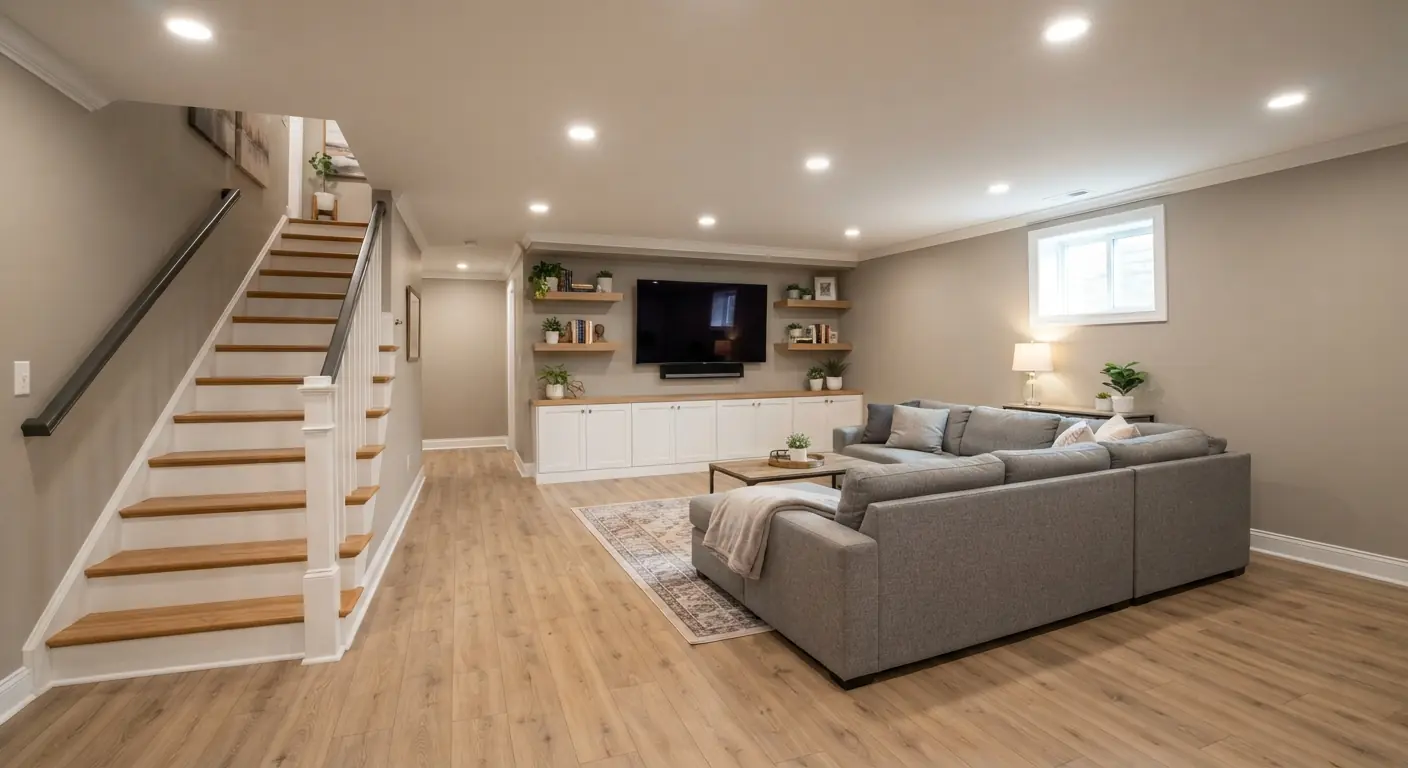
The cheapest way to cover a concrete basement floor is to seal the slab you already have, at $1 to $3 per square foot.1 The cheapest floor you can lay on top is standard sheet vinyl at $2 to $7 per square foot installed, with carpet close behind at $2 to $8.1 Moisture in the slab decides whether a cheap floor lasts. Get the slab checked before you buy anything.
TL;DR
- Sealing bare concrete is the lowest line item. Epoxy, a resin coating for existing concrete, costs $4 to $10 per square foot installed.1
- Sheet vinyl is the cheapest floor you can lay, but HomeGuide calls it the least durable vinyl. Vinyl tile and plank cost more and typically last longer.1
- Compare floors by cost per year. Divide the installed price by the years you can expect from that product in your basement.
- Vinyl laid straight on a damp slab traps moisture. Building Science Corporation says impermeable floor finishes like vinyl typically lead to mold and other moisture problems in basements.2
- A failed floor costs more than a good one. Mold removal runs $15 to $30 per square foot, which by our math is more than double the top price of sheet vinyl.1
What does each cheap basement floor cost installed?
Concrete sealing is the cheapest option at $1 to $3 per square foot, according to HomeGuide's February 2026 cost guide.1 Sheet vinyl follows at $2 to $7 installed, then carpet at $2 to $8 and standard vinyl tile at $2 to $10.1 Budget luxury vinyl plank starts at $4, and epoxy coating runs $4 to $10.1
Every price below comes from that one national source, so the rows compare like for like. Apart from sealing, which HomeGuide doesn't break down, they are installed prices covering materials and labor. HomeGuide publishes basement totals for 500 to 1,500 square feet on most of these floors.1 Where it doesn't, we multiplied its per-square-foot range by 500 and 1,500 and marked the row.
| Floor | Installed cost per sq ft | Total for a 500 to 1,500 sq ft basement | What the cost guide notes |
|---|---|---|---|
| Concrete sealing | $1 to $3 | $500 to $4,500 (our math)1 | Concrete floors typically need sealing to finish the job |
| Standard vinyl sheet | $2 to $7 | $1,000 to $10,5001 | The cheapest vinyl and the least durable |
| Carpet | $2 to $8 | $1,000 to $12,0001 | Comfortable underfoot and still common in finished basements |
| Standard vinyl tile | $2 to $10 | $1,000 to $15,000 (our math)1 | Costs more than sheet vinyl and typically lasts longer |
| Standard vinyl plank | $3 to $10 | $1,500 to $15,000 (our math)1 | Costs more than sheet vinyl and typically lasts longer |
| Polished concrete | $3 to $15+ | $1,500 to $22,5001 | Price excludes the slab itself |
| Epoxy coating | $4 to $10 | $2,000 to $15,0001 | Durable and easy to clean, slow to cure, poor in extreme temperatures |
| Luxury vinyl plank (LVP) | $4 to $16 | $2,000 to $24,0001 | Thicker and more durable than standard vinyl |
| Laminate | $4 to $14 | $2,000 to $21,0001 | Not suitable for humid spaces |
Labor is a big share of these numbers. HomeGuide puts flooring labor at $2 to $8 per square foot, and as low as $0.50 for carpet.1 Material alone for sheet vinyl is $1 to $4 per square foot.1
Three budget floors don't get their own line in HomeGuide's cost guide: peel-and-stick vinyl tile, carpet tile and concrete floor paint. The closest rows are standard vinyl tile, carpet and concrete sealing or epoxy. We have no sourced price for those three, so get each one priced in writing before you compare. For paint, see our guide to painting a basement concrete floor.
For a wider look at mid-range and premium floors, see our guide to basement flooring options.
Which cheap floor gives you the most years for the money?
Basement Remodeling Co. recommends comparing basement floors by cost per year, because the lowest price per square foot often buys the shortest life. HomeGuide calls sheet vinyl the cheapest and least durable vinyl, while vinyl planks and tiles cost more and typically last longer.1 Divide the installed price by the years you expect the floor to last.
The math is simple. The hard part is the number of years.
How to work out cost per year
- Take the installed cost per square foot from your written quote.
- Ask your contractor what the manufacturer's warranty covers for that exact product. HomeGuide lists that question among the ones to ask an installer.1
- Divide the price by the years you can reasonably expect in your basement.
Cork is the one floor in HomeGuide's guide with a published lifespan. It costs $5 to $15 per square foot installed and lasts 15 to 40+ years, depending on quality and care.1 At $5 over 40 years, that works out to about 13 cents per square foot per year. At $15 over 15 years, it works out to $1 per square foot per year.1 The same floor can land anywhere in that range, depending on what you pay and how long it survives.
Why cheaper floors tend to cost more per year
HomeGuide states the general rule plainly: higher quality flooring costs more but typically lasts longer than lower cost materials.1 Luxury vinyl plank and tile are thicker and more durable than standard vinyl.1 In a basement, the slab adds a second risk. Building Science Corporation says impermeable floor finishes over a basement slab typically lead to mold growth.2 A floor that grows mold comes out early, and its cost per year jumps.
Removal eats into the savings too. Pulling out old carpet costs $0.70 to $1.60 per square foot before the new floor goes in.1
What flooring can you put straight on concrete?
Coatings go straight on concrete: a clear sealer, epoxy or a polished finish turns the slab itself into the floor.13 Vinyl tile can also go directly onto a prepared slab once any water problem is fixed.4 Carpet, laminate and floating vinyl usually go over an underlayment or pad, which adds cost.1
Coatings and polish
Epoxy is a resin that coats an existing concrete floor for a smooth, glossy finish. It takes a while to cure and doesn't suit extreme temperatures.1 Polished concrete costs $3 to $15+ per square foot, not counting the slab.1 In a 2016 Houzz discussion, a general contractor suggested renting a floor machine and polishing the concrete, calling the result "nearly bullet proof."3
Ask about moisture before any coating goes down. Building Science Corporation's basement digest lists epoxy paint systems among the impermeable finishes to avoid on basement walls.2 Your contractor can tell you whether your slab needs to breathe.
Vinyl tile
When a homeowner asked JustAnswer in 2012 for the cheapest fix for a two-room concrete basement, a California licensed contractor suggested two things. The first was an epoxy floor coating. The second was 12x12 vinyl tile in a 1/16 inch household grade.4 He started from the assumption that the water problem was already fixed, and he warned that the quality of the job depends on the preparation.4
Floors that need a layer underneath
HomeGuide says an underlayment is typically needed under linoleum, laminate, vinyl and hardwood. It costs $0.50 to $3.50 per square foot installed.1 Carpet pad costs $0.75 to $1.75 per square foot installed.1 Add that line to the floor price before you compare.
On a slab that may be damp, a dimpled membrane is one option. A commenter in the same Houzz discussion suggested Delta FL or an equivalent, followed by LVT or carefully chosen laminate, as an economical alternative to vinyl laid directly on the floor.3
Will a cheap floor fail on a damp basement slab?
Yes, if the slab carries moisture and the floor seals it in. Building Science Corporation's basement digest says impermeable finishes such as vinyl floor coverings inhibit drying and typically lead to mold growth and other moisture problems.2 Settle the moisture before you pick the floor, and have it checked at the estimate.
A basement slab sits on the ground. When water gets trapped between the slab and the plastic vapor barrier under it, it can't dry downward, so it can only dry upward through the concrete. The digest says that typically damages interior floor finishes.2 It also says basement floor finishes should be chosen with flooding in mind, from leaky appliances, failed plumbing, overflowing sinks or surface water.2
HomeGuide gives the same advice in cost terms. Basement flooring should be waterproof or water-resistant unless the space is finished and sealed.1 Waterproofing a basement costs $6,000 to $18,000.1 That's a separate job from the floor, and it comes first.
Getting this wrong is expensive. Mold removal runs $15 to $30 per square foot.1 If you find mold under an old floor, have a licensed mold professional assess it before any new floor goes down.
Carpet is a poor bet over a slab that has flooded before. Wet carpet and pad usually have to come out, which means paying for removal and a new floor.
Which cheap floor fits how you use the basement?
Match the floor to the room. HomeGuide recommends sheet vinyl as a budget choice for storage-only basements. For a basement you'll live in, it suggests something more comfortable and durable.1 Coatings and vinyl tile suit hard-use rooms like a gym or craft space.4
Storage and utility space
Sheet vinyl or a sealed slab is enough here, as long as the slab is dry. Sealing is the lowest-cost finish at $1 to $3 per square foot, and sheet vinyl is the cheapest floor you can lay at $2 to $7.1
Gym or craft room
Hard, cleanable surfaces work best. The contractor who answered on JustAnswer described epoxy as highly durable and easy to clean.4 The homeowner in that thread wanted a quilt room where fabric wouldn't stick and a low-maintenance exercise room. Epoxy and household-grade vinyl tile were his two picks.4
Family room, office or bedroom
Comfort matters more here. Carpet is comfortable underfoot and still a common choice for finished basements.1 Luxury vinyl plank costs more at $4 to $16 installed, but it's thicker and more durable than standard vinyl.1 If the slab has any history of water, settle that before you choose carpet or luxury vinyl plank.
What should a good flooring quote show?
A good quote lists the flooring, the underlayment and the installation as separate lines. HomeGuide recommends comparing at least three estimates on that basis.1 It should also say who moves furniture, who removes the old floor and what the warranty covers.1
Watch for these costs, which often sit outside the headline price:
- Many contractors charge a $200 to $500+ minimum project fee.1
- Furniture moving costs $25 to $75 per room if you don't clear the space first.1
- Carpet removal costs $0.70 to $1.60 per square foot, and tile removal costs $2 to $7.1
- Underlayment adds $0.50 to $3.50 per square foot installed where the floor needs it.1
Ask whether the installer uses formaldehyde-free glue and what maintenance the floor needs. HomeGuide lists both among the questions to ask.1
If the floor is part of a bigger build-out, plan it with the walls, moisture control and permits. You can get a written quote for finishing your basement from one vetted, licensed basement contractor. The contractor books a free on-site estimate, checks moisture and gives you a written, itemized quote. Nothing starts until you sign. If your basement is already finished and you're replacing a worn floor, start with basement remodeling instead.
Local detail changes the job. You can see how it works for basement finishing in Denver, Colorado Springs, Fort Collins or metro Atlanta. Elsewhere, find a basement contractor by ZIP code.