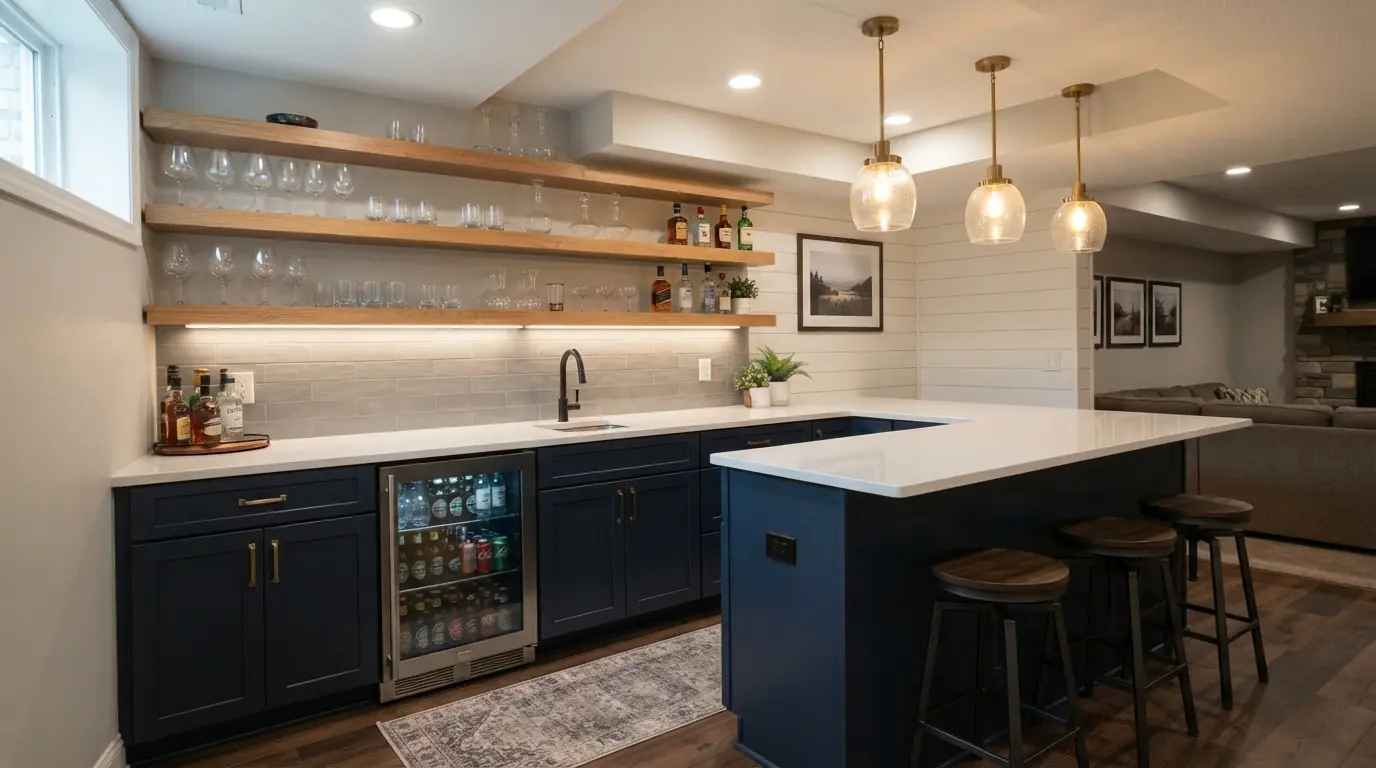
Yes, you can put a wet bar in most basements. The sink is the hard part. Water supply is easy to branch off nearby pipes. The drain decides the plan: a sink above your main sewer line drains by gravity, and a sink below it needs a drain pump or a sewage ejector. The drain also needs a vent, and the outlets need GFCI protection. Settle the plumbing first, then choose the look.
TL;DR
- Find where your main drain leaves the house before you pick a spot. That one fact decides whether the bar sink drains by gravity or needs a pump.
- A small under-sink drain pump suits a bar sink on its own. A floor ejector pit makes more sense when a basement bathroom is planned too.
- Put the bar on or near the wall that already carries plumbing. Short runs cost less and cause fewer problems.
- A wet bar costs $2,000 to $12,000 as a prefab unit or $10,000 to $30,000 as a custom basement bar, before any basement finishing.1
- If drainage is too hard or too costly in your basement, a dry bar skips the sink and still gives you counters, storage and a fridge.
Can I put a wet bar in my basement?
Yes. A wet bar needs three things your basement can usually supply: a water line, a drain the sink can empty into, and power for the outlets and appliances. What changes from house to house is how the sink drains. That decides the cost, the location and whether a pump goes in the cabinet.
A few building rules still apply to the room around the bar. The 2021 International Residential Code, section R305.1, asks for a ceiling height of at least 7 feet in basement habitable space.2 It lets beams, girders and ducts project to within 6 feet 4 inches of the finished floor.2 A bar area with a low duct run can still work. Just check your finished ceiling height against the code before you plan a raised counter or hanging pendants.
Egress is less of an issue than many people fear. Under section R310.7 of the same code, alterations to an existing basement do not trigger a new emergency escape opening unless you add a new sleeping room.2 Smoke alarms are different. Section R314.2.2 says that when alterations needing a permit happen, the home gets smoke alarms placed as a new home would need them. That section exempts work that only installs or alters plumbing.2 So a plumbing-only bar sink may not trigger it, while a full bar build-out with new walls and wiring likely will.
Your city or county adopts its own code edition and may amend it. Our guide to permits for finishing a basement covers what the permit office looks at and why the permit protects you later.
How do you get water to a basement bar sink?
Getting water to a basement bar sink is the easy part. Your plumber tees hot and cold lines off the nearest existing pipes, runs them to the bar and fits a shutoff valve under the sink. Basements usually have supply lines running along the joists overhead, so this is often a short run with no concrete work at all.
A few choices make the supply side better:
- Keep lines in interior walls. A supply pipe inside an exterior foundation wall sits next to cold concrete. In a cold climate like Colorado's, that's where pipes are most likely to freeze.
- Ask for an accessible shutoff for the whole bar. Then a leaking faucet or ice maker line never means shutting off the house.
- Plan the fridge and ice maker line now. If you want an ice maker or a filtered water tap, the line goes in before the walls close.
- Think about hot water distance. A bar far from the water heater waits a while for hot water. For a bar that mostly rinses glasses, you may be fine with that. Otherwise ask about a small point-of-use heater, which then needs its own power.
How does a basement bar sink drain?
A basement bar sink drains by gravity only if its drain can slope down to your main sewer line. If the main line leaves the house above the basement floor, or the bar sits below it, the water has to be pumped up. That single question drives most of the plumbing cost.
Here is how to read your own basement. Look for the large drain stack coming down from the floors above and follow it. It either disappears into the slab or turns and leaves through the foundation wall at some height above the floor.
- If it goes into the slab, the main line runs under your floor. A bar sink can usually drain by gravity, but the plumber may need to cut and trench the concrete from the bar to that line.
- If it leaves through the wall above the floor, anything lower than that exit point is below the sewer. A basement sink there needs a pump.
Your contractor confirms this on site. The house often tells you, though, and knowing it before the estimate helps you read the quote.
The three ways a bar sink drains
| Option | When it fits | What gets installed | Tradeoffs |
|---|---|---|---|
| Gravity drain | The bar sits above the main line, or the main runs under the slab | A sloped drain pipe to the main line, plus a vent | No moving parts. May need slab cutting and trenching to reach the main. |
| Under-sink drain pump | The sink is below the sewer and nothing else needs to drain there | A small pump unit in the bar cabinet that lifts sink water to a drain line overhead | Less concrete work. Needs an outlet, takes cabinet space, makes some noise and stops draining if the power goes out. |
| Sewage ejector pit | A basement bathroom exists or is planned, or several fixtures sit below the sewer | A sealed, vented pit set into the floor with a pump that lifts waste to the main | Handles a toilet and several fixtures at once. Costs more and needs floor excavation, unless the bar can tie into an existing pit. |
Under-sink drain pumps
For a bar sink alone, this is usually the simplest answer. The pump sits in the cabinet, collects water from the sink and pushes it up through a small pipe to a drain line in the ceiling. Plan cabinet space for it and a service panel you can open. Ask your plumber which unit they install and how it vents, because the pump box needs venting too.
Sewage ejector pits
An ejector handles solid waste, so it's built for toilets. If you already have one for a basement bathroom, the bar sink can often drain into it with a short run. If you are planning a bathroom later, putting the ejector in now and draining the bar into it avoids doing the floor twice.
What not to drain into
Keep the sink away from the sump pit. A sump pit collects groundwater and usually pumps it outside. Sink water is waste water and belongs in the sanitary drain.
Does a wet bar sink need a vent?
Yes. Every sink drain needs a vent so water flows freely and the trap keeps its water seal. Without one, the trap can siphon dry and let sewer gas into the room. In a basement, venting is often the hardest part of the drain to route.
Your plumber has three common routes:
- Tie into an existing vent in a nearby wall or at the main stack. Best when the bar sits close to existing plumbing.
- Run a new vent up through the house. This works anywhere but can mean opening finished walls upstairs.
- Use an air admittance valve under the sink, a one-way valve that lets air in without letting gas out. Some jurisdictions accept these in certain spots and some don't, so your plumber and permit office decide.
Distance matters. A cost guide on bathroom additions notes that you pay more when the new bathroom sits far from existing drainage and venting lines.3 The same logic applies to a bar sink. That is the strongest practical reason to put your bar on the plumbing wall.
What electrical does a basement wet bar need?
A wet bar needs GFCI-protected outlets near the sink, enough circuit capacity for its appliances, and power for any drain pump. A licensed electrician should plan and install new circuits. Your adopted electrical code sets the exact rules for your house.
Walk through it with your electrician appliance by appliance:
- GFCI protection. Outlets near a sink need ground-fault protection, which cuts power fast if current leaks through water. Your electrician will know exactly which outlets your local code covers.
- Refrigeration. A beverage fridge, kegerator or ice maker runs all day. Check the manufacturer's install instructions for circuit needs, and share them with your electrician before rough-in.
- Dishwasher. A compact or full dishwasher usually wants its own circuit. Confirm with the appliance's instructions.
- The drain pump. It needs a reachable outlet inside or next to the cabinet. Ask whether it should share a circuit with anything.
- Lighting. Under-cabinet strips, pendants over the counter and a switch you can reach from the stairs. Plan these with the ceiling height in mind.
If your bar build needs a permit, section R314.2.2 of the 2021 International Residential Code calls for smoke alarms placed as a new home would need them. Section R314.6 of the same code lets alarms added this way run on battery power.2 Your local code may differ, so confirm with your electrician and permit office.
How much does it cost to put a wet bar in your basement?
A basement wet bar costs $2,000 to $12,000 for a prefab model or $10,000 to $30,000 for a custom bar, according to HomeGuide's cost guide.1 Your spot on that range depends on size, finishes and appliances. The plumbing route matters most in a basement, because a pump, a trench or a long vent run adds labor.
HomeGuide's line items give a feel for what makes up the total. Most are installed costs from a guide dated August 2023, so use them for planning and get your real number from a written quote.1
| Item | Average cost |
|---|---|
| Prefab wet bar | $2,000 to $12,0001 |
| Custom wet bar | $10,000 to $30,0001 |
| Plumbing | $450 to $1,800 per fixture1 |
| Sink installation | $380 to $1,4001 |
| Faucet installation | $250 to $6001 |
| Electrical wiring | $4 to $9 per square foot1 |
| Cabinets | $150 to $500 per linear foot1 |
| Countertops | $50 to $150 per square foot1 |
| Refrigerator | $680 to $2,5001 |
| Dishwasher | $550 to $1,6001 |
| Bar stools | $50 to $200 per stool1 |
Source: HomeGuide home wet bar cost guide, August 2023.1
The same guide lists labor rates. Plumbers charge $45 to $150 per hour, electricians $50 to $130 per hour, and general contractors charge 10% to 20% of construction costs to hire subcontractors and oversee the work.1
Three things push a basement bar toward the top of the range:
- Below-sewer drainage. A pump or ejector adds equipment and labor the gravity case does not.
- Distance from existing plumbing. Longer drain, vent and supply runs cost more.3
- An unfinished basement. HomeGuide notes a basement bar costs more if the basement needs finishing first, at $30 to $50 per square foot with labor, or $15,000 to $75,000 to convert an unfinished space.1 For local examples, typical basement finishing ranges are $30,000 to $90,000 in metro Denver and $45,000 to $80,000 in metro Atlanta (checked September 2026). You can see what goes into finishing a basement in Denver or finishing a basement in Atlanta.
Build in a buffer. A bathroom addition cost guide suggests setting aside an extra 10% to 20% of the total budget for surprises such as plumbing, wiring or foundation issues found once work starts.3 That advice was written for bathrooms, but a below-grade drain run carries the same kind of risk.
If the drain route kills the budget, look at a dry bar. HomeGuide puts a dry bar at $1,000 to $15,000 installed, since it skips the sink.1
Which design choices suit a basement wet bar?
Start from the plumbing and let the design follow. Place the bar on the wall closest to your drain, vent and supply lines, choose a sink and cabinet layout that leaves room for any pump, and pick finishes that handle splashes. Everything else is style.
Size and layout
Home bars are typically 6 to 8 feet long and 36 to 42 inches tall.1 A single-wall bar along the plumbing wall is the cheapest layout to plumb. An L or a peninsula with stools adds seating, but keep the sink on the leg nearest the pipes.
HomeGuide sorts custom bars into three tiers. A basic or small bar runs $2,000 to $5,000, a mid-range sit-down bar with cabinets runs $7,000 to $10,000, and a large high-end bar with premium counters runs $12,000 to $30,000.1 The basic tier describes a bar cart or small counter. HomeGuide's range for a custom wet bar starts higher, at $10,000.1
Sink and faucet
A small bar sink fits most layouts and needs less cabinet width. If a drain pump is going in, choose the cabinet with the pump in mind so you do not lose all your storage below the sink. A tall faucet makes it easier to fill pitchers and rinse shakers.
Counters, backsplash and floors
Water gets splashed around a bar. Choose counters and a backsplash that shrug off water, and a floor that tolerates spills near the sink. HomeGuide lists backsplash at $10 to $50 per square foot and flooring at $6 to $10 per square foot installed.1
Refrigeration and storage
Decide early between a beverage fridge, an ice maker, a dishwasher or all three. Each one fixes a cabinet width, and some need a water line or their own circuit. Leave space for glassware, and closed storage for bottles. If the bar is growing into a small kitchen, our basement kitchenette guide is the better starting point.
For more layouts and looks, our basement bar ideas guide covers bar styles, shapes and sizes.
What are the essential basement bar items?
A wet bar typically includes a countertop, a sink, storage and sometimes a mini fridge.1 Behind those sit the parts you won't see: a supply line with a shutoff, a vented drain, GFCI outlets and enough circuits for the appliances.
A practical checklist:
- Countertop at bar height, with a work surface near the sink
- Bar sink and faucet
- Hot and cold supply with an accessible shutoff
- A vented drain, plus a drain pump or ejector connection if the sink sits below the sewer
- GFCI-protected outlets near the sink
- Power for the fridge, ice maker, dishwasher and pump as needed
- Cabinets and shelving for glassware and bottles
- Task lighting over the counter
- Seating, if the layout has an overhang
Do basement wet bars add value?
Wet bars generally add value to a home, especially when the room is designed for entertaining, though they go in and out of style.1 That comes from one independent cost guide, so read it as a general pattern. Resale value depends on your market and your house.
A few things help a bar hold its appeal. HomeGuide notes a home bar can also work as a coffee or dessert station, which widens who might use it.1 Because bar styles come and go, a neutral design is the safer bet if resale matters to you. Permitted plumbing and wiring also give a future buyer less to question.
This is general information. For tax or appraisal questions, ask a tax professional or an appraiser.
What should a wet bar quote show?
Basement Remodeling Co. suggests one test for any wet bar quote: can you see how the sink drains, how it vents and which circuits it gets? If those three are itemized, you can compare prices fairly. If they are missing, the hardest work is unpriced.
A good written quote shows:
- The drain method: gravity, an under-sink pump or an ejector, and where it connects to the main
- The vent route: existing vent, new vent or an air admittance valve where your jurisdiction allows it
- Any concrete work, with the trench length if the slab gets cut
- The circuits: which outlets are GFCI protected and which appliances get dedicated circuits
- The appliances included, or the allowance for them
- Permits and inspections, and who handles them
- Cabinets, counters and finishes listed separately from plumbing and electrical
Useful questions to ask, drawn from HomeGuide's hiring checklist: How long will the project take? Does this estimate include materials, labor and cleanup? Will you hire any subcontractors? What unexpected costs might come up? Will you handle any necessary permits?1
Basement Remodeling Co. matches you with one vetted, licensed basement contractor for your metro. You get a free on-site estimate and a written, itemized quote, and nothing starts until you sign. Your contractor pulls the permit and books the inspections. If you are ready to plan yours, you can get a written quote for a basement bar or find a basement contractor by ZIP code. If the bar is part of a bigger project, see how basement finishing and basement remodeling differ.