Set your basement dehumidifier to 50% to start.1 In humid summer months, drop a finished basement to 45% and hold an unfinished one at 50%.1 In winter, 50% is enough, and the unit may barely run. Whatever the season, keep the room under 60%.2 The EPA gives 60% as the ceiling and calls 30 to 50% ideal.2
The number on the dial matters less than whether water is getting in.
TL;DR
- 50% is the right starting set point for almost any basement.1 Move it in 5-point steps based on what you see and smell.
- Finished basements need the lower summer setting of 45%, because drywall, carpet and framing soak up moisture and hide mold.1
- 60% is the line.2 The EPA and ENERGY STAR both put the ideal range at 30 to 50%.23
- Winter advice conflicts between sources. Use 50%, the top of the EPA's ideal range, and watch for sweating windows and pipes.2
- A dehumidifier that never shuts off, or a basement that seeps or sweats, points to a water problem. Fix that before you frame a wall.
What should you set a basement dehumidifier to in each season?
Set it to 45 to 50% in summer and about 50% in winter, with finished basements at the low end.1 Those numbers sit inside the 30 to 50% range the EPA calls ideal and under its 60% ceiling.2
| Situation | Unfinished basement | Finished basement | Why this number |
|---|---|---|---|
| First setting, any season | 50% | 50%1 | A dehumidifier maker's starting point, adjusted up or down by 5%1 |
| Humid summer months | 50% | 45%1 | Summer range of 45 to 50%, and finished spaces absorb moisture faster1 |
| Winter heating season | 50% | 50%23 | Top of the EPA and ENERGY STAR ideal range |
| Storage only, bare concrete and metal shelving | Up to 55%1 | Does not apply | A maker allows a higher setting here, but the EPA ceiling is 60%2 |
| After a leak, visible mold or a damp feel | 40 to 45% | 40 to 45%1 | A maker's lower setting for damp or finished spaces |
| Never let the room sit at | 60% or higher | 60% or higher2 | EPA ceiling for indoor humidity |
The dial on your dehumidifier shows relative humidity. Relative humidity is the water vapor in the air compared with the most the air can hold at that temperature.3 Cooler air reads a higher relative humidity for the same amount of water.1
Summer
Summer is the hard season below grade. Warm, moist air meets basement walls that are colder than its dew point, and water condenses on them.4 Joseph Lstiburek's basement digest on buildingscience.com flags rim joists as a special concern, because they stay cold in both summer and winter.4
So summer is when you set the lowest number. Use 45% in a finished basement and 50% in an unfinished one.1 If your basement regularly reads 75% or more in summer, ENERGY STAR rates it very damp and calls for a larger unit than a slightly damp space needs.3
Winter
Winter advice splits, and it helps to see both sides.
- ENERGY STAR says that in colder climates during the heating season, humidity should sit at 30 to 40% to prevent window condensation.3
- One dehumidifier maker says to set a basement unit to around 50 to 55% in winter, and notes that some basements drop to 30 to 40% on their own.1
Use 50%. It is the top of the ideal range from both the EPA and ENERGY STAR, and it keeps you out of the maker's higher band.23 The same maker notes that some basements drop to 30 to 40% on their own in winter, and there a 50% setting means the unit rests, which is fine.1 If you see condensation on windows, walls or pipes, the EPA says to dry the surface and reduce the moisture source quickly, because condensation can signal high humidity.2 Lower the set point toward 40% if that happens.
Temperature matters too. Frost can form on the coils below 65 degrees Fahrenheit, which makes the compressor cycle on and off without removing moisture.3 If your basement runs that cold, look for a model rated for low temperatures or one with an anti-frost sensor.3
Spring and fall
Start at 50% and adjust in 5% steps.1 Let the room tell you which way to move:
- Too high: musty odors, condensation on windows or walls, mold on wood or drywall, damp concrete floors, or rust on pipes.1
- Too low: cracking wood, uncomfortably dry air, static shocks, or brittle stored papers and boxes.1
What humidity level is safe for a basement?
Keep a basement between 30 and 50% relative humidity, and never let it sit at 60% or higher.2 The EPA and ENERGY STAR both give 30 to 50% as the ideal range.23 ENERGY STAR says anything above that range may promote mold growth.3 Around 50% is also where air feels comfortable without feeling dry.1
Here are the thresholds that matter, with where each one comes from.
| Reading | What it means | Source |
|---|---|---|
| 30 to 40%3 | ENERGY STAR's range for colder climates in the heating season, to prevent window condensation | ENERGY STAR |
| 30 to 50%23 | The ideal indoor range | EPA and ENERGY STAR |
| Around 50%1 | Comfortable without being overly dry | Dehumidifier maker |
| Above 50%3 | May promote mold growth | ENERGY STAR |
| Above 55%, consistently, through the house3 | The point where a whole-home dehumidifier can bring significant benefits in a well sealed home with central air | ENERGY STAR |
| 60%2 | Keep indoor humidity below this | EPA |
| 50 to 75%3 | Slightly to moderately damp, with a musty odor that may come and go | ENERGY STAR |
| 75 to 90%3 | Very damp, with damp spots on walls and floors | ENERGY STAR |
| 90 to 100%3 | Wet, with sweating walls or floors or seepage | ENERGY STAR |
The mold line and the comfort line land close together, so a basement held near 50% protects the building and feels fine to sit in.31
Check the dehumidifier's own display against a separate meter. A humidity meter costs $10 to $50 at many hardware stores, according to the EPA.2 ENERGY STAR suggests hanging one near the unit if your model has no humidistat or doesn't show relative humidity.3 A dehumidifier maker adds that a separate monitor reads more accurately than the unit's internal sensor, and that readings can vary by corner in a large basement.1
Why should a finished basement run drier?
A finished basement should run at the low end, about 45% in summer, because its materials trap moisture and hide mold.1 Drywall, carpet and insulation soak up water that bare concrete would simply show you. The EPA lists the back of drywall and the underside of carpets and pads among the places mold hides.2
An unfinished basement shows its problems. You see the damp patch, the white residue or the puddle. A finished one hides them behind paint and carpet until the smell gives it away.
The cost of missing it is higher too. The EPA says porous materials like ceiling tiles and carpet may have to be thrown away if they grow mold.2 In a finished basement, that's the room you paid for.
The wall design matters as much as the dial. Joseph Lstiburek's basement guidance says vapor barriers belong on the outside of the foundation, so the wall dries inward to a space where ventilation or dehumidification removes the moisture.4 An interior frame wall covered in plastic sheeting blocks that drying, and the common result is odor, mold, decay and corrosion.4 Vinyl wall coverings and oil paints on basement walls cause the same trouble.4
So a finished basement built to this advice relies on a dehumidifier to do part of the drying, which is one more reason to run it 5 points lower in summer. If you're still planning the build, the basement finishing page covers the steps that come before framing.
Is 60% humidity too high for a basement?
Yes. 60% is the level the EPA tells homeowners to stay below, so a basement that sits there is at the edge of mold risk.2 ENERGY STAR puts the ideal range at 30 to 50% and says anything above it may promote mold.3 Aim to hold a basement at 50% or lower.
A dehumidifier maker describes the same pattern from the other side. It says mold, mildew and condensation become more likely above 60 to 65%.1
There's also a basement-specific reason to stay well under the line. Your meter reads the air in the middle of the room. The air right against a cold foundation wall is cooler, and cooler air reads a higher relative humidity.1 A room at 60% can have wall surfaces at or past the point where water condenses, which is the summer problem building scientists warn about.4
Can mold grow in 40% humidity?
Mold can grow in a basement that reads 40%, but only where a surface is wet.2 The EPA says no mold grows without water or moisture, and spores start growing when they land on wet surfaces.2 At 40% room air, the risk sits at leaks, sweating pipes and cold walls.
40% is inside the ideal range, so the air itself isn't the problem.23 The problem is any spot that stays wet. Common ones in basements include:
- A leaking or sweating pipe inside a wall, which the EPA lists as a place mold hides.2
- Cold water pipes with condensation on them. The EPA suggests covering them with insulation.2
- Rim joists, which stay cold year round.4
- Foundation walls where warm air reaches cold concrete.4
Speed matters more than the dial. The EPA says that if wet materials are dried within 24 to 48 hours of a leak, mold usually won't grow.2 If mold has already started, clean it and fix the water source. The EPA warns that mold usually comes back if you clean it without fixing the water.2
Size decides who does the cleanup. The EPA says a moldy area under about 10 square feet is usually a job you can handle yourself.2 For anything larger, the EPA points to its remediation guidance and says any contractor you hire should have mold cleanup experience.2 If you suspect mold hidden inside walls, it suggests an experienced professional.2 Mold remediation costs $1,500 to $15,000 depending on severity and basement size, according to HomeGuide's national cost guide.5
Should you run a dehumidifier 24/7 in your basement?
Leave it switched on with the humidistat set, and let it decide when to run. ENERGY STAR says a dehumidifier with a built-in humidistat cycles on and off by itself to hold the level you set.3 If it runs nonstop, check three things: air leaks, basement temperature and unit size.
There's no correct number of hours per day. Runtime follows the moisture load. A sealed basement in dry weather might need very little. A leaky one in a humid July might need nearly all day.
If your unit never shuts off, check these in order.
Doors and windows
ENERGY STAR says doors and windows to the space should stay closed while the dehumidifier runs.3 An open basement window in humid weather means you're drying the outdoors.
Temperature
Below 65 degrees Fahrenheit, frost can form on the coils. The compressor then cycles on and off without removing moisture.3 ENERGY STAR says to switch the unit off and let it defrost before turning it back on.3
Size
ENERGY STAR sizes portable dehumidifiers in pints per day, by how damp the space is and how big it is.3 It also says it's better to oversize than undersize.3
| Basement condition without a dehumidifier | Room under 2,000 sq ft3 | Room over 2,000 sq ft3 |
|---|---|---|
| Slightly to moderately damp, musty at times, 50 to 75% RH | 20 to 30 pints per day | 30+ pints per day3 |
| Very damp, damp spots on walls and floors, 75 to 90% RH | 25 to 40 pints per day | 40+ pints per day3 |
| Wet, walls or floor sweat or seep, 90 to 100% RH | 30 to 50 pints per day | 50+ pints per day3 |
Source: ENERGY STAR capacity chart.3 For the full walk-through, see how to size a basement dehumidifier.
Set point
A very low setting keeps the unit chasing a number the basement may never reach. If yours is set at 35% and never rests, try 50% and watch the meter.
When is a dehumidifier not enough?
A dehumidifier is not enough once liquid water gets into the basement. Sweating walls or floors and seepage put a basement in ENERGY STAR's wet category of 90 to 100% relative humidity.3 At that point the fix is drainage or waterproofing. The dehumidifier handles what's left.
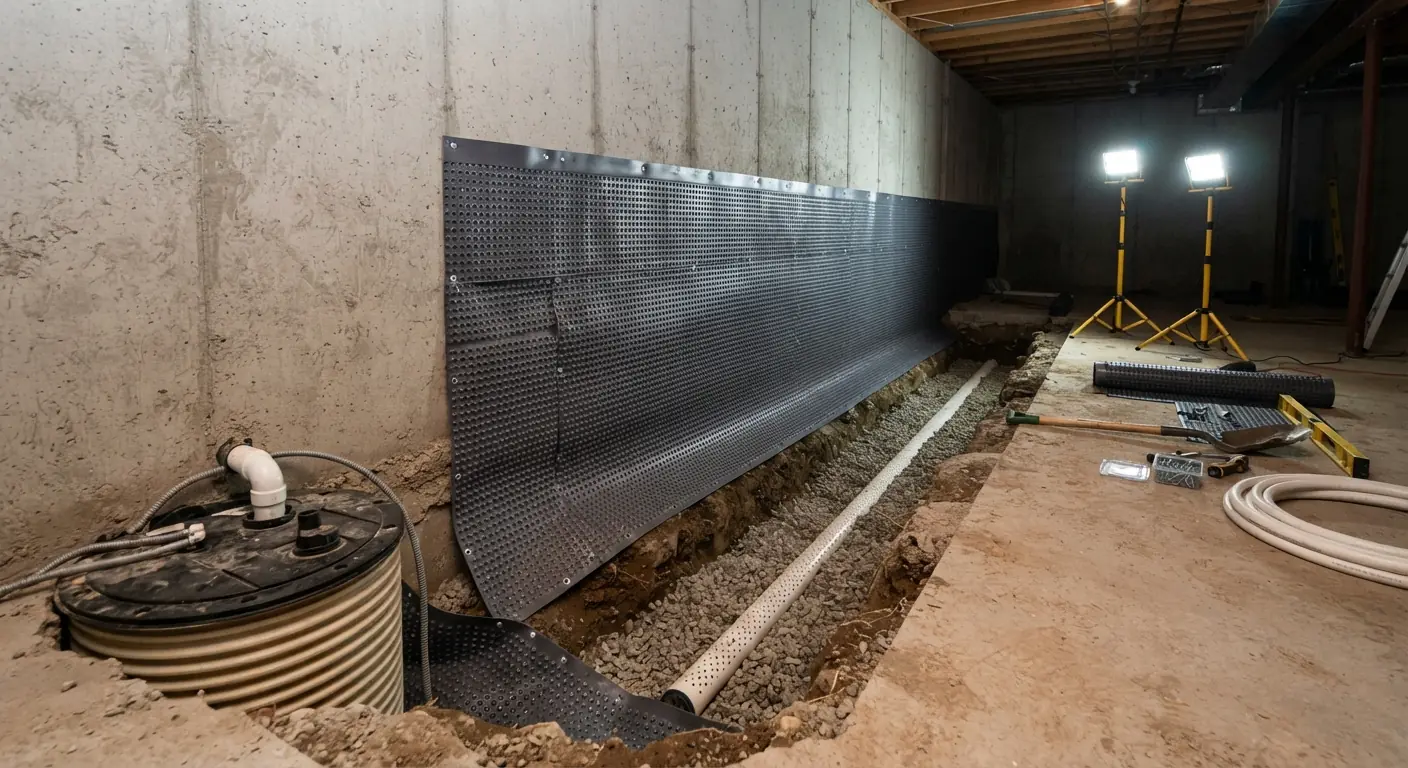
Building science puts water control first. Liquid water should be kept out of the basement with surface drainage, drainage layers, perimeter drains and capillary breaks.4 ENERGY STAR lists simple outside steps that can lower basement humidity.3
- Extend downspouts away from the foundation.
- Keep gutters and downspouts clear.
- Make sure soil slopes away from the house.
- Avoid overwatering plants next to the foundation.
HomeGuide lists warning signs that a basement needs waterproofing.5 They include standing water or leaks, water stains, white or gray chalky residue, damp walls, musty odors, mold, bowed walls and cracks.5
Here's how the fixes compare on cost. All figures come from HomeGuide's national averages, dated January 23, 2026.5
| Fix | Typical cost |
|---|---|
| Portable dehumidifier | $130 to $3005 |
| Whole-house dehumidifier, installed | $1,500 to $3,5005 |
| Interior waterproofing | $6,000 to $12,0005 |
| Exterior waterproofing | $10,000 to $18,0005 |
| Mold remediation | $1,500 to $15,0005 |
A whole-home unit makes sense in some houses. ENERGY STAR points to humid climates, central air and humidity above 55% consistently through a relatively well sealed house.3 Its drain should be routed to a floor drain or condensate pump by an HVAC professional during installation.3
If your basement shows the warning signs, fix the water before anything else. You can get a written quote for basement waterproofing and settle the source before you finish or refinish the space.
What to ask your contractor about basement moisture
Basement Remodeling Co. treats moisture as a planning step that gets settled before framing. The one vetted, licensed basement contractor you're matched with checks moisture at the free on-site estimate. Use that visit to ask where water gets in, how the finished walls will dry and where the dehumidifier will drain.
Good questions to bring:
- Where is the moisture coming from? Groundwater, water wicking up through the footing and humid indoor air hitting cold concrete need different fixes.4
- Will the new walls let the foundation dry inward? Ask whether any plastic vapor barrier goes on the inside of the framing. Building-science guidance says it shouldn't.4
- How will the rim joists be insulated? Lstiburek's guidance calls for air impermeable insulation there.4
- Where will the dehumidifier drain? A hose to a floor drain or sump pump means nobody empties a bucket.3
- Does the job need waterproofing first, and is it itemized? You get a written, itemized quote, and nothing starts until you sign.
If your basement is already finished and you're reworking it, the basement remodeling page explains how that differs from a first build-out. To see who covers your area, use the contractor finder by ZIP code. Local pages cover basement finishing in Atlanta and basement finishing in Denver.