Look at the U-tube manometer on your radon pipe. If the liquid sits higher on one side, the fan is pulling suction. If both sides are level, the fan has stopped or something has failed. The gauge only proves the fan runs, so retest the house every two years, as New York's health department advises.1 Expect the fan to need repair or replacement after 5 to 10 years.2 One supplier lists replacement fans at $135.87 to $372.69.3 Labor is priced at your estimate.
TL;DR
- Write down the manometer reading on the day your system passes its test. Any later reading that's level or far from that mark is your cue to get it checked.
- A running fan and a working system aren't the same thing. Only a radon test after install, after repairs and after renovations tells you the level in your home.
- Budget for a new fan within 5 to 10 years, even though good fans often last longer. Keep the install date and fan model with your house papers.
- The fan is the cheap part. What you're paying a mitigator for is the right replacement model, a sealed install, a valid warranty and a follow-up test.
- Finishing a basement around a radon system is normal. Keep the pipe and gauge visible, protect the sump seal and retest when the work is done.
How do you read a radon manometer?
A U-tube manometer shows whether the fan is pulling suction on the pipe. Uneven liquid, with one side higher than the other, means it's pulling. Level liquid means no suction, so the fan is off, dead or disconnected. A reading far from the day-one level means something in the system has changed since install.
The manometer is the small clear U-shaped tube with colored liquid, usually mounted on the vent pipe near where it leaves the floor or slab. It measures the suction inside the pipe in inches of water column, written "in.wg", the same unit manufacturers use when sizing a fan for sub-slab suction.4 Radon suppliers also sell micro-manometers so installers can check how far that suction spreads under the slab.3
You don't need to understand the numbers to use it. You only need to know what "normal" looks like for your house.
| What you see | What it usually means | What to do |
|---|---|---|
| Liquid uneven, close to the day-one mark | The fan is running and pulling about as it did at install | Nothing. Keep your retest schedule |
| Liquid level on both sides | No suction. The fan has no power, has tripped a breaker or has failed | Check that the fan's outlet or switch has power. If it does, have a mitigator inspect it |
| Much less difference than the mark, but not level | Suction is weaker. A loose coupling, a cracked pipe or a tired fan are common causes | Have the system inspected before the next radon test |
| Much more difference than the mark | Suction is higher while airflow may be lower, which can point to a blocked pipe or water sitting in a low spot | Have the pipe and fan inspected |
Mark the day-one reading
When your system is installed or repaired, ask the mitigator to write the manometer reading and the date on the pipe label or in your paperwork. Without that mark you can only tell "running" from "not running". With it you can spot a slow change.
What the gauge can't tell you
A manometer measures suction, not radon. A radon test is the only way to confirm the levels in your home.2 Some systems add an alarm on top of the gauge. Fantech, for example, sells a radon alarm among its fan accessories.4 One low-voltage fan system, the KTA 2.0, has a built-in ANSI/AARST radon alarm.3
Do radon fans really work?
Yes, when the system suits the house. An active soil depressurization system can reduce radon levels by up to 99%.2 New York's health department uses the same figure and says most homes can be brought to 2 pCi/L or below.1 The only proof for your own house is a radon test after the system goes in.
Active radon mitigation systems use a fan to pull radon from under the building through a sealed pipe and exhaust it outside.4 Most vent the gas above the roofline.2
Results depend on the match between fan and soil. PDS Radon Supply says bigger fans aren't always better, and that fan choice depends on soil type, foundation size and type, radon level, pipe size, climate and humidity.3 High-volume fans move more air with less resistance and suit porous soil, but they tend to "max out" quicker in tight soils.3 That's why a system can run perfectly and still leave radon too high.
New York's health department says to test within 30 days of installing a system.1 The EPA says to fix your home at 4 pCi/L or higher and to consider fixing between 2 and 4 pCi/L.5 If your post-install result isn't below 4 pCi/L, the system needs adjusting, whatever the manometer says.
Should a radon fan be on all the time?
Yes. A radon fan is built to run nonstop, pulling gas from below the basement, crawlspace or slab and venting it outside.2 Turning it off removes the suction the system depends on, and your manometer will read level. Leave it on and watch it instead.
PDS Radon Supply describes radon fans as running continuously through all types of weather.3 Running costs are modest. HomeGuide says the fan uses about the same electricity as a 60-watt light bulb, around $70 to $80 per year.2 Some models are sold as low-power, energy star rated fans.3
Because the fan never stops, noise matters. As PDS puts it, a noisy fan running constantly will drive you nuts, and suppliers sell mufflers for exactly that problem.3 A new rattle, hum or whine is worth noting, since a change in sound often comes before a change on the gauge.
What are the signs a radon fan is failing?
The common signs are a level or drifting manometer, a system alarm, a fan that's gone silent or suddenly loud, and a radon retest above your target. Water stains around the roof pipe or ceiling point to a seal leak, a separate repair from the fan. Radon systems have moving parts and failure points, so none of this is unusual.3
| Symptom | Likely cause | Who should fix it |
|---|---|---|
| Manometer reads level | Fan has no power or has failed | Check power first, then a mitigator |
| Manometer drifted from its mark | Loose coupling, cracked pipe, blockage or a weakening fan | A mitigator |
| Alarm sounds | The monitor has detected low suction or a system fault | A mitigator |
| Fan is suddenly loud | Worn fan or vibration at the couplings | A mitigator, or a same-model fan swap |
| Fan is silent | Fan has stopped | Check power first, then a mitigator |
| Leak or stain near the roof pipe | Roof gasket not sealed around the pipe, or loose fittings | A mitigator or roofer |
| Retest above 4 pCi/L5 | System no longer controls radon, or never did | A mitigator |
Noise and silence
In one mitigator's replacement video, the fan being swapped was simply loud and annoying, and the host notes that some fans quit altogether.6 The same video shows the fan held in place by two worm-drive clamps, with a new fan fitted in the same spot.6
Leaks at the roof
That video also warns that the neoprene gasket at the roof must seal around the pipe, and that every fitting must be tightened, or the system can leak.6 If you see a stain on the ceiling below the pipe after a fan swap, that's the first place to look.
Condensation on outdoor fans
Fans installed outside the house handle cold, wet exhaust. PDS Radon Supply says a condensate bypass can add years to fan life on outdoor installs.3 Ask whether your system has one when the fan is replaced.
How long does a radon mitigation system last?
The pipe lasts decades. The fan is the part that wears out. HomeGuide puts piping at 20 to 50+ years and says the fan may need repair or replacement after 5 to 10 years.2 PDS Radon Supply says good fans typically last quite a long time, often over a decade.3 Budget from the 5 to 10 year figure.
The two sources aren't far apart. HomeGuide ties the range to the system's design, placement and sun exposure.2 A fan in a shaded attic has an easier life than one on a south wall in full sun. Budgeting for the shorter figure means a fan that lasts 12 years is a bonus, while one that dies at year 6 isn't a surprise.
| Part | Expected life | Source |
|---|---|---|
| Pipe | 20 to 50+ years | HomeGuide2 |
| Fan | 5 to 10 years before repair or replacement | HomeGuide2 |
| Fan | Often over a decade | PDS Radon Supply3 |
| Fan warranty | 5 years for professionally installed systems, from most manufacturers | HomeGuide2 |
Warranty terms depend on who installs the fan. HomeGuide says most manufacturers offer a 5-year warranty on fans in professionally installed systems.2 PDS says reputable manufacturers offer five years or more on inline radon fans, and that RadonAway's ProSeries warranties are only valid for certified contractor installations.3 Keep the receipt and the install date.
How much does a radon mitigation system fan cost?
A replacement inline radon fan cost $135.87 to $372.69 at PDS Radon Supply on September 29, 2026, before labor.3 Low-voltage KTA 150 fan systems with 25 to 100 feet of cable ran $488.27 to $507.76.3 Installation labor is priced at your estimate.
These are one supplier's online prices on one day. Your mitigator may pay a different price and will add labor, so treat the table as a guide to the hardware slice of the bill.
| Fan model | PDS Radon Supply price, Sept. 29, 2026 | Note |
|---|---|---|
| Fantech Rn1 | $135.873 | |
| Fantech Rn2 | $143.283 | |
| RadonAway RP 145 | $145.443 | |
| PDS-150 | $148.053 | Sold as low power, energy star rated |
| RadonAway RP 260 | $177.653 | |
| Fantech Rn3 | $187.413 | High-volume fan |
| RadonAway GX3 ProSeries | $207.893 | Sale price, listed at $228.983 |
| RadonAway RP 265 | $208.083 | High-volume fan. Sale price, listed at $245.953 |
| RadonAway GX4 | $247.153 | Sale price, listed at $320.073 |
| RadonAway GX5 PRO | $265.453 | Sale price, listed at $337.483 |
| RadonAway GP 501 | $309.763 | |
| Fantech Rn2EC | $313.953 | |
| Fantech Rn4-3EC or Rn4-4EC | $372.693 | Sits outside the usual high-suction and high-volume split |
Source for every row: PDS Radon Supply.3
For scale, a whole active soil depressurization system costs $1,200 to $2,000 installed on average, according to HomeGuide.2 A fan swap is a fraction of that. Add the $70 to $80 a year in electricity if you're comparing the total cost of keeping a system running.2
Why the replacement model matters
The safest replacement is usually the same model or its current equivalent. Manufacturers periodically change model names or discontinue fans, which is why one mitigator publishes a replacement guide.6 Swapping in a bigger fan "to be safe" isn't automatically better, since fan size has to match the soil and the pipe.3
Doing it yourself
A same-model swap can look simple. The replacement video shows it done with a 5/16 nut driver or flat blade screwdriver.6 Before you try, check three things. Is the fan plugged in or hardwired? New or changed wiring is a job for a licensed electrician. Does your warranty require a certified installer? It does for RadonAway ProSeries fans.3 And can you reach the roof seal safely? If any answer gives you pause, hire a certified mitigator.
Do radon mitigation systems need to be serviced?
Yes, lightly. The job is mostly watching and retesting. Check the manometer on a routine you'll keep, retest every two years as New York's health department advises for homes with a mitigation system, and retest after major renovations.1 Homeowners insurance doesn't cover radon mitigation or testing, so plan the cost.2
A simple upkeep schedule:
| When | What to do | Typical cost |
|---|---|---|
| Within 30 days of install, and again after any repair | Radon test1 | Home kit $10 to $30, or professional test $125 to $4002 |
| Monthly, or whenever you're near it | Glance at the manometer | Free |
| Every two years | Radon test, ideally in winter with windows and doors closed1 | Same as above |
| After a major renovation | Radon test1 | Same as above |
| Around 5 to 10 years | Expect fan repair or replacement2 | Fan plus labor |
If you want a constant readout, a digital radon detector costs $150 to $300 and monitors levels continuously, much like a carbon monoxide detector.2 New York homeowners can order a state test kit for $12.25, including analysis and postage.1 Check whether your own state offers something similar. HomeGuide notes some states provide free short-term kits.2
What should you ask before a radon fan is replaced?
Ask what failed, which fan goes in and how they'll prove the fix worked. A good quote names the replacement model, explains why it suits your house, states the warranty terms and includes a follow-up radon test. If it only says "replace fan" with a price, ask for more detail before you sign.
Questions worth asking any radon mitigator:
- Are you NRPP or NRSB certified?2
- What exactly failed: the fan, the power, the pipe or the seal?
- Which fan model goes in, and does it match the old fan's job?
- Will the manufacturer's warranty be valid with your installation?3
- Does the price include follow-up testing to confirm the system works?2
- What maintenance will the system need from here?2
- What does your warranty cover?2
- Will you record the new manometer reading on the pipe?
HomeGuide also advises never paying in full before installation. Pay a partial deposit and get a receipt.2
How does finishing a basement affect your radon system?
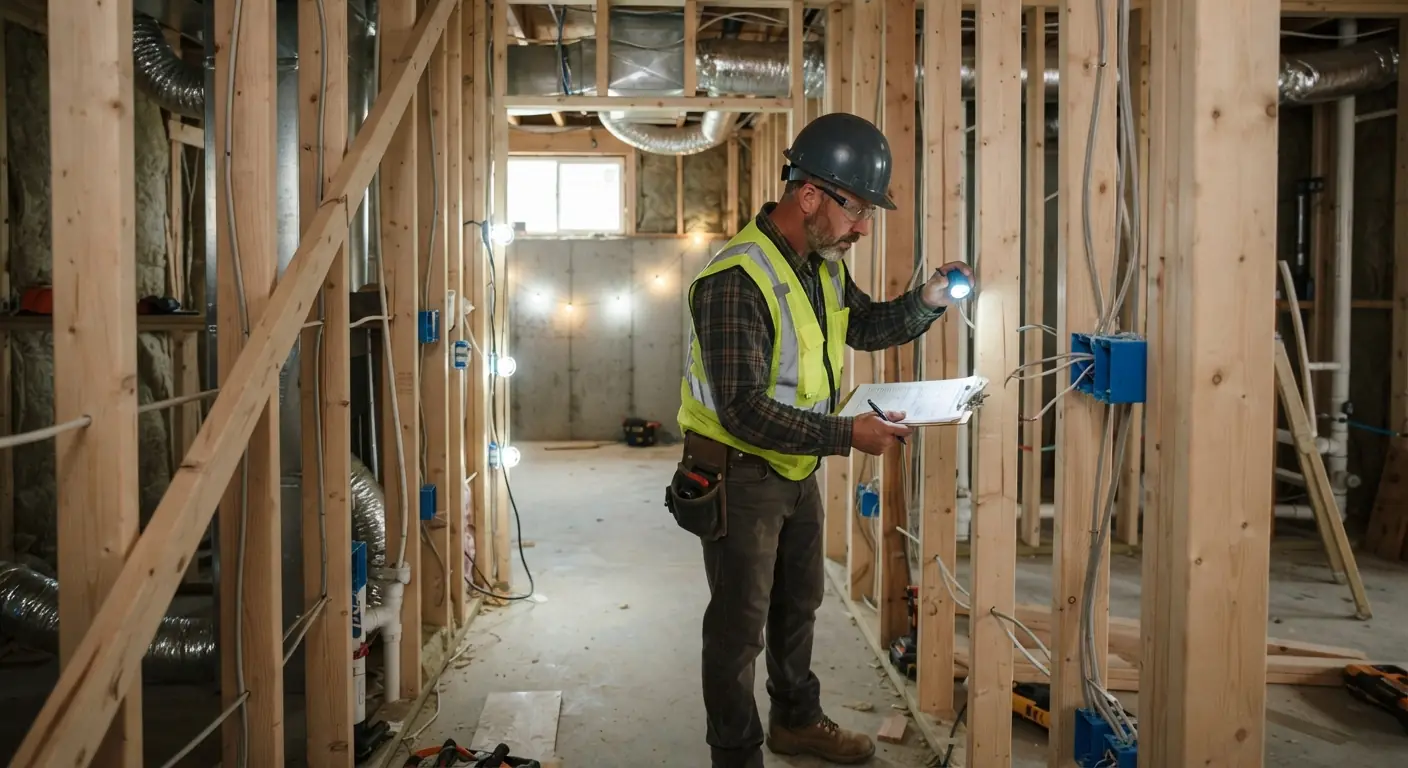
Finishing doesn't bring the fan into the basement. PDS Radon Supply says US radon fans belong outside the home, in the attic or in an unfinished garage with no living space above.3 What changes is access to the pipe, the gauge and the slab, and you'll need one more radon test after the work.1
Settle radon before anyone frames a wall. Test first, fix or repair the system, then plan the basement finishing steps around it. Three details are worth raising with your contractor at the estimate.
Keep the pipe and manometer visible
The vent pipe usually rises through the basement, and the gauge sits on it. Plan a utility closet, an access panel or an open section of wall so you can still read the manometer every month. A gauge hidden behind drywall is a gauge nobody checks.
Protect the sump and slab seals
Radon enters through slab cracks, block walls, slab-footing joints, exposed soil in a sump and gaps around loose pipes.1 Sealing a sump pit and fitting a cover costs $900 to $2,500.2 If water is part of the story, sort it out with basement waterproofing before finishing so new flooring doesn't cover a problem.
Retest when the work is done
New York's health department lists "after major renovations" as a time to test.1 Book it once the basement is finished and in use.
When your system checks out, you're ready to get a written quote for finishing your basement. Basement Remodeling Co. matches you with one vetted, licensed basement contractor who gives a free on-site estimate and a written, itemized quote. Mention the radon system at that visit so it's in the plan. If your basement is already finished and you're reworking it, the basement remodeling page covers that job. You can also find the basement contractor for your ZIP code, or go straight to finishing in metro Atlanta, Denver, Colorado Springs or Fort Collins.
What type of home is more likely to have radon?
Any home can have radon, old or new.2 High concentrations are more common in cold climates with rocky or dry soil.2 Gas gets in through cracks in the slab, pores in concrete block, slab-footing joints, exposed soil in a sump and loose pipe gaps.1 Testing is the only way to know your level.
HomeGuide cites the EPA's estimate that 1 in every 15 US homes has high radon levels.2 The EPA's Map of Radon Zones shows which areas have higher radon potential, built from indoor measurements, geology, aerial radioactivity, soil data and foundation types.5 The EPA also says the map should not be used to decide whether an individual home needs testing.5 Homes with high radon turn up in all three zones.2
So if you're wondering whether your state or county is "bad for radon", the map gives a general picture. It doesn't tell you what's under your slab. Radon can get into any type of building, homes, offices and schools included.1
Is radon overblown?
No, according to the EPA. It estimates radon causes about 21,000 lung cancer deaths a year in the US, about 2,900 of them among people who have never smoked.7 The risk grows with the level in your home and is much higher for smokers. That's why a working fan, and a test that proves it, matter.
The EPA's own risk tables show how the numbers scale over a lifetime of exposure.7
| Radon level | People who never smoked, per 1,000 who could get lung cancer | People who smoked, per 1,000 who could get lung cancer |
|---|---|---|
| 20 pCi/L7 | About 367 | About 2607 |
| 10 pCi/L7 | About 187 | About 1507 |
| 4 pCi/L7 | About 77 | About 627 |
| 2 pCi/L7 | About 47 | About 327 |
Source: EPA, "Health Risk of Radon".7
The evidence isn't only from miners. In 2005, a North American study and a European study each pooled earlier home studies and found an association between residential radon and lung cancer.7 The EPA also notes that getting below 2 pCi/L is difficult.7 Its guidance is to fix your home at 4 pCi/L or higher and to consider fixing between 2 and 4 pCi/L.5