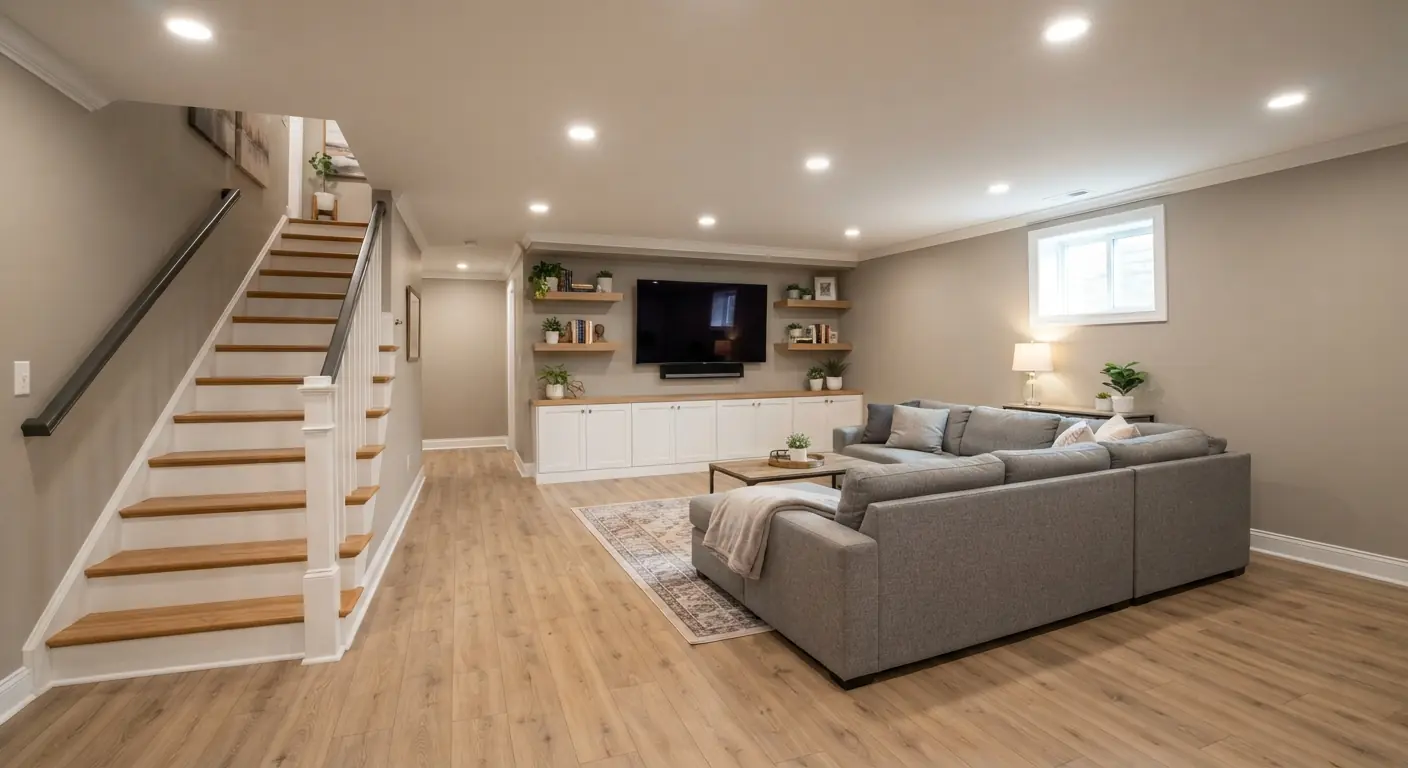
Yes, laminate works on a basement slab if the slab stays dry. The slab should pass a moisture test against the limit in your plank's installation instructions. Lay a vapor barrier layer under the planks and buy a waterproof-rated laminate.1 If water has ever come through the floor, fix that first. Vinyl plank handles spills better, but neither floor fixes a damp slab.2
TL;DR
- Laminate is a fair choice for a dry, tested slab in a basement people live in. Buy a waterproof or water-resistant plank with sealed edges and treat the vapor layer and underlayment as part of the job.1
- Each plank maker sets its own moisture limit in the installation instructions, so ask your contractor for the reading and the limit side by side.
- Vinyl plank holds up better to spills and humidity. On price the two overlap: $4 to $14 per square foot installed for laminate and $4 to $16 for luxury vinyl plank.3
- A sheet on top of a wet slab traps the water. Building science guidance links impermeable layers on basement slabs to mold, so dry the slab before any floor goes down.2
- Laminate is hard to repair after a leak. If your basement holds a water heater, washer or bar sink, weigh that risk before you choose.3
Is laminate flooring okay for a basement?
Yes, for a dry basement that people live in. Laminate gives you a wood or stone look at a much lower price than the real thing, and it resists scratches and stains. Its weak point is water. HomeGuide calls it difficult to repair and not suitable for humid spaces, so your slab and your basement's humidity decide whether it lasts.3
Laminate is a sound pick when all four of these are true.
- No liquid water comes in. The basics haven't changed in centuries: drain the site and drain the ground. Gutters should carry roof water away from the foundation.2 If water has ever sat on the slab, fix the source before you price flooring.
- The slab passes a moisture test. The limit comes from the plank you plan to buy. Your contractor checks moisture during the free on-site estimate, so you'll have a reading before you commit.
- A vapor barrier and good underlayment go under the planks. A Virginia flooring retailer lists subfloor moisture testing, vapor barriers and quality underlayment as the prep that keeps laminate from failing.1
- The plank is rated for it. Home Depot's basement laminate listing splits products into "Waterproof" and "No Water Protection."4 HomeGuide's rule for basements is waterproof or water-resistant flooring unless the space is finished and sealed.3
If any one of those fails, fix the slab first or look hard at luxury vinyl plank for basements.
Which holds up better in a basement, laminate or vinyl plank?
Vinyl plank holds up better to water. Laminate holds up fine to everyday wear on a dry slab, and it costs about the same. HomeGuide puts laminate at $4 to $14 per square foot installed and luxury vinyl plank at $4 to $16.3 Neither one stops a damp slab from causing trouble.
| Laminate | Luxury vinyl plank (LVP) | |
|---|---|---|
| Installed cost per square foot | $4 to $143 | $4 to $163 |
| Installed cost, 500 to 1,500 sq ft basement | $2,000 to $21,0003 | $2,000 to $24,0003 |
| Water and humidity | HomeGuide calls it not suitable for humid spaces3; waterproof-rated lines are sold4 | A spill won't swell the plank |
| Everyday wear | Scratch and stain resistant3 | Thicker and more durable than standard vinyl3 |
| Underlayment | Typically needed3; some planks come with it attached4 | Typically needed3 |
| Effect on slab drying | Needs a vapor layer under it1 | Building science guidance warns against impermeable vinyl coverings on basement slabs2 |
| Best fit | A dry, tested slab with low spill risk | A dry slab near a laundry, bar sink or water heater |
Laminate is a printed wear layer over a wood-fiber core. When water gets into the core at the joints, the planks swell. Basement-rated lines seal the edges to reduce that swelling.1 Vinyl plank is plastic, so a spill sits on top until you wipe it up.
There's a catch with vinyl, though. Building Science Corporation's basement digest says impermeable floor finishes such as vinyl floor coverings should be avoided on basement slabs. They stop the slab drying into the room and typically lead to mold growth.2 The digest dates from 2006 and speaks about vinyl coverings in general.2 The physics still applies to any tight layer: water under the floor has nowhere to go.
So choose by risk:
- Dry slab, tested, no water history: laminate is a fair, lower-cost way to get a wood look.
- Spill risk nearby: vinyl plank. The same digest says basement floor finishes should be chosen with flooding in mind, from leaky appliances, failed plumbing, overflowing sinks or surface water.2
- Slab that gets damp: neither yet. Fix the water, then test again.
How dry does the slab need to be?
Dry enough to pass the moisture test named in your plank's installation instructions. Each maker sets its own limit and test method, and its warranty is written against them. Ask your contractor to write the reading and the product's limit side by side on the quote.
Several things move the reading.
What's under the slab
Building science guidance puts a capillary break of crushed stone and a polyethylene vapor barrier under the slab, in direct contact with the concrete.2 You can't see whether yours has one once the slab is poured. The moisture test is your window into it.
The same digest warns about sand between that sheet and the slab. The sand can soak up water that can only dry upward through the slab, which typically damages the floor finish above.2
How new the slab is
Freshly placed concrete holds several thousand pounds of water that tries to dry inward.2 In a new house, ask when the basement slab was poured and test before any flooring goes down.
Summer humidity
Concrete in contact with the ground runs cold.2 The digest notes that sub-slab insulation improves resistance to moisture damage, including summertime condensation.2 A basement that dries inward sheds its moisture through ventilation or dehumidification, so plan for a dehumidifier in humid months.2
After a failed test, the water gets fixed first and the slab gets retested before the floor is ordered.
Can you put laminate flooring directly on concrete?
Not on bare concrete. Most laminate floats: the planks click together and rest on an underlayment instead of fixing to the slab. HomeGuide says underlayment is typically needed under laminate.3 Some planks come with the pad attached, and the instructions say whether a separate vapor sheet still goes under it.
Read the spec for the exact plank. Home Depot's basement laminate filters alone show floating, click lock and adhesive installs. They also show "Underlayment Required - Pre-Attached" and "Underlayment Not Required" as separate categories.4 Those labels change what goes between your slab and the floor.
Three more details matter on concrete:
- Flatness. Floating planks bridge small dips but flex over bigger ones, which strains the joints. Your contractor grinds high spots or fills low ones before the floor goes down.
- Expansion gaps. Laminate needs the correct expansion gap at the walls and secure seams to last.1
- Acclimation. Some flooring needs to sit in the room for a day or more to adjust to temperature and humidity, which prevents warping later.3 Home Depot lists some basement laminates with a two-day minimum and others with no acclimation required.4
Do you need a vapor barrier between concrete and laminate?
Usually yes, as part of the underlayment system your plank's instructions call for. The sheet under the planks is a second line of defense. Building science guidance puts the main vapor barrier under the slab itself.2 No sheet on top can make a wet slab safe, because it traps the water against your floor.
Put the two ideas together and the order of work is clear:
- Stop liquid water from reaching the slab.
- Test the slab against the plank's limit.
- Lay the vapor layer and underlayment the plank maker specifies.
- Install the floor with its expansion gap.
Skipping step 2 is where basements go wrong. Building Science Corporation says impermeable layers over a basement slab inhibit drying and typically lead to mold.2 A vapor sheet only helps on a slab that has already tested dry.
If your plank has a pad attached, ask whether that pad includes a vapor layer or whether a separate vapor barrier sheet still goes under it. The instructions answer that, and your contractor should follow them.
What underlayment should basement laminate have?
Basement laminate needs underlayment with a vapor layer that matches the plank maker's instructions. Pair it with a thicker plank. One Virginia flooring retailer notes that thicker planks paired with the right underlayment reduce noise and improve insulation.1 HomeGuide prices underlayment at $0.50 to $3.50 per square foot installed.3
Use this as your spec sheet when you compare products and quotes.
| Item | What to ask for | Why it matters |
|---|---|---|
| Vapor layer | A vapor barrier sheet or a pad with one built in, as the plank's instructions require | It's the plank's defense against slab moisture1 |
| Pad type | Pre-attached pad or separate underlayment, per the product | Home Depot's filter separates "Underlayment Required - Pre-Attached" from "Underlayment Not Required"4 |
| Plank thickness | Compare within the 7 to 8.9 mm, 9 to 10.9 mm and 11 mm and up bands | These are the thickness bands on Home Depot's basement laminate filter4 |
| Wear rating | Check the AC rating on the box | The same filter lists AC4 as "Commercial Medium Traffic"4 |
| Water rating | Waterproof or water-resistant, with sealed edges | Sealed edges reduce swelling and surface damage1 |
| Cost | Underlayment as its own line on the quote | Typically $0.50 to $3.50 per square foot installed3 |
The plank maker's instructions win over any general rule, including this table. The warranty is written against them.
Can mold grow under laminate flooring on concrete?
Yes, if moisture gets trapped between the slab and the floor. Building Science Corporation says impermeable layers over basement slabs inhibit drying and typically lead to mold growth.2 You often won't see it from above. The first signs tend to be a musty smell or planks that start to swell at the joints.
Moisture reaches the space under a floating floor in three main ways:
- Vapor from the slab, when the slab never passed a moisture test or the barrier under it is missing.
- Spills and floods, from leaky appliances, failed plumbing, overflowing sinks or surface water outside.2
- Summer condensation, on a cold slab with no insulation under it.2
The digest's standard for anything touching a basement slab is that it allows drying, isn't sensitive to moisture damage and doesn't support mold growth.2 Hold your underlayment to the same standard.
Water ruins finished basements. The moisture check at a free on-site estimate costs you nothing, while HomeGuide puts mold removal at $15 to $30 per square foot.3 If you smell mustiness or find mold under old flooring, have a mold professional (licensed where your state requires it) assess it before new flooring goes down.
What your contractor's quote should show
A good quote for basement laminate names the moisture reading, the product and every layer under it. You should see exactly what goes between the slab and the planks. You should also see what happens if the slab fails the test. A single line that says "install flooring" hides the parts that decide whether the floor lasts.
Check for these lines:
- Moisture test: the method, the reading and the plank's published limit.
- Water fixes: any drainage or leak work needed first, priced as its own item.
- Plank: brand, product line, thickness, water rating and AC rating.
- Under the plank: the vapor layer and underlayment by product name, and whether the pad is attached.
- Prep: removal of old flooring and any grinding or leveling of the slab.
- Edges: the expansion gap and the trim that covers it.
- Acclimation: how long the planks sit in the basement before install.
Basement Remodeling Co. matches you with one vetted, licensed basement contractor for your metro. They give you a free on-site estimate and a written, itemized quote, and nothing starts until you sign. When you're ready, get a written quote for finishing your basement. If you want to see who covers your area first, find the basement contractor for your ZIP code.
In metro Atlanta or metro Denver, start from basement finishing in Atlanta or basement finishing in Denver. Replacing the floor in a basement that's already finished is basement remodeling work. If pulling up the old floor turns up damage, the job can grow into a wider basement renovation.