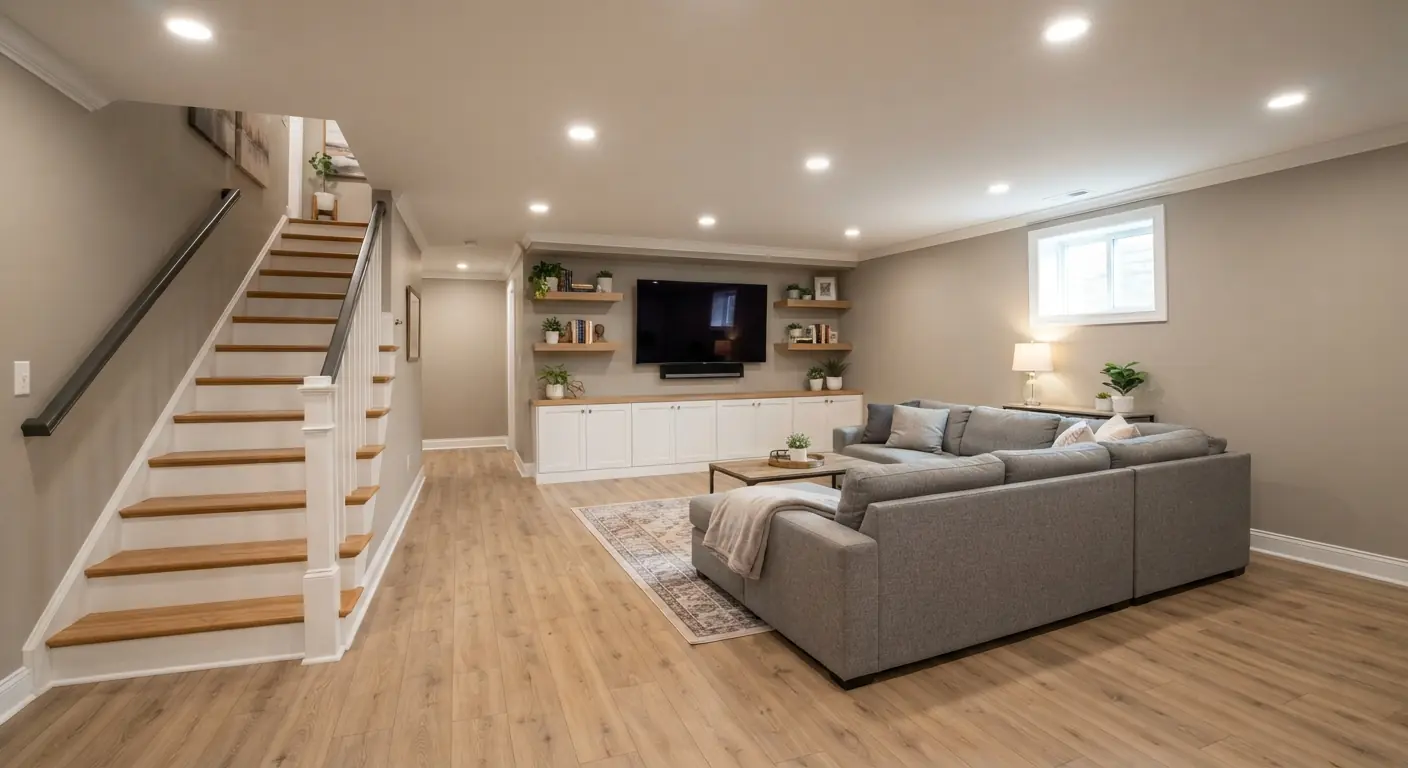
Yes. Engineered hardwood gives you a real wood floor in a basement, and it's safe on concrete when the slab is dry and the product is approved for below-grade use. It can be glued to the slab or floated over it.1 Solid hardwood is the one to skip, because it can't go below grade or over concrete.2 The slab's moisture decides whether the job lasts, so test it before you pick a board.
TL;DR
- Engineered hardwood is the real wood option for a basement. Its layered core handles humidity swings that make solid wood swell and cup.
- Moisture is the deciding rule. Your contractor tests the slab against the limit in the product's own instructions, and any water problem gets fixed first.
- Glue-down bonds the planks to the slab and takes more skill. Floating clicks together over an underlayment and is simpler and less permanent.
- LVP costs less installed ($4 to $16 per square foot against $7 to $20), and engineered wins if a real wood surface matters to you.3 Neither one saves a wet slab.
- Engineered costs less than solid hardwood, but you trade away most of the refinishing and some of the lifespan.
Is engineered hardwood flooring good for basements?
Yes, engineered hardwood is the best way to get real wood below grade. Its top layer is genuine hardwood bonded to cross-ply layers of plywood or high-density fiberboard, which makes it far more stable than solid wood as humidity swings.2 That stability is why flooring sellers point basement buyers to engineered planks.1
The layers are the whole trick. Each one runs in a different direction and they're glued together, so they push against each other's movement instead of swelling as one piece.1 Solid wood works the other way. It soaks up moisture from damp basement air and can swell, warp and cup, which is why it's almost never recommended below grade.1
"Good for basements" has a condition attached, though. Building Science Corporation's basement digest makes the point that a lived-in basement has to be dry, comfortable and free of contaminants, and that getting there is anything but simple.4 Engineered wood tolerates humidity swings. It doesn't tolerate standing water, and no wood floor does.1 If your basement has leaked, seeped or flooded, that gets fixed before anyone talks about flooring.
Is engineered hardwood safe on concrete?
Yes, engineered hardwood is safe on concrete when the slab stays dry. The risk is ground moisture moving up through the slab, which a finished floor can trap.4 Your contractor should test the slab and compare the reading with the limit in the product's installation instructions before any flooring goes down.
Concrete looks solid, but water from wet soil can wick and diffuse through it.4 How much reaches your floor depends on what was built under the slab, and you can't see that from the basement.
Building Science Corporation's guidance is that a basement slab should sit on a capillary break of crushed stone or gravel, with a polyethylene vapor barrier in direct contact with the underside of the concrete.4 The same digest warns about one common mistake. A sand layer between the plastic and the slab can get saturated and dry only upward through the concrete, which typically results in damaged floor finishes.4 That's the failure you're guarding against when you put wood on top.
So the test matters more than the brochure. The moisture limit and the test method come from the flooring manufacturer, and they vary by product. Get the number from the actual installation instructions for the plank you're buying, then have the slab tested against it. "It looks dry" is not a reading.
When you go through Basement Remodeling Co., the matched contractor checks moisture at the free on-site estimate, along with ceiling height and layout. That's the right time to learn whether your slab can take wood at all.
Getting this wrong is expensive. HomeGuide puts mold removal at $15 to $30 per square foot.3 The digest also says basement floor finishes should be chosen with flooding in mind: leaky appliances, failed plumbing, overflowing sinks and outside surface water.4 If your water heater or laundry sits on the same slab, plan for that before you commit to wood.
Glue-down or floating: which install suits a basement slab?
Both work on concrete, and the choice comes down to skill, cost and permanence. Glue-down bonds each plank straight to the slab and often needs special tools and expertise. A floating floor clicks together without attaching to the slab, which makes it simpler and less permanent.1
Glue-down
Engineered planks can be glued directly to a concrete subfloor.1 Glue-down installs are more complex than floating ones and often need special tools and expertise, so this is usually a job for your contractor.1 Ask what adhesive they plan to use. HomeGuide suggests asking installers whether they use formaldehyde-free glue.3
Floating
A floating floor uses a click-lock system. The planks lock to each other but not to the slab.1 Spacers hold a small gap at the walls so the floor can expand, and baseboards or quarter-round trim cover that gap at the end.5 Plan for an underlayment under the planks. HomeGuide prices underlayment at $0.50 to $3.50 per square foot installed and says it's typically needed under hardwood.3
A floating floor is the more approachable option if you're an experienced DIYer.1 Because it isn't bonded to the slab, it's also the less permanent choice.
Nail-down
Nailing or stapling needs a wood subfloor.2 Engineered planks can be nailed like solid wood, but over concrete that means building a wood subfloor first.1 The basement subfloor guide covers what goes between a slab and the finished floor. For scale, HomeGuide prices replacing a subfloor at $2.20 to $4.75 per square foot.3 That's a replacement figure. A new subfloor over a slab is priced at your estimate.
How long should engineered hardwood acclimate in a basement?
Let the planks sit in the basement for the time the manufacturer sets before install. HomeGuide says some floors need a day or more3, and one flooring retailer tells buyers to allow at least 48 hours.5 The wait lets the wood adjust to the room's temperature and humidity so it doesn't expand or shrink later.
The two minimums differ, and neither one is for your product. Budget from the number printed in the installation instructions for the plank you buy. Improper installation is one of the main ways a flooring warranty gets voided.1
Acclimation only works if the room is already at the conditions it will live in. Get the basement to its normal living temperature first, with the dehumidifier running if the space is damp.5 Boards that settle into a cold, muggy construction site will move again once the space is heated and dry.
The product's instructions give its own humidity range. For a sense of scale, one Wisconsin flooring retailer puts the ideal indoor humidity for solid hardwood at 35 to 55%.2
Keep the order straight. Test the slab, fix any water, condition the space, acclimate the boards, then install. Acclimation doesn't make a wet slab safe.
What type of hardwood flooring is best for a basement?
The best hardwood for a basement is an engineered plank approved for below-grade installation, with a multi-layer plywood or high-density fiberboard core and a thick wear layer. The core resists movement from humidity. The wear layer, the top slice of real wood, decides whether the floor can ever be sanded and refinished.1
Quality matters more than the category name. A premium engineered floor will outperform a low-grade solid one.1 When you compare samples, look at two things first.
Wear layer
A thicker veneer may allow one or two light refinishes. A thin top layer can't be sanded at all.1 One flooring retailer puts engineered wood at 0 to 2 refinishing cycles, depending on the veneer.2 If you want the option to sand out wear in ten or fifteen years, the wear layer is the spec to pay for.
Core and finish
Look for a multi-layered, high-density core, because that's where the stability comes from.1 For a busy basement with kids or pets, a harder species like oak and a durable factory-applied finish give you the best defense against daily wear.1 Engineered planks come in oak, maple, walnut and hickory, among others.5
Solid hardwood doesn't make this list. It's almost never recommended for basement installs.1 If you're still weighing wood against carpet, tile, vinyl and the rest, our guide to basement flooring options compares them side by side.
Which is better for a basement, LVP or engineered hardwood?
LVP is the better fit if cost comes first. Engineered hardwood is better if you want a real wood surface and can keep the basement dry. HomeGuide puts LVP at $4 to $16 per square foot installed and engineered wood at $7 to $20.3 Neither is a fix for a wet slab. The luxury vinyl plank basement guide covers LVP on its own.
Here's how the three floors compare for a typical basement. The per-square-foot figures are HomeGuide's installed ranges.3 The room totals simply multiply those ranges out.
| Floor | Installed cost per sq ft | 500 sq ft basement | 1,000 sq ft basement | Surface | Refinishing | Below grade |
|---|---|---|---|---|---|---|
| Engineered hardwood | $7 to $203 | $3,500 to $10,000 | $7,000 to $20,000 | Real wood veneer | 0 to 2 times, set by the veneer2 | Yes, if the product is approved for it |
| Luxury vinyl plank (LVP) | $4 to $163 | $2,000 to $8,000 | $4,000 to $16,000 | Vinyl | None | Yes |
| Solid hardwood | $11 to $253 | $5,500 to $12,500 | $11,000 to $25,000 | Solid wood | Many times2 | Not recommended |
HomeGuide's own basement table, which covers 500 to 1,500 square feet, lands on $2,000 to $24,000 for LVP and $5,500 to $37,500 for solid hardwood.3 Those match the math above. The refinishing column comes from one flooring retailer: 0 to 2 cycles for engineered wood and typically 4 to 6 for solid.2
The vinyl question on a basement slab
Vinyl isn't automatically the "safe" choice below grade. Building Science Corporation's 2006 basement digest says impermeable interior floor finishes such as vinyl floor coverings should be avoided, because they stop the slab drying into the room and typically lead to mold and other moisture problems.4 Whether that applies to your slab depends on how it was built and what goes under the new floor. Ask your contractor to explain how the floor they're recommending lets your slab behave.
Resale
HomeGuide says new flooring can raise a home's value, with the amount depending on floor type, quality and the local market, and that new hardwood floors tend to have the biggest return.3 That's a general note about hardwood. It isn't a measured figure for engineered wood in basements. Treat any promise of a specific resale gain from either floor with care.
Who each floor suits
Choose LVP if budget is tight, the basement is a playroom or gym, or you'd rather not think about the floor. Choose engineered hardwood if the basement is living space you want to feel like the rest of the house, the slab tests dry and you'll keep the humidity steady.
Which is cheaper, hardwood or engineered hardwood?
Engineered hardwood is cheaper. HomeGuide puts engineered wood at $7 to $20 per square foot installed, against $11 to $25 for solid hardwood.3 Material alone runs $2 to $9 for engineered and $4 to $15 for hardwood.3 Below grade the question mostly answers itself, because solid hardwood isn't recommended there.1
You'll see other numbers online. One flooring retailer's guide gives engineered hardwood at $4.50 to $16 per square foot and solid at $5 to $28, then quotes $4 to $7 and $8 to $15 further down the same page and tells readers to add installation costs on top.1 Budget from the HomeGuide installed ranges, because they include labor and come from one consistent method.
The floor itself isn't the whole bill. Add these lines when you compare quotes:
- Underlayment at $0.50 to $3.50 per square foot installed.3
- Baseboards and trim at $4 to $10 per square foot or $350 to $1,200 per room.3
- Carpet removal at $0.70 to $1.60 per square foot, if you're replacing an old floor.3
- A minimum project fee. HomeGuide notes many contractors charge $200 to $500 or more.3
Over the long run the gap narrows a little. Solid hardwood can last 30 to 100 years because it can be refinished again and again, while engineered hardwood typically lasts 20 to 30 years.1 In a basement you don't get to make that trade, so the fair comparison is engineered wood against LVP.
What are the downsides of engineered hardwood flooring?
The main downsides are limited refinishing, a shorter life than solid wood and no protection against standing water. A thick wear layer may allow one or two light refinishes, and a thin one allows none.1 It also costs more installed than LVP.3
Limited refinishing
Once the veneer is worn through, it's done. Engineered wood's refinishing depends entirely on the thickness of its top layer.1 A deep scratch in a thin-veneer floor means replacing boards, not sanding.
Shorter lifespan
Engineered hardwood typically lasts 20 to 30 years, depending on the product and the veneer thickness. Solid hardwood often lasts 30 to 100.1
Water
Neither engineered nor solid wood is waterproof, so spills need wiping up quickly.1 A burst pipe or failed sump on a wood floor is a bigger problem than on tile or concrete. Moisture damage is also one of the main things that voids a flooring warranty.1
Humidity upkeep
Engineered wood is more stable than solid, but it still needs the humidity kept in check. That means a humidifier in dry months and a dehumidifier in damp ones.5
Cost against the alternatives
It sits above LVP, laminate and carpet on installed price. HomeGuide lists laminate at $4 to $14 and carpet at $2 to $8 per square foot installed.3
If a finished basement already has a tired floor you want gone, that's a basement remodeling job as much as a flooring one, because trim, doors and transitions usually change with it.
What to ask your contractor before the floor goes down
Basement Remodeling Co.'s view is simple: settle the slab's moisture before you choose the floor. A good quote for engineered hardwood names the moisture test, the product's below-grade approval, the install method, the underlayment and the acclimation plan. If those lines are missing, ask for them in writing before you sign.
Questions worth asking at the estimate:
- What moisture test will you run on my slab, and what limit does this product's installation instructions set?
- Is this exact product approved for below-grade installation?
- Glue-down or floating, and why for my slab?
- What underlayment goes under it, and is it itemized?
- Do you use formaldehyde-free glue?3
- How long will the boards acclimate, and at what room conditions?
- What does the manufacturer's warranty require, and will you submit the warranty registration for me?3
- What does the estimate include, and what extra costs might come up during install?3
Flooring is usually one line inside a full finish. For scale, one Atlanta design-build firm publishes $45,000 to $80,000 for a typical metro Atlanta full finish. If you're in that market, start with the Atlanta basement finishing page. One local builder's 2026 guide puts metro Denver at $30,000 to $90,000, and the Denver basement finishing page covers that metro. A Colorado Springs contractor's 2026 guide puts a typical 1,000 square foot finish at $30,000 to $75,000, and the Colorado Springs basement finishing page covers that city. All three ranges were checked September 2026.
When the slab and the plan are settled, you can get a written quote for finishing your basement. Your request goes to one vetted, licensed basement contractor for your metro. They contact you, book a free on-site estimate, check moisture and ceiling height, and give you a written, itemized quote. Nothing starts until you sign. If you're not sure your area is covered yet, find a basement contractor by ZIP code.