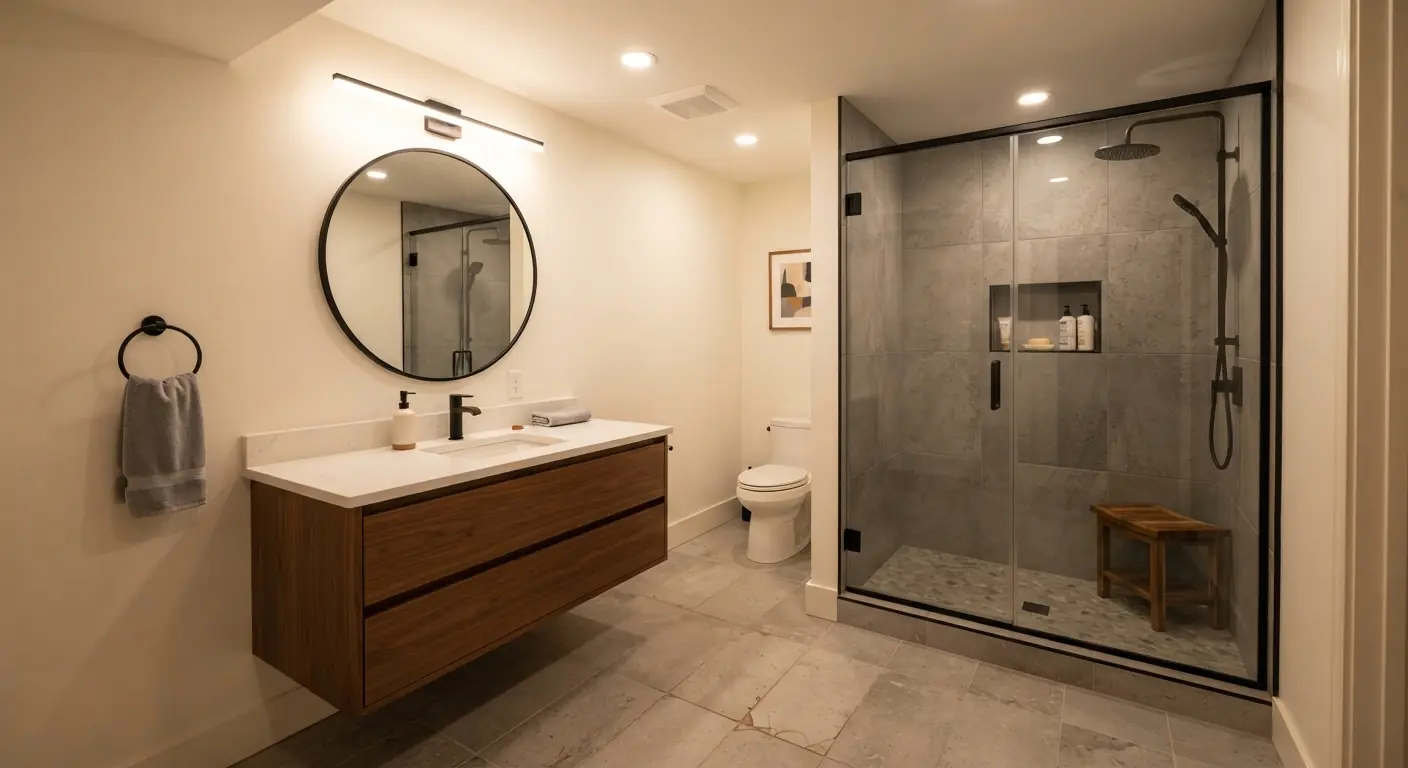
A basement bathroom needs a sewage ejector pump when its toilet, shower or sink sits below the sewer line leaving your house, because waste can't flow uphill on its own.1 If your main drain runs below the slab, gravity may do the job. For a full bathroom, plan on a sealed basin, a clear vent and a high-water alarm.12 Most smells come from a blocked vent, a dirty basin or a pump that sits idle.3
TL;DR
- Height decides it, not the room. Fixtures below the sewer line need a pump, and a submersible ejector in a sealed basin under the floor is the usual fit for a full bathroom.4
- A sump pump moves groundwater away from the house. An ejector moves sewage into the sewer or septic line. They aren't interchangeable.52
- One pump maker lists a basic ejector at $500 to $1,000 and a grinder model at $1,000 to $3,000.2
- A high-water alarm is cheap insurance. It tells you to stop using water before the basin overflows into your drains.1
- Test the pump every few months and have the vent and check valve inspected yearly. Leave the dirty work to a licensed plumber.3
Do you need an ejector pump for a basement bathroom?
You need one when the bathroom's fixtures sit lower than the sewer line leaving your house. Upstairs, waste runs downhill to the sewer. In many basements it can't. It drains into a basin instead, and a pump lifts it up to the main line.1 Most basement bathrooms fall into this group, but not all of them.
Do all basement bathrooms need an ejector pump? No. Some houses have a main drain that leaves below the basement slab. A basement toilet in that house can drain by gravity like any other toilet, and your contractor ties into the line under the floor. Other houses have a sewer line that exits partway up the foundation wall. Anything below that line needs help.
A Reddit thread that ranks for this search puts it plainly: when the bathroom is below the sewage outlet, the pump is "obviously required."6 Pump maker SFA Saniflo describes the same rule. The pump is needed wherever wastewater must be lifted to reach the main sewer or septic system.2 Septic homes are no different. If gravity can't carry waste to the tank, a pump has to.
Your contractor settles this at the estimate. They find where the main drain leaves the house and how deep it sits. The depth of that line changes the plan and the price. If you're still sketching the room, our guide to adding a bathroom to a basement covers layout and rough-in first.
What is the difference between a sump pump and an ejector pump?
A sump pump keeps groundwater out of your basement. It sends water that seeps in away from the house to higher ground or a storm drain.5 An ejector pump moves wastewater from basement fixtures up into the sewer or septic line.2 One handles rain and seepage. The other handles sewage.
Here's how the four pumps you'll hear about compare.
| Sump pump | Sewage ejector | Grinder ejector | Macerating upflush toilet | |
|---|---|---|---|---|
| What it moves | Groundwater that gets into the basement | Wastewater and soft waste from basement fixtures | Wastewater plus solids it grinds into slurry | Waste from the toilet and nearby fixtures |
| Where it sends it | Away from the house | Up to the sewer or septic line | Up to the sewer or septic line, including long or uphill runs | Up into the house drain line |
| Where it sits | Basin in the floor | Sealed basin below the floor | Sealed basin below the floor | Unit behind the toilet |
| Takes toilet waste | No | Yes | Yes | Yes |
| Price in our research | $100 to $800 for the unit, $600 to $2,500 installed5 | $500 to $1,000 for a basic pump2 | $1,000 to $3,0002 | Priced at your estimate |
Sump prices come from HomeGuide's national cost guide.5 Ejector and grinder prices come from pump maker SFA Saniflo, and the grinder details are theirs too.2 The sealed basin comes from a retailer's buying guide and a plumbing forum.41 Macerating upflush toilets are sold as basement toilet systems with the pump built in.
Why not use a sump pump for the toilet? The ejector basin has a sealed lid to hold in sewer gas, and the discharge line has a check valve so waste can't flow back into the basin.1 A sump setup is built for groundwater leaving the house. Some basements have both, each doing its own job.
What kind of pump do I need for a basement bathroom?
For a full bathroom with a toilet, sink and shower, the usual answer is a submersible sewage ejector in a sealed basin below the floor.4 Pick a grinder model if the waste has to travel far or climb high.2 A macerating upflush toilet can suit a half bath where breaking the slab isn't practical, and our guide to basement toilet options compares the choices.
Standard sewage ejector
This is a pump in a basin under the floor. A float switch starts it when the level rises. The check valve stops backflow. A vent pipe lets air out, and some systems add an alarm.2 SFA Saniflo says single pumps suit homes and duplex systems give backup where demand is high.2 For one basement bathroom, a single pump is the normal starting point.
Grinder ejector
A grinder has blades that chop solids into a slurry, which helps over long distances or against gravity.2 One example is the Sanipit 24 GR CB. It's a packaged 1 HP grinder with a 24 by 24 inch basin, a control panel and an alarm.2 We name it only as an example of what a complete kit includes, not as a recommendation.
Macerating upflush toilet
These sit behind the toilet and are sold as upflush systems for basements. They come up when a long drain run to the basin gives trouble. In one plumbing forum thread, a basement toilet sat about 20 feet from its ejector and wouldn't flush properly.1 A plumber who checked it suggested moving the toilet closer to the pump or switching to "some kind of sani-flo toilet."1 The homeowner later traced the problem to a shared vent, covered below.
Shower or sink only
A basement with no toilet only produces gray water. Some houses run it to its own pump. The forum homeowner above had a second ejector that only pumped gray water.1 Utility pumps sold for laundry and sinks come with their own small basins. Ask your contractor whether your local code accepts that setup for a shower before you buy one.
How the pump gets sized
We didn't find a published sizing chart we'd trust for a home bathroom. SFA Saniflo says the right type depends on waste volume, the plumbing setup and your needs.2 In practice, your contractor measures three things. How high the pump must lift waste to reach the sewer line. How far it has to push it. How many fixtures drain into the basin. Distance on the inlet side matters too, which is why the plumber in the forum thread first suggested moving a toilet that sat 20 feet from its pump.1
Why does the basin need a sealed lid, a vent and an alarm?
The lid keeps sewer gas inside the basin.1 The vent lets air escape so pressure doesn't build and odors don't push back into the room.2 The alarm warns you when the level is too high, before sewage backs up into the drains.1 A basement bathroom needs all three working together.
Here's what happens when the pump fails. Waste keeps filling the sealed basin until it backs up into the toilet's drain line. A forum moderator who runs a similar setup warns that lifting the lid on a full basin can send waste out of the opening.1 He added a high-level alarm to his basin. It tells him to stop using the sink, toilet and shower before the basin overfills. Caught early, the lid comes off easily and the problem gets fixed.1 Some packaged systems include an alarm and control panel.2 If yours doesn't, ask for one.
The vent is the part people forget. A clogged or blocked vent can cause odors or pressure problems.3 The same forum thread shows how odd that can look. A new basement toilet barely flushed and burped now and then. Two plumbers checked the ejector, the check valve and the drain line, and all of it worked. Then the homeowner found a second pump next door that only handled gray water. It had stopped running, and the only thing the two pumps shared was the vent. Once that pump ran again, the toilet drained.1 The diagnosis is the homeowner's own, but the lesson holds. When two pumps share a vent, one failure can show up at the other.
Local plumbing code sets how the basin is covered and vented and where the vent runs. Adoption and amendments vary by city and county. Your contractor pulls the permit and books the inspections.
How often should a sewage ejector pump run?
It should run only when you use water downstairs. Waste fills the basin to a set point, the float switch starts the pump, and the pump stops once the basin drops to a lower set point.1 A healthy cycle empties the basin quickly and shuts off.3 Running when nobody is using water is a warning sign.
There's no right number of cycles a day. The pump tracks your use. A flush, a shower or a load of laundry can each trigger a cycle. Expect more cycles in busy months. One plumbing firm notes the pump may run more often in summer, when washing and water use go up.3
Watch for these patterns:
- Gurgling, or water flowing back into the pit. The check valve may need replacing.3
- Never starts, and the level keeps rising. Look for a stuck float, a power problem or a mechanical failure.3
- Rarely runs at all. A guest bathroom used a few times a year lets waste sit. Run water through the system now and then.3
What are the common problems with sewer ejector pumps?
The sources we checked point to a short list of causes: no power, a stuck float, a clog, a failed check valve, a blocked vent or a worn-out motor.13 Each one shows up differently, so the symptom usually points to the cause. Anything past a tripped breaker is a job for a licensed plumber, because you're dealing with raw sewage.
| Symptom | Likely causes | First step |
|---|---|---|
| Pump won't start | Stuck float, power issue or mechanical failure | Check the breaker and the float |
| Toilet won't drain or backs up | Clog between toilet and basin, clogged pump or discharge line, dead motor, faulty check valve | Stop using the basement bathroom |
| Sewage smell | Blocked vent, dirty pit or infrequent use | Check the vent and have the pit cleaned |
| Gurgling or water flowing back into the pit | Faulty check valve | Have the valve inspected |
The causes in this table come from a Michigan plumbing firm's maintenance guide and a plumbing forum moderator's troubleshooting advice.31
Float switches deserve a closer look. SFA Saniflo says mechanical floats can fail from debris, tangling or wear, and a float can get stuck and stop the pump.2 Some systems use air-pressure level sensors instead of a float, so ask your contractor which kind yours has.2
If sewage is backing up, stop using water in the basement bathroom first. Then try resetting the pump's breaker.1 Past that, have a licensed plumber open the system.
Why does my basement ejector pump smell?
An ejector pump smells when sewer gas escapes or waste sits too long. Moore Mechanical, a Michigan plumbing and HVAC firm, names three causes: a blocked vent pipe, a dirty ejector pit and infrequent use.3 The fix follows the cause. Clear the vent, clean the pit and run water through the system regularly.3
Work through it in this order:
- Check the lid. The basin is built with a sealed lid to hold gas in.1 If the smell is strongest at the floor over the basin, a worn seal or loose fitting on the lid is the first suspect.
- Check the vent. If the vent exits outdoors, clear any plants, dirt or debris away from it.3 Smell plus slow drains or gurgling points the same way.
- Run the system. In a bathroom that sits unused, run water through the pump now and then.3
- Get the pit cleaned. Pits collect debris, grease and waste.3 Cleaning means pulling the pump out, which is messy work. Wear gloves, or better, have a plumber do it.3
Vent repairs are best left to licensed plumbers.3 If the smell comes back after all four steps, ask your contractor to check how the vent was run.
How long does a sewer ejector pump last?
The sources we checked give no firm lifespan. One Reddit commenter says plumbers suggest replacing the pump every 5 to 7 years, depending on use.6 Treat that as a planning figure, not a rule. Debris, heavy use and a failing check valve work against the pump. Routine care keeps it working longer.3
For contrast, HomeGuide gives 5 to 20 years for submersible sump pumps.5 Those pumps move clean groundwater, so treat that range as a contrast only, not an ejector estimate.
Warranty length gives you another clue. SFA Saniflo offers a 2-year warranty on its grinder systems, plus 2 more years when you register the product.2 Whatever pump you pick, get the pump warranty and the labor warranty written into the quote.
How do you maintain a sewage ejector pump?
Test it every few months, keep the pit clean, and have the vent and check valve inspected once a year.3 Keep anything but toilet paper and human waste out of the toilet. Leave pump removal and valve work to a licensed plumber. Raw sewage and a heavy pump make this a poor DIY job.
Moore Mechanical publishes this schedule.3 Your plumber may set a different one for your system.
| Task | How often | What it catches |
|---|---|---|
| Flush the basement toilet until the pump starts, then watch it empty and shut off | Every 3 to 6 months3 | A pump that won't start or pumps slowly |
| Inspect and clean the pit | Every 3 to 4 months3 | Debris, grease and waste that clog the pump |
| Check the vent pipe | Once a year | Blockages, cracks and loose connections |
| Inspect the check valve | Once a year | Backflow into the pit |
The same guide adds seasonal steps.3
- Winter: In unheated spaces, insulate pipes connected to the pump. If the bathroom sees little use, run water through it now and then.
- Summer: With more washing and water use, check the pit and pump monthly.
- Every year: Book a professional inspection.
What does an ejector pump add to a basement bathroom budget?
A basic sewage ejector pump costs $500 to $1,000 and a grinder model $1,000 to $3,000, according to pump maker SFA Saniflo.2 The maker doesn't say whether those figures include installation, so read them as the pump's price. Cutting the slab, setting the basin, running the vent, wiring the pump and adding an alarm are priced at your estimate. Distance from the existing drain and vent lines pushes that number up.7
For the whole room, HomeGuide puts a full-size basement bathroom at $10,000 to $25,000.7 Rough-in plumbing runs $450 to $1,800, and you'll pay more if the new bathroom is far from existing drainage and venting lines.7 HomeGuide also notes a basement bathroom often costs more than converting space on the main floor, and it suggests setting aside 10% to 20% for surprises.7 It doesn't break out the pump's share, so read these as national ranges for context, not a line item. Our basement bathroom cost guide walks through the full budget.
We didn't find a captured source for an installed ejector replacement price. Get it priced on site, because access to the basin and the state of the check valve and vent change the job.
If you're finishing in one of our live markets, the local pages for basement finishing in Denver and basement finishing in Atlanta show sourced local price ranges.
What to ask your contractor about the ejector pump
A good quote names the pump, the basin and the alarm, and shows where the vent runs. Ask these questions at the free on-site estimate, and expect the answers in a written, itemized quote. If the plumbing line is one number with no detail, ask what it includes.
- Where does the main drain leave the house? Does this bathroom need a pump at all?
- Standard ejector or grinder, and why for this run?
- Which pump model, what horsepower and what basin size? Single or duplex?
- Is a high-water alarm included, and where will it sound?
- Where does the vent run? Does it share a vent with any other pump?
- Where does the check valve go, and can the pump be swapped without opening the floor again?
- Who pulls the permit and books the inspections?
- What are the pump warranty and the labor warranty?
If the bathroom is part of a bigger job, it helps to see the whole scope. A first build-out falls under finishing a bare basement, and reworking a finished one falls under remodeling an existing basement. Basement Remodeling Co. matches you with one vetted, licensed basement contractor for your metro. The contractor does the free on-site estimate, writes the itemized quote and pulls the permit. When you're ready, get a written quote for your basement bathroom, or find the basement contractor for your ZIP code.