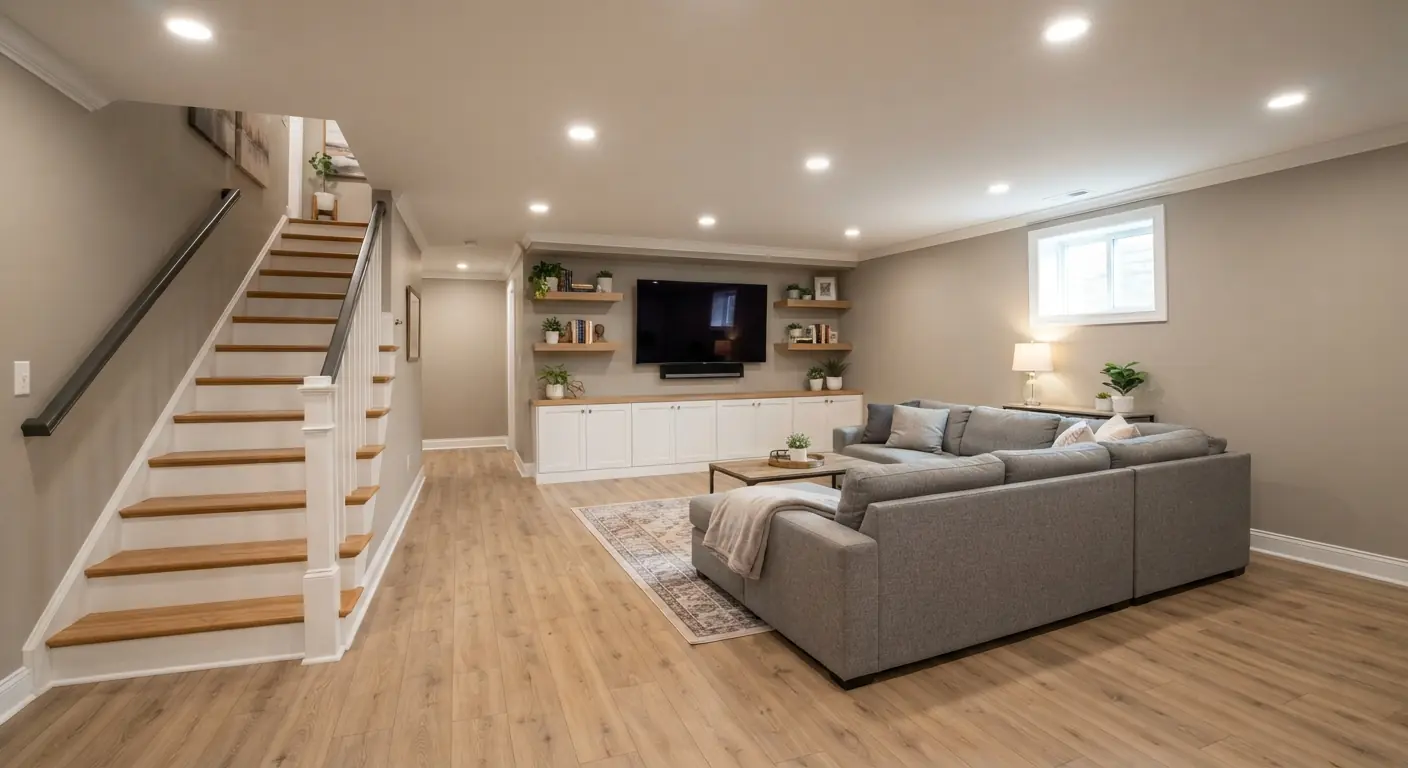
For most existing basement slabs, an electric mat or cable system laid on top of the slab, under a new floor, is the practical choice. Hydronic tubing is mostly used in new construction, so it suits new slabs better than old ones.1 Budget roughly $7 to $17 per square foot installed for the heat, plus the new floor, and test the slab for moisture before anything goes down.2
TL;DR
- On an existing slab, electric heat goes on top of the concrete, under the new floor. Hydronic heat needs a boiler and is mostly used in new construction, so it rarely fits a retrofit.
- The heat is often the smaller cost. In a 400 square foot room, electric heating materials run $1,400 to $3,640, and the floor on top can cost more.1
- Tile and luxury vinyl carry heat best. Vinyl can also trap slab moisture, so let a moisture test decide the floor.
- Running cost comes down to your electric rate, your hours of use and the insulation under the heat. Insulation is the part you control at install.
- If you just want warmer feet, carpet over a pad, cork, an insulating underlayment or insulated walls may be enough for less money.
Which heated floor system fits an existing basement slab?
An electric system fits an existing slab best. Mats, rolls or cable sit on an insulating layer over the concrete and under the new floor, so nothing gets cut into the slab. Hydronic heat pushes hot water from a boiler through tubing under the floor, and it's mostly used in new construction.1
Here's how the two compare for a slab that's already there.13
| Electric mats, rolls or cable | Hydronic tubing | |
|---|---|---|
| How it heats | Heating cable powered by electricity | Hot water from a boiler, through tubing |
| Fit on an existing slab | Goes over the slab, under the new floor | Described by one electric maker as not practical for retrofits |
| Upfront cost | Heating materials $5 to $13 per heated square foot, by product and floor type1 | No sourced figure; priced at your estimate |
| Upkeep | No boiler to service | Boiler maintenance |
| Control | Its own thermostat, one zone at a time | Ties into the whole-home heating system |
| Running cost | $0.25 to $0.60 per hour for a full basement zone, by one maker's estimate1 | Depends on the boiler and fuel; no sourced figure |
Read the hydronic column with care. The only side-by-side comparison in our research comes from WarmlyYours, a company that sells electric systems. It lists higher upfront cost, boiler maintenance, a more complex install and poor retrofit fit as hydronic's drawbacks in a basement.1 Those points match how the two systems work. Still, no independent study in our research measures the cost gap.
The bigger question on an old slab is what's under it. Building Science Corporation's basement digest says sub-slab insulation is critical for radiantly heated basement slabs, and rigid foam under the concrete is the preferred way to do it.4 You can't slide foam under a slab that's already poured. So an above-slab system brings its own insulation. WarmlyYours puts a vapor barrier and then an insulating underlayment on the slab before the heating element goes down.1 Warmup sells a 1/4 inch insulation board meant to sit right under its heaters.3
Electric cable can also be buried in concrete, but only in a new pour. Warmup's in-slab cable is meant for new basement construction.3 WarmlyYours' slab cable is embedded directly into new concrete at 15 to 20 watts per square foot.1 If you're replacing the slab anyway, that option opens up. Otherwise, plan on heat above the concrete.
If your home already runs on a boiler, ask your contractor whether a hydronic zone makes sense. That's as much a heating question as a flooring one, and our guide to basement heating options covers the wider set of choices.
How much does it cost to put heated floors in a basement?
Radiant floor heat costs $7 to $17 per square foot installed, according to HomeGuide's national cost guide.2 The new floor on top is a separate cost. For a 400 square foot room with 280 heated square feet, electric heating materials alone run $1,400 to $3,640, depending on the floor you choose.1
The heated area can be smaller than the room. WarmlyYours' own example heats 280 square feet of a 400 square foot basement.1 The table below prices that same room. Each rate comes from the source named in its row, and the sample column is that rate times the area.12
| Line item | Rate | Sample room (280 sq ft heated, 400 sq ft floor) | Source |
|---|---|---|---|
| Electric heat materials under tile, stone or luxury vinyl | $5 to $12 per heated sq ft | $1,400 to $3,3601 | WarmlyYours |
| Electric heat materials under carpet or floating wood | $10 to $13 per heated sq ft | $2,800 to $3,6401 | WarmlyYours |
| Radiant floor heat, installed | $7 to $17 per heated sq ft | $1,960 to $4,7602 | HomeGuide |
| Luxury vinyl plank, installed | $4 to $16 per sq ft | $1,600 to $6,4002 | HomeGuide |
| Laminate, installed | $4 to $14 per sq ft | $1,600 to $5,6002 | HomeGuide |
| Carpet, installed | $2 to $8 per sq ft | $800 to $3,2002 | HomeGuide |
| Tile, installed | $10 to $50 per sq ft | $4,000 to $20,0002 | HomeGuide |
| Old carpet removal | $0.70 to $1.60 per sq ft | $280 to $6402 | HomeGuide |
| Calcium chloride moisture test | $100 to $300 | $100 to $3001 | WarmlyYours |
| New electrical circuit and thermostat wiring | Priced at your estimate | Priced at your estimate | None captured |
Which heat number should you budget from? Use HomeGuide's installed range, because the WarmlyYours figures cover heating materials only.21 HomeGuide's figure is for radiant floor heating in general and doesn't split electric from hydronic. Treat it as a planning range until your contractor prices the actual system.
Put those lines together and the floor often costs more than the heat. At HomeGuide's rates, luxury vinyl in the sample room works out to about $1,600 to $6,400 installed, against about $1,960 to $4,760 for the heat.2 That's why the best time to add heat is when a new floor is going in anyway.
If the heat is part of a full finish, it's a small line in a bigger budget. The published range for a full basement finish in metro Denver is $30,000 to $90,000 (checked September 2026).
What type of flooring is best for a heated basement floor?
Tile and luxury vinyl are the usual best matches for basement floor heat. Tile conducts heat best and resists moisture. Luxury vinyl is warmer underfoot and costs less to install. Laminate, floating engineered wood and carpet can work with the right system. Solid hardwood is the one to skip.12
The makers match a different heating product to each floor. Tile goes over mats or cable set in thinset or self-leveling cement, and Warmup offers an uncoupling mat built to help protect tile from cracking.13 Floating floors like laminate, engineered wood and carpet go over dry-install rolls or foil sheets with no mortar.13 The installed floor costs below are HomeGuide's national ranges.2
| Floor | Heating system that suits it | Installed floor cost per sq ft (HomeGuide) | Basement watch-outs |
|---|---|---|---|
| Tile | Mat or cable in thinset or self-leveling cement | $10 to $502 | Best heat conductor; moisture-resistant; highest cost1 |
| Luxury vinyl plank or tile | Mat or cable rated for luxury vinyl; thin mat under floating vinyl | $4 to $162 | Choose a product rated for radiant heat; vinyl can trap slab moisture14 |
| Laminate | Dry-install roll or foil sheet under a floating floor | $4 to $142 | Moisture-resistant types only; standard laminate suits humid spaces poorly1 |
| Engineered wood | Dry-install roll or foil sheet, floating install only | $7 to $202 | Not ideal for very damp basements1 |
| Carpet | Dry-install roll or foil sheet | $2 to $82 | One maker warns standard carpet can trap moisture underneath1 |
| Solid hardwood | Not recommended in a basement | $11 to $252 | Risk of cupping, warping or splitting1 |
Luxury vinyl needs a closer look. WarmlyYours lists it as waterproof, warm underfoot and rated for radiant heat.1 Building Science Corporation takes a harder line. Its digest says impermeable floor finishes such as vinyl should be avoided in basements, because they block the slab from drying inward and typically lead to mold.4
So which do you follow? Let the slab decide. If the slab tests dry and water isn't getting in, vinyl rated for radiant heat is a common install. If the slab shows moisture, fix the water first. Then ask your contractor about tile or another finish that handles a damp slab better.
Warranty terms also change by floor. WarmlyYours lists 25 years on its tile-rated mats and cable. Its roll for floating floors carries 10 years under laminate and floating hardwood and 5 years under carpet.1 For a wider look at what each material costs and how it holds up below grade, see our guide to basement flooring options.
Does a heated floor use a lot of electricity?
A heated basement floor draws real power while it runs, and a thermostat decides how often that is. Common mats are rated 12 to 15 watts per square foot. WarmlyYours estimates $0.25 to $0.60 per hour for a full basement zone.1 Your rate, hours and insulation set the actual bill.
Here's the math for the 280 square foot example. A roll rated at 12 watts per square foot works out to 3,360 watts, or 3.36 kilowatts. A mat rated at 15 watts works out to 4.2 kilowatts.1 Every hour at full power uses that many kilowatt-hours. Multiply by the rate on your electric bill and you have the most it can cost per hour. When the thermostat cycles the heat off, the real cost drops.
The maker's own project listings show how wide the range is. Of the 20 featured projects on the WarmlyYours basement page, 17 list an estimated running cost under $1 an hour, and the highest is $3.42.1 Those are the seller's estimates for rooms of different sizes, so treat them as a rough spread.
Insulation is the lever you control. WarmlyYours says that without insulation a significant share of the heat escapes down into the soil.1 A colder climate means more hours of use, so the insulation layer matters more the colder your winters get.
What has to happen before heat goes on an old slab?
The slab has to be dry and sound before any heat goes on it. Test it for moisture, fix any water coming in, then lay a vapor barrier, an insulating underlayment, the heating element and the floor, in that order. Heat on a wet slab can ruin the floor above it.1
Test the slab
WarmlyYours sets the bar at under 3 to 5 percent moisture content by weight.1 The quick check is the plastic sheet test (ASTM D4263). Tape a 6-mil plastic sheet flat to the concrete for 24 hours. If condensation shows up underneath, the moisture is too high.1 A calcium chloride test is more precise. It should read under 3 pounds per 1,000 square feet per 24 hours, and a professional test costs $100 to $300.1
Fix water first
If the slab fails, the install waits. The fixes are better drainage and grading, waterproofing, and running a dehumidifier for several weeks before you retest.1 Building Science Corporation puts the basics simply: drain the site and drain the ground. That means gutters that carry roof water away and grade that slopes away from the house.4
Build the layers in order
The order WarmlyYours gives is slab, then 6-mil polyethylene with taped seams overlapped 6 inches, then insulation, then the heating element, then the floor.1 The heating element stays 2 to 3 inches from walls and fixtures.1 Tile gets thinset or self-leveling cement over the heat, and floating floors get an underlayment.1 Our guide to basement floor vapor barriers covers that first layer in more detail. Skip the foil bubble wrap products. Building Science Corporation says radiant barrier bubble insulations don't provide enough insulation or value.4
Wire it safely
A heated floor usually needs a new circuit and breaker, and that's work for a licensed electrician. Your contractor pulls the permit and books the inspections. Every complete WarmlyYours system ships with a backup floor sensor. Both sensors should test at 8 to 15 kΩ before the floor covers them.1 Without the backup, a failed sensor under a finished floor would mean tearing the floor up.1
Are heated floors worth the money?
Heated floors are worth it when you're already putting down a new floor in a room you'll use often. Basement Remodeling Co.'s planning view is simple: add heat at the flooring stage, on a dry slab, under tile or luxury vinyl. Skip it for a room you'll rarely use or a slab that tests wet.
Timing drives most of the value. Adding heat to a finished basement means taking out the existing floor first.1 If that floor is tile, removal alone runs $2 to $7 per square foot.2 Put the heat in when the old floor is already coming out and you skip paying for that twice.
HomeGuide describes radiant floor heat as quiet and efficient, and says it adds comfort and home value and lasts 30 to 50 years.2 Treat the home value point as a general claim. It isn't a promise about your house or your market.
Be more careful with savings claims. Makers of these systems publish efficiency and payback figures, and we found no independent test behind them. Your own payback depends on your electric rate, how you heat the rest of the house and how often you use the room.
If your goal is a lower energy bill, look at the walls before the floor. Building Science Corporation says basement heat loss can reach upwards of 20 percent of a home's total space-conditioning load. It also says sub-slab insulation saves less energy than wall insulation, even though it matters a lot for comfort.4 A heated floor is mostly a comfort upgrade. Wall insulation is the energy upgrade.
How else can you warm up a cold basement floor?
You can warm a cold basement floor without heat cables. Carpet over a good pad, cork, an insulating underlayment and insulated walls can all make the room feel warmer, and several cost less per square foot than radiant heat. Control humidity too, because moist summer air condenses on cold concrete.24
Carpet over a pad
Carpet costs $2 to $8 per square foot installed and is still a common choice for finished basements.2 The pad adds $0.75 to $1.75 per square foot and helps insulate and cushion the floor.2 The tradeoff is water. HomeGuide says basement flooring should be waterproof or water-resistant unless the space is finished and sealed.2 Building Science Corporation says to choose basement floor finishes with flooding from appliances, plumbing or outside water in mind.4
Cork
Cork costs $5 to $15 per square foot installed.2 HomeGuide describes it as naturally mold-resistant and insulating, soft but firm underfoot, and quiet to walk on. It can be glued down or floated.2
An insulating layer over the slab
An underlayment costs $0.50 to $3.50 per square foot installed and is typically needed under laminate, vinyl and hardwood anyway.2 Choosing an insulating one puts a thermal break between your feet and the concrete. Warmup's heater board, for example, is 1/4 inch thick and sold for its insulating value.3 Skip foil bubble products for this job too.4
Insulate the walls and rim joist
Below-grade concrete walls stay cold because they sit against the ground. Building Science Corporation recommends foam-based insulation on basement walls that lets the wall dry inward. It also says the rim joist needs air-impermeable insulation.4 Of the options here, this is often the bigger energy win.
Keep humidity in check
Warm, moist summer air condenses on cold basement surfaces that sit below its dew point.4 A dehumidifier removes that moisture.4 WarmlyYours suggests keeping basement humidity at 40 to 60 percent.1
Add room heat
If the whole room is cold, the answer may be room heat. Our guide to heating a basement compares the ways to do that.
What a good heated floor quote shows
A good heated floor quote names the system, the heated square footage, the insulation layer, the new circuit and the moisture test, each as its own line. It also says what floor goes on top and whether the old floor comes out. Anything missing is a cost that shows up later.
Check for these lines:
- The product. Its name, its watts per square foot and the maker's warranty term.
- Heated area against room area. The heated square footage can be smaller than the room.
- The moisture test. Which test, the result and what happens if the slab fails.
- The layers. The vapor barrier and the insulating underlayment, named with their thickness.
- Electrical work. The new circuit, breaker and thermostat, done by a licensed electrician, with the permit and inspections listed.
- Floor sensors. A primary and a backup sensor, both resistance-tested before the floor goes down.1
- The floor. A product rated for radiant heat, plus removal of the old floor if needed.1
Questions to ask your contractor:
- Will this floor be the room's main heat or a comfort layer on top of other heat?
- What does the moisture test show, and what would you do if it fails?
- How thick is the finished floor build-up, and does it affect doors or stairs?
When the moisture checks out and heat fits the plan, you can get a written quote for finishing your basement. Basement Remodeling Co. sends your request to one vetted, licensed basement contractor. You get a free on-site estimate and a written, itemized quote, and the contractor checks moisture during the visit. You can also find the contractor who covers your ZIP code. In Colorado, see what finishing looks like in Denver, and in Georgia, basement finishing across metro Atlanta.