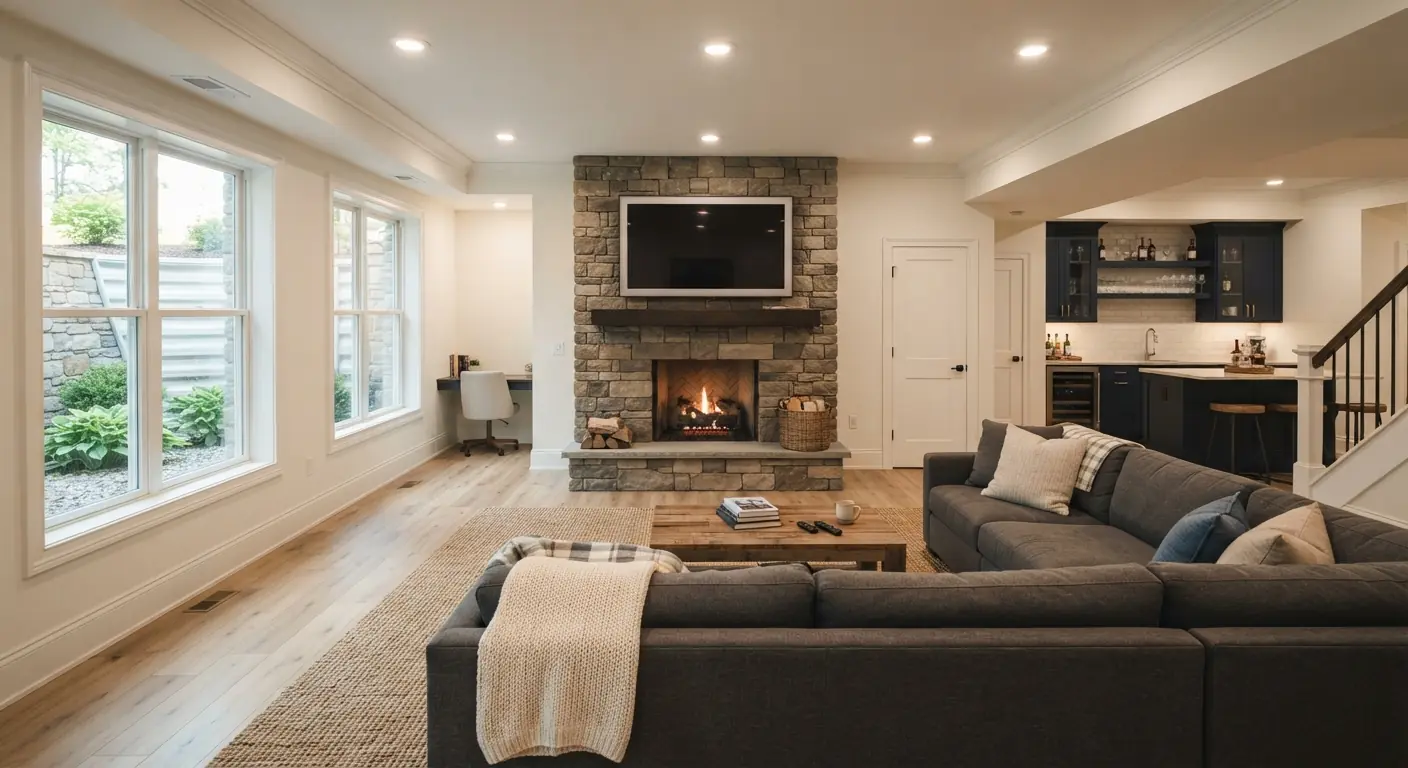
Yes. Since February 2025, Fort Collins allows an accessory dwelling unit (ADU) in every zone district, as long as your property meets City requirements.1 A basement apartment counts as an attached ADU when it has its own kitchen, bathroom and living area.1 You'll need a Basic Development Review and a building permit, and the old U+2 roommate rule is gone.123 The real hurdle is money. The City says ADU fees alone may run $20,000 to $25,000.1
TL;DR
- A basement unit with a kitchen, bathroom and living area is an attached ADU. Fort Collins allows ADUs in all zone districts, but no new units are allowed in the Poudre River 100-year floodplain.1
- Budget for approvals before construction. The $6,925 Basic Development Review fee is mandatory, and total City fees may reach $20,000 to $25,000.1
- Fire-rated separation, a separate heating system, a separate exit door and a separate electric meter shape the floor plan. Settle them before anyone frames a wall.1
- You don't need extra parking beyond what the main house already needs.1
- Renting it out means registering with the City every year. The family-based U+2 limit ended in July 2024, but minimum housing standards still apply.24
Is a basement apartment legal in Fort Collins?
Yes, in most cases. State law HB 24-1152 allows ADUs in every Fort Collins zone district from February 2025, and the City lists a basement as one form of attached ADU.1 Your lot needs a house, duplex or triplex, and it can't sit in the Poudre River 100-year floodplain.1
The City defines an ADU as a small home on the same property as a larger house, duplex or triplex.1 It must include a kitchen, a bathroom and a living area.1 That definition is the dividing line for most homeowners. A finished basement with a bedroom and a bathroom but no kitchen doesn't meet it, so renting it out means renting rooms in your house. A basement with all three is a separate dwelling, and it goes through the ADU process.
Most properties may add one ADU only.1 Some zones allow a second detached house on the lot, but that route doesn't involve your basement.
Two checks come first. Look up your lot on the City's online floodplain map, then check your zone on the zoning map.1 If your property is in the Poudre River 100-year floodplain, a new unit is off the table.1
What occupancy rules apply now that U+2 is gone?
Fort Collins can no longer cap how many people share a home based on whether they're related. Colorado's HB 24-1007 banned those family-based limits, and the City's ordinance removing its residential occupancy limitations took effect July 12, 2024.32 That ended the U+2 rule. Health and safety standards and rental registration still apply.34
U+2 was the City's family-based occupancy rule. A Coloradoan headline quoted by Colorado State University's Off-Campus Life office called it one of the "family-based roommate rules" the state bill outlawed.3 The same office quoted the mayor citing a 2024 City estimate of 15,000 empty bedrooms.3
Search for a basement apartment in Fort Collins and the results are almost all rental listings. One of them is a one-bedroom basement unit described as a 13-minute walk to the CSU campus, listed at $1,000.5 Treat single listings as a snapshot, not a rent estimate for your unit.
Removing U+2 didn't remove every limit. CSU's Off-Campus Life office notes that health and safety standards can still come into play.3 The City's rental minimum requirements include windows that open and working heat and water.4 When you register, you also confirm that you understand the minimum standards of the International Property Maintenance Code.4 Read the City's landlord-tenant handbook before you decide how many bedrooms to build.
How big can a basement ADU be?
A basement ADU in Fort Collins can be up to 750 square feet or 100% of that floor, under the City's ADU size rules.1 Above-grade attached ADUs are held to 750 square feet or 45% of the main home. Detached units follow a separate scale tied to the main home's size.1
| ADU type | Size limit (City of Fort Collins) |
|---|---|
| Attached, basement | Up to 750 sq ft or 100% of that floor1 |
| Attached, above grade | Up to 750 sq ft or 45% of the main home1 |
| Detached, main home under 1,667 sq ft1 | Up to 750 sq ft1 |
| Detached, larger main home | Up to 1,000 sq ft or 45% of the main home, whichever is less1 |
| Existing accessory building converted | Up to 800 sq ft1 |
Source: City of Fort Collins ADU page, captured September 30, 2026.1
The basement line is the only one that refers to a whole floor, which makes it the most flexible on paper. The City page doesn't say which of its two basement figures governs when they differ. Ask that question at the free Conceptual Design Review before your contractor draws the plan.
Floor area is only half of it. Ceiling height, window wells and where the stairs land decide how many rooms you can actually use. Your contractor measures the space and checks ceiling height at the free on-site estimate. The guide to finishing a basement in Colorado covers the Front Range issues that shape any basement build. If you're still weighing a plain finish against a full unit, the Fort Collins basement finishing page covers the standard build.
What separation, exit and egress rules apply?
An attached basement ADU in Fort Collins needs fire-rated separation between units, a separate heating system, separate exit doors and kitchens and bathrooms that meet minimum standards.1 These come from the City's building code requirements for ADUs. They shape the floor plan more than any finish choice, and the basement apartment design guide shows layouts that work around them.
Fire separation and heating
Fire-rated separation keeps a fire in one unit from spreading to the other. In a basement, that usually means the ceiling between the two units and any shared stair or door. Your contractor and the City's plan reviewer set the exact assembly.
The separate heating system needs planning from day one.1 A single furnace and duct system serving both floors won't meet it, so the unit needs its own equipment and its own space for it. That equipment takes room you might have wanted for a closet or a laundry.
Exits, walkways and egress windows
The unit needs its own exit door.1 A walkway must connect the ADU's main door to the street, and the ADU's address must be visible from the street.1 For a basement, that may mean an exterior stairwell and a path around the side of the house.
Any basement bedroom also needs an egress window, which is an escape opening big enough to climb out of. Sizes and well dimensions come from the edition of the International Residential Code (IRC) the City has adopted, and local adoption and amendments vary. The basement egress windows guide explains the sizing and what the install involves.
The other kind of separation
The City's ADU page uses "separations" for a second set of rules. These cover how far utility lines, trees and landscaping sit from each other outside.1
| Item | Required spacing |
|---|---|
| Water and sewer lines | 10 feet apart1 |
| Storm drains and other utilities | 10 feet apart1 |
| Trees and water or sewer lines | 6 feet apart1 |
| Shrubs and water or sewer lines | 4 feet apart1 |
Source: City of Fort Collins ADU page, captured September 30, 2026.1
A basement ADU also needs its own electric meter.1 In some cases, that means upgrading nearby transformers or paying for trenching.1 If the project creates more than 1,000 square feet of new roof or paving, you'll need stormwater treatment such as a rain garden or permeable pavers.1 Ask your contractor whether a new walkway and stairwell push your plan over that line.
Do you need extra parking for a basement apartment?
No. Fort Collins requires no extra parking for an ADU beyond what the main home already needs.1 A house needs one off-street space if the lot is wider than 40 feet and two spaces if the lot is less than 40 feet wide.1 Duplexes are counted by unit and bedrooms.1
For a duplex, each unit with one or two bedrooms needs one off-street space. A duplex needs two spaces if it has three or more bedrooms.1
Measure your lot width before you assume you're covered. If the main house is already short of its required spaces, raise it at the Conceptual Design Review so it doesn't surface later in formal review.
What does approval cost, and what are the steps?
Every Fort Collins ADU goes through a Basic Development Review, then a building permit, then inspections during the build.1 The review carries a flat $6,925 fee. With utility capacity charges, transportation fees and building permit fees added, the City says total ADU fees may range from $20,000 to $25,000.1
The City lays the process out in order:1
- Check eligibility. Confirm the floodplain status, the primary dwelling and your zone.
- Book a Conceptual Design Review (optional and free). You share the idea with City staff and learn about likely costs, utility connections and site issues before you apply.
- Apply for Basic Development Review. Planning, Utilities, Fire, Stormwater and other departments review it. The Planning Manager or Community Development Director decides. No neighborhood meeting is required, but notice is posted or mailed, and your plans become public records.
- Apply for a building permit. This happens after development review approval. The Fort Collins basement permits guide covers the City's permit side.
- Build. Follow the approved plans and pass City inspections along the way.
Your contractor pulls the permit and books the inspections. The basement finishing permits guide covers what a permit set usually includes.
The fees sit on top of construction. For scale, a typical full basement finish in Fort Collins runs $50,000 to $110,000, checked September 2026. An apartment adds a kitchen, a second heating system, fire separation and a meter, so its build cost is priced at your estimate. The Fort Collins basement remodeling cost page breaks down what moves a local quote.
What do you need to do before you rent it out?
Register it. Since January 1, 2025, most long-term rentals in Fort Collins, meaning homes rented for 30 days or more, must register with the City every year and certify that they meet minimum housing standards.4 The base fee is $37 a year for each rental property, plus $10 for each additional rental unit on the same property.4
Owner-occupied units aren't counted when you register.4 So if you live upstairs and rent only the basement unit, that works out to one rental unit at the $37 base fee. If you rent both the house and the basement unit, that works out to $37 plus $10, or $47 a year.
Registration doesn't come with an inspection. You self-certify that the property meets minimum standards.4 Tenants can still request a City inspection at any time, and inspectors look at the outside, inside, electrical, mechanical and fire safety.4 Tenants can also check online whether a property is registered before they sign.4
Skipping registration brings fines, though the City sends several notices before writing a violation.4 The same program has paid more than $200,000 in grants to landlords for upgrades and repairs, and funding rounds typically open in December.4
What should you ask your contractor before you build?
Basement Remodeling Co.'s view is simple: settle the ADU rules before anyone frames a wall. Ask your contractor to show fire separation, the separate heating system, the exit door, egress windows and the electric meter on the drawings and in the written quote. Those items decide whether the unit passes review, and each one changes the price.
Good questions to ask at the estimate:
- Is my lot outside the Poudre River 100-year floodplain, and which zone am I in?
- Where does the fire-rated separation go, and what assembly will the plan use?
- What heating equipment will serve the unit on its own, and where will it sit?
- Where's the separate exit door, and how does the walkway reach the street?
- Which rooms get egress windows, and are the windows and wells in the quote?
- Is the separate electric meter priced, including any transformer or trenching cost?
- Does the quote show City fees apart from construction?
- Has the basement been tested for radon?
Radon testing matters for anyone who'll sleep down there. Colorado's health department says radon is the leading cause of lung cancer among non-smokers in the United States and is responsible for about 500 lung cancer deaths a year in Colorado.6 Test before you finish. If the result is high, hire a licensed radon mitigation professional before the walls close in.
When you're ready, you can get a written quote for a basement apartment from one vetted, licensed basement contractor. You'll get a free on-site estimate and a written, itemized quote, and nothing starts until you sign. For other projects around town, the Fort Collins basement remodeling hub lists the local pages.